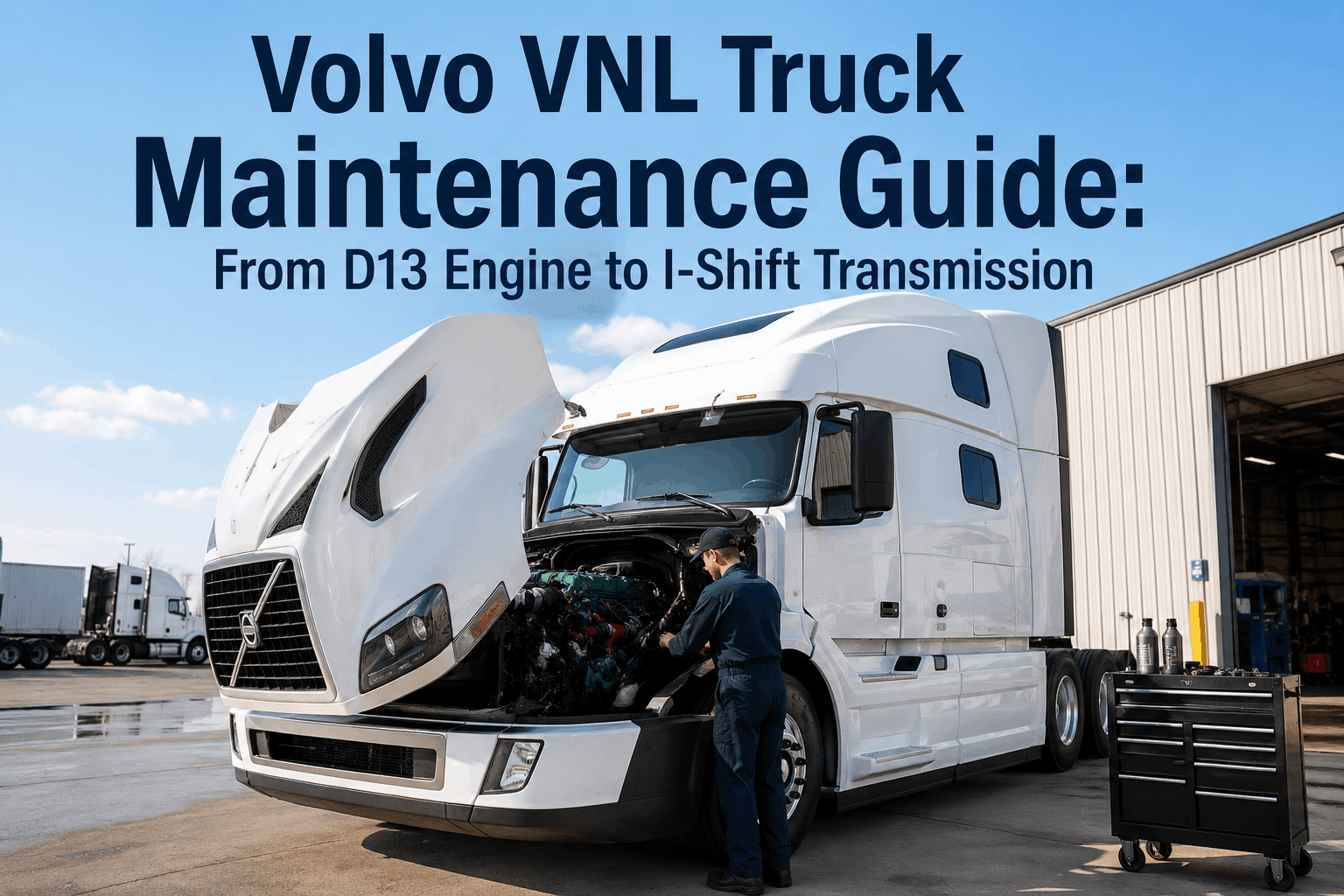
The Volvo VNL has been the backbone of North American long-haul trucking since 1996. With the 2024 redesign bringing a 90% overhaul of the truck's architecture — including major upgrades to the D13 engine and I-Shift automated transmission — fleet managers now have access to one of the most fuel-efficient and technologically advanced Class 8 tractors on the road. But all that engineering only pays off when your maintenance game is equally sharp. This guide breaks down everything you need to know to keep your Volvo VNL running at peak performance, from the engine bay to the gearbox — and shows you how FleetRabbit can make managing it all far less painful. If you want to track this the smart way, sign up on FleetRabbit and keep every service record organized automatically.
Fleet Maintenance Series
Volvo VNL Truck Maintenance Guide
From D13 Engine to I-Shift Transmission — everything your fleet needs to stay on the road, on schedule, and ahead of costly breakdowns.
The D13 Engine: What Changed and Why It Matters
The Volvo D13 is a 6-cylinder inline diesel engine available in horsepower ratings from 405 hp to 500 hp, with torque outputs between 1,750 and 1,950 lb-ft. For the 2024 VNL, Volvo's engineers made a series of targeted improvements to this already proven platform that improve combustion efficiency, reduce wear, and extend service intervals — all of which directly affect your operating costs.
Wave Piston Redesign
A shorter piston height combined with a longer connecting rod creates more efficient combustion geometry. Less wasted energy per stroke means better fuel economy and reduced thermal stress on internal components over the long haul.
Smaller Injector Needle Valves
Precision needle control valves in the fuel injectors allow finer atomization of diesel fuel. The result is a more complete burn, reduced particulate emissions, and lower thermal load on the combustion chamber walls.
Variable Displacement Oil Pump
Adjustable vanes in the oil pump adapt output to real-time engine demands. The system prevents excess oil flow during low-demand operation, reducing parasitic losses and delivering measurable fuel economy benefits across all load conditions.
Turbo Compounding Improvements
Insulation upgrades and a refined compressor and turbocharger design on the TC unit recover more exhaust energy and convert it back into crankshaft power — the kind of efficiency that quietly adds up to thousands in fuel savings per year, per truck.
D13 Maintenance Schedule at a Glance
Volvo has progressively extended its recommended maintenance intervals as oil technology and engine design have matured. For fleets running modern VNL trucks under normal duty using Volvo VDS-4.5 premium oil, the intervals look like this:
| Duty Cycle | Oil & Filter Change | DPF Service | Valve Adjustment | Coolant Replacement |
|---|---|---|---|---|
| Long Haul | Every 60,000 mi | 400,000 mi | 150K then 300K | 750,000 mi / 96 mo |
| Regional Haul | Every 45,000 mi | 250,000 mi | 150K then 300K | 750,000 mi / 96 mo |
| Heavy Haul | Every 35,000 mi | 250,000 mi | 150K then 300K | 750,000 mi / 96 mo |
I-Shift Transmission: Speed, Precision, and Care
The I-Shift automated manual transmission is what turns the D13's raw power into seamless forward motion. The 2024 updates focused on one goal: make it shift faster without compromising durability. Engineers redefined control algorithms, reduced clutch throw distance, and introduced an enhanced clutch brake system — resulting in shift speeds 30% faster than earlier versions. Faster, cleaner shifts reduce drivetrain stress and clutch wear across hundreds of thousands of miles.
I-Shift Maintenance Checklist
Check at every service interval via the sight glass on the right side of the transmission. Park on a level surface before checking. Top up with Volvo-approved synthetic transmission oil only.
The drain plug on your I-Shift indicates which type of oil is currently in use. Before adding any fluid, confirm the oil type match — mixing incompatible oils degrades transmission performance rapidly.
Monitor clutch engagement quality during operation. Rough or delayed shifts during loaded climbs often signal early clutch wear or software calibration drift in the enhanced clutch brake system.
The I-Shift's performance relies heavily on its electronic control unit. Shift hesitation or fault codes often respond to a software reset via Volvo's Premium Tech Tool (PTT) before any mechanical inspection is needed.
For 2022–2024 VNL models, if the onboard diagnostic display freezes, hold the home button below the screen for 30 seconds to reboot — this resolves apparent transmission fault indicators that are actually display errors.
FLEET MANAGEMENT MADE EFFORTLESS
Stop Tracking Maintenance in Spreadsheets
FleetRabbit gives you a centralized platform to schedule D13 oil changes, log I-Shift service records, set DPF cleaning reminders, and track every truck in your Volvo fleet — all in one place. No more missed intervals, no more expensive surprises at the shop. Whether you are managing 3 trucks or 300, FleetRabbit scales with your operation and keeps your team aligned on every vehicle's health status in real time.
Oil Management: The Most Important Thing You Can Do
Engine oil is the lifeblood of the D13, and getting it wrong is the most common and most avoidable cause of premature engine wear. Here is what practical D13 oil management looks like for a working fleet:
Use the Right Grade
Volvo recommends Volvo VDS-4.5 premium motor oil for current VNL models. Some operators run 15W-40 conventional oil with shorter intervals; others use full synthetic for extended drain capability. Either can work — but only if you stay within Volvo's approved oil lists.
Monitor Idle Time
High idle time is a silent oil killer. Fuel dilution from excessive idling breaks down oil viscosity, reducing its ability to protect engine surfaces during high-load operation. If your fleet's trucks idle more than 30% of operating time, your real-world oil change interval should be shorter than the published chart suggests.
Do Not Neglect the Filters
The D13 uses a two-full-flow-filter housing. Changing oil without changing filters defeats the purpose of either service. Filters past their life reintroduce debris into the oil circuit. Always service both together at the recommended interval.
Air and Fuel Filter Discipline
Clean combustion depends on clean air and clean fuel. A clogged air filter forces the turbocharger to work harder, accelerating wear on the turbo compounding unit — one of the most expensive components in the D13's drivetrain. Check air filters regularly, especially for trucks operating in dusty corridors.
What Fleet Managers Actually Deal With
Beyond scheduled maintenance, real-world VNL operation throws up a recurring set of issues that experienced fleet managers learn to anticipate. Knowing these patterns lets you set up preventive protocols rather than reacting to breakdowns.
Coolant Quality Degradation
The D13 runs hot under sustained load, and coolant past its service life cannot protect against cavitation erosion or freeze damage. Test coolant concentration and inhibitor levels at every major service interval, not just at the 750,000-mile replacement milestone. A $15 test strip is cheap insurance against a cracked block.
DEF System Maintenance
The aftertreatment system — including the DEF pump, AHI nozzle, and DEF tank — has its own service schedule that many operators overlook. DEF tank filter cleaning, nozzle replacement, and periodic data resets are all part of keeping emissions systems compliant and avoiding derate conditions that cap engine power.
DPF Regeneration Patterns
If your VNL is triggering frequent active regeneration cycles, it is a signal worth investigating. Frequent regens can point to injector fouling, poor combustion efficiency, or an underlying issue with the turbo compounding unit. Extended DPF intervals are contingent on proper engine operation upstream.
Rear Axle Lubrication
Volvo's service documentation flags rear axle lube type and capacity as vendor-specific — specifications vary depending on the axle configuration installed. Always consult the vendor-specific documentation for your actual rear axle setup, and do not assume one VNL's axle spec applies to another in your fleet.
What Good Maintenance Actually Saves You
The business case for rigorous VNL maintenance is not abstract — it shows up in your P&L every quarter. Here is what the numbers look like in practice:
Fuel efficiency gain from the combined D13 and I-Shift improvements in the 2024 VNL. A 10% reduction in fuel costs on a truck that burns 20,000 gallons per year at $4.00/gallon is $8,000 saved — per truck, per year.
Industry estimates put the cost of an unplanned truck breakdown — including lost revenue, towing, emergency repair labor, and expediting fees — well above $1,000 per day per truck. One skipped interval can erase months of fuel savings.
A DPF allowed to fail rather than being serviced on schedule typically costs $3,000–$5,000 to replace, versus a few hundred dollars for a scheduled cleaning. The ROI on following Volvo's extended DPF intervals is straightforward.
READY TO RUN A TIGHTER FLEET
FleetRabbit Keeps Your VNL Fleet Moving
From D13 oil change scheduling to I-Shift service logs, DPF tracking to driver assignment — FleetRabbit is the operations platform built for modern fleets. Get complete visibility into every vehicle's maintenance status, reduce admin overhead, and stop relying on memory and spreadsheets to keep your trucks compliant and on the road. Join the fleet managers who have already made the switch to smarter operations.