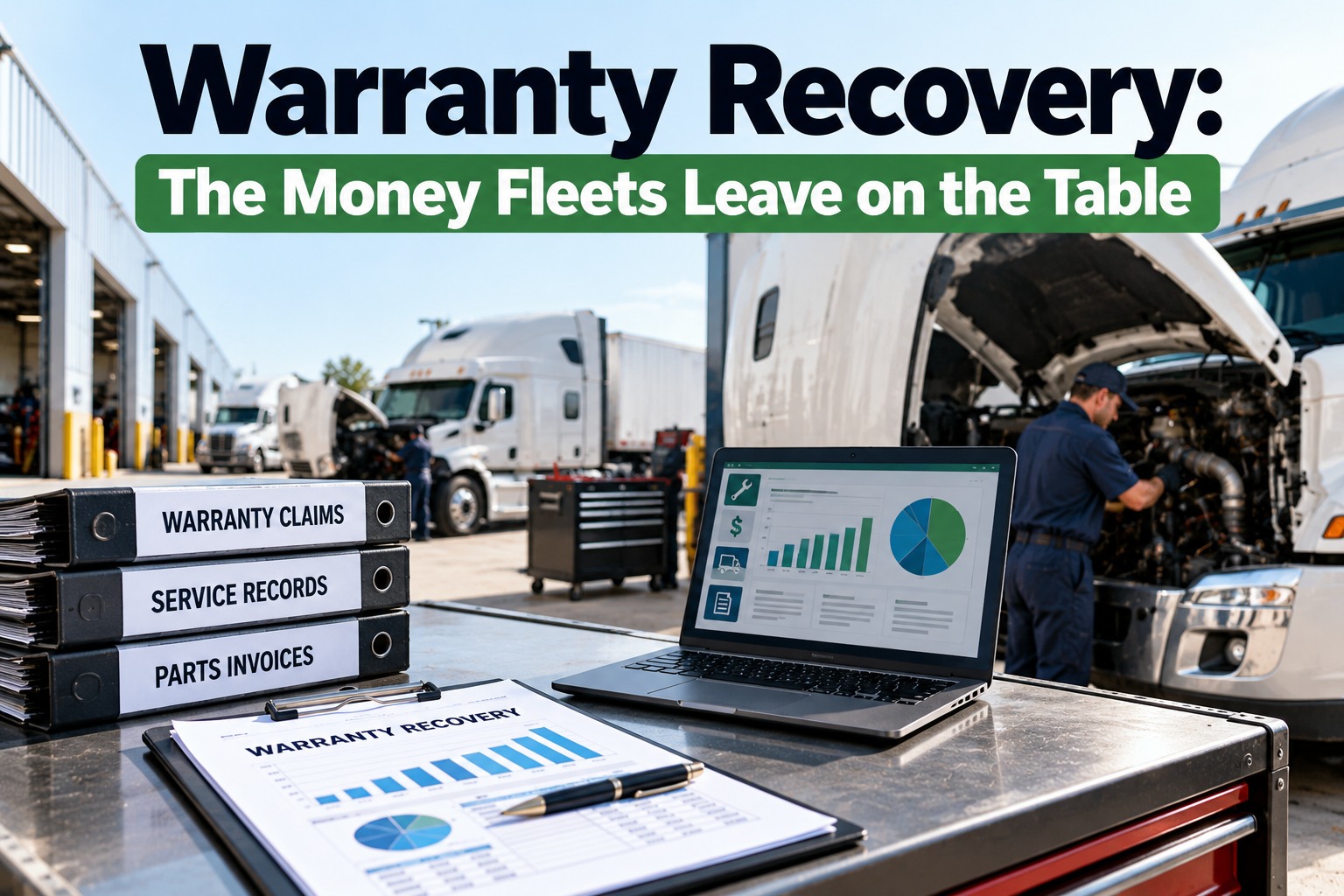
Warranty recovery is the work of getting paid for repairs a manufacturer already owes you. Most fleets lose money here through missed expiry dates, thin paperwork and late filing, not through bad luck. This page shows how coverage differs by component, the filing windows manufacturers use, why claims get missed and the records that support a claim. Schedule a call to set up warranty tracking for your trucks.
WARRANTY RECOVERY · CLAIMS · COVERAGE TRACKING
Every Repair Under Warranty Is a Claim You Have Not Filed Yet
Coverage ends on different dates for different parts. The records you keep decide whether the money comes back.
30 daysfiling window that gives the best chance of approval, per a fleet software vendor
5 to 8coverage schedules a fleet manager may track per vehicle, same source
Why Fleets Miss Warranty Claims on Repairs the Manufacturer Already Owes Them
Most misses trace back to records and dates, not to manufacturers refusing valid claims
Two fleet software vendors, OxMaint and FleetRabbit, publish near-identical lists of why claims fall through. We found no independent study behind them, so use the list as a diagnostic, not as evidence of how often it happens.
No claim paperwork
The documentation was never created
Expiry not tracked
Component end dates were not recorded or watched
Techs unaware
Shop did not know the part was still covered
Weak documentation
Claim rejected for thin records
Filed too late
Coverage window had already closed
Recalls unmatched
Notices never checked against your VINs
Treat the dollar figures with care. Both vendor pages say 12 to 18% of eligible repairs go unclaimed and that a 50-vehicle fleet may leave $15,000 to $40,000 a year unclaimed. Neither cites a study, so we have not built a savings estimate on them. Work out your own number from last year's repair orders.
Warranty Coverage Differs by Component, Mileage and Rating, So One Truck Has Several End Dates
An International HX example shows engine, transmission, aftertreatment and cab each running on their own clock
The table follows a Tri-County Truck Centers summary of International warranties. It is one OEM, shown to illustrate the spread, and the dealer states that full terms are in the standard warranty forms and policy. Your truck and engine may differ.
| Component (International HX example) | Coverage stated | Why it matters for claims |
|---|
| Base vehicle | 12 months, unlimited miles | Shortest window, so check early |
| S13 base engine | 2 years, unlimited miles and hours | Different end date from the base truck |
| Transmission and clutch | 3 years unlimited miles under 52,000 lb rear axle rating, 2 years above | Depends on axle rating |
| Dual-stage aftertreatment | 2 years, unlimited miles and hours | A common failure area on diesels |
| Cummins X15 engine | 24 months or 250,000 miles, whichever first | Mileage cap can end it sooner |
| Cab structure and corrosion | 120 months, unlimited miles | Long window nobody tracks |
Extended service contracts also exist for engine components, chassis and supplier parts such as Eaton transmissions, so track them beside the base warranty.
Components expiring on different dates? Schedule a call and we will set up one coverage record per truck.
Stop tracking warranty end dates in a spreadsheet.
Filing Windows and the Four-Step Claim Process Fleets Follow from Failure to Reimbursement
Check coverage before you authorize labor, document before you scrap and file as early as you can
FleetRabbit's guide says most manufacturers want claims within 30 to 60 days of repair completion, and some allow up to 90. It adds that filing inside 30 days gives the best chance of approval, and that some manufacturers accept late claims with full explanation and records. Check your own warranty terms for the actual deadline.
CLAIM FILING WINDOWS AFTER REPAIR COMPLETION, AS DESCRIBED BY FLEETRABBIT
Typical filing window
30 to 60 days
Some manufacturers allow up to
up to 90 days
Best chance of approval
first 30 days
1
Check coverage
Before authorizing labor
→
2
Document the failure
Photos, fault codes, tech notes
→
3
File fast
Ideally within 30 days
→
4
Track to payment
Approval and reimbursement
→
5
Review quarterly
Close out and audit
The Records That Make a Warranty Claim Stick: Work Orders, Fault Codes, Photos and Clean PM History
OEMs increasingly check service compliance, so a gap in maintenance records can cost you the claim
Capture on every repair
Photos of the failed part before disposal
Fault codes from diagnostics
Technician notes and timestamps
Part numbers and labor hours
VIN and mileage at failure
Keep ahead of expiry
Expiry date for each component
Alerts at 90, 60 and 30 days
A pre-expiry inspection
Extended warranties in the same list
Recall notices matched to VINs
OxMaint also suggests a quarterly calendar of annual audit, pre-expiry inspection push, mid-year recovery review and year-end close-out. Both pages are vendor content.
Warranty Recovery Checklist to Run Before Any Repair Order Is Closed
Tick each item so that no covered repair leaves the shop without a claim decision
Recover More Warranty Money: Track Coverage, Work Orders and Repair Cost per Vehicle in FleetRabbit
FleetRabbit keeps work orders, service history and costs for every vehicle in one record, so the paperwork a claim needs already exists and you can see repair spend per truck. Free for up to 3 vehicles, then $5 per vehicle per month.
Work orders per vehicle
PM history on file
Cost per vehicle
Free for 3 vehicles
Warranty Recovery FAQs: Filing Deadlines, Documentation, Extended Coverage and Missed Claims
Short answers on how fleets claim back repair costs from manufacturers
What is warranty recovery?
Getting reimbursed by the manufacturer or an extended-warranty provider for repairs that were covered, by checking coverage, documenting the failure and filing a claim.
How long do I have to file a claim?
FleetRabbit says most manufacturers expect filing within 30 to 60 days of repair completion, some up to 90. Your warranty document sets the real deadline.
What records do I need?
Photos of the failed part, fault codes, technician notes, work order details and clean time-stamped PM history.
Does skipping PM void a claim?
FleetRabbit says OEMs increasingly check service compliance before approving claims, so keep PM records complete. Read your warranty terms for specifics.
How much do fleets leave unclaimed?
Vendor pages say 12 to 18% of eligible repairs, but cite no study. Measure your own by reviewing the past year of repair orders against coverage.
What does FleetRabbit cost?
Know What Is Covered Before the Repair Order Opens
Keep one coverage and service record per truck so every eligible repair becomes a filed claim.
Free tier for up to 3 vehicles · No credit card required · Records stored per vehicle
October 17, 2026By Derek Goes
All Blogs