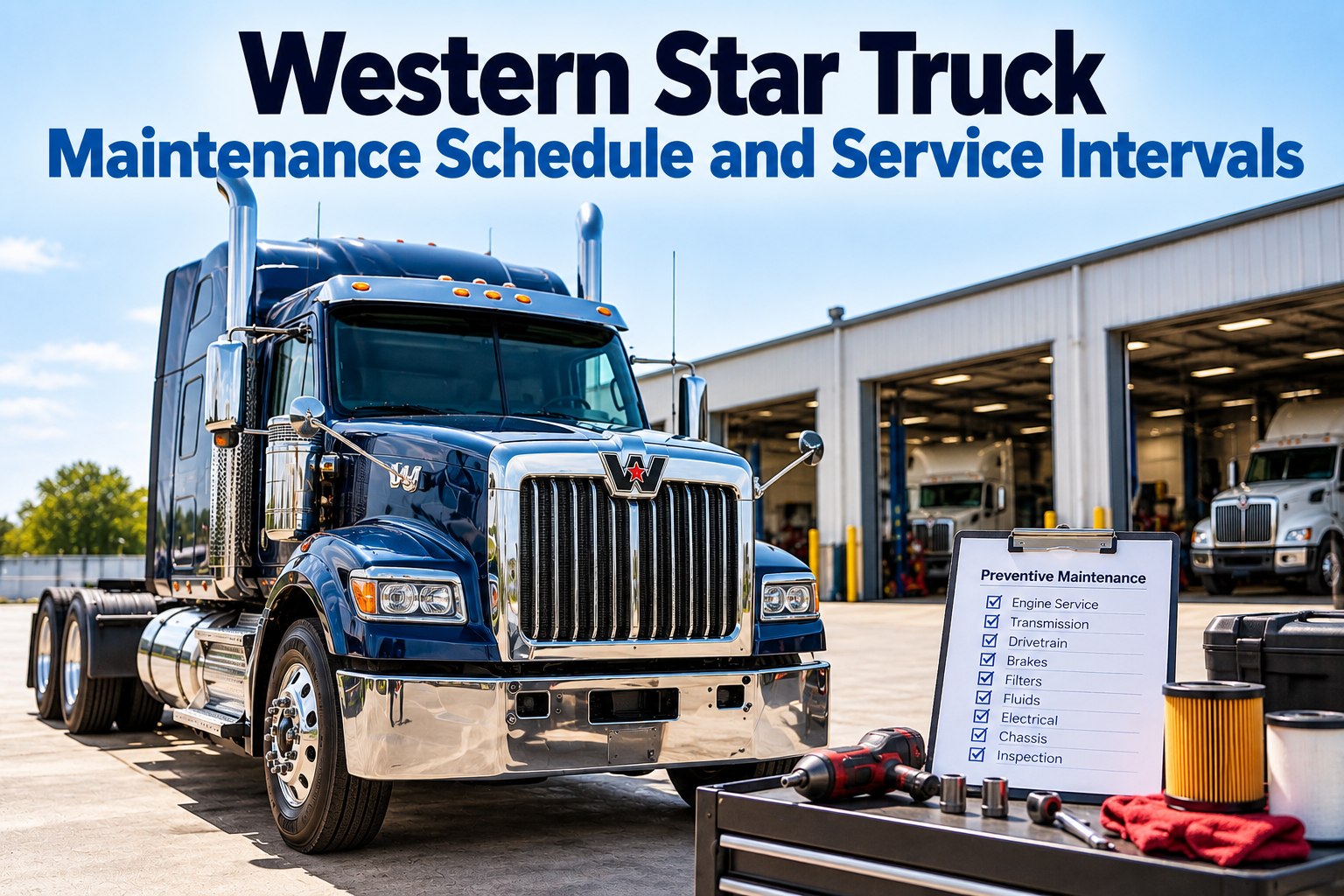
The Western Star maintenance schedule is a matrix rather than a list, and three inputs resolve it. Detroit defines the duty cycle by two tests at once — annual distance and average fuel economy — then the interval shifts again depending on whether the truck has a DD13, DD15 or DD16, and again depending on which oil specification you buy. A DD15 on efficient long haul runs 75,000 miles between oil changes; a DD13 on identical work runs 65,000, and the same route with a DD16 is not even eligible for that tier. Get one input wrong and the whole column is wrong — and severe duty does not only shorten the oil change, it cuts valve lash from 500,000 miles to 200,000. Book a Western Star PM review.
Three Inputs Decide Every Interval on the Truck
The published Detroit schedule, read properly: the two-part duty cycle test, the per-engine differences, what severe duty actually changes beyond the oil, and the oil specification that quietly rewrites the whole table.
Two Tests Decide Your Duty Cycle, Not One
This is where most schedules go wrong before anything else is entered. Detroit's tiers are not vocations and they are not a single threshold.
More than 60,000 miles a year puts you in long-haul territory. Between 30,000 and 60,000 is short haul. Under 30,000 is severe, on distance alone.
Above 7.0 mpg, 6.0 to 6.9, 5.1 to 5.9, or below 5.0. Each band maps to a tier, and it has to be your measured figure rather than a brochure number.
The first three tiers require both conditions. Severe is reached by either — under 30,000 miles a year, or under 5.0 mpg, or operating under severe conditions. One trigger is enough.
The asymmetry matters. To claim an upper tier you must satisfy both tests; to fall into severe you need satisfy only one. A truck covering 90,000 miles a year at 4.8 mpg is severe duty despite the distance, and a truck returning 7.4 mpg over 25,000 miles a year is severe duty despite the economy.
Annual distance and rolling fuel economy are held per unit and evaluated against both tests, so the tier is derived rather than declared at setup. A truck that crosses a threshold mid-year changes tier when it crosses it.
Same Duty Cycle, Three Different Intervals
Once the tier is settled, the engine decides the number. The spread is wider than most people expect.
At the efficient long-haul tier a DD15 is specified at 75,000 miles and a DD13 at 65,000 — a 10,000-mile gap on identical work — while the DD16 is not offered at that tier at all. By the severe tier all three have converged on 35,000 miles or 750 hours. Any schedule that stores one oil interval for "Western Star" is therefore wrong for at least one engine in the fleet, and the error is largest on the units running best.
| Duty cycle | How you qualify | DD13 | DD15 | DD16 |
|---|---|---|---|---|
| Efficient Long Haul | >60,000 mi/yr and >7.0 mpg | 65,000 mi | 75,000 mi | Not offered |
| Long Haul | >60,000 mi/yr and 6.0–6.9 mpg | 55,000 mi | 60,000 mi | 55,000 mi |
| Short Haul | 30,000–60,000 mi/yr and 5.1–5.9 mpg | 40,000 mi or 1,000 hrs | 45,000 mi or 1,000 hrs | 40,000 mi or 1,000 hrs |
| Severe | <30,000 mi/yr or <5.0 mpg or severe conditions | 35,000 mi or 750 hrs | 35,000 mi or 750 hrs | 35,000 mi or 750 hrs |
Engine model is a scheduling field, not a note. The same PM task carries a different interval per engine, so a mixed DD13 and DD15 fleet runs one schedule with two sets of due points rather than an average that suits neither.
Most fleets store one interval where Detroit publishes twelve
Four duty cycles across three engines is twelve oil intervals, and that is before the hour limits, the severe-duty knock-ons and the oil specification. In thirty minutes we will load the Detroit matrix against your actual unit list and show you which trucks are currently on the wrong row.
Severe Duty Changes Six Things, Not One
When a unit drops to severe, people shorten the oil change and stop. The published table moves considerably more than that, and by different amounts.
| Item | Upper tiers | Severe duty | The change |
|---|---|---|---|
| Engine oil and filter | 65,000 mi at the efficient tier | 35,000 mi or 750 hrs | Roughly halved, and an hour limit appears |
| Valve lash adjustment | 500,000 mi | 200,000 mi | Cut by 60% — the one most often missed |
| Frame-mounted fuel filter | 100,000 mi | 70,000 mi or 750 hrs | Down 30%, plus an hour clock |
| Belts | 150,000 mi on a DD13 | 105,000 mi or 2,690 hrs | Down 30%, plus an hour clock |
| Oil and engine fuel filter | Every oil change | Every oil change | Unchanged as a rule, but the oil change itself is sooner |
| Coolant and DEF pump filter | 300,000 mi standard coolant; DEF filter 500,000 mi or 3 years | Same | Genuinely unchanged by duty cycle |
Valve lash is the one worth circling. It sits at 500,000 miles across all three upper tiers and then falls to 200,000 on severe duty — a 60% reduction on an item nobody thinks of as duty-cycle sensitive. A fleet that demotes a truck's oil interval but leaves valve lash at 500,000 has carried over an interval that is now two and a half times too long.
A tier change is applied as a set. When a unit moves to severe, the oil, valve lash, frame fuel filter and belt intervals all shift by their own amounts and the hour clocks switch on, without anyone editing six rows by hand.
The Oil You Buy Rewrites the Table
A third input, and the one least likely to be recorded anywhere in a maintenance system.
Detroit publishes two interval tables. The figures above are for oils approved to its CK-4 and FA-4 specifications. There is a second, shorter table for the older CJ-4 specification: long haul at 50,000 miles, short haul at 35,000 miles or 895 hours or one year, and severe at 25,000 miles or 640 hours or six months.
So the same DD15 on the same route is on 60,000 miles or 50,000 miles depending purely on what came out of the barrel. The approved specifications are API FA-4, CK-4 or CJ-4 certified oil, in 15W-40 or 5W-30 and 10W-30 grades according to specification. If the schedule in your system assumes the longer table and the shop is filling with the older specification, the truck is running past interval by 10,000 miles and nothing in the system will say so.
Worth a separate check: Detroit states that supplemental filters are not allowed on the DD5, DD8, DD13, DD15 and DD16. If a unit has one fitted — sometimes added in good faith to stretch a drain — that is a prohibition rather than a preference, and the fuel must be ultra-low sulphur at below 15 ppm.
Oil specification is recorded against the unit and against each service, so the interval follows what was actually used. A change of product is a change of schedule, and the record shows which barrel each drain was done on.
The Limits That Override the Schedule Entirely
Intervals are the plan. Detroit also publishes the conditions under which the plan stops applying.
Alongside the drain intervals are oil analysis warning limits, with the instruction to change the oil immediately if contamination exceeds them. Soot at 4.5%, water at a maximum of 3,000 ppm, and fuel dilution capped in a 2.5% to 7% range depending on the measure, alongside wear metal limits.
That turns oil analysis from a nice-to-have into the thing that can countermand the schedule. A truck at 30,000 miles into a 60,000-mile interval with soot above 4.5% is due now, not in another 30,000. The schedule is the default and the sample is the override — which only works if sample results reach whoever is planning the work, rather than sitting in an inbox.
Sample results are attached to the unit and can pull a due date forward. An adverse result raises the work immediately instead of waiting for the mileage, and the sample history stays with the vehicle for the next decision.
The Long-Cycle Items and the DPF Estimate
These sit far enough out that they fall off most schedules entirely, which is exactly why they get missed on a second or third owner.
Coolant replacement is published at 300,000 miles for standard coolant and 600,000 miles for extended life, unchanged across every duty cycle. The DEF pump filter is 500,000 miles or three years, also constant across tiers — and the three-year limit is the one that will arrive first on anything but a hard-running highway unit.
Diesel particulate filter ash cleaning is published as an estimate rather than a fixed interval, in bands: above 640,000 miles or 14,000 hours at the cleanest end, then 550,000 to 640,000, then 455,000 to 550,000, and below 455,000 miles or 10,000 hours at the other. Which band you fall into is a function of how the truck is run, so it is a planning range rather than a date.
For the exact intervals on your own units, the operator's manual for your engine, model year and emissions configuration is the authority, and a dealer can confirm the emissions generation a given VIN falls under. Everything here is the published Detroit framework for the DD platform, not a substitute for that manual — and if a unit is spec'd with a non-Detroit engine, that engine maker's own schedule applies instead.
How FleetRabbit Handles This
Four things, each aimed at the specific way this schedule breaks when it is kept by hand.
Duty cycle, engine model and oil specification held against each truck, so the due date is the correct cell of the Detroit table rather than one interval applied fleet-wide.
Several intervals are miles or hours or months, whichever first. FleetRabbit runs them together and raises the work on whichever arrives, which is how Detroit writes them.
Annual distance and fuel economy are measured, not declared. If a truck slips below 5.0 mpg it has moved tier, and the schedule should move with it rather than at the next review.
When a unit demotes, every affected item shifts — oil, valve lash, fuel filter and belts, each by a different amount. Handled as a set rather than one row at a time.
Questions Western Star Operators Ask
What is the oil change interval on a Western Star?
There are twelve published answers. On CK-4 or FA-4 oils a DD13 runs 65,000 / 55,000 / 40,000 / 35,000 miles across the four duty cycles and a DD15 runs 75,000 / 60,000 / 45,000 / 35,000, with the DD16 matching the DD13 from long haul down. Your tier depends on annual distance and measured fuel economy together. Work out your cell.
How is the duty cycle actually decided?
By two tests. The upper three tiers need both the annual distance and the fuel economy band to match; severe duty is triggered by either one on its own, or by severe operating conditions. So high mileage does not protect a truck running under 5.0 mpg. Measure both inputs.
Does severe duty change anything besides the oil?
Yes, and this is the common miss. Valve lash falls from 500,000 to 200,000 miles, the frame-mounted fuel filter from 100,000 to 70,000, and belts from 150,000 to 105,000 on a DD13 — each with an hour limit attached. Shortening only the oil interval leaves three items badly over-extended. Check Your Severe-Duty Items.
Does the oil brand or specification matter?
The specification does, considerably. Detroit publishes a shorter table for CJ-4 approved oils — 50,000 long haul, 35,000 short haul, 25,000 severe — against the CK-4 and FA-4 figures quoted above. Same engine, same route, different interval. Record what was used.
When does the DPF need ash cleaning?
Detroit gives bands rather than a figure: above 640,000 miles or 14,000 hours at best, down to below 455,000 miles or 10,000 hours at the other end, with two bands in between. Which one applies depends on how the truck is operated, so treat it as a planning range. Plan the window.
Can oil analysis let us extend a drain?
Detroit's published limits work in the other direction — they tell you when to change immediately, with soot at 4.5%, water at 3,000 ppm and fuel dilution capped. Treat sampling as the thing that can shorten an interval on evidence, and talk to your dealer before extending one. Attach sample results.
Why does our system only have one interval in it?
Because most were set up by typing a number once. That is fine on a single-engine fleet at a stable duty cycle and wrong the moment either varies — which, given the tier is recalculated from measured economy, is most fleets. Load the full matrix.
Can we run Western Star alongside other makes?
Yes, and the matrix is the reason to. Each make and engine carries its own ladder, so they belong on one maintenance record with per-unit intervals rather than in separate sheets that drift apart. Build Your PM Schedule Free.
Put the Whole Matrix Behind the Schedule
FleetRabbit holds duty cycle, engine model and oil specification per truck, runs miles, hours and months together, and shifts every affected item when a unit changes tier — so the due date is the right cell of the Detroit table rather than one number somebody typed in once.
Free for 3 vehicles · no credit card required