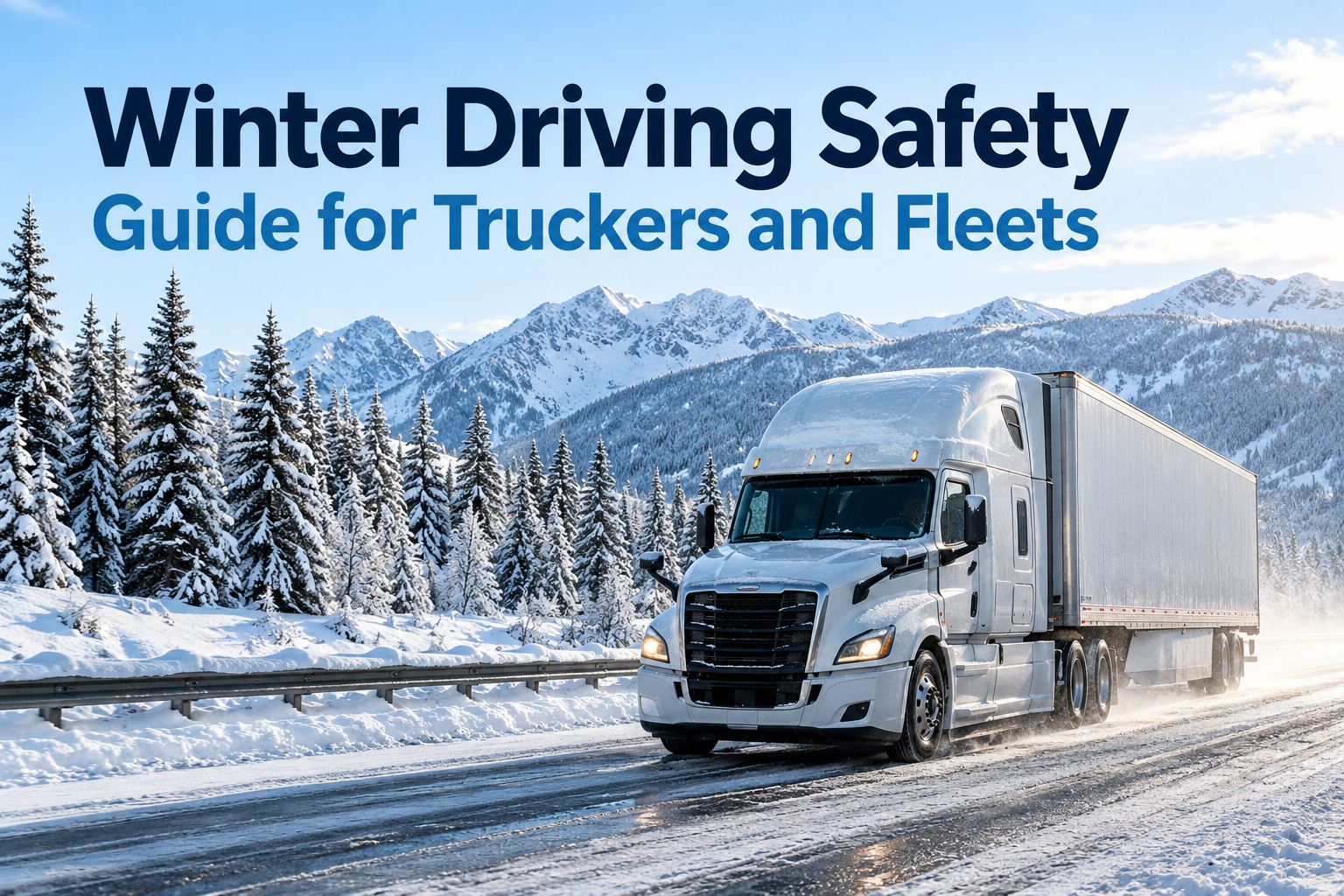
Winter doesn’t make trucks crash. Speed, following distance and missed pre-trip items do, and snow takes away the margin that usually covers them. This guide covers what changes on a winter run for a tractor-trailer or a container chassis: how far to slow down on each surface, the federal rules that apply in bad weather, the winter pre-trip items for each unit, chain laws, and when to park. It ends with a checklist you can run as a daily inspection. To see how FleetRabbit handles winter inspections, book a short demo with our team.
Winter driving safety · tractors, trailers and chassis
The same 55 mph road, four winter surfaces, four very different safe speeds
Training guidance for commercial drivers: cut speed by a third on wet roads, by at least half on packed snow, and slow to a crawl on ice, then park.
Packed snow
about 27 mph or less
Speeds are worked from 55 mph using commercial driver training guidance. Always drive slower when conditions demand it.
Snow, slush and ice: where weather-related crashes actually happen
The Federal Highway Administration’s road weather program reports that 24% of weather-related vehicle crashes happen on snowy, slushy or icy pavement, killing more than 1,300 people and injuring more than 116,800 each year. Another 15% happen while snow or sleet is falling, with nearly 900 deaths and nearly 76,000 injuries. On snowy or slushy pavement, average arterial speeds drop 30 to 40%, and freeway speeds fall by up to 40% in heavy snow.
Share of weather-related crashes by condition
Snowy, slushy or icy pavement
24%
During snowfall or sleet
15%
Source: FHWA Road Weather Management Program, snow and ice. Bars scaled to 100% of weather-related crashes.
For a loaded 80,000 lb combination, the stakes are higher than for a car. Stopping distances stretch further, a trailer can swing out on a slick curve, and a jackknife can shut down an interstate for hours.
Three federal rules every driver should know before a winter run
Winter doesn’t suspend the Federal Motor Carrier Safety Regulations. Three sections matter most when the weather turns.
49 CFR 392.14
Extreme caution
When snow, ice or sleet cuts visibility or traction, the driver must slow down, and stop driving altogether if conditions are dangerous enough, until the truck can be operated safely.
49 CFR 395.1(b)
Adverse driving conditions
Up to two extra hours of driving, inside an extended window, but only for conditions the driver and carrier couldn’t have known about before dispatch. A forecast storm doesn’t qualify.
49 CFR 396.11 and 396.13
Inspection reports
The pre-trip and post-trip still apply in a blizzard. Defects found in the cold go on the driver vehicle inspection report and get repaired before the unit runs again.
How far to slow down on each winter surface
The guidance most drivers learn for their commercial driver’s license is simple and conservative. The figures below start from a 55 mph cruising speed; posted limits and conditions on the day may call for slower still.
| Surface | Guidance | 55 mph becomes | What to watch for |
|---|
| Wet pavement | Cut cruising speed by about one-third | About 37 mph | Spray from trucks ahead; standing water on ruts |
| Packed snow | Cut speed by at least one-half | About 27 mph or less | Drifting snow over lane lines and shoulders |
| Slush | Treat as packed snow, steer gently | About 27 mph or less | Slush pulling the trailer toward the shoulder |
| Black ice | Slow down at once, no hard braking | A crawl | Road looks wet but trucks ahead stop throwing spray |
| Bridges and ramps near 32°F | Slow before the deck, not on it | Lower than the approach | Decks freeze before the road around them |
| Ice | Slow to a crawl and find a safe place to park | Park | Stop until crews have salted or sanded |
The one that catches experienced drivers is black ice. If the trucks ahead stop throwing spray off a road that still looks wet, assume it has frozen.
The winter pre-trip: what changes on the tractor, the trailer and the chassis
A winter pre-trip covers the same items as any other, with a few that only matter below freezing. These are the ones most often missed when the driver is cold and in a hurry.
Tractor
Drain air tanks and check the air dryer is purging
Wipers, washer fluid rated for freezing temperatures, defroster
Headlamps, marker lamps and mirrors cleared of snow and ice
Fuel treated or winter blend, and DEF level checked
Tires: tread depth and chains on board where required
Trailer
Glad hand seals not frozen or cracked, lines coupled cleanly
Brakes release fully after a cold soak; no frozen shoes
Lamps, reflectors and conspicuity tape free of snow
Roof cleared of snow and ice before departure
Landing gear raised fully and crank stowed
Chassis
Twist locks and locking pins free of ice and fully seated
Lamps and reflectors on the rear bolster cleaned
Tires and wheels checked after sitting in a cold yard
Container secured; no ice packed in the corner castings
Unit number readable for the inspection report
Any defect found goes on the inspection report, the same as in summer. FleetRabbit’s DVIR and DOT inspection app supports custom inspection types, so these items can be a winter template the driver signs every morning.
Turn this checklist into a daily winter inspection
In a 20-minute demo we’ll set up a tractor, trailer and chassis pre-trip with photos, signatures and mechanic sign-off.
Jackknifes and trailer swing: six habits that keep a combination straight
Most winter losses of control start with one input too many: too much brake, too much throttle or too sharp a turn on a surface with almost no grip.
Light and empty trailers
An empty van or flatbed has far less weight over its axles, so it loses grip first and swings out. Slow down more when running empty.
Smooth inputs only
Brake, steer and accelerate gently. On ice, a sudden input on any of the three can start a skid.
Engine brakes and retarders
On slippery roads a retarder can lock the drive wheels. Many fleets tell drivers to switch it off on snow and ice.
Space ahead and behind
Stopping distance grows sharply on snow and ice. Leave far more room than on dry pavement, and stay out of packs.
Downgrades
Pick a low gear before the top, not partway down. Braking hard on a slick downgrade is where jackknifes start.
Visibility
Clear every window, mirror and lamp before moving. A truck that can’t be seen is a hazard even when it’s parked.
Chain laws: what Colorado’s I-70 rules show about the cost of not chaining
Several mountain states require trucks to carry or fit chains. Colorado’s law, in place since 1996, is one of the best known. From 1 September to 31 May, commercial vehicles on I-70 between milepost 133 at Dotsero and milepost 259 near Golden must carry enough chains. When the chain law is called, single-drive-axle combinations must chain all four drive tires, and at the higher level every commercial vehicle must chain up.
$50 + $17 surcharge
Driving the I-70 corridor without chains on board, 1 September to 31 May
$500 + $79 surcharge
Not chaining up when the chain law is in effect
$1,000 + $157 surcharge
Not chaining up, then blocking the highway
Fines as reported by FreightWaves. Check CDOT and COtrip for current amounts and approved alternatives such as automatic chains and textile socks.
Rules differ in California, Oregon, Washington and other states, so drivers need the rules for each route before they leave. Chains also wear tires, fenders and air lines, which is one more reason to look closely at the post-trip.
When to park: a decision the fleet should make before the driver needs it
Federal rules already tell drivers to stop when conditions are dangerous enough. What drivers need from their fleet is clear permission to do it, without a dispatcher pushing back.
1
Before dispatch
Check the forecast and road reports for the whole route. If a storm is forecast, the adverse-conditions exception won’t cover it, so plan the hours now.
2
On the road
If traction or visibility is going, the rule is to slow down, and to stop when it’s dangerous enough. The fleet should say in writing that the driver may stop without asking.
3
Choosing a place
A truck stop, rest area or chain-off area, not the shoulder, unless there is no choice. Lights and triangles go out at once.
4
Reporting
The driver tells dispatch where they stopped and why. A late load is a phone call. A jackknife is a claim.
A winter emergency kit for every cab
A driver stuck on a closed interstate may be in the cab for many hours. The kit below fits behind the seat and costs far less than one tow.
Warm clothing, gloves, boots and a blanket
Water and food for at least a day
Flashlight and spare batteries
Phone charger that works without the engine running
Ice scraper and snow brush
Bag of sand or traction material
Tire chains, bungees and gloves for chaining
Warning triangles and extra fuses
Glad hand seals and a spare air line
First-aid kit
The post-trip after a winter run: report what the cold broke
Winter is hard on equipment. A frozen glad hand seal that cracks, a lamp knocked out by ice, a mud flap torn off by a chain, a tire cut by a chain link: each one should go on the post-trip report so it’s fixed before the next driver takes the unit. Recurring winter defects belong in the preventive maintenance schedule, for example draining air tanks more often or replacing glad hand seals before the season, and every repair should land in the unit’s maintenance history.
Where FleetRabbit fits a winter safety program, and where it doesn’t
Documented on fleetrabbit.com
Digital pre-trip and post-trip inspections with custom inspection types
Defect photos and electronic driver signatures
Mechanic sign-off on repairs, with records kept digitally
Preventive maintenance scheduling
Free for up to three vehicles
Use other tools for
Weather forecasts and road-condition reports
Chain-law status by route
Hours-of-service logging
FleetRabbit for winter fleets
A winter pre-trip every driver signs, and every cold-weather defect fixed before the next run
Winter inspection template
Custom checks for tractors, trailers and chassis.
Photos and signatures
A frozen glad hand or torn mud flap, shown and signed.
Mechanic sign-off
Repairs certified before the unit goes back out.
Preventive maintenance
Pre-season and in-season service on a schedule.
What the 20-minute demo covers
Building a winter pre-trip template
A driver flagging a defect with a photo
Mechanic sign-off and the repair record
The free plan for three vehicles
Winter driving safety questions from drivers and fleet managers
How much should a truck slow down on snow?
Commercial driver training guidance says to cut speed by about one-third on wet roads and by at least half on packed snow. On ice, slow to a crawl and park as soon as it’s safe.
Can a driver legally stop because of snow or ice?
Yes. 49 CFR 392.14 says the driver must stop operating the truck when conditions are dangerous enough, and not resume until it can be driven safely.
Does the adverse-driving-conditions exception cover a forecast storm?
No. The extra two hours apply only to conditions the driver and carrier didn’t know about, and couldn’t reasonably have known about, before dispatch.
When does Colorado’s chain law apply to trucks?
From 1 September to 31 May on I-70 between mileposts 133 and 259, commercial vehicles must carry chains. When the law is in effect, they must chain up as the signs require.
Is there a winter driving safety checklist I can use?
Yes. The tractor, trailer and chassis checklist on this page can be set up as a custom inspection in a digital DVIR app, so each item is checked and signed every day.
Does FleetRabbit send weather or chain-law alerts?
That isn’t described on FleetRabbit’s site. FleetRabbit covers inspections, defects and maintenance; use 511 services and state road reports for conditions.
Get every truck through the winter on a pre-trip that catches the cold-weather defects
Set up a winter inspection for your tractors, trailers and chassis before the first storm.
October 21, 2026By Derek Goes
All Blogs