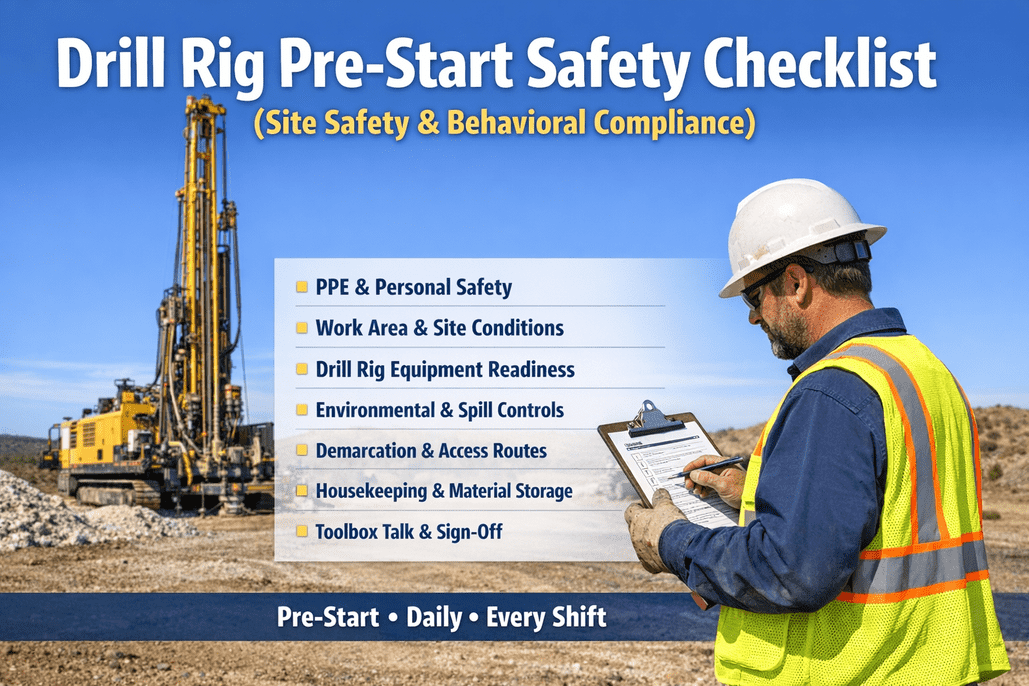
Every drill rig shift starts with one question: is this site safe to operate? A pre-start safety checklist answers that by verifying PPE compliance, machine guarding, work area hazards, environmental controls, and housekeeping before anyone turns the key. This isn't a maintenance inspection—it's a behavioral and site-condition verification that ensures your crew, equipment, and environment are ready for safe drilling operations. Skipping it means starting blind, and on a drill site, blind gets people killed. Start your free fleet trial
Drill Rig Pre-Start Safety Checklist
Site Safety & Behavioral Compliance — Pre-Start • Daily • Every Shift
Checklist Purpose
Crew Protection
- Drill rigs involve rotating machinery, high-pressure air, and heavy suspended drill rods. A pre-start PPE and behavioral check ensures every crew member is properly equipped and alert before hazardous operations begin—catching missing hardhats, expired harnesses, and loose clothing before they cause injuries.
Site Readiness
- Ground conditions, lighting, trip hazards, and overhead power lines change overnight. A pre-start site walk confirms the work area is safe, demarcation is intact, and environmental controls are in place before the rig starts—not after an incident forces a shutdown.
Compliance & Accountability
- OSHA 29 CFR 1926 and MSHA standards require documented pre-shift hazard assessments and toolbox talks. A signed pre-start checklist provides legal proof that your site met safety standards at the beginning of every shift, protecting your operation from citations and liability claims.
1. PPE & Personal Safety (Behavioural)
Verify all crew members are wearing required personal protective equipment before work begins:
Head & Eye Protection
Body Protection
Hearing & Fall Protection
2. Work Area & Site Conditions
Walk the immediate work area and confirm conditions are safe before starting the rig:
Ground Conditions
Obstructions & Hazards
Lighting & Visibility
3. Drill Rig Equipment Readiness
Confirm the drill rig and associated machinery are safe to operate this shift:
Rig Condition
Guarding & Safety Devices
Air System & Hoses
4. Environmental & Spill Controls
Verify environmental protections and spill response readiness before drilling begins:
Waste Control
Spill Prevention
Spill Response
5. Demarcation & Access Routes
Confirm site barricading, exclusion zones, and access routes are intact since the last shift:
Access Control
Work Zone Barriers
Sump & Pit Safety
6. Housekeeping & Material Storage
Ensure the work area is clean, organized, and materials are safely stored before operations:
Site Cleanliness
Tool & Equipment Storage
Drill Rod Storage
7. Toolbox Talk & Sign-Off
Complete the pre-shift safety briefing and document all findings before operations begin:
Toolbox Talk
Emergency Preparedness
Checklist Sign-Off
Streamline Drill Rig Pre-Start Safety Checks
Fleet Rabbit's Drill Rig Benefits:
- ✓ Digital pre-start checklists with crew sign-off, photos & GPS tagging
- ✓ Automated alerts for PPE expiry dates, harness service life & tag renewals
- ✓ Track toolbox talk completion, crew attendance & near-miss reports
- ✓ Instant hazard notifications to site supervisors with priority flagging
- ✓ MSHA & OSHA compliant pre-shift records stored securely in the cloud
Common Hazards to Watch For
Whip Check Failure
- Missing Restraints: High-pressure air hoses on drill rigs operate at extreme PSI. When a coupling fails without a whip check restraint, the hose whips violently—capable of killing a crew member on impact. Pre-start checks must confirm every air hose coupling has a properly sized whip check with cable in good condition. If even one is missing or frayed, the rig must not start until it's replaced.
Missing Machine Guards
- Exposed Rotating Parts: Guards are frequently removed for maintenance and not replaced before the next shift. Exposed drive shafts, pulleys, and drill chucks cause severe injuries including de-gloving and amputations. The pre-start check must verify every guard is bolted in place—not wired, taped, or resting loose. If a guard is missing, the rig is out of service until it's reinstalled and secured.
Drill Rod Stack Collapse
- Unsecured Rods: Drill rods are heavy steel cylinders that build momentum quickly when they roll. Rods left unstacked overnight can shift due to ground settlement or vibration. The pre-start walk must confirm rods are in proper racks with chocks/pins on both ends, the rack is level, and no rods have shifted since the last shift. A single rolling rod can crush limbs or trap a worker against equipment.
Essential Pre-Start Check Tools
Equip your site team with the right tools for thorough pre-start safety verification:
Safety Verification
- Gas Detector: 4-gas monitor for ground gas hazards before start-up.
- Lux Meter: To confirm adequate lighting levels for night shifts.
- Sound Level Meter: To verify noise zones & PPE hearing requirements.
- Wind Speed Meter: To assess conditions for mast operations.
Site Assessment
- High-Lumen Flashlight: For pre-dawn undercarriage & hose checks.
- Marking Paint: For identifying new hazards & refreshing demarcation.
- Tape Measure: For verifying exclusion zone distances.
- Utility Locator: For confirming underground service clearance.
Documentation
- Clipboard & Forms: For toolbox talk sign-off & hazard recording.
- PPE Inspection Tags: For verifying harness & lanyard service dates.
- Spill Kit Checklist: Quick-reference card for verifying kit contents.
- Digital Camera: For documenting hazards—or use Fleet Rabbit's in-app photo capture.
Drill Rig Pre-Start Safety FAQs
1. What's the difference between a pre-start safety checklist and a maintenance inspection?
A pre-start safety checklist is a shift-level behavioral and site-condition verification—it confirms PPE is worn, guards are in place, the work area is hazard-free, and environmental controls are active. It's done by the operator or crew before every shift. A maintenance inspection is a detailed mechanical evaluation of engine, hydraulics, brakes, and structural components done by qualified mechanics at scheduled intervals. Both are essential, but they serve different purposes and are done by different people at different frequencies.
2. How often should a pre-start safety check be completed?
Before every shift, every day, without exception. Site conditions change overnight—rain creates slippery surfaces, wind can displace barricading, and previous crews may have removed guards for maintenance. OSHA and MSHA require documented pre-shift hazard assessments. If a crew change happens mid-day, the incoming crew must complete their own pre-start check—never rely on the previous shift's assessment. Start a free Fleet Rabbit trial to ensure every shift starts with a verified, timestamped safety check.
3. What PPE is required for drill rig operations?
At minimum: hardhat, safety glasses, steel-toe boots, gloves, hearing protection, dust mask, and overalls with no loose fabric that could catch on rotating parts. Work at height on the mast requires a full-body safety harness with shock-absorbing lanyard attached to an approved anchor point. Chemical handling requires appropriate gloves and splash protection. All PPE must be visually checked before use—not just owned, but actually worn and in serviceable condition.
4. Who is responsible for completing the pre-start checklist?
The drill operator or designated competent person is responsible for walking the site and completing the checklist before operations begin. However, PPE compliance is every crew member's individual responsibility. The site supervisor must review and authorize the checklist before giving the go-ahead to start the rig. If any critical hazard is identified and cannot be immediately resolved, the supervisor must halt operations until it's corrected. Book a Fleet Rabbit demo to see how digital sign-off workflows ensure accountability from operator to supervisor.
5. What are whip checks and why are they on a pre-start checklist?
Whip checks are steel cable restraints that connect air hoses across coupling joints. If a coupling blows under pressure, the whip check catches the hose before it can whip freely. On drill rigs running at 150+ PSI, an unrestrained hose strikes with lethal force. They're on the pre-start checklist because they can be removed during maintenance, damaged during the previous shift, or incorrectly reinstalled. Verifying them before every start-up is a non-negotiable life-safety item.
6. What should a toolbox talk cover before drilling operations?
The toolbox talk should cover the specific hazards of that day's work—drill depth, ground conditions, weather changes, nearby utilities, and any site changes since the last shift. Review the emergency plan including muster points and nearest medical facility. Discuss any incidents or near-misses from previous shifts. Every crew member must sign the record. The talk should take 10–15 minutes and be a genuine conversation about that day's risks—not a form-signing exercise. Schedule a demo to see how Fleet Rabbit digitizes toolbox talks with crew sign-off and photo attachments.
7. What happens if a hazard is found during the pre-start check?
Minor hazards (debris in walkway, low washer fluid) can be corrected immediately and noted on the checklist. Critical hazards—missing machine guards, failed whip checks, slippery rig floor, collapsed barricading—require the rig to remain shut down until the hazard is eliminated. The operator must report the hazard to the supervisor, document it with photos and description, and not authorize start-up until the corrective action is verified. Never start a rig with an unresolved critical safety finding. Use Fleet Rabbit to flag critical hazards with instant supervisor notifications and photo evidence.
8. Why is drill rod stacking checked during a pre-start walk?
Drill rods are heavy steel tubes (often 20+ kg each) that can roll with devastating force. Rods can shift overnight due to ground settlement, rain, vibration from nearby equipment, or improper stacking by the previous crew. The pre-start walk must confirm all rods are in racks with chocks on both ends, the rack is level, and no rods have shifted position. A cascading rod stack has caused multiple fatalities in drilling operations. It takes 30 seconds to verify and can save a life.
Standardize Drill Rig Pre-Start Safety Checks
Paper safety checklists get signed without being done, toolbox talks happen without records, and critical hazards go unreported until someone gets hurt. Fleet Rabbit replaces that with a mobile-first pre-start platform where operators walk the site, check every PPE item, verify every guard and whip check, photograph hazards, and get supervisor sign-off—all timestamped, GPS-tagged, and stored in MSHA/OSHA-compliant cloud records before the rig turns over.


