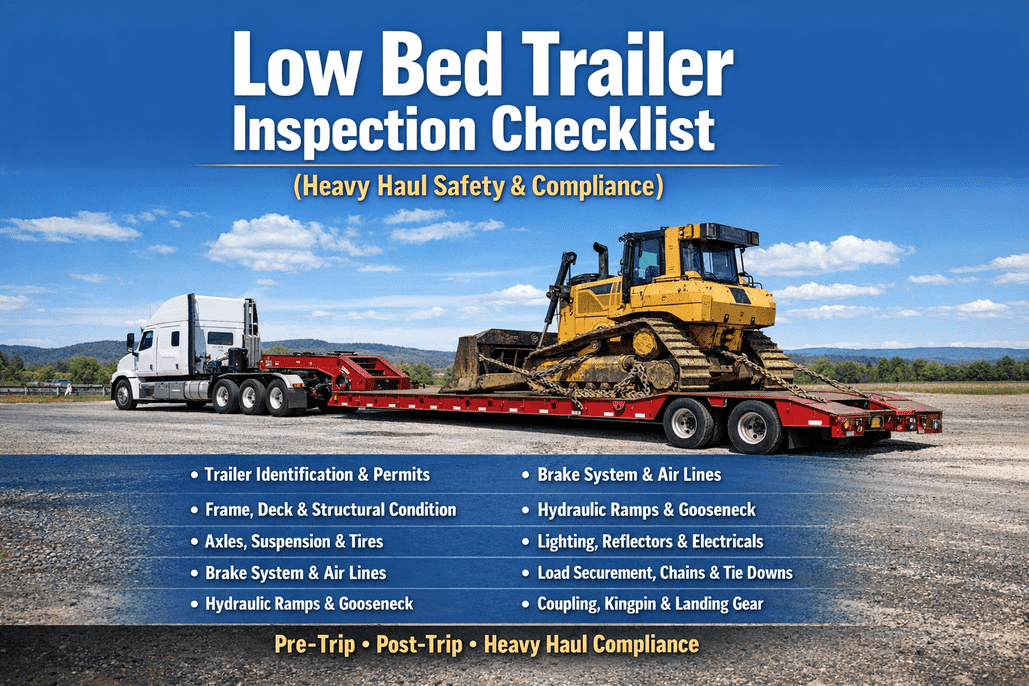
Low bed trailers move the heaviest, most expensive cargo on the road—excavators, bulldozers, transformers, and industrial machinery that can exceed 80,000 lbs. A single missed inspection point can mean a blown tire under extreme load, a hydraulic ramp failure during loading, or an oversize permit violation that shuts your haul down mid-route. This low bed trailer inspection checklist covers every critical system from gooseneck integrity and multi-axle braking to chain securement and escort vehicle coordination, ensuring your heavy haul operations stay safe, legal, and on schedule. Start your free fleet trial
Low Bed Trailer Inspection Checklist
Heavy Haul Safety & Compliance — Pre-Trip • Post-Trip • Heavy Haul Compliance
Inspection Purpose
Heavy Haul Safety
- Low bed trailers carry loads that can crush vehicles and collapse bridges if something goes wrong. Inspecting axles, brakes, and structural integrity before every haul prevents catastrophic failures under extreme weight that endanger the operator, escort crews, and the public.
DOT & Oversize Compliance
- Heavy haul operations require oversize/overweight permits, escort vehicles, and route-specific approvals. A documented pre-trip inspection ensures your low bed meets FMCSA 49 CFR Part 393 standards and avoids permit revocations, roadside out-of-service orders, and CSA score damage.
Equipment & Cost Protection
- The cargo on a lowboy often costs more than the trailer itself. A single load shift or ramp failure can destroy a $500K excavator and generate massive liability claims. Regular inspections catch hydraulic leaks, worn chains, and deck damage before they become six-figure losses.
1. Trailer Identification & Permits
Record trailer details and verify all permits and documentation are current before departure:
Trailer Details
Registration & Compliance
Permits & Route Planning
2. Frame, Deck & Structural Condition
Inspect the trailer chassis, deck surface, and structural members for heavy load support:
Trailer Chassis
Deck & Well Area
Structural Accessories
3. Axles, Suspension & Tires
Examine all axle assemblies, suspension components, and tires for heavy load readiness:
Tyre Condition & Pressure
Wheel Hubs, Bearings & Axle
Suspension Components
4. Brake System & Air Lines
Verify all braking components are functional for safe heavy load stopping:
Trailer Brakes
Air System
Brake Operation
Book a demo to automate brake inspection tracking for heavy haul trailers
5. Hydraulic Ramps & Gooseneck
Inspect loading ramps, detachable gooseneck, and hydraulic systems unique to low bed operations:
Hydraulic System
Ramps & Loading
Detachable Gooseneck (RGN)
6. Lighting, Reflectors & Electricals
Ensure all required lights, reflectors, and electrical connections are functional and DOT compliant:
Trailer Lights & Wiring
Marker & Clearance Lights
Reflectors & Visibility
7. Load Securement, Chains & Tie-Downs
Verify all cargo restraint equipment meets FMCSA heavy haul securement standards:
Chain Securement
Load Positioning
Securement Compliance
Track chain certifications & load securement compliance digitally
8. Coupling, Kingpin & Landing Gear
Inspect all coupling devices and landing gear for safe towing under extreme loads:
Tow Hitch & Kingpin
Safety Connections
Landing Gear
9. Final Walkaround Safety Check
Complete a 360° walkaround to catch anything missed and confirm haul readiness:
Safety Equipment
Overall Condition
Sign-Off
Streamline Low Bed Trailer Inspections
Fleet Rabbit's Heavy Haul Benefits:
- ✓ Digital pre-trip & post-trip DVIRs with photo evidence for load securement
- ✓ Automated alerts for annual inspections, chain certifications & permit renewals
- ✓ Track hydraulic ramp maintenance, brake adjustments & axle service intervals
- ✓ Instant defect notifications to maintenance with critical priority flagging
- ✓ DOT, FMCSA & oversize permit compliant records stored securely in the cloud
Common Defects to Watch For
Gooseneck Locking Pin Failure
- Fatigue Cracking: Detachable gooseneck (RGN) locking pins endure enormous shear stress with every load. Pins can develop hairline cracks invisible to the naked eye. If pins fail at highway speed, the gooseneck separates from the deck—dropping the front of the trailer and cargo onto the road. Inspect pins for wear grooves and replace at manufacturer intervals, not just when visibly damaged.
Multi-Axle Brake Imbalance
- Uneven Wear: Low bed trailers with 3+ axles often develop brake imbalance where one axle does most of the braking work. This causes premature wear on those brakes while others barely engage. Under heavy load, this creates dangerous stopping distance increases and jackknife risk. Check push rod stroke on every axle—variance of more than ½ inch between axles needs immediate correction.
Hydraulic Cylinder Seal Failure
- Slow Leaks: Ramp and gooseneck hydraulic cylinders develop slow seal leaks that go unnoticed until the ramp won't hold position or the gooseneck drifts during loading. A ramp that drops while heavy equipment is driving onto it can cause rollovers and crush injuries. Check for fluid weeping at cylinder seals and test hold pressure by raising ramps and monitoring for drift over 5 minutes.
Essential Inspection Tools
Equip your team with the right tools for thorough low bed trailer evaluations:
Measurement Tools
- Tire Pressure Gauge: Calibrated heavy-duty gauge rated for multi-axle duals.
- Tread Depth Gauge: Digital type for precise 4/32" heavy haul threshold checks.
- Brake Stroke Gauge: To verify push rod travel on every axle position.
- Kingpin Gauge: Go/no-go gauge for measuring kingpin wear limits.
Diagnostic Tools
- Hydraulic Pressure Gauge: For testing ramp & gooseneck circuit pressures.
- Multimeter: For tracing electrical faults in trailer lighting circuits.
- Torque Wrench: For confirming lug nut torque on all axle positions.
- Chain Wear Gauge: For measuring link stretch on securement chains.
Visual & Safety Aids
- High-Lumen Flashlight: For undercarriage, brake drum & frame inspection.
- Inspection Mirror: Telescoping mirror for behind-axle & gooseneck checks.
- Dye Penetrant Kit: For detecting hairline cracks in locking pins & welds.
- Digital Camera: For documenting defects—or use Fleet Rabbit's in-app photo capture.
Low Bed Trailer Inspection FAQs
1. How often should low bed trailers be inspected?
FMCSA requires a pre-trip inspection before every dispatch and a post-trip inspection after each use. A comprehensive annual inspection per 49 CFR §396.17 is mandatory. For heavy haul operations, a detailed inspection before every load is critical because each haul subjects the trailer to extreme stress. Hydraulic systems, ramps, and gooseneck mechanisms should be inspected monthly at minimum. Start a free Fleet Rabbit trial to automate inspection scheduling for your heavy haul fleet.
2. What permits are required for low bed trailer operations?
Oversize and overweight loads require state-issued permits for each state on the route. Permits specify allowable dimensions (height, width, length, weight), approved routes, travel time restrictions (often daylight-only), and escort vehicle requirements. Some loads require bridge analysis and utility coordination for overhead clearances. All permits must be carried in the cab and available for DOT inspection at any time.
3. What are the FMCSA chain securement requirements for heavy equipment on lowboys?
Under 49 CFR §393.130, heavy equipment on low bed trailers must be secured with chains whose aggregate working load limit (WLL) equals at least 50% of the cargo weight. A minimum of 4 tie-downs is required for most equipment. Chains must be Grade 70 or 80 transport chain—never utility chain. Equipment must also have its parking brake set, blade/bucket lowered, and articulation points locked. Book a Fleet Rabbit demo to track chain WLL ratings and securement compliance digitally.
4. How do I inspect a detachable gooseneck (RGN) before loading?
Start by verifying hydraulic fluid level, then cycle the gooseneck through full detach and reattach. Listen for unusual sounds and watch for jerky movement. Once reattached, inspect all locking pins for full engagement—pins should seat flush with no visible gap. Check safety backup retainers are in position. Inspect the gooseneck-to-deck connection point for cracks or weld failures. Any hesitation in the mechanism or pin that doesn't fully seat means the trailer is out of service until repaired.
5. What puts a low bed trailer out-of-service during a DOT inspection?
Common out-of-service violations include: brake push rod travel exceeding limits on any axle, inoperative brake lights or turn signals, cracked frame members, hydraulic leaks in the ramp or gooseneck system, kingpin wear beyond 2" diameter, any load securement deficiency that could result in load loss, and operating without valid oversize permits. A single violation can sideline your haul for hours and damage your CSA score. Use Fleet Rabbit to catch these issues before your driver leaves the yard.
6. Why is brake inspection especially critical on multi-axle low bed trailers?
Low bed trailers often have 3 to 5 axles, each with its own brake chamber. Under loads exceeding 80,000 lbs, every axle must contribute proportionally to stopping force. If one axle's brakes are out of adjustment, the remaining axles absorb that load—causing overheating, brake fade, and dramatically increased stopping distances. Check push rod stroke on every single axle and compare readings. Variance greater than ½ inch between any two axles requires immediate correction.
7. How do I verify hydraulic ramp safety before equipment loading?
Fully deploy the ramps and check for smooth, even extension on both sides. Inspect ramp hinge pins for wear and play. Verify the ramp surface has intact non-skid material. Then raise the ramps and hold for 5 minutes—any downward drift indicates hydraulic seal failure and the ramps must be repaired before loading. Also confirm ramp locking pins fully engage and hold for travel. A ramp that drops during loading can cause equipment rollover. Schedule a demo to see how Fleet Rabbit tracks hydraulic maintenance intervals and ramp inspection history.
8. Can this checklist be used for step deck and double drop trailers?
This checklist covers core components shared across low-profile trailer types including step decks, double drops, and RGN lowboys. However, step decks require additional checks for deck transition ramps and upper deck securement points, while double drops need extra attention to well-area clearance and load height calculations. Fleet Rabbit lets you customize checklist templates to add trailer-specific items while keeping base safety items standardized across your heavy haul fleet.
Standardize Low Bed Trailer Fleet Inspections
Heavy haul mistakes are measured in crushed equipment, highway shutdowns, and seven-figure lawsuits. Fleet Rabbit gives your operators a mobile-first inspection platform purpose-built for low bed operations—capturing hydraulic ramp checks, gooseneck pin verification, multi-axle brake measurements, and chain securement photos with GPS timestamps and FMCSA-compliant cloud storage. Whether you run 5 lowboys or 500, automate permit tracking, annual certifications, and defect close-outs so every trailer leaves the yard verified and every load arrives intact.


