Municipal fire departments, county emergency services districts, and state fire rescue agencies operate under rigorous mechanical standards where equipment readiness directly impacts firefighter safety and community response. Unlike commercial vehicle fleets, emergency apparatus—such as structural pumpers, aerial ladder trucks, heavy rescue squads, and wildland tenders—endure extreme thermal, hydraulic, and mechanical stresses during high-consequence incidents. To ensure structural integrity, pumping performance, and road safety, fire rescue fleets must maintain compliance with the standard for inspection, maintenance, testing, and retirement of in-service emergency vehicles. When fire departments rely on handwritten station logbooks, paper apparatus clipboards, and disconnected maintenance spreadsheets, critical mechanical deficiencies get overlooked. An undetected brake air leak, degrading aerial structural weld, or slipping fire pump transmission can trigger catastrophic apparatus failure on the fireground. Transitioning to dedicated emergency fleet management software unifies digital shift inspections, certified annual pump tests, aerial non-destructive testing (NDT), and out-of-service decision criteria into an audit-ready platform. To explore how our emergency vehicle operations engine keeps your frontline apparatus mission-ready, book a technical demonstration with our public sector fire fleet specialists or configure your fire department apparatus roster immediately through our free platform sign up.
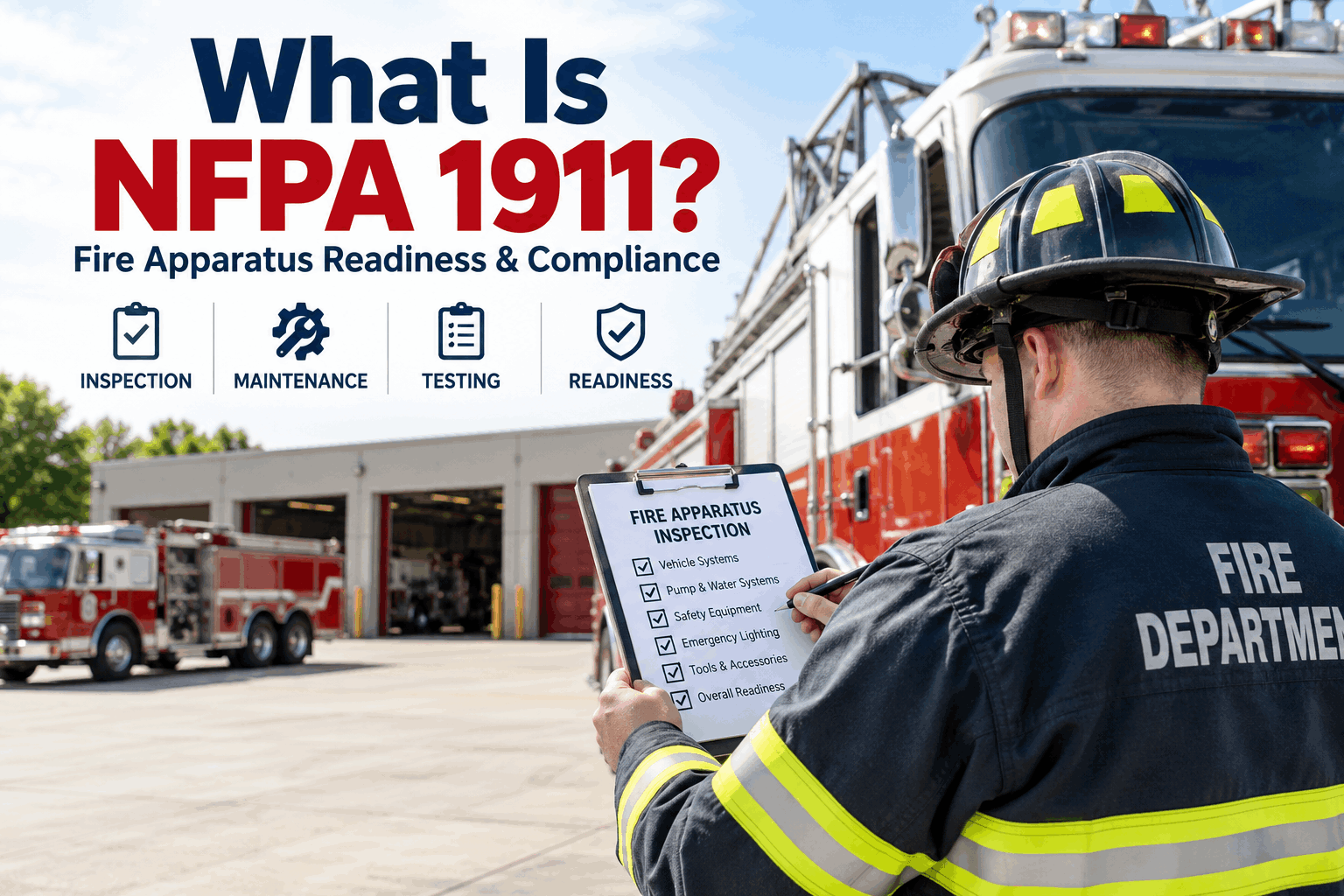
What Is NFPA 1911? Fire Apparatus Readiness & Compliance
An operational engineering guide for fire chiefs, fleet superintendents, and apparatus technicians. Master in-service inspection schedules, service testing requirements, objective out-of-service criteria, and digital records retention for frontline municipal apparatus.
The Legal and Operational Scope of NFPA 1911 for Fire Fleets
The National Fire Protection Association standard governs the comprehensive lifecycle care of in-service emergency vehicles. Rather than functioning as a voluntary suggestion, NFPA 1911 serves as the legal and professional benchmark referenced during OSHA safety evaluations, municipal risk management audits, and catastrophic incident civil litigation. When a collision occurs involving an emergency apparatus, investigators review preventative maintenance logs, brake stroke measurement records, and mechanic qualification files to evaluate whether the agency exercised due diligence. Furthermore, the Insurance Services Office (ISO) evaluates fire department apparatus testing records under the Public Protection Classification (PPC) program: agencies that fail to document certified annual service tests on pumps, aerials, and ground ladders suffer downgraded community ratings, directly raising commercial property insurance premiums across their municipality. Dedicated emergency fleet software digitizes these statutory mandates, guiding technicians through compliant preventative maintenance checklists while capturing verifiable digital technician signatures. Fire department leaders can evaluate compliant apparatus tracking by scheduling a tailored public safety fleet demonstration or establish custom apparatus test profiles directly via our quick platform sign up.
Daily, Weekly & Shift Apparatus Inspections
Establishes rigorous pre-shift and weekly inspection protocols covering chassis steering, braking systems, transmission interlocks, SCBA bottle storage brackets, warning lights, siren controllers, and fluid reservoirs. The digital workflow prevents pencil-whipping by enforcing photo verification of high-risk mechanical assemblies.
Annual Fire Pump Performance Testing
Mandates certified annual testing of all water pumps installed on in-service fire apparatus. The system automatically calculates 100% capacity tests at 150 PSI, 70% capacity tests at 200 PSI, and 50% capacity tests at 250 PSI, plotting dry vacuum primer pull and engine discharge relief valve curves.
Aerial Device & Ladder Structural Testing
Governs annual structural and non-destructive testing (NDT) for aerial ladders, elevating platforms, and water towers. Tracks magnetic particle testing of structural welds, ultrasonic pins examination, hydraulic cylinder drift tolerances, operational interlocks, and third-party NDT certification dates.
Objective Out-of-Service Criteria Enforcement
Removes ambiguity regarding when an apparatus must be removed from emergency service. If an inspection detects a critical safety violation—such as a defective steering drag link, inoperative windshield wiper in rain, or unseated pump transmission—the system immediately locks the unit out of dispatch.
Direct Technical Matrix: Manual Paper Logs vs. FleetRabbit Fire Fleet Platform
Operating a municipal emergency fleet with paper station binders, manual whiteboard defect tracking, and disconnected desktop databases creates blind spots that jeopardize operational readiness and expose jurisdictions to liability. Review how traditional station logging compares directly against FleetRabbit's connected emergency fleet management platform across essential fire rescue operational benchmarks. Fire chiefs and emergency vehicle technicians (EVTs) can evaluate custom apparatus work order triage by booking an executive public safety software demo or explore apparatus checklist templates through our self-service platform sign up.
| Emergency Vehicle Operational Dimension | Paper Station Binders & Legacy Spreadsheets | FleetRabbit Emergency Fleet Engine | Fire Department & Community Advantage |
|---|---|---|---|
| Out-of-Service Gating Enforcement | Subjective officer judgment; trucks run with defects | Instant automated dispatch lockout on critical fails | Zero compromised emergency vehicles on the road |
| Annual Fire Pump Testing Calculation | Manual mathematical plotting; human error risk | Automated net pump pressure & flow rate math curves | Guarantees 100% ISO PPC credit compliance |
| Emergency Technician Certification (EVT) | Paper certificates in HR files; unverified sign-offs | Mechanic sign-off gated by verified EVT qualification | 100% legal defensibility during post-collision audits |
| Apparatus Telematics Integration | Manual odometer recording during weekly checks | Live J1939 CAN-bus engine hours, DPF soot, & DTCs | Triggers preventative work orders before breakdown |
| FEMA AFG Capital Grant Reporting | Weeks spent manually assembling repair histories | 1-click export of lifetime maintenance costs & SGR | Secures federal vehicle replacement grants faster |
4-Stage Daily Apparatus Lifecycle and Readiness Workflow
FleetRabbit standardizes emergency vehicle management into an automated, four-stage operational sequence that connects daily company-level morning inspections to certified EVT repairs and long-term capital replacement planning. To explore how this automated workflow protects emergency crews, schedule an apparatus inspection walkthrough demo with our team.
Company Shift Inspection (eDVIR)
Drivers and apparatus operators execute mobile smartphone walkarounds at shift change, verifying fluid levels, tire tread depths, siren controllers, breathing air systems, and hydraulic extrication tool pressures.
Automated Defect Triage & Gating
If a component breaches critical parameters (such as low reservoir air pressure), the system flags the apparatus as Out of Service, alerts central dispatch, and opens a prioritized repair work order in the maintenance shop.
Certified EVT Repair & Sign-Off
Certified emergency vehicle technicians pull replacement parts from digital inventory, execute repairs according to OEM specifications, and certify mechanical roadworthiness using electronic signatures on glass.
Return to Service & ISO Audit Sync
The completed work order automatically updates the apparatus service history, clears dispatch locks, logs lifetime operational costs, and synchronizes records with the department's annual ISO inspection report.
Financial Capital Stewardship: Eliminating Emergency Fleet Budget Drains
Operating an emergency apparatus fleet without connected fleet software creates compounding financial losses across catastrophic engine and pump overhauls, unbudgeted commercial emergency repairs, and shortened vehicle service lives. When a municipal pumper or aerial platform suffers major mechanical failure during an emergency response, the municipality incurs staggering towing costs, third-party rental fees, and potential civil liability. Analyzing these common operational drains helps fire chiefs and municipal budget directors defend fleet technology appropriations before city councils. Calculate your fire department's exact cost recovery by booking an apparatus cost assessment demo or get started directly via our rapid platform sign up.
Top Causes of Municipal Emergency Fleet Budget Waste
Public Safety Platform Capabilities
Instantly calculates net pump pressure, slip tests, priming speed, and discharge flow curves according to national emergency standards.
Maintains comprehensive histories of third-party ultrasonic inspections, magnetic particle tests, and structural ladder certifications.
Exports parts costs, work orders, and mechanic labor hours directly to public accounting software such as Tyler Technologies, SAP, and Workday.
ROI & Capital Replacement Framework for Public Safety Fleets
When municipal leadership evaluates emergency vehicle management technology, elected officials must measure financial return across vehicle longevity, risk mitigation, community insurance ratings, and grant funding success. FleetRabbit delivers quantifiable financial return across all primary emergency fleet operating categories. To examine your customized apparatus life-cycle forecasting model, schedule an executive public safety consultation demo with our team or start configuring your fire apparatus profiles today with a free account.
Extended Apparatus Service Life
Rigorous preventative maintenance and proactive oil sampling extend the operational front-line service life of structural engines and aerial trucks beyond 15 years, delaying multi-million-dollar capital bond referendums.
ISO PPC Credit Maximization
Maintaining complete, verifiable maintenance and annual service testing records secures maximum credits under the ISO Fire Suppression Rating Schedule, helping lower commercial insurance rates citywide.
Risk & Liability Mitigation
Automated out-of-service gating and EVT digital certifications ensure no compromised vehicle rolls on an emergency response, shielding city leadership from costly post-collision liability lawsuits.
Frequently Asked Questions: Emergency Vehicle Readiness and Testing
What is the primary difference between a daily shift check and an annual service test?
A daily shift check is an operational inspection conducted by company firefighters or driver-engineers to verify immediate operational readiness, fluid levels, warning devices, breathing air systems, and basic braking functions. An annual service test is an extensive mechanical and performance evaluation—typically conducted by certified Emergency Vehicle Technicians (EVTs)—that measures pumping capacity across varied pressures, checks dry primer vacuum pull, and inspects aerial ladder structural integrity.
What happens when an apparatus fails a critical inspection parameter?
When an apparatus fails a critical out-of-service parameter (such as a brake system air leak exceeding allowable tolerances or an inoperative aerial safety interlock), FleetRabbit immediately flags the vehicle as Out of Service. The software generates an emergency work order for the shop and alerts dispatch to ensure the unit cannot be dispatched on active emergency calls until an EVT certifies the repair.
Does this software calculate net pump pressure and discharge flow curves automatically?
Yes. During annual fire pump service testing, technicians enter observed engine RPMs, pump discharge pressures, intake vacuum readings, and nozzle pitot pressures. The software automatically applies atmospheric correction formulas, computes total net pump pressure, and graphs flow curves against OEM rated capacity, identifying pump impeller wear or transmission slippage instantly.
How does digital maintenance tracking assist with Insurance Services Office (ISO) audits?
The ISO evaluates fire department apparatus maintenance under the Fire Suppression Rating Schedule (FSRS). Agencies must document that pumpers receive certified annual service tests, that aerial devices undergo structural non-destructive testing, and that daily vehicle checks occur consistently. FleetRabbit generates pre-formatted ISO audit dossiers in minutes, ensuring departments receive maximum credit points.
Share This Story, Choose Your Platform!
From our blog

FTA-Compliant CMMS for Transit: Funding, ROI & Costs

Sanitation Fleet Management Software | Government Guide

SMS Delivery Notification Integration for Fleet Software

OMS Integration Software for Delivery Fleet Management

Temperature Sensor & Data Logger Integration for Cold Chain

Thermo King & Carrier Telematics Integration for Reefer Fleets

Driver Onboarding & Food-Safety Training Software for Fleets