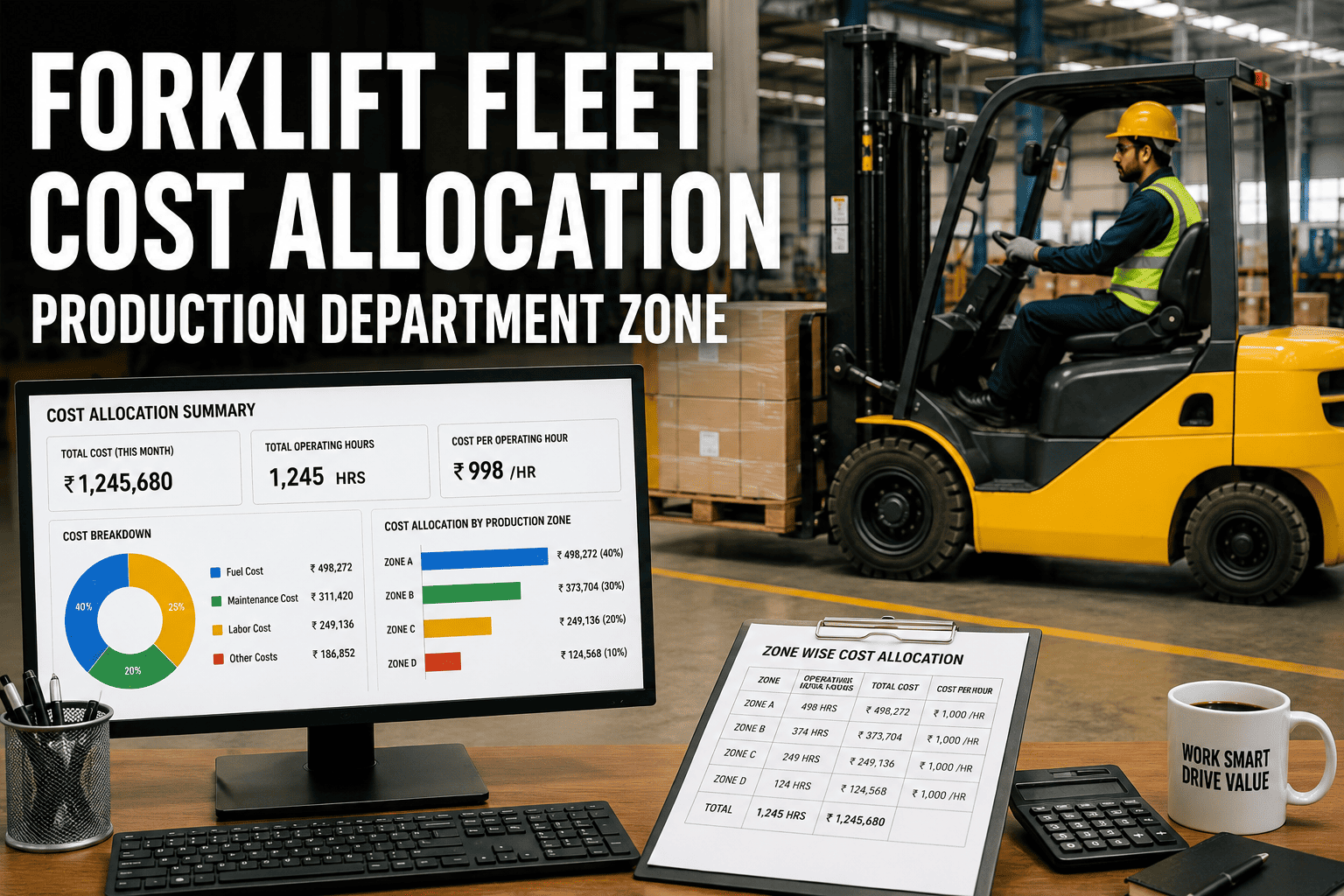
Ask a plant controller how much material handling cost belongs to the paint line versus final assembly, and the honest answer at most facilities is a shrug followed by a shared overhead percentage. Forklifts move between departments all shift long, and unless someone is standing at each zone boundary with a stopwatch, that usage never gets recorded by where it actually happened. The result is a cost report that spreads material handling expense evenly across departments that use a forklift constantly and departments that barely see one, and neither number is right.
Forklift fleet cost allocation assigns operating hours, fuel or energy use, and maintenance cost to the specific production department or zone where they occurred, instead of spreading total fleet cost evenly across the plant. This gives finance an accurate picture of true department cost and gives operations a data-backed way to right-size equipment by area. See how automatic zone tagging turns fleet hours into department-level cost with a free FleetRabbit trial.
Three Ways Plants Allocate Material Handling Cost Today
Most plants use one of three approaches to split forklift fleet cost across departments, and the level of accuracy rises sharply with each step, along with the effort required to maintain it.
| Allocation Method | How It Works | Accuracy |
|---|---|---|
| Plantwide Rate | Total fleet cost divided evenly across every department, regardless of actual usage | Low, penalizes light-usage departments and hides heavy-usage ones |
| Departmental Estimate | Cost split using rough estimates like headcount or floor space per department | Moderate, better than plantwide but still not tied to real hours |
| Zone and Hour Tagging | Cost assigned directly from tracked hours, fuel, and maintenance by zone | High, reflects exactly what each department actually consumed |
Why the First Two Methods Fall Short
A plantwide rate treats a forklift idling near the shipping dock the same as one running constant cycles on the press line. A departmental estimate improves on that slightly, but headcount and floor space are proxies, not measurements, and proxies drift further from reality every time a layout or staffing pattern changes.
How Zone and Department Tagging Actually Works
Accurate allocation does not require anyone to log hours by hand. It requires connecting the location data a forklift already generates to the zone map your plant already has.
FleetRabbit automatically tracks which zone every forklift is operating in and turns that time into department-level cost, no manual logging required. Try it free with your current fleet, or walk through a sample cost report with our team.
What Gets More Accurate Once Cost Follows the Zone
The moment cost is tied to real usage instead of a shared estimate, three things become possible that were guesswork before.
Accurate Department P&Ls
A department that rarely touches a forklift stops absorbing cost it never generated, and a department running constant material moves finally shows the true cost of its process, both of which change how margins get calculated.
Right-Sized Equipment by Zone
When a zone consistently shows low tracked hours, that is hard evidence for reassigning or retiring a truck instead of leaving it parked and still counted as active fleet cost.
Fair Cross-Charging Between Departments
Shared fleets that serve multiple departments can be cross-charged based on actual tracked time, ending the recurring argument over which department's budget absorbs a shared truck.
The Benchmark Finance Teams Look For
Material handling cost typically runs a small but meaningful percentage of manufacturing revenue, and most of that spend sits inside a shared overhead line until someone breaks it apart by zone. Plants that move to zone-level allocation commonly find that two or three departments were absorbing a disproportionate share of fleet cost relative to what they actually used, while lighter-usage areas were quietly overpaying for equipment they rarely touched. Surfacing that imbalance is often the fastest way to build a credible case for reallocating trucks instead of buying new ones. If you want to see what your own plant's zone-level cost picture looks like, it is worth taking a few minutes to book a demo with the FleetRabbit team.
Cost that cannot be traced to where it happened tends to get absorbed by whichever department has the least room to argue. Zone and department tagging closes that gap, turning forklift fleet cost from a shared estimate into a number finance and operations can both stand behind. If your plant is ready to see material handling cost land where it actually belongs, start a free trial with FleetRabbit or book a short demo to walk through your own zone map.
FleetRabbit tags forklift hours, fuel, and maintenance to the exact zone and department where they happened, turning a shared overhead line into accurate, defensible cost data. Get started today, no credit card required.