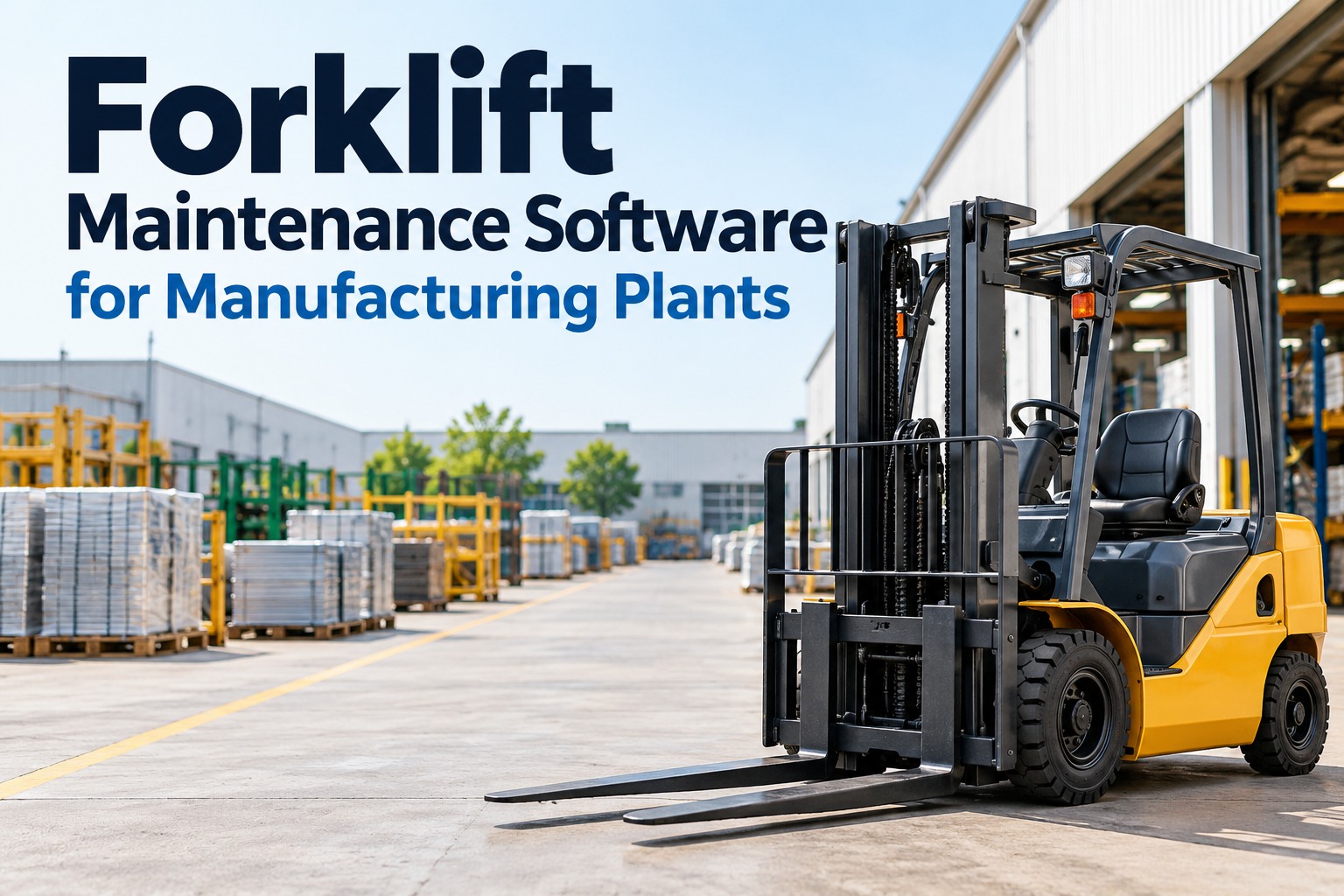
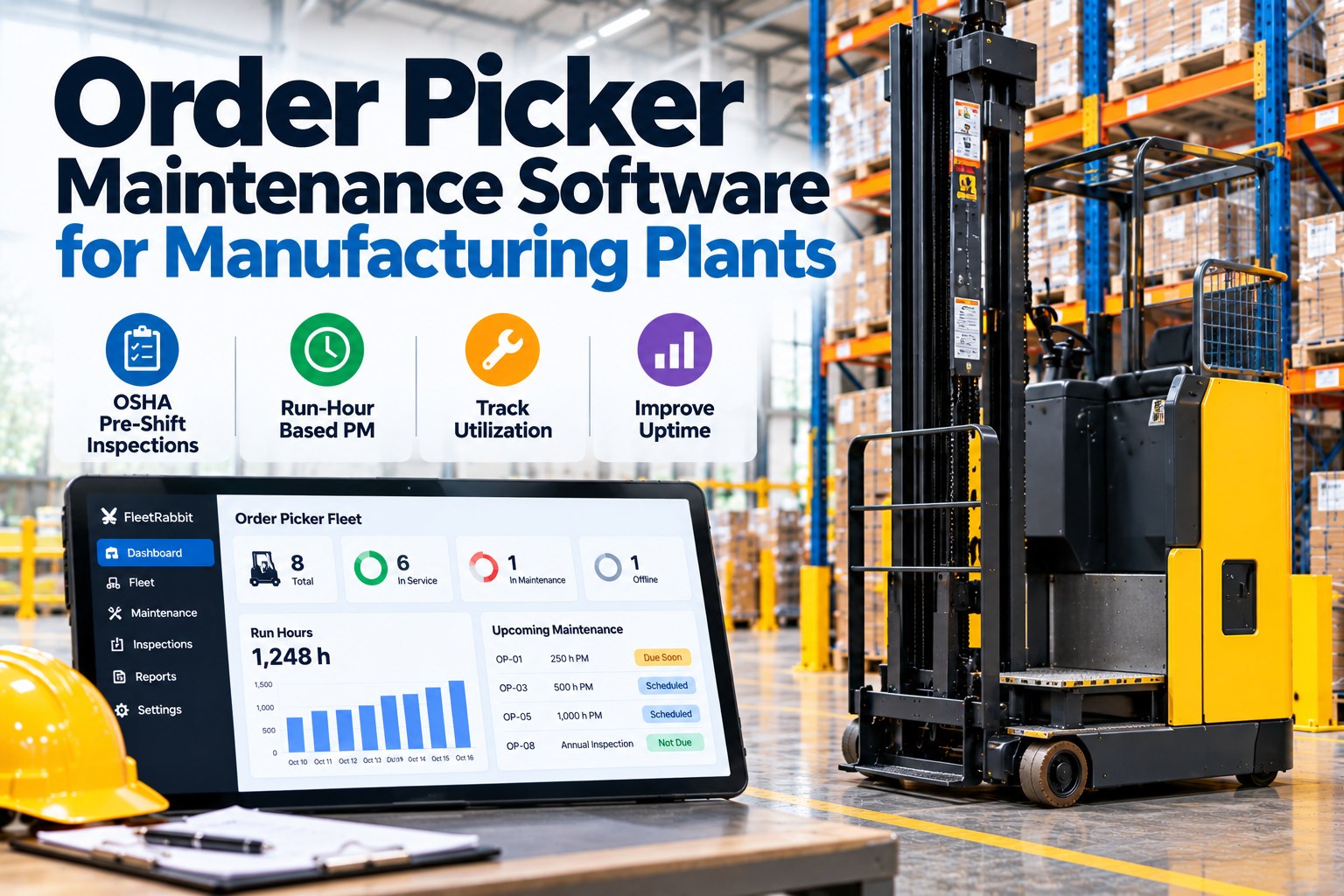
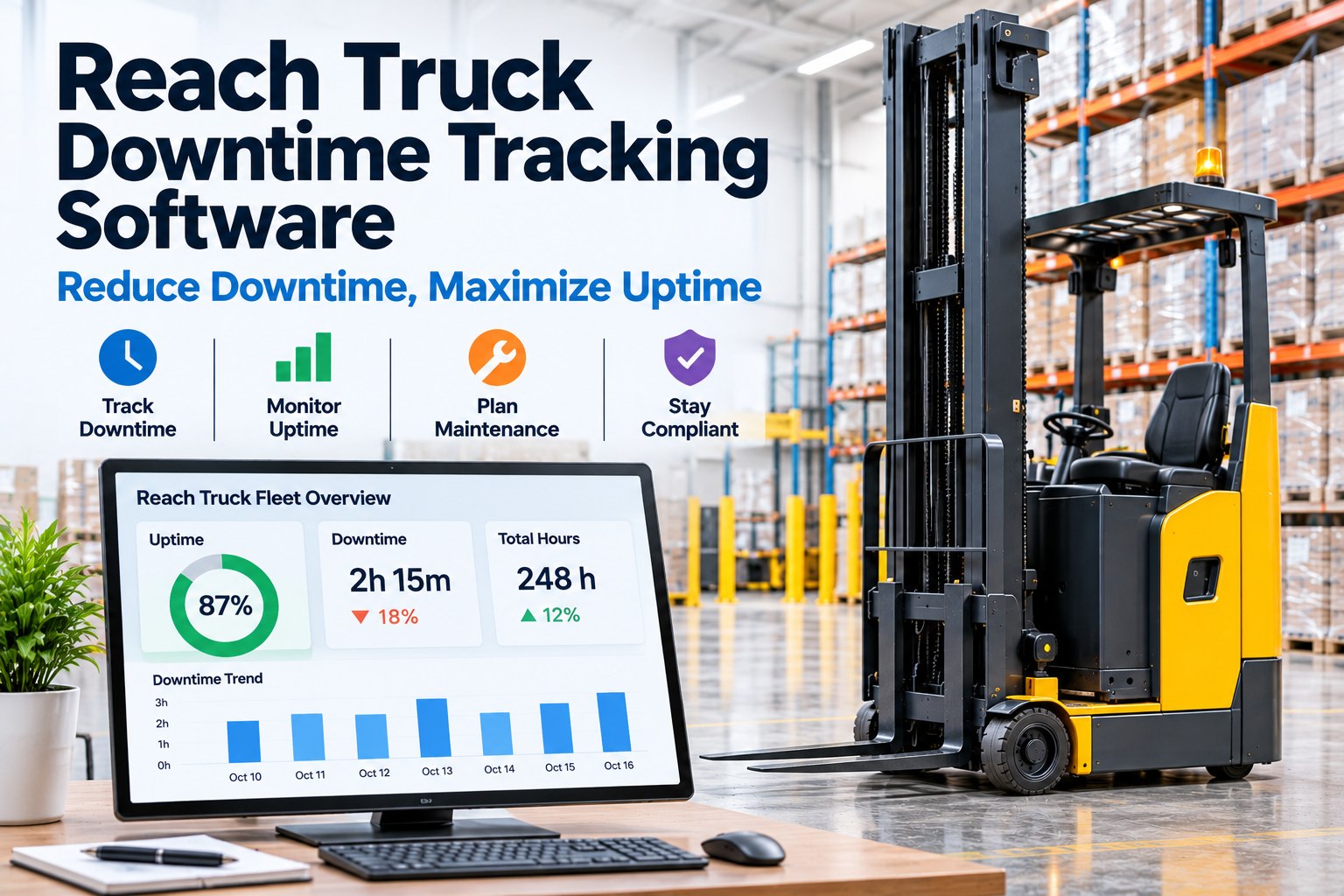
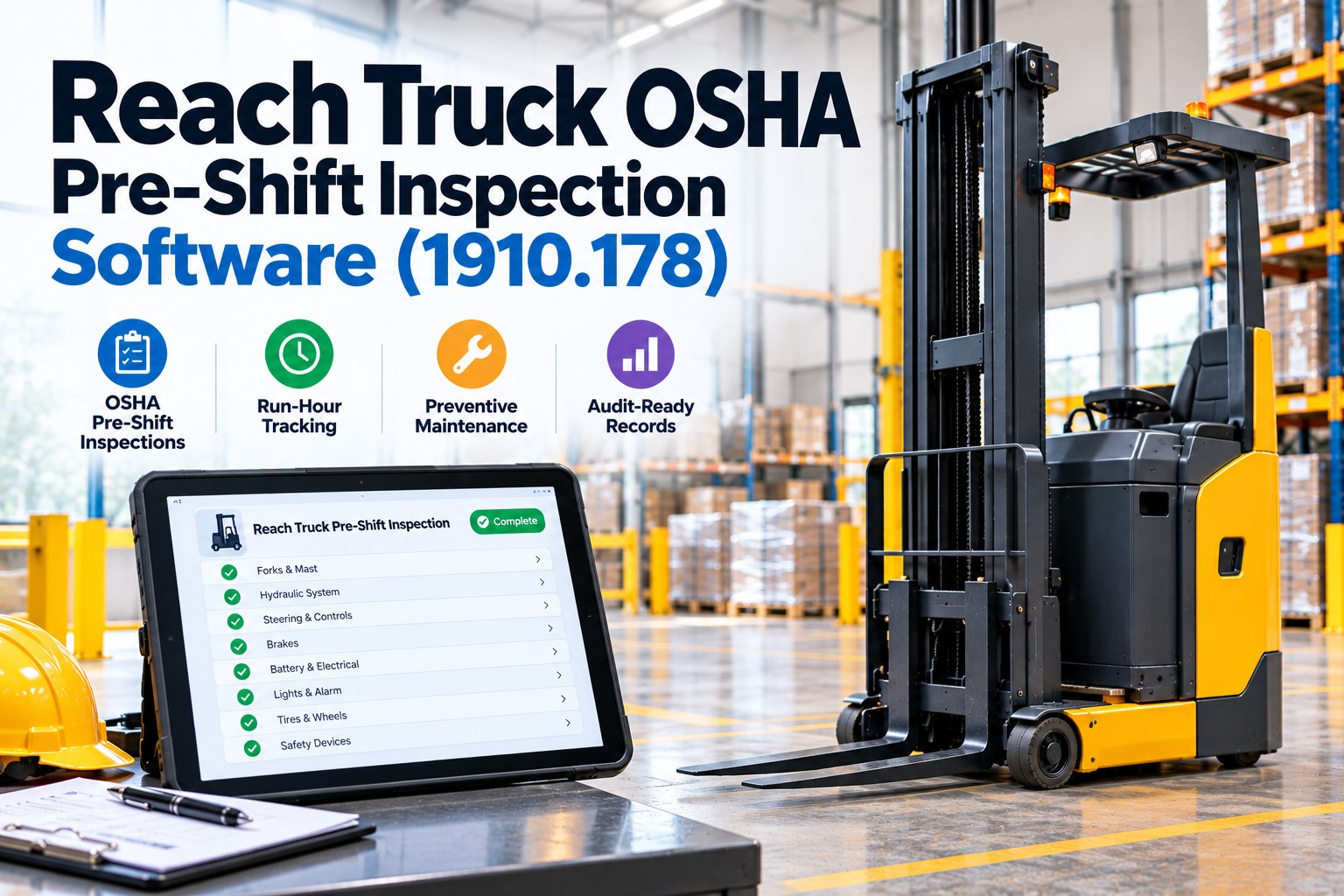
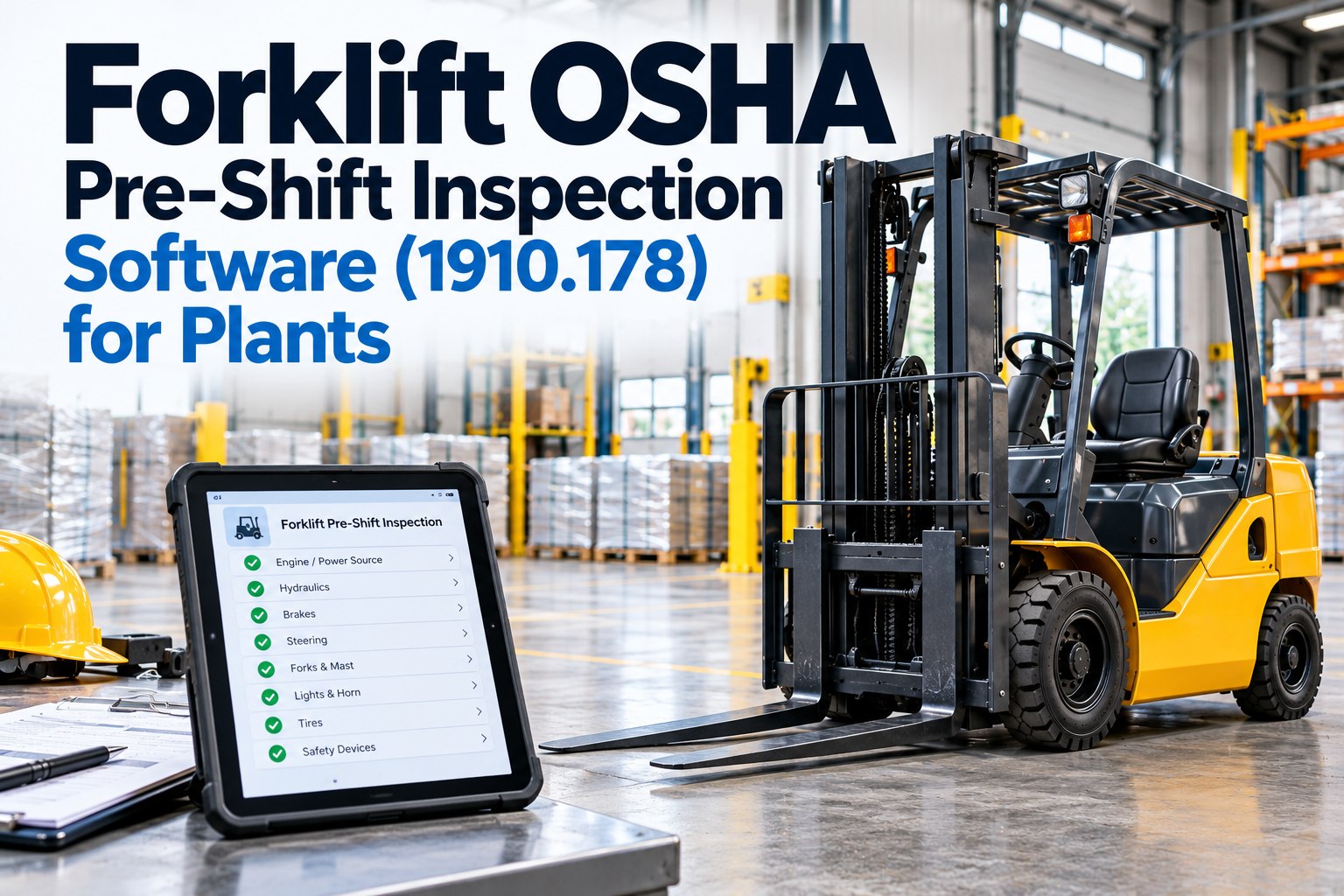
Forklift maintenance software for a manufacturing plant starts where OSHA does: with an examination before every truck goes into service, and a rule that any unsafe truck stays parked until it's fixed. Everything else — run-hour PM, battery care, fork and chain wear, spotting the truck that's about to fail — builds on that daily record. This guide shows how to build it across shifts, power types and plant areas. Book a 20-minute FleetRabbit demo to see it set up for your forklifts.
Manufacturing plants · Forklifts and powered industrial trucks
In a three-shift plant, the same forklift gets three different operators a day — and OSHA expects it examined before each one takes it.
For plant maintenance managers, EHS leads and shift supervisors running electric, LPG and diesel lift trucks.
!
3rd shift
22:00 check · mast chain flagged
Powered Industrial Trucks Were OSHA's 8th Most-Cited Standard in FY 2025, With 1,826 Violations
Forklifts were linked to 84 work-related deaths in 2024, according to the National Safety Council's analysis of BLS data, and OSHA's preliminary FY 2025 list ranked 29 CFR 1910.178 eighth among all standards. Training draws many of those citations, but four paragraphs of the standard fall squarely on the maintenance team.
(q)(7)
Examine before service
At least daily, and after each shift where trucks run around the clock. Defects reported and corrected immediately.
Your pre-shift checklist
(q)(1)
Remove unsafe trucks
A truck not in safe operating condition comes out of service; only authorized personnel repair it.
Out-of-service tag
(p)(1)
Stays out until fixed
A defective truck remains out of service until it's restored to safe operating condition.
Repair sign-off
(q)(5)
Equivalent parts only
Replacement parts must be equivalent in safety to the original design.
Parts records
29 CFR 1910.178 (eCFR); OSHA FY 2025 preliminary Top 10, as reported by Occupational Health & Safety; NSC Injury Facts.
Each of those paragraphs is easy to follow and hard to prove without a record. A digital pre-shift inspection leaves that record every time a truck is checked, and you can start using it free on three trucks.
One Pre-Shift Checklist Doesn't Fit Every Forklift: Electric, LPG and Diesel Trucks Fail Differently
Every lift truck shares a core of load-handling and safety checks. What sits behind the counterweight changes the rest. Building one checklist per power type keeps operators from skipping irrelevant items, and from missing the ones that matter.
Every truck
Forks and fork locks
Mast, chains and rollers
Hydraulic leaks
Tires
Brakes and parking brake
Steering
Horn, lights and alarms
Seat belt and overhead guard
Data plate legible
Battery charge level and connector condition
Cable insulation not cut or frayed
Electrolyte level checked per watering schedule
Battery restraint in place
Cylinder secured, locating pin in place
Hose and fittings: no damage or leaks
Relief valve pointing up
Engine oil and coolant
Engine oil, coolant and fuel level
Air filter restriction indicator
Belts and hoses
Exhaust and fuel leaks
Plants with mixed fleets often run all three in one building: electric reach trucks in the warehouse, LPG counterbalance trucks on the floor, diesel trucks in the yard. A short walkthrough shows each truck getting its own checklist automatically.
Round-the-Clock Plants Must Examine Forklifts After Every Shift, Not Once a Day
The "at least daily" rule has an exception that catches multi-shift manufacturers: where trucks are used around the clock, §1910.178(q)(7) requires an examination after each shift. A single morning check doesn't cover a truck that runs until 6 a.m. the next day.
One shift a day
1 examination
Around the clock
3 examinations
Orange markers: an examination at each shift change, with defects reported to the next shift and the maintenance team.
The hard part isn't the checklist; it's knowing at 2 a.m. whether second shift completed theirs. Time-stamped checks per truck, per shift, answer that in seconds.
Every truck · every shift
See which forklifts were checked this shift, and which ones weren't, before the supervisor walks the floor
Fork Blades Come Out of Service at 90% of Original Thickness: The Wear OSHA's Standard Doesn't Mention
OSHA's forklift standard says nothing about fork wear. The industry standard does: ASME B56.1 says a fork can't return to service once its blade has worn to 90 percent of its original thickness. Forks wear at the heel, where they drag on the floor, so the loss is easy to miss by eye.
Fork blade thickness · sample readings, left fork
Illustrative
90% limit
Measured with fork calipers at the heel, compared with the shank
Lift chains need the same treatment: measure elongation against the truck maker's limit rather than eyeballing slack. Logging both readings on the truck's record turns fork and chain replacement into a planned purchase. Forks, chains and rollers can then be stocked through parts and inventory before they're needed.
Predictive Forklift Maintenance Starts With Patterns Already Sitting in Your Inspection Records
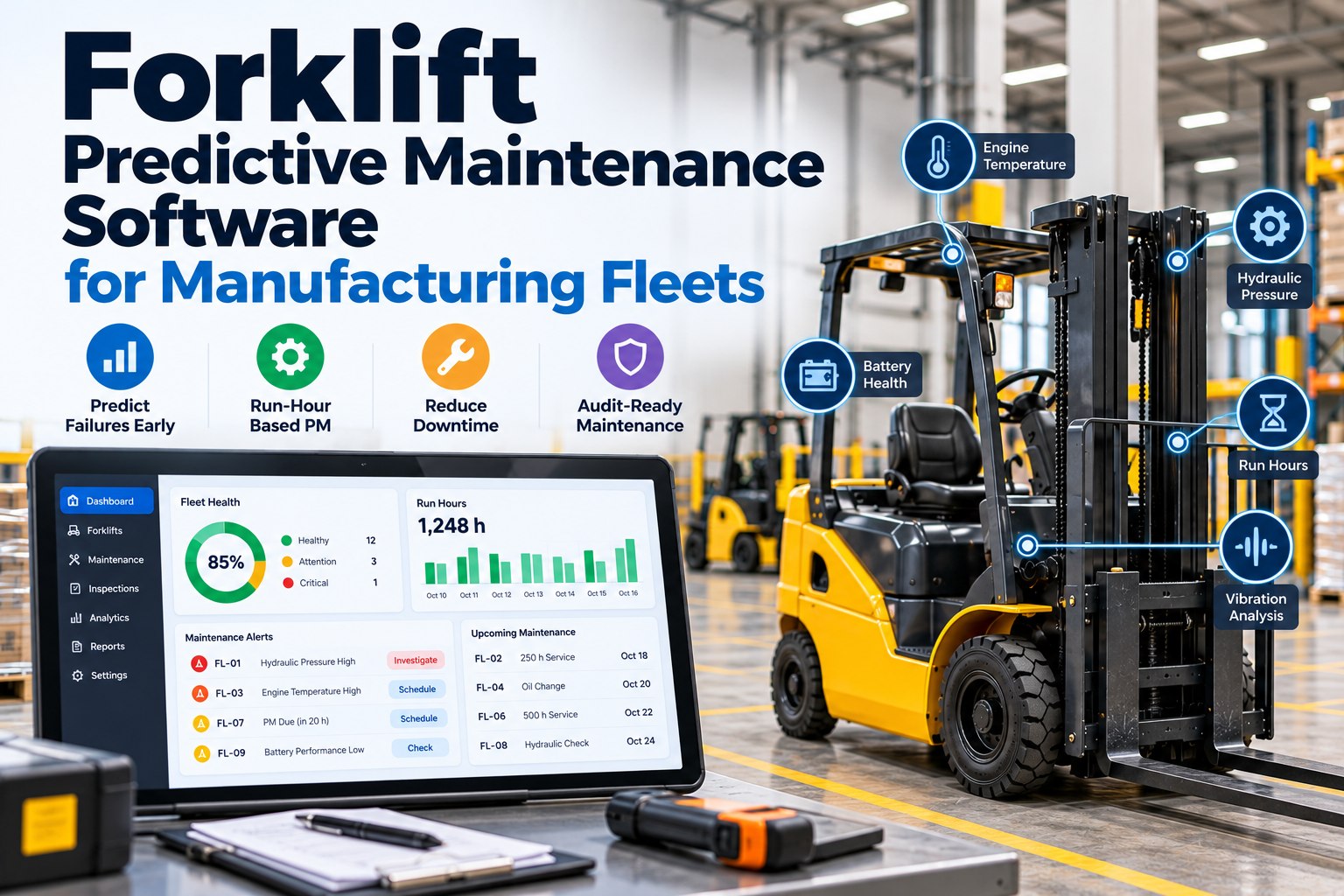
Predictive maintenance doesn't have to mean sensors on every mast. Most plants already collect the signals; they're just scattered across paper checklists and work orders. Put them on one record per truck and patterns show up early.
The same defect, three checks in a row
A slow hydraulic leak or a brake heading for failure. Schedule it before it becomes an out-of-service tag.
Hour meter climbing faster than the fleet
A truck absorbing another area's work. Its next PM arrives early; rotate trucks or bring service forward.
Battery watering or charge checks missed
Shortened battery life and mid-shift power loss. The fix is the routine, not a new battery.
Repeat impact or rack damage notes
An operator, aisle or attachment problem. Bent forks and mast damage usually follow.
Hour-based PM is the other half: FleetRabbit's guide to run-hour forklift maintenance scheduling covers the service ladder in detail. Together, defects and hours tell you which truck needs attention next.
Out of Service Until Repaired: How a Red Tag Should Move From the Plant Floor to Maintenance and Back
When an operator finds a defect that affects safety, the truck has to stop. The tag itself is easy; the gaps are who knows, who fixes it, and who confirms it's safe again.
DO NOT OPERATE
Forklift FL-14 · Line 2
Left lift chain: broken link plate
Tagged 22:14 · 3rd shift operator
Tagged and reported
Operator fails the item; supervisor and maintenance alerted with a photo
Repaired by authorized tech
Work order with parts used, equivalent to original design
Verified and returned
Function check passed; tag cleared on the record, not just pulled off
How FleetRabbit Keeps Every Plant Forklift Inspected, Serviced and Ready for the Next Shift
FleetRabbit gives maintenance and EHS one view of every truck, area by area, built from the checks operators already do.
Plant forklift board · sample
2nd shift
Receiving
FL-02 · checked
FL-05 · checked
FL-07 · PM in 18 hrs
Line 2
FL-11 · checked
FL-14 · out of service
FL-16 · not checked
Shipping
FL-21 · checked
FL-23 · checked
FL-24 · battery watering due
OSHA pre-shift inspections
Checklists by power type on phones, with photos, signatures and shift time stamps
Run-hour PM
Services due on hour-meter readings with a calendar backstop
Out-of-service control
Failed safety items tag the truck and open a work order instantly
Audit-ready by default
Every check, repair and part on one record per truck
What the 20-minute demo covers
Checklists for your electric, LPG and diesel trucks
A failed chain check tagging a truck out of service
The shift board showing trucks not yet checked
Run-hour PM and fork wear readings on one record
Forklift Maintenance Software for Manufacturing: Questions Plants Ask
How often does OSHA require forklifts to be inspected?
Before being placed in service, at least daily. Where trucks run around the clock, after each shift, under 29 CFR 1910.178(q)(7).
Does OSHA require a written forklift checklist?
The standard requires the examination, not a specific form. A written or digital checklist is how most plants show the examination happened and what it found.
When should forklift forks be replaced?
ASME B56.1 says a fork may not return to service once blade thickness has worn to 90% of the original. Check cracks, bends and fork tip height difference too.
How often should forklifts get preventive maintenance?
Many dealers recommend planned service around every 250 run hours, adjusted for how hard the truck works. Follow your manufacturer's schedule.
What is predictive forklift maintenance?
Using patterns in inspection results, hour meters and repair history to catch a failure before it happens, such as a repeat defect or an unusually fast-climbing hour meter.
Can we try it on a few forklifts first?
Check · Tag · Repair · Return
Keep Every Forklift in Your Plant Checked Each Shift and Serviced Before It Fails
Pre-shift inspections by power type, out-of-service control, run-hour PM and fork wear on one record per truck.
Free for up to 3 units · No credit card required
October 23, 2026
By Emily Parker
All Posts