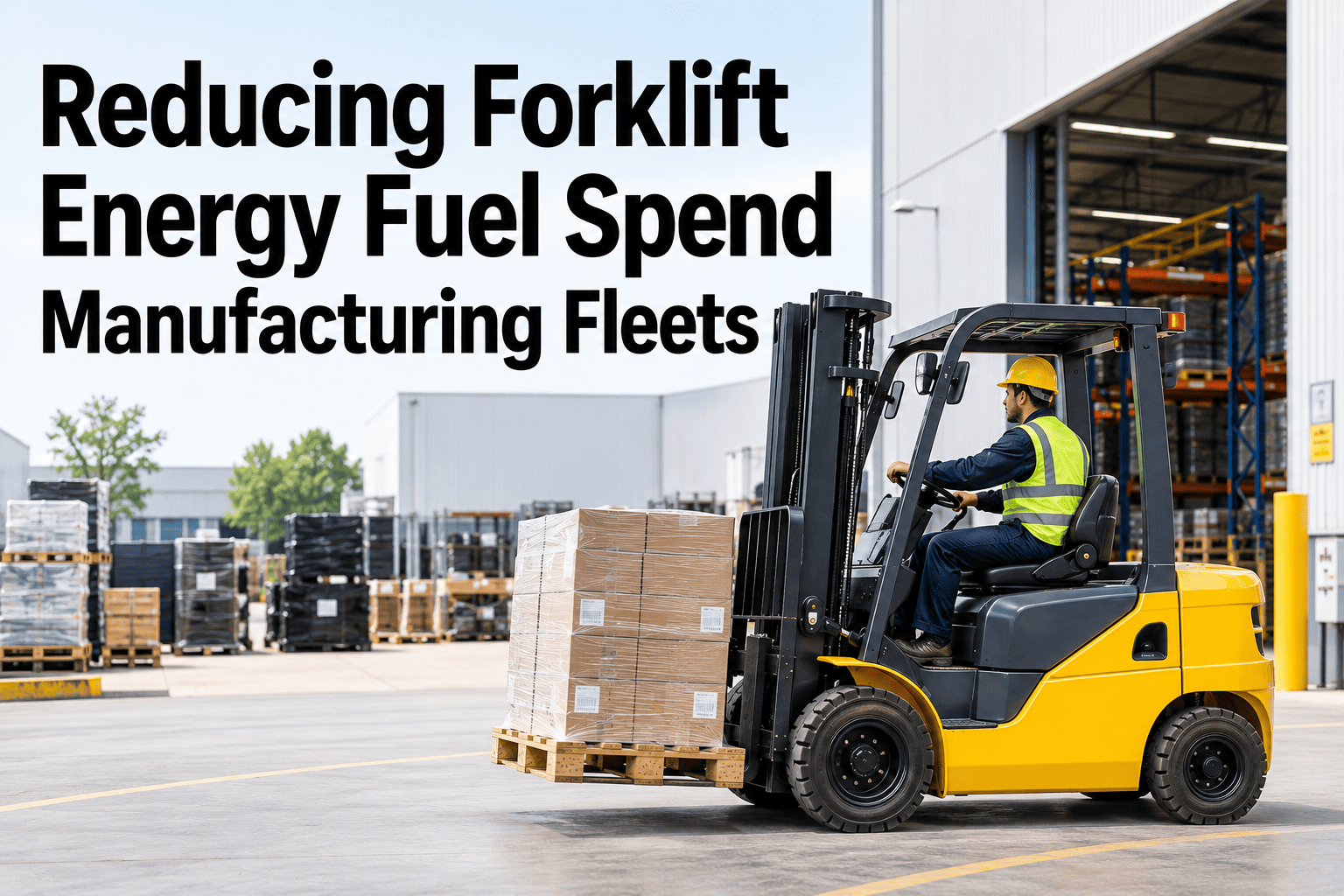
Energy and fuel are two of the few forklift costs a plant manager can actually control day to day, yet most facilities never look past the electricity bill or the propane invoice to see where the money really goes. Idle trucks left running between pallets, batteries opportunity-charged at the wrong moments, and propane cylinders swapped early "just in case" quietly inflate spend month after month. None of it shows up as a single alarming number. It shows up as a slow leak that, over a full fleet and a full year, adds up to real money. FleetRabbit exists to make that leak visible, and to help plants close it without slowing the line down.
A single electric forklift typically costs $0.55 to $1.50 an hour to run depending on electricity rates and battery condition, while a propane forklift runs $1.40 to $3.00 an hour in fuel alone. Across a 20 to 30 truck manufacturing fleet, avoidable waste from idling, poor charging habits, and unscheduled fuel swaps adds up to 15000 to 40000 dollars a year. Most of that is recoverable through usage tracking and better charging or refueling discipline, not new equipment.
Three Places Forklift Energy Money Disappears
Why This Is Different From a Maintenance Problem
Energy and fuel waste rarely breaks anything, which is exactly why it survives budget reviews year after year. A truck that idles too much or charges inefficiently still moves pallets and still passes inspection. The cost hides inside the utility bill and the fuel account, split across departments that never compare notes. Plants that finally line up hours-of-use data against energy spend are often surprised to find that two seemingly identical trucks on the same shift can differ in fuel cost by 25 percent or more, purely based on operator habits and charging routines.
The Manufacturing-Specific Wrinkle
Manufacturing fleets add a layer that warehouses and distribution centers do not always face: multi-shift handoffs. When a truck changes operators mid-shift without a clean charging or refueling checkpoint, energy waste compounds because nobody owns the outcome. Tracking usage at the truck level, not just the fleet level, closes that gap. Teams that want this visibility without building it themselves can start a free trial and see per-truck energy data within the first week.
Electric, Propane, or Diesel: What Each One Actually Costs
The right power source changes the entire fuel budget conversation, and the gap between options is larger than most procurement decisions account for. Electricity is consistently the cheapest energy per hour of operation, propane offers speed and simplicity at a higher running cost, and diesel sits in between with strong torque for heavy, sustained loads. None of these numbers hold if charging or refueling habits are poor, which is why the source matters less than the discipline around it.
| Power Source | Typical Cost Per Hour | Where Waste Creeps In | Best Fit |
|---|---|---|---|
| Electric | 0.55 to 1.50 dollars | Opportunity charging, aging batteries, poor charger scheduling | Indoor, single or double shift manufacturing lines |
| Propane | 1.40 to 3.00 dollars | Early cylinder swaps, idling, inconsistent tank tracking | Mixed indoor and outdoor, fast changeover shifts |
| Diesel | 1.80 to 3.50 dollars | Idling during loading, cold starts, low-load operation | Heavy loads, outdoor yards, rough terrain |
FleetRabbit tracks run hours, idle time, and charge or refuel cycles for every forklift on your floor, so energy waste stops being a guess. Most plants find their first 10 to 15 percent in savings within the first month.
Five Habits That Quietly Fix Fuel Spend
None of the fixes below require new trucks or new infrastructure. They require visibility into what is already happening on the floor, and a small amount of process discipline to act on it.
Turning These Habits Into a Repeatable Process
Habits stick when they are backed by data instead of memory. A charging schedule written on a whiteboard fades within a month; a charging schedule enforced through connected tracking does not. Plants that pair these five habits with real-time usage data typically see the full 15 to 25 percent range in savings rather than the smaller, inconsistent gains that come from a one-time reminder to operators.
Where to Start This Week
Pick the single highest-hour truck in your fleet and track its energy use for two weeks before changing anything. That baseline alone usually reveals which of the five habits above is costing you the most, and gives you a number to measure improvement against once changes go in. Plants that want this baseline built automatically can sign up for a free trial and have tracking running the same day.
What This Looks Like in Dollars for a 25-Truck Fleet
A manufacturing plant running 25 mixed electric and propane forklifts across two shifts spends roughly 85000 to 140000 dollars a year on energy and fuel combined. Industry data on idle time, opportunity charging, and habit-based refueling suggests 15 to 25 percent of that spend is avoidable waste, meaning 13000 to 35000 dollars a year is sitting inside routine operations, unclaimed. Recovering even the lower end of that range covers the cost of usage-tracking software many times over within the first year.
FleetRabbit's dashboard shows run hours, idle time, and energy cost per truck side by side, so you can see exactly where the 15 to 25 percent is hiding in your fleet. Get your first snapshot within days of connecting your trucks.
Frequently Asked Questions
Every idle minute and every short charge cycle is a cost you can see and fix once you have the data. FleetRabbit puts run hours, idle time, and fuel cost per truck on one screen, so your team can act on real numbers instead of habits. Start free and see your first savings opportunity within days.