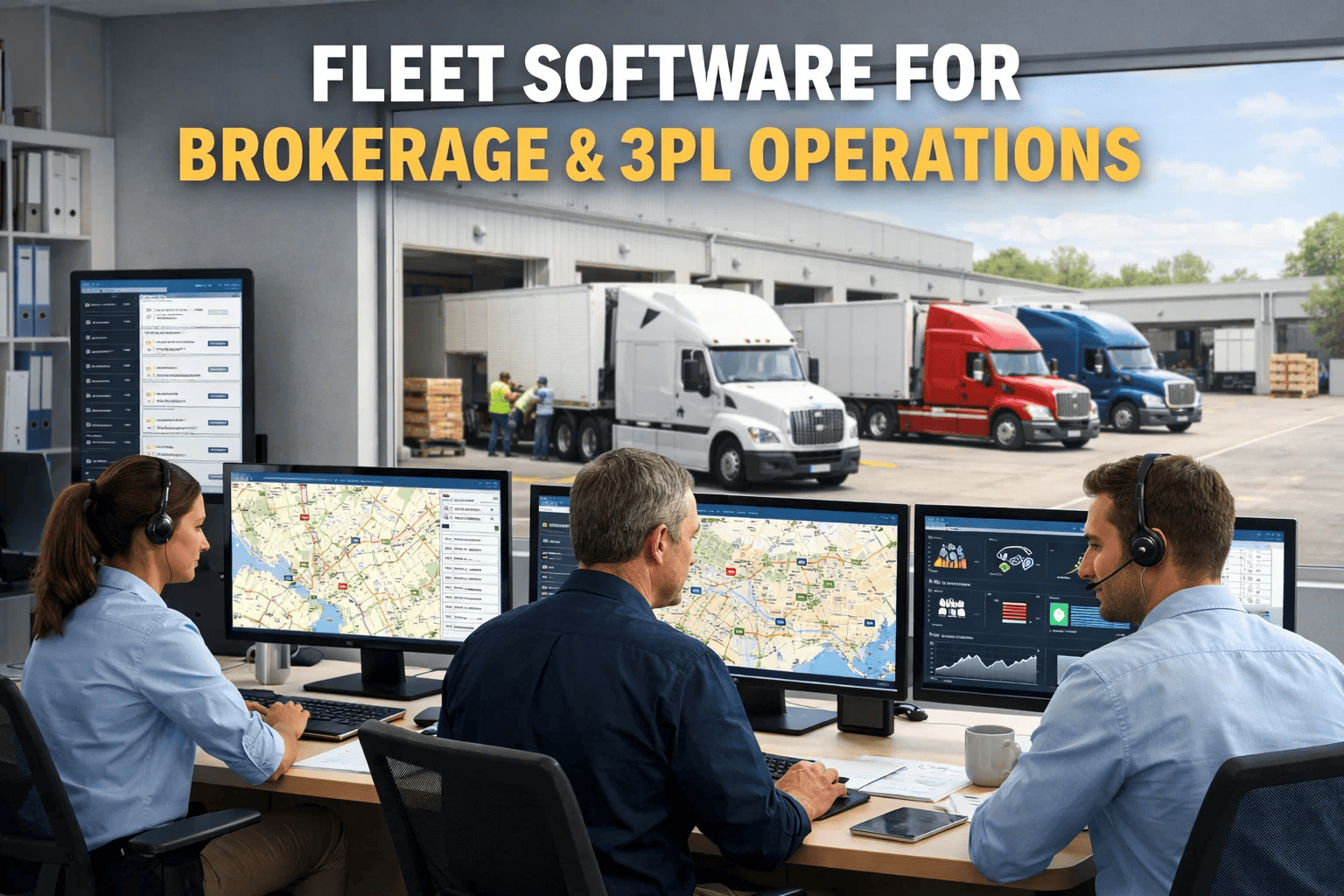
Freight brokerage and third-party logistics operations run on margin compression, carrier relationship management, and the ability to move loads reliably at volume while controlling overhead costs. A broker handling 300 loads per month with four dispatchers and a manual tracking spreadsheet is not failing because of effort — they are failing because the operational complexity of multi-carrier coordination, load status visibility, document collection, and invoice reconciliation exceeds what a spreadsheet architecture can manage at scale. The inflection point arrives when load volume grows past the point where individual dispatcher memory and manual tracking can substitute for a system, and when shipper expectations for real-time visibility exceed what email updates and phone calls can deliver. Book a FleetRabbit demo to see 3PL and brokerage operations management applied to your volume and carrier base.
Quick Answer
FleetRabbit provides freight brokers and 3PL operators with centralized load management, multi-carrier dispatch coordination, real-time shipment tracking, automated document collection workflows, and analytics that measure carrier performance, load profitability, and operational efficiency — replacing the manual coordination overhead that limits broker capacity without requiring additional headcount.
The Operational Challenges Unique to Brokerage and 3PL Environments
Asset-based carriers manage a defined fleet of vehicles with known performance characteristics, established maintenance schedules, and employed drivers whose compliance records they directly control. Brokers and 3PLs manage none of these things directly — they coordinate loads across hundreds of carrier relationships, each with different equipment types, service areas, compliance profiles, and communication preferences. This operational model creates challenges that asset-focused fleet management tools are not designed to address.
The carrier relationship portfolio changes constantly — new carriers onboarded, non-performing carriers removed, capacity tightening in regional lanes during peak demand periods. Compliance status across carrier partners fluctuates — insurance certificates expire, carrier authorities lapse, safety ratings change following DOT audits. Document collection after delivery — proof of delivery, bill of lading, weight tickets, temperature logs for temperature-controlled freight — requires coordination with carriers who have varying levels of process discipline. Invoice reconciliation against agreed rates, accessorial charges, and fuel surcharges requires matching carrier invoices to load records with accuracy sufficient to prevent both overpayment and disputed invoice delays. FleetRabbit addresses each of these operational dimensions within a platform designed for the brokerage and 3PL workflow model.
Load Management Architecture — From Quote to Delivery Documentation
FleetRabbit structures the complete load lifecycle as a managed workflow with visibility at every stage — eliminating the status uncertainty that forces dispatchers to spend hours each day on carrier phone calls and email chains confirming pickup times, transit status, and delivery confirmations.
01
Load Entry and Requirements Capture
Rate, pickup and delivery details, equipment requirements, special handling instructions, shipper reference numbers, and customer contact information captured in a single load record. Shipper-specific requirements — temperature ranges, appointment windows, hazmat classifications, oversize permits — stored in the load record and communicated to assigned carriers automatically.
↓
02
Carrier Matching and Dispatch Assignment
Available carrier capacity in the lane matched against equipment requirements, carrier compliance status, historical service performance, and current rate market. FleetRabbit surfaces qualified carriers with current insurance certificates, valid operating authority, and acceptable safety ratings. Dispatch assignment recorded with rate confirmation, pickup number issuance, and carrier contact notification — all within the load record.
↓
03
Real-Time Transit Monitoring
GPS integration provides continuous shipment location data from carriers using supported telematics systems. Status updates — pickup confirmed, in transit, approaching delivery, delivered — are captured automatically where available or via driver mobile app updates. Exception alerts trigger when check calls are missed, transit times deviate from expected schedule, or temperature excursions are detected for refrigerated freight.
↓
04
Delivery Documentation Collection
Proof of delivery, signed bill of lading, and any required special documentation collected through FleetRabbit's mobile document capture workflow. Carriers submit delivery documentation through the platform — creating an organized, searchable delivery record matched to the load record without manual document management. Missing documentation triggers automated reminders to carrier dispatch contacts.
↓
05
Invoice Processing and Reconciliation
Carrier invoices matched against load records automatically — verifying rate, mileage, accessorial charges, and fuel surcharge calculations against contracted terms. Discrepancies flagged for review before payment approval. Invoice-to-payment cycle documented with complete audit trail. Shipper billing generated from delivery-confirmed load records with all supporting documentation attached.
Carrier Compliance Management — The Risk No Broker Can Afford to Ignore
Freight brokers carry significant liability exposure when loads are tendered to carriers with lapsed insurance, invalid operating authority, or adverse safety ratings that were not identified through reasonable due diligence. A cargo claim against a carrier with expired cargo insurance becomes a direct broker liability. An accident involving a carrier whose authority was under suspension creates regulatory exposure for the brokerage. A load tendered to a carrier with a conditional safety rating in violation of shipper contract requirements creates commercial liability for missed compliance obligations.
FleetRabbit maintains a carrier compliance database that tracks insurance certificate expiry, operating authority status, FMCSA safety rating, and DOT registration for every carrier in the system. Compliance alerts notify the operations team when carrier credentials approach expiry — requiring certificate updates before loads can be tendered. Carriers whose credentials lapse are automatically flagged as ineligible for dispatch and removed from available carrier matching until compliance is restored and documented.
Insurance Certificate Tracking
Primary liability, cargo, and general liability certificate expiry dates tracked for every carrier. Automated alerts at 60-day, 30-day, and 15-day intervals before expiry. Certificate updates required before carrier remains eligible for load tender. Insurance tracker integrates with FMCSA insurance filing data where available.
Operating Authority Verification
MC number and DOT number validity confirmed against FMCSA carrier registry. Authority status checked at carrier onboarding and monitored continuously. Carriers with revoked or suspended authority flagged immediately and removed from eligible carrier pool. Broker liability protection through documented compliance verification at each load assignment.
Safety Rating Monitoring
FMCSA safety rating and SMS BASIC scores tracked for carrier partners. Carriers with "Conditional" or "Unsatisfactory" ratings flagged for review. Shipper-specific carrier compliance requirements configured to block load tender to carriers not meeting contracted safety thresholds. Safety rating changes trigger immediate compliance review notifications.
Carrier Performance Scorecard
On-time pickup rate, on-time delivery rate, check-call compliance, documentation submission timeliness, and claim frequency tracked for every carrier across all loads tendered. Performance scorecards available to dispatchers during carrier selection — prioritizing high-performing carriers and identifying low-performing carriers for relationship review or removal from active pool.
Dispatcher Productivity — How FleetRabbit Expands Capacity Without Adding Headcount
The central operational constraint for growing brokerage and 3PL operations is dispatcher capacity. A dispatcher managing carrier relationships, load status, customer communication, and document collection manually reaches throughput limits that cannot be overcome through longer hours. FleetRabbit automates the routine coordination tasks that consume dispatcher time without generating revenue — allowing each dispatcher to manage higher load volume while improving service quality for existing customers.
Without FleetRabbit
Load Status Checks
Average 8-12 carrier phone calls per dispatcher per day to obtain transit status updates for loads without automated tracking. Each call takes 3-7 minutes including hold time, status recording, and customer notification. 45-90 minutes of dispatcher time daily on status calls that generate no revenue.
With FleetRabbit
Automated Status Visibility
Real-time shipment status visible on the dispatch dashboard for all active loads. Exception alerts notify dispatchers only when intervention is required — missed check calls, delivery appointments at risk, temperature deviations. Dispatcher attention redirected from routine status checking to exception management and customer service.
Without FleetRabbit
Document Collection
Manual follow-up with carriers for proof of delivery, signed BOL, and special documentation after each delivery. Email threads, fax requests, and phone calls to carrier dispatch offices. Documents received in inconsistent formats stored in email folders or shared drives with no systematic organization by load reference or shipment date.
With FleetRabbit
Automated Document Workflow
Carriers submit delivery documentation through the FleetRabbit mobile app — automatically matched to the corresponding load record. Missing documentation triggers automated reminders without dispatcher involvement. All delivery documents searchable by load reference, shipper name, carrier, or date range — available in seconds for customer billing and dispute resolution.
3PL Shipper Visibility Portal — Meeting Customer Expectations for Transparency
Shipper customers increasingly expect real-time shipment visibility as a baseline service requirement — not a premium offering. The 3PL or broker that cannot provide live tracking status and delivery confirmation on demand is at a competitive disadvantage against carriers who have invested in customer-facing tracking technology. FleetRabbit's shipper visibility capabilities allow brokers and 3PLs to deliver enterprise-grade shipment tracking without building proprietary technology infrastructure.
Shippers with FleetRabbit portal access can view real-time status for all active shipments — current location, next scheduled milestone, estimated delivery time, and exception alerts — without calling the broker's dispatch team. Automated delivery confirmation notifications are sent to shipper contacts when deliveries are completed and documented. Historical shipment data with performance metrics — on-time delivery rate, transit time consistency, carrier-level performance — is available for shipper review, providing the data transparency that supports shipper retention and contract renewal negotiations.
3PL and Brokerage Fleet Management
Scale Load Volume Without Adding Dispatcher Overhead
See how FleetRabbit's brokerage operations platform automates carrier coordination, status tracking, and document collection — letting your dispatchers manage more loads with better service quality.
3x
Load Throughput per Dispatcher
94%
On-Time Delivery Rate Target
Analytics and Reporting — The Business Intelligence Layer for 3PL Executives
3PL and brokerage executives require visibility into business performance metrics that operating-level dispatchers do not prioritize — load profitability by lane, customer and carrier margin analysis, volume trend analysis by trade lane and equipment type, and operational efficiency metrics that identify where overhead costs are concentrated. FleetRabbit's analytics suite provides the business intelligence layer that allows operations leadership to make informed decisions about market focus, carrier relationships, and operational investment.
Lane Profitability Analysis
Revenue, carrier cost, fuel surcharge, and accessorial charges analyzed by origin-destination lane — identifying high-margin lanes to prioritize and underperforming lanes where carrier cost structure, market rate compression, or high accessorial frequency is eroding operating margin. Lane analysis updated in real time as loads close and invoices are reconciled.
Carrier Cost Benchmarking
Average carrier cost per mile by lane and equipment type tracked across all load history — providing the market intelligence to evaluate carrier rate requests, identify opportunities for rate negotiation with high-volume carriers, and flag lanes where current carrier pricing is above market rate for equivalent capacity and service quality.
Customer Margin Reporting
Gross margin by customer account calculated from load revenue versus carrier cost across all shipments. Customer accounts with below-average margin identified for pricing review or operational efficiency improvement. High-margin customers identified for relationship investment and volume growth initiatives. Customer retention risk flagged when service metrics decline relative to contracted service levels.
Operational Efficiency Metrics
Loads per dispatcher, carrier tender-to-acceptance time, document collection cycle time, invoice-to-payment cycle, and exception event frequency tracked by period and by dispatcher — identifying operational bottlenecks, training opportunities, and process improvements that increase throughput without proportional overhead increases.
Volume Trend and Capacity Planning
Load volume by week, month, and quarter analyzed by customer, lane, equipment type, and geographic region — identifying seasonal patterns, customer volume growth trends, and capacity requirements for peak periods. Forward-looking capacity planning based on committed volume from contract customers versus spot market activity proportion.
Claims and Loss Analysis
Cargo claims by carrier, freight type, lane, and time period tracked across all shipments — identifying carriers with elevated claim frequency for performance review, freight categories requiring enhanced handling instructions, and lanes with specific risk characteristics that warrant additional insurance coverage or carrier qualification requirements.
Technology Integration — Connecting FleetRabbit to Your Existing Tech Stack
Established brokerage and 3PL operations typically operate with existing technology investments — TMS platforms, load boards, accounting systems, EDI trading partner connections, and carrier communication tools. FleetRabbit is designed to complement rather than replace purpose-built tools, with integration capabilities that allow data to flow between systems without manual reentry.
Accounting system integration with QuickBooks and similar platforms eliminates double-entry of load revenue and carrier cost data — allowing financial reporting to reflect operations activity without the reconciliation overhead of maintaining separate operating and financial records. Fuel card integration brings fleet fuel cost data into the load cost calculation for asset-light operations that own some equipment alongside brokered loads. GPS and telematics integration with carrier partner systems provides the shipment tracking data that powers the visibility portal and exception management workflows. API integration capability allows custom connections to proprietary shipper systems, load boards, and rate management platforms used by individual operations.
Implementation Timeline — From Onboarding to Full Production
Brokerage and 3PL operations require implementation approaches that minimize disruption to ongoing load operations. A system transition that takes three months and requires load operations to pause is not viable for organizations with committed shipper contracts and daily load targets. FleetRabbit's implementation process is structured to achieve production capability within the first two weeks of deployment, with advanced configuration and integration work completed in parallel with ongoing operations.
Week 1
Foundation Configuration
Carrier database import from existing records, user account setup for dispatcher and management team, load entry workflow configuration, basic reporting setup. First loads entered into FleetRabbit in parallel with existing systems while team gains familiarity with platform workflows.
Week 2
Full Production Transition
All new loads entered exclusively in FleetRabbit — dispatchers using carrier matching, load assignment, and status tracking features for all active loads. Document collection workflow activated. Accounting integration configured and tested with initial invoice reconciliation workflow.
Weeks 3-4
Advanced Feature Activation
Shipper visibility portal configured and activated for key customer accounts. Analytics reporting configured for executive team reporting cadence. Carrier compliance monitoring activated for full carrier database. Carrier performance scorecards begin populating from production load history. Custom integrations with specific tech stack components completed.
Month 2+
Optimization and Scaling
Lane profitability analysis provides first full-month data set for management review. Carrier performance scorecards inform carrier relationship review decisions. Dispatcher productivity metrics identify training opportunities and workflow refinements. Load throughput expansion begins as automation reduces manual coordination overhead per load.
Frequently Asked Questions
QHow does FleetRabbit handle load tracking for carriers that do not use GPS telematics or the FleetRabbit mobile app?
FleetRabbit supports multiple tracking methods to accommodate the diverse technology adoption levels across the carrier market. For carriers with compatible telematics systems, automated GPS tracking provides continuous shipment visibility. For carriers without integrated tracking, FleetRabbit's mobile app provides a lightweight check-call interface — drivers submit location and status updates without requiring full platform access. For carriers using neither, FleetRabbit's scheduling and exception management system prompts dispatchers for manual status updates at configurable check-call intervals — ensuring the tracking discipline is maintained even when carrier technology does not support automation.
QCan FleetRabbit manage both brokered loads and owned equipment within the same platform?
Yes. FleetRabbit is designed for hybrid operations that combine asset-based trucking with brokered freight. Owned vehicles and employed drivers are managed through FleetRabbit's full fleet management module — maintenance, DVIR, HOS compliance, and fuel management. Brokered loads managed through third-party carriers are handled through the carrier management and load tracking modules. Analytics reporting can segment owned-asset and brokered load performance separately or in combined views — providing the unified operational picture that hybrid operations require for profitability optimization across their full service model.
QHow does FleetRabbit protect broker liability during carrier compliance lapses?
FleetRabbit's carrier compliance module creates a documented due diligence record for every carrier in the system — tracking when compliance credentials were verified, when alerts were generated for approaching expiry, and when loads were blocked due to lapsed compliance. This documentation trail demonstrates that the brokerage performed reasonable compliance verification before tendering loads. In the event of a cargo claim or incident involving a carrier whose credentials subsequently lapsed, the compliance record shows the status at time of tender — which is the legally relevant standard for broker liability assessment. Compliance verification records are preserved indefinitely and exportable for legal review.
QWhat is the minimum operation size for which FleetRabbit is designed?
FleetRabbit is effective for brokerage and 3PL operations moving as few as 50 loads per month — where the manual coordination overhead is already creating errors and missed service commitments — and scales to support operations moving thousands of loads monthly with multiple dispatcher teams across different geographic regions. The platform scales with the operation rather than requiring a minimum volume tier, and pricing reflects the actual usage rather than forcing small operations into enterprise tiers built for much larger volumes.
Discuss your operation's volume and configuration in a scoping conversation.
Stop Managing 3PL Operations Through Spreadsheets and Phone Calls
FleetRabbit gives freight brokers and 3PL operators the load management, carrier compliance, shipment tracking, and business analytics platform needed to scale volume, improve service quality, and protect operating margin — without proportional increases in dispatcher headcount or coordination overhead.
Multi-Carrier Dispatch
Carrier Compliance Tracking
Shipper Visibility Portal
Lane Profitability Analytics
Document Automation
April 17, 2026
By Jason Smith
All Posts