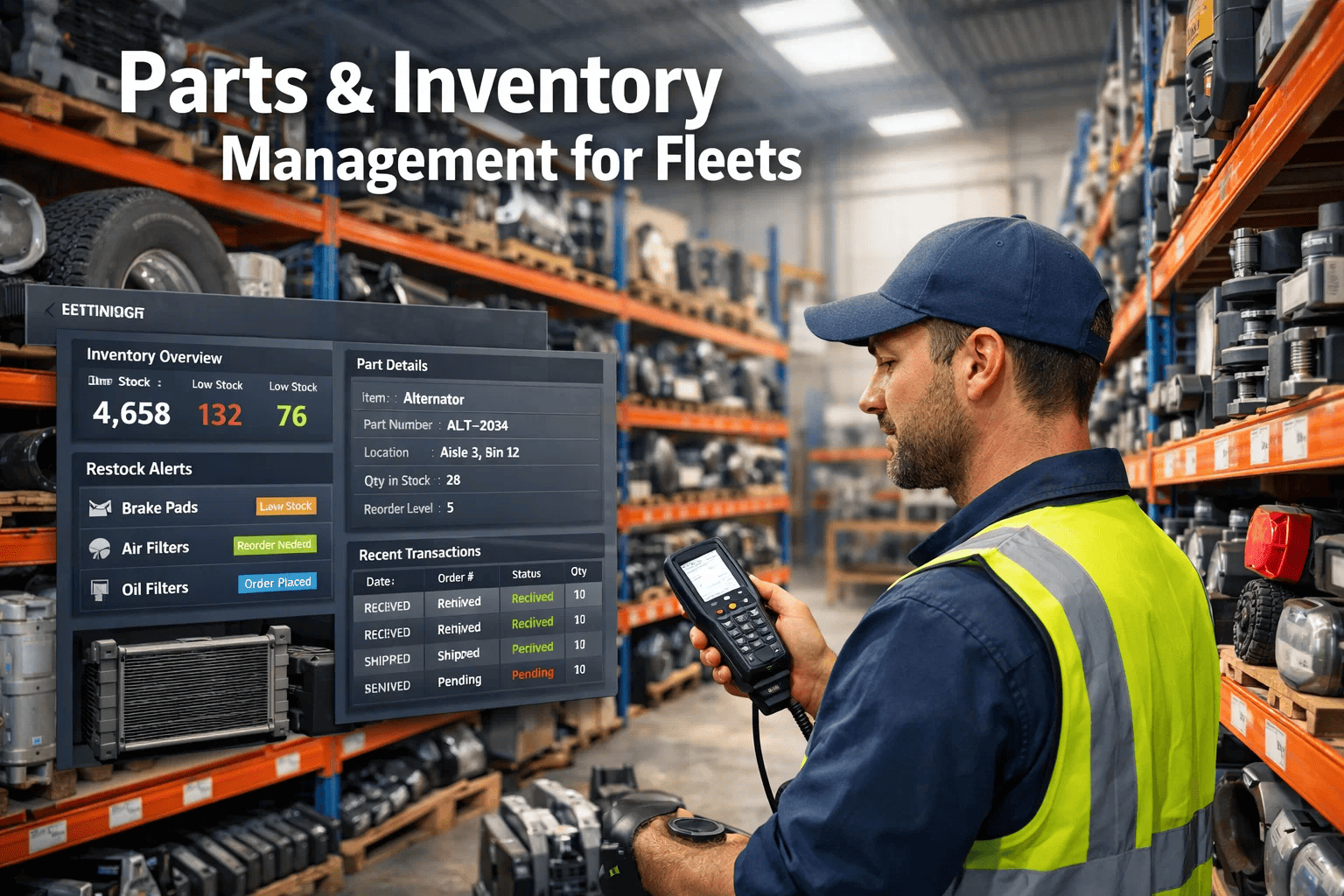
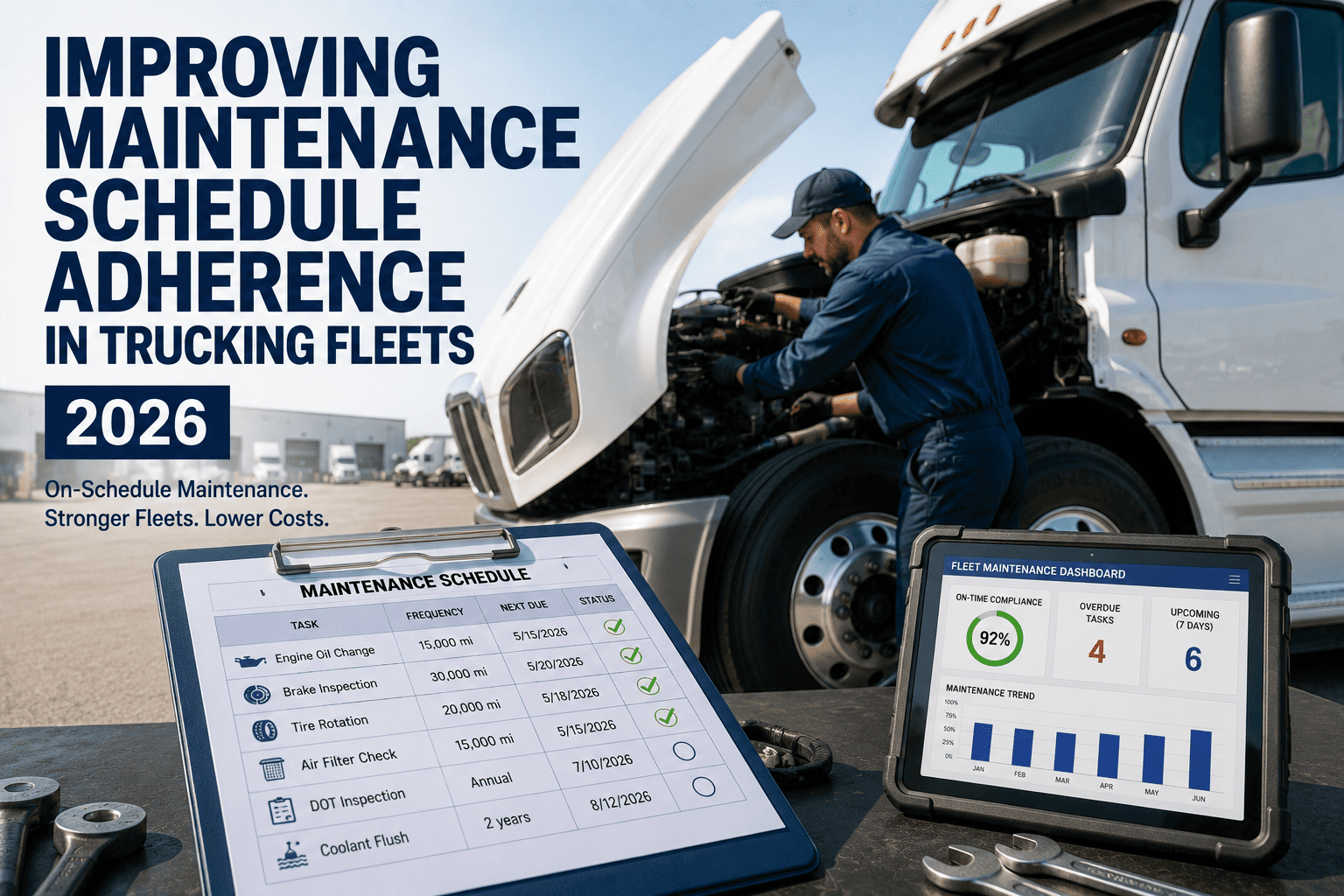
Parts and inventory management is one of the most financially impactful — and most frequently neglected — areas of trucking fleet operations. When the right part isn't available when maintenance needs it, trucks sit idle. When parts stockouts require emergency procurement, costs spike 40–80% above negotiated pricing. When inventory is tracked on spreadsheets or whiteboard lists, parts get ordered twice, stock levels are guesswork, and maintenance directors make decisions without accurate cost data. FleetRabbit's parts and inventory management module gives transportation fleet maintenance teams digital control over every part: tracking stock levels, linking parts to work orders, automating reorder triggers, and delivering per-unit repair cost data that changes how fleet executives understand their true operating costs. Book a demo to see inventory management in action for your fleet.
Quick Answer
FleetRabbit's parts and inventory management tracks real-time stock levels, links parts directly to maintenance work orders, calculates per-repair and per-unit parts cost, triggers automated reorder alerts before stockouts occur, and integrates with preventive maintenance scheduling to pre-stage required parts before service dates — eliminating emergency procurement, reducing inventory carrying cost, and giving maintenance directors accurate repair cost data to support fleet investment decisions.
The Hidden Cost of Poor Inventory Management in Trucking Fleets
Most fleet maintenance directors know their labor cost per hour and their PM service cost. Far fewer have accurate visibility into their true parts cost per unit — because inventory management systems that don't link to work orders make it impossible to trace a part's cost to a specific repair event. The result is a maintenance budget that's chronically underestimated, trucks sidelined waiting for parts, and expensive ordering patterns driven by urgency rather than planning.
01
Stockouts Cause Avoidable Downtime
A truck grounded by a parts stockout costs $1,200–$2,000 per day in lost revenue capacity — plus emergency shipping on the part. A single stockout event for a high-frequency consumable (brake pads, seals, filters) that takes 2 days to resolve costs $2,400–$4,000 in downtime — more than the annual inventory cost of maintaining adequate stock of the item.
02
Emergency Procurement Destroys Budget Accuracy
Emergency parts orders cost 40–80% more than planned procurement at negotiated pricing. Last-minute purchases from non-preferred vendors, premium shipping charges, and the inability to use fleet purchasing agreements combine to significantly inflate per-repair costs — making budget forecasting unreliable and obscuring the true cost of reactive vs preventive maintenance.
03
Duplicate Orders Inflate Carrying Cost
When parts inventory is tracked manually or in disconnected systems, technicians order parts already in stock — creating overstock situations that tie up capital in slow-moving inventory. Average carrying cost for excess fleet parts inventory is 20–30% of inventory value annually, representing preventable capital tied up in shelf stock that could fund truck improvements or capital investments.
04
No Per-Unit Cost Visibility for Asset Decisions
Fleet executives making hold-or-replace decisions need accurate cumulative repair costs by unit. Without parts tracking linked to work orders, "maintenance cost" is a blended average — hiding high-cost units consuming disproportionate resources. Fleets without this data routinely keep trucks in service 12–24 months past their economically justified replacement point.
FleetRabbit Parts and Inventory Management — The Complete System
FleetRabbit's inventory management module connects every parts transaction to the maintenance workflow — stock levels, work orders, preventive maintenance schedules, and cost tracking all share the same data layer. Here is how the complete parts management system works from receiving to repair closure.
1
Parts Catalog and Stock Level Management
Every part in the maintenance operation is catalogued with part number, description, compatible vehicles, preferred vendor, unit cost, and minimum/maximum stock levels. Technicians look up parts in the digital catalog before ordering — confirming what's in stock before creating a purchase requisition. Real-time stock levels are updated automatically every time parts are used in a work order or received from an order — no manual count reconciliation required.
Part Lookup: Fuel filter 23146-F | Compatible: Units 4, 7, 12, 18, 24, 31 (Class A engines) | Current stock: 6 units | Min level: 4 | Max level: 12 | Preferred vendor: Fleet Supply Co | Unit cost: $28.40 | Last ordered: Feb 14 | Next PM using this part: Unit 7 — Mar 28
2
PM-Linked Parts Pre-Staging — Parts Ready Before Service Starts
When FleetRabbit's preventive maintenance scheduling creates a work order for an upcoming service event, the system automatically checks parts availability for all items required in that PM service class. If required parts are below minimum levels, a purchase requisition is created automatically — ensuring parts arrive before the service date. Technicians arrive at the service event to find parts staged and ready, not discovering a missing part after the truck is already on the lift.
Class B PM Work Order — Unit 12 (Mar 28): Required parts checked | Oil filter: 6 in stock — OK | Air filter: 2 in stock — BELOW MIN (min: 4) | Reorder triggered: 6x air filter ordered from Fleet Supply Co | ETA 2 days before service date | Parts reserved for Unit 12 PM
3
Work Order Parts Consumption Tracking — Per-Repair Cost in Real Time
When a technician uses parts from inventory on a work order, the parts cost is recorded against that specific repair event — updating both inventory stock levels and the work order cost automatically. Parts cost plus labor (by technician hourly rate and time logged) creates the total repair cost per event, which accumulates into per-unit lifetime maintenance cost. This data is the foundation of hold-or-replace decision making for fleet executives.
Work Order WO-4821 closed — Unit 18 brake repair: Labor 3.5 hrs @ $68/hr = $238 | Parts used: Brake pads (4x @ $42 = $168), brake hardware kit ($34), caliper grease ($8) | Total parts cost: $210 | Total work order cost: $448 | Unit 18 cumulative YTD maintenance cost: $3,840
4
Automated Reorder Alerts — Restock Before Stockout, Not After
When stock drops below the configured minimum level — either from work order usage or manual adjustment — FleetRabbit sends an automated reorder alert to the maintenance director and optionally creates a purchase order draft with preferred vendor details pre-populated. Reorder quantity is calculated to reach the maximum stock level, avoiding fractional orders that generate disproportionate shipping costs. Critical parts can be configured for higher minimum levels to provide additional buffer against supply chain delays.
Reorder Alert: Brake pads Part 8821-B | Current stock: 3 units | Minimum level: 6 units | Trigger: Stock depleted by WO-4821 | Reorder quantity: 12 units (to reach max level 15) | Preferred vendor: FleetParts Direct | Estimated cost: $504 | Draft PO created — awaiting approval by Maintenance Director
5
Maintenance Cost Reporting — Fleet and Per-Unit Analytics for Executives
FleetRabbit's cost analytics layer aggregates work order data into fleet-level and per-unit maintenance cost reports — showing total maintenance spend, cost per mile by unit, parts cost vs labor cost ratio, highest-cost repair categories, and year-over-year maintenance trend. Executives see which units are cost outliers, whether maintenance spend is increasing or decreasing relative to miles, and where budget allocation is producing the highest maintenance ROI.
Fleet Maintenance Cost Report — Q1: Total maintenance spend: $128,400 | Cost per mile (fleet avg): $0.08 | Highest cost unit: Truck 22 — $14,200 (112% above avg) | Top repair category: Brake system (28% of total) | PM cost vs reactive repair: 34% vs 66% | Recommendation: PM optimization opportunity — brake PM interval review
FleetRabbit Inventory Management
Eliminate Stockouts, Emergency Orders, and Hidden Repair Costs
FleetRabbit's parts and inventory management module connects every part to every work order — giving maintenance directors stock visibility, automated reorder alerts, and per-unit cost data that transforms fleet financial management. Fleets using FleetRabbit inventory management report 35% reductions in emergency parts orders and 28% improvements in maintenance cost accuracy. Book a personalized demo to see how the parts management system integrates with your current maintenance workflow.
35%
Fewer Emergency Parts Orders
28%
Better Maintenance Cost Accuracy
Best Practices for Fleet Parts Inventory Management
Digital tools enable inventory best practices — but the practices themselves are what drive results. The eight disciplines below define how high-performing fleet maintenance operations manage parts inventory, and how FleetRabbit enables each one consistently without manual oversight.
01
Set Min/Max Levels Per Part, Not Per Order
Configuring minimum stock levels per part number — not ordering on gut feel — ensures reorder triggers before stockout, not after. Set minimums based on lead time and average consumption rate. FleetRabbit calculates consumption automatically from work order history.
02
Pre-Stage Parts Before Every PM Event
Request parts availability checks 5–7 days before scheduled PM service dates. FleetRabbit triggers this automatically — but fleets that manually double-check high-value or long lead-time parts avoid the most expensive PM delays from last-minute shortages.
03
Track Emergency Orders Separately
Differentiating planned procurement from emergency orders reveals the true cost of reactive maintenance. Each emergency order should be tagged as such in FleetRabbit — creating a visible metric that motivates PM compliance by making the cost of preventive maintenance negligence financially explicit.
04
Consolidate to Preferred Vendor Agreements
Fewer, larger orders to preferred vendors unlock negotiated pricing that emergency single-unit purchases can't access. FleetRabbit's vendor assignment per part number enables purchasing coordinators to consolidate orders automatically — improving pricing leverage while maintaining the parts variety required for multi-make fleets.
05
Conduct Quarterly Slow-Mover Reviews
Parts that haven't moved in 90+ days represent tied-up capital generating carrying cost without maintenance value. FleetRabbit's inventory reports identify slow-moving parts automatically — enabling quarterly reviews that rightsize stocking strategy as fleet composition and PM programs evolve.
06
Link Every Part to Compatible Vehicle List
Parts linked to compatible vehicle profiles in FleetRabbit enable accurate PM pre-staging — the system knows which parts a PM service class requires for each vehicle based on make, model, and engine configuration. This prevents wrong-part usage events that cause rework and waste both labor and parts cost.
07
Review Per-Unit Cost Monthly, Not Annually
Monthly per-unit maintenance cost reviews catch rising-cost units before they become hold-or-replace crises. FleetRabbit surfaces units with month-over-month cost increases automatically — giving fleet managers and executives early warning of escalating maintenance cycles that indicate end-of-economic-life approaching.
08
Use Warranty Tracking to Eliminate Chargeable Repairs
Parts installed under warranty should never be charged to the maintenance budget — but without tracking, warranty claims are missed and costs absorbed unnecessarily. FleetRabbit tracks warranty periods on parts and installed components, alerting when a repair may qualify for warranty coverage before the technician places a chargeable order.
Parts and Inventory Management Performance Outcomes
35%
Fewer Emergency Parts Orders
40%
Less Unplanned Downtime
28%
Improved Cost Accuracy
20–30%
Reduction in Excess Inventory Carrying Cost
$0
Manual Stock Reconciliation Required
100%
Work Orders Linked to Parts Cost
Frequently Asked Questions About Fleet Inventory Management
QCan FleetRabbit integrate with existing parts suppliers and purchasing systems?
FleetRabbit supports integration with major fleet parts suppliers and purchasing systems — enabling purchase order creation within the platform and automating the procurement workflow from reorder alert through vendor order submission. For fleets using ERP or accounting software (QuickBooks, SAP, Oracle), FleetRabbit's accounting integration syncs parts purchase data automatically — eliminating duplicate data entry between maintenance and finance systems.
Review your current purchasing workflow in a demo call.
QHow does FleetRabbit handle inventory across multiple shop locations?
FleetRabbit supports multi-location inventory management — tracking stock levels, work orders, and parts consumption separately at each maintenance location while giving fleet management a consolidated view across all sites. Parts can be assigned to a specific location's inventory, and transfers between locations are tracked as inventory movements. Fleet directors overseeing multiple yards see total inventory value and per-location stock status from a single executive view without requiring site-by-site reports..
QHow quickly can existing parts inventory be entered into FleetRabbit?
FleetRabbit supports bulk parts catalog import via CSV — allowing maintenance teams to migrate from spreadsheet-based inventory tracking in hours rather than days. For fleets starting from scratch, the FleetRabbit onboarding team provides templates and guided setup to catalog core inventory during the onboarding process. Most fleet maintenance shops have functional inventory tracking in FleetRabbit within the first week of deployment.
Start your free trial and upload your parts catalog today.
End Stockouts, Emergency Procurement, and Invisible Parts Costs — Permanently.
FleetRabbit's parts and inventory management module connects every part to every work order, every PM schedule, and every cost report — giving maintenance directors real-time stock visibility, automated reorder alerts, and per-unit repair cost data that transforms operational decisions. Transportation fleets that manage inventory through FleetRabbit eliminate the emergency procurement cycles that destroy maintenance budgets and reduce unplanned downtime by 40%. Book a personalized demo or start your free trial to see the complete inventory management system for your fleet.
Real-Time Stock Levels
Automated Reorder Alerts
PM Parts Pre-Staging
Work Order Cost Tracking
Per-Unit Repair Analytics
Multi-Location Support
April 9, 2026
By Smith
All Posts