Artificial intelligence is fundamentally changing how logistics fleets plan, dispatch, and execute routes — shifting from static, experience-based routing to dynamic, data-driven optimization that adjusts in real time to traffic, weather, vehicle capacity, driver availability, and delivery constraints. FleetRabbit integrates AI-powered route intelligence directly into the dispatch workflow, enabling logistics operations to reduce fuel costs, improve on-time delivery rates, and maximize vehicle utilization without adding dispatcher headcount. Book a FleetRabbit demo to see AI routing in your operation.
23%
Average fuel reduction from AI route optimization vs. manual planning
31%
Improvement in on-time delivery performance in the first 60 days
18%
Reduction in total fleet miles driven across optimized routes
Why Manual Routing Falls Short
An experienced dispatcher manually planning 35 daily routes processes roughly 8–12 variables per route — historical experience, basic traffic awareness, delivery windows, and vehicle capacity. FleetRabbit's AI engine processes hundreds of dynamic variables simultaneously, including live traffic density, weather impact on road speed, fuel efficiency curves by vehicle, driver HOS remaining hours, customer time window constraints, and real-time load changes — producing optimized routes in seconds that human planning cannot achieve in hours.
The Limitations of Traditional Route Planning in Logistics
Most logistics fleets still rely on dispatcher experience, basic mapping software, or static route templates that were effective under last year's conditions — not today's dynamic environment. The cost of suboptimal routing accumulates invisibly across thousands of daily route decisions.
Problem 1
Static Routes Ignore Real-Time Conditions
Drivers follow assigned routes that don't account for accidents, construction delays, or sudden traffic events discovered mid-journey. The dispatcher learns of the delay through a driver call, then manually reroutes — losing 20–45 minutes of delivery time and compressing all subsequent delivery windows.
Estimated impact: $80–$220 per rerouting event
Problem 2
Driver HOS Not Factored Into Route Assignments
Routes assigned without checking remaining HOS hours result in drivers reaching regulatory limits before completing their delivery sequence — requiring incomplete loads to be handed off, expedited, or delayed until the next available driver.
Estimated impact: $150–$500 per HOS-driven disruption
Problem 3
Vehicle Capacity and Load Type Mismatches
Manual dispatch systems don't automatically match vehicle payload capacity, refrigeration availability, or special equipment requirements to load specifications — creating situations where oversized or temperature-sensitive loads are assigned inappropriate vehicles, requiring costly reloading or customer renegotiation.
Estimated impact: $200–$800 per mismatch incident
Problem 4
No Backhaul Identification — Dead Miles by Default
Without AI analysis of available load data against vehicle return positioning, dispatchers default to sending vehicles back empty — generating 15–22% dead mile rates that add pure cost with zero revenue. AI routing continuously identifies backhaul opportunities within delivery radius constraints before vehicles depart.
Estimated impact: $0.85–$1.40 per dead mile × thousands of miles monthly
How FleetRabbit's AI Route Optimization Engine Operates
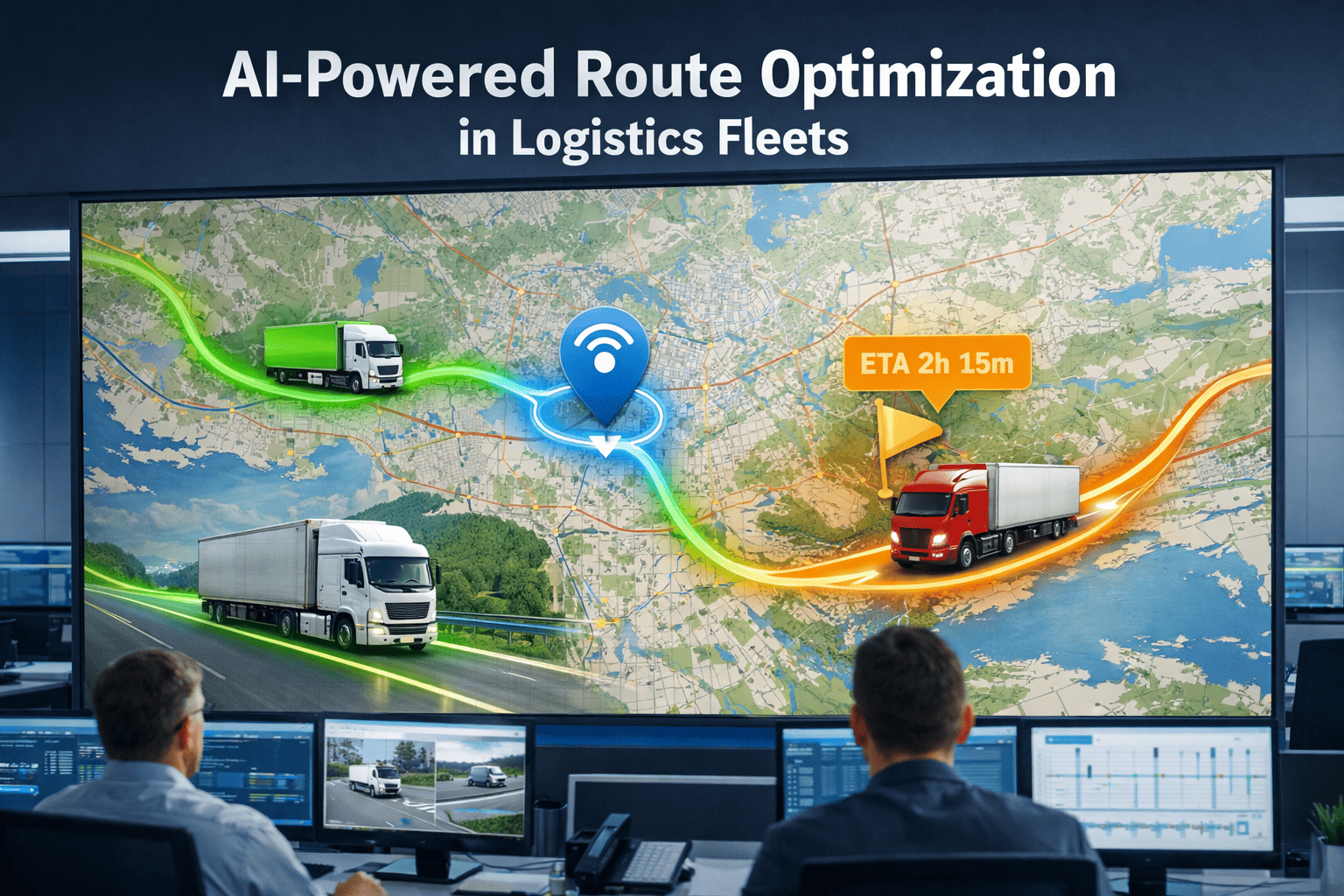
FleetRabbit's route optimization AI uses real-time data from multiple sources — live traffic APIs, weather services, vehicle telematics, ELD HOS data, customer delivery preferences, and historical route performance — to generate and continuously refine optimal route assignments for every vehicle in your fleet.
01
Input: Real-Time Data Aggregation
FleetRabbit ingests live data from GPS telematics, ELD systems, traffic APIs, weather feeds, customer portals, and load management — creating a complete operational picture updated every 30–60 seconds across your entire fleet.
GPS Live PositionsHOS BalancesTraffic DataWeather Feeds
02
Processing: Multi-Variable Optimization
The AI engine evaluates hundreds of variables simultaneously — minimizing total fleet miles, honoring delivery time windows, respecting vehicle payload limits, staying within driver HOS constraints, and accounting for customer priority tiers — to generate globally optimal route sets.
Optimized routes are presented to dispatchers in the FleetRabbit interface with side-by-side comparison of AI-suggested vs. current routing — showing estimated fuel savings, time savings, and delivery window compliance before the dispatcher confirms the plan.
Once routes are live, FleetRabbit monitors execution continuously — detecting traffic events, driver delays, or customer changes that affect remaining stops and automatically recalculating the optimal sequence for each affected driver, pushing updates to the mobile app in real time.
Time Window Optimization — Guaranteed Delivery Compliance
FleetRabbit's AI sequences stops to honor every customer delivery window, reducing late-delivery penalties and customer churn. System flags time-window conflicts before routes are confirmed — giving dispatchers time to negotiate windows or reallocate loads rather than discovering conflicts mid-route.
94%On-time delivery rate with AI window optimization
Multi-Stop Sequence Optimization — Minimum Miles, Maximum Stops
For fleets handling 8–30+ stops per vehicle per day, stop sequence is where routing efficiency is won or lost. FleetRabbit evaluates all possible stop orderings against traffic conditions, delivery windows, and geographic clustering — identifying sequences that minimize total drive time without sacrificing window compliance.
18%Average reduction in daily miles per vehicle
Backhaul Intelligence — Eliminate Dead Miles Automatically
FleetRabbit analyzes available inbound loads, shipper locations, and vehicle return positioning to identify backhaul opportunities that keep trucks loaded in both directions. Backhaul suggestions are surfaced to dispatchers automatically — requiring only confirmation to convert empty return miles into revenue-generating runs.
58%Reduction in dead miles for fleets using backhaul intelligence
Driver Performance Learning — Routes That Improve Over Time
FleetRabbit's AI learns from historical driver performance data — identifying which drivers perform best on specific route types, time windows, or geographic areas — and applies this intelligence to future route assignments. Routes improve continuously as the system learns your fleet's specific operational patterns.
11%Additional efficiency gain from 90 days of AI learning
AI Route Optimization vs. Manual Dispatch — Side-by-Side
Scenario
Manual Dispatch
FleetRabbit AI
Major highway closure reported at 6 AM
Dispatcher notified by driver call. Manual rerouting — 25–40 min delay per affected vehicle
Automatic reroute pushed to driver app within 90 seconds of traffic event detection
Driver approaching HOS limit with 3 stops remaining
Discovered by driver mid-route. Emergency reassignment, incomplete delivery
Flagged before departure. Remaining stops reassigned to compliant driver proactively
Vehicle returning empty 180 miles
Standard empty return. No backhaul visibility available to dispatcher
Backhaul load match presented — operator confirms, vehicle returns loaded
Customer adds same-day delivery request
Dispatcher manually evaluates available capacity — 15–30 min assessment
AI identifies optimal vehicle and route insertion in seconds — dispatcher confirms
AI Route Intelligence
Routes That Plan Themselves — And Improve With Every Mile.
FleetRabbit's AI routing engine reduces planning time, cuts fuel costs, eliminates dead miles, and keeps your drivers compliant — making your logistics operation faster, cheaper, and more competitive.
Implementation — Getting AI Routing Running on Your Fleet
FleetRabbit is built for rapid deployment without requiring hardware changes or extended IT implementation projects. Fleet managers are typically live with AI routing within one to two weeks of onboarding.
1
Connect Existing Systems
FleetRabbit integrates with your ELD provider, GPS telematics, and TMS system — pulling vehicle data, driver HOS, and load information without manual configuration.
Timeline: 2–3 days
2
Configure Route Parameters
Upload customer delivery windows, vehicle capacity profiles, and driver hour preferences. Set optimization priority weights — time, fuel, or balanced — based on your operational model.
Timeline: 1–2 days
3
Dispatcher Onboarding
FleetRabbit's dispatch interface is designed for adoption without extensive training. Dispatchers review and confirm AI route suggestions — maintaining approval control while gaining AI intelligence.
Timeline: 1 day guided training
4
Live Operations and AI Learning
Routes go live immediately. The AI begins learning fleet-specific patterns from day one — with optimization performance improving measurably over the first 30–60 days of operation.
Timeline: Ongoing improvement
Frequently Asked Questions — AI Route Optimization
Does AI route optimization work for both local delivery routes and long-haul trucking?
Yes. FleetRabbit's optimization engine is designed for both use cases. For multi-stop local delivery routes, the AI focuses on stop sequencing, time window compliance, and geographic clustering. For long-haul operations, the optimization concentrates on fuel efficiency, driver HOS planning, rest stop scheduling, and backhaul identification. The optimization parameters are configurable to match your specific operational model.
Does the dispatcher still have control over routes, or does AI make all decisions?
FleetRabbit's AI generates route suggestions and presents them to dispatchers for review and approval — dispatchers always retain final decision authority. This human-in-the-loop design means AI handles the computational complexity while dispatchers apply operational judgment and customer relationship knowledge. Dispatchers can also override any AI suggestion with a manual adjustment at any time. See the dispatcher interface in a live demo.
What data does FleetRabbit need to generate optimized routes?
FleetRabbit requires delivery addresses and time windows, vehicle profiles (capacity, type), driver HOS data from your ELD, and live vehicle position from GPS telematics. Additional inputs — customer priority tiers, vehicle fuel efficiency profiles, and historical performance data — enhance optimization quality but are not required for initial deployment.
How does FleetRabbit handle same-day or last-minute load additions?
When a new load is added to a live routing plan, FleetRabbit's AI evaluates all active vehicles and remaining HOS hours to identify the optimal insertion — determining whether the new stop can be added to an existing route or requires a separate vehicle dispatch. The analysis is completed in seconds and presented to the dispatcher for confirmation, dramatically reducing the time and mental load of managing dynamic load changes.
How long before we see measurable fuel savings from AI routing?
Most fleets see measurable fuel consumption reductions within the first two to three weeks of full AI routing deployment. Initial savings typically range from 8–14% as the most significant inefficiencies (excessive dead miles, non-optimal stop sequencing) are corrected immediately. Savings compound over 60–90 days as the AI learns fleet-specific patterns and route performance continues to improve. Start your free trial now.
Put AI in the Driver's Seat of Your Route Planning — Try FleetRabbit Free.
Stop paying for suboptimal routes, empty miles, and reactive dispatch decisions. FleetRabbit's AI route optimization gives your logistics fleet the intelligence to move smarter, faster, and at lower cost — every day.