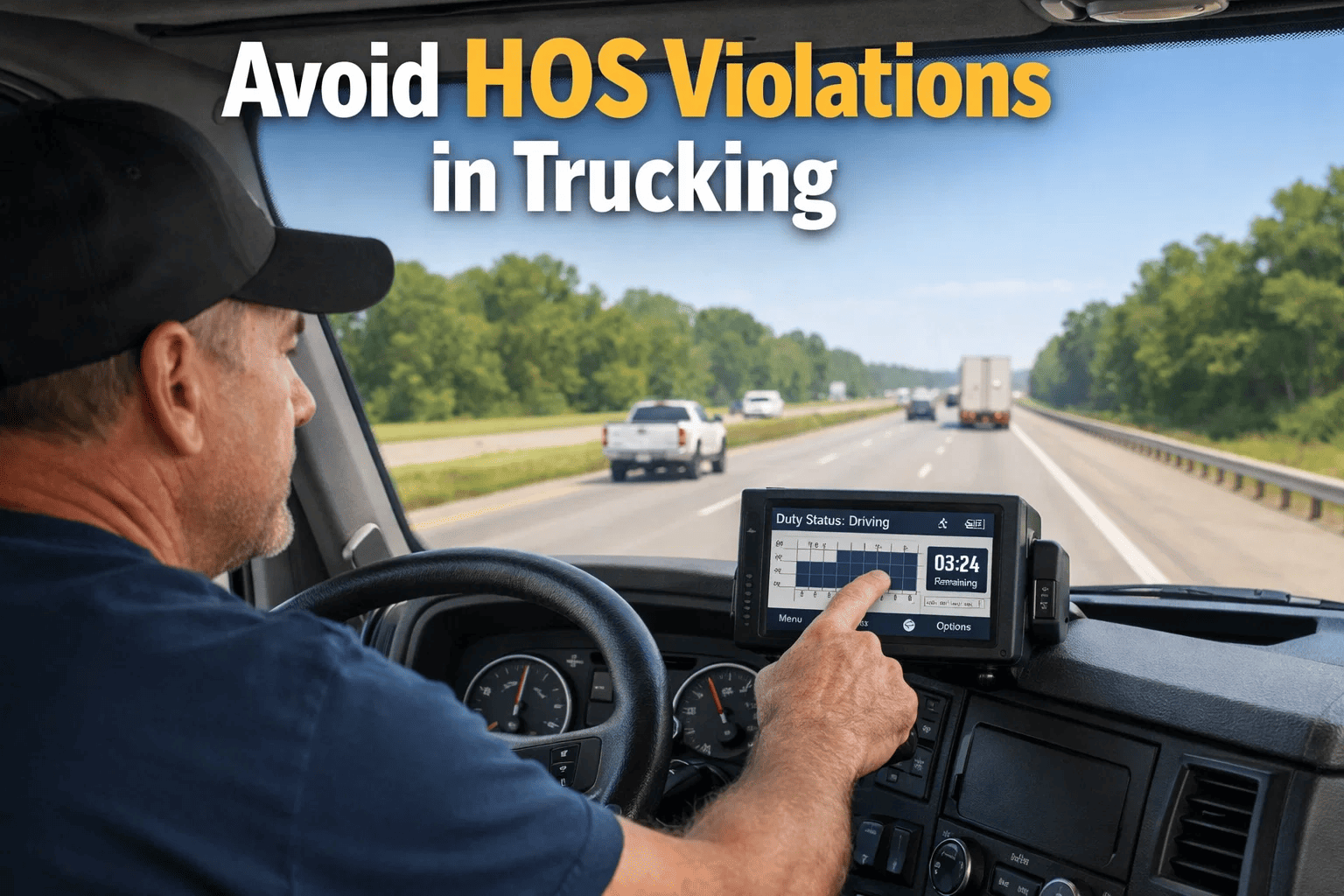
Hours of Service violations are the highest-frequency compliance citation category in commercial trucking — accounting for more roadside out-of-service orders, more CSA score degradation, and more FMCSA enforcement actions than any other regulatory domain. The financial consequences are direct and compounding: per-violation civil penalties from $1,000 to $16,000, CSA score damage that persists for 24 months and inflates insurance premiums by 20-40%, and the operational disruption of out-of-service orders that remove revenue-generating equipment from the road mid-delivery. What makes HOS violations particularly damaging is their preventability. Unlike equipment failures that occur without warning, HOS violations almost always follow a predictable trajectory that monitoring systems can detect and dispatchers can interrupt — if the right tools and processes are in place. Book a FleetRabbit demo to see real-time HOS violation prevention applied to your fleet operations.
Quick Answer
The most common HOS violations in trucking fleets — 11-hour driving limit violations, 14-hour on-duty window breaches, missed 30-minute breaks, and 60/70-hour weekly limit violations — are preventable through real-time monitoring with pre-violation alerts, dispatcher trip feasibility analysis before load assignment, and structured management processes that intercept developing violations before they become chargeable events. FleetRabbit provides the ELD integration, alert system, and corrective workflows that make proactive HOS compliance operationally achievable rather than aspirationally stated.
The Seven Most Common HOS Violations and Their Operational Root Causes
Understanding which HOS violations occur most frequently — and why they occur — is the foundation of an effective prevention strategy. Each violation type has specific operational conditions that produce it and specific intervention points where prevention is feasible. The following analysis examines the seven most common violation categories with the operational trigger pattern and the FleetRabbit monitoring and prevention approach for each.
01
High Frequency
11-Hour Maximum Driving Limit
Operational root cause: Dispatchers assign loads that extend beyond remaining driving hours without checking HOS status at time of dispatch. Traffic delays, shipper detention, and unexpected route diversions consume time buffers. Pressure to deliver on time overrides compliance discipline when supervisor oversight is limited.
FleetRabbit prevention: Trip feasibility analysis before dispatch flags assignments that cannot be completed within available driving hours. Pre-violation alerts at 60, 45, and 30 minutes to limit notify dispatchers in time to authorize rest, arrange driver swap, or contact consignee to manage delivery expectation. Dashboard shows real-time remaining drive time for all active drivers simultaneously.
02
High Frequency
14-Hour On-Duty Window Violation
Operational root cause: Extended shipper detention at origin or destination pushes the clock on the 14-hour window without consuming driving hours. Drivers who experience lengthy waits before loading still face the 14-hour daily window expiring — creating situations where legally sufficient driving hours remain but the on-duty window is exhausted.
FleetRabbit prevention: The 14-hour window clock begins automatically from the driver's first on-duty action each day. FleetRabbit tracks elapsed on-duty time independently from driving hours — alerting dispatchers when the 14-hour window is at risk of expiring before delivery completion, regardless of remaining driving hours. Detention time tracking identifies chronic shipper delay patterns that create 14-hour window violations.
03
Moderate Frequency
30-Minute Break Requirement Violation
Operational root cause: Drivers on tight delivery schedules skip the required 30-minute break after 8 cumulative hours of driving — particularly when approaching a delivery appointment that the driver believes requires immediate completion. Some drivers misunderstand when the break requirement applies under short-haul exemptions, creating inadvertent violations for drivers who incorrectly believe they qualify for the exemption on a particular day.
FleetRabbit prevention: Automated notification to driver at 7.5 hours of cumulative driving that the 30-minute break requirement is approaching — giving advance notice before the 8-hour mark is reached. Dispatcher visibility of drivers approaching the break requirement allows proactive scheduling of break periods at safe locations rather than reactive compliance after the violation has occurred.
04
High Frequency
60/70-Hour Weekly Limit Violations
Operational root cause: Drivers on 7-day or 8-day operating cycles approach cumulative on-duty hour limits later in the week without dispatcher awareness of their weekly accumulation. End-of-week delivery pressure creates situations where a driver's final loads of the week push accumulated hours past the 60/70-hour limit. Drivers who take the 34-hour restart incorrectly — not including the required 1:00 AM to 5:00 AM period — operate on hours they believe have been reset but legally have not.
FleetRabbit prevention: 7-day and 8-day rolling hour accumulation tracked in real time for every driver. Weekly hour status visible on the dispatch dashboard — identifying drivers approaching the weekly limit before load assignments are made. 34-hour restart qualification is validated against the required overnight periods before the restart benefit is credited to the driver's available hours.
05
Moderate Frequency
Off-Duty and Sleeper Berth Misclassification
Operational root cause: Drivers incorrectly classify duty status on ELD records — logging as off-duty during periods when they remain responsible for the vehicle, logging short breaks as off-duty rather than on-duty not-driving, or failing to use the correct sleeper berth split provisions. ELD form and manner violations result from after-the-fact log editing, missing required notes, or incorrect location entries on the ELD record.
FleetRabbit prevention: ELD integration provides real-time duty status classification review — flagging duty status changes that appear inconsistent with GPS location, vehicle movement, or time-of-day patterns. Driver coaching workflows for misclassification patterns identified through log audit. Required ELD notation reminders for commonly missed entries (adverse driving conditions, sleeper berth certifications).
06
Lower Frequency
Short-Haul Exemption Over-Reliance
Operational root cause: Drivers operating under the 150 air-mile or 100 air-mile short-haul exemptions on days that qualify occasionally take assignments that exceed the geographic or time boundaries of the exemption — creating RODS violations because ELD logging was not initiated for a day the driver incorrectly believed would remain within the exemption boundary. One non-qualifying day in a week does not affect other days but creates a violation for that specific day.
FleetRabbit prevention: Short-haul exemption qualification is tracked at the load assignment level — alerting dispatchers when a load assignment would require a driver operating under the short-haul exemption to exceed the time or distance boundary that makes the exemption applicable. ELD logging initiation prompt activated automatically when the exemption boundary is approached.
07
Lower Frequency
Team Driver Coordination Violations
Operational root cause: Team drivers sharing a sleeper berth across extended routes face complex HOS calculations — the sleeper berth split provision requires specific combinations of berth time and driving time to be legally valid. Coordination errors between co-drivers, incorrect sleeper berth qualification, or confusion about which driver's 8-hour clock is running create violations that neither driver nor dispatcher detected in the multi-day operational cycle.
FleetRabbit prevention: Team driver HOS tracking maintains separate compliance records for each driver while correlating activity across co-driver pairs. Sleeper berth split qualification is validated in real time against the regulatory requirements — alerting team drivers when a planned berth period will not qualify as a compliant split and recommending adjustment to the rest schedule before the compliance issue is locked in.
FleetRabbit's Three-Layer HOS Prevention Architecture
Effective HOS violation prevention requires intervention at three different operational stages — before the driver's shift begins, during active operations while decisions can still be changed, and as a retrospective learning mechanism after violations occur despite preventive measures. FleetRabbit structures HOS compliance support across all three stages to create a comprehensive prevention framework rather than a single-point alert system.
Layer 1: Pre-Shift Prevention
Trip and Schedule Planning Compliance Review
Before a driver begins a shift or a dispatcher assigns a load, FleetRabbit calculates the HOS budget available for the driver — current weekly accumulation, yesterday's end-of-shift status, time since last rest period, and projected accumulation through the day's assignments. Trip feasibility analysis compares planned route distance and estimated transit time against available driving hours — flagging assignments that create HOS violation risk before the driver departs.
Analysis: Driver R. Thompson — Available driving: 8h 20m. Assigned load: Chicago to Indianapolis (280 miles, est. 4h 45m transit). Detention buffer assessment: Last three loads at this shipper averaged 1h 15m detention. Remaining hours after delivery: 2h 20m. Assessment: LOW RISK. Alternate scenario analysis available if departure delayed beyond 11:00 AM.
Layer 2: Real-Time Prevention
Active Monitoring and Pre-Violation Alerts
During active operations, FleetRabbit monitors every driver's HOS status in real time from the ELD data integration — tracking driving time, on-duty time, weekly accumulation, and break compliance simultaneously. Configurable alert thresholds trigger notifications to dispatchers and drivers through the mobile app at pre-violation warning intervals. Alerts contain specific recommended actions — rest location options, estimated impact on delivery schedule, driver swap availability within the operations roster.
Alert 14:37 CST: Driver M. Jefferson — 10h 12m driving. 48 minutes to 11-hour limit. Current location: I-70 WB near Salina, KS. Remaining route: 213 miles to Denver (3h 22m est.). REQUIRED ACTION: Authorize 10-hour rest. Next available truck stop: 6 miles (Exit 249). Consignee appointment impact: +10h 48m delay, arrival 07:15 tomorrow. Route plan adjusted.
Layer 3: Post-Violation Learning
Violation Analysis and Systemic Correction
When violations occur despite pre-shift and real-time prevention efforts, FleetRabbit documents the violation with full contextual data — operational conditions at the time, dispatcher decisions, driver communications, and contributing factors. Violation analytics identify systemic patterns that require process changes rather than individual corrective action — routes with structural time pressure, dispatchers with elevated violation rates under their supervision, times of day or week when violations concentrate.
Pattern Analysis: Violations on the Atlanta-Charlotte corridor increased 340% in Q3 vs Q2. Root cause analysis: Average shipper detention at Atlanta terminals increased from 47 minutes to 2h 15m during summer peak. Drivers departing Atlanta at 13:00 or later with a full day's driving behind them cannot complete the 4h 20m Atlanta-Charlotte run within remaining hours after detention. Systemic recommendation: Adjust Atlanta-Charlotte load assignment cut-off time to 11:30 during periods of elevated shipper detention.
Dispatcher Decision-Making — The Human Element in HOS Prevention
Technology that provides accurate HOS data without changing dispatcher decision-making behavior does not prevent violations — it just makes them more visible. Fleet managers implementing FleetRabbit's HOS monitoring often discover that a significant portion of their violations trace back to a small number of dispatch decisions: loads assigned to drivers without checking available hours, delivery commitments made to customers without confirming driver HOS availability, and routine pressure to "make it work" that overrides compliance considerations when time is tight.
FleetRabbit provides dispatchers with the HOS data visibility they need to make compliance-informed decisions at the point of load assignment — not as a secondary consideration but as a primary input to the dispatch workflow. When a dispatcher navigates to the load assignment screen, the HOS status of available drivers is visible alongside their current location and equipment type. The system flags assignments that create HOS risk during the tender process — before the assignment is confirmed — rather than alerting after the driver is en route and the flexible intervention window has closed.
HOS Violation Prevention
Stop HOS Violations Before They Become CSA Score Events
FleetRabbit's three-layer HOS prevention system monitors every driver's hours in real time, alerts dispatchers before violations occur, and provides the trip planning analysis that keeps compliance status visible at every assignment decision point.
87%
Reduction in HOS Violations After 6 Months
60 min
Pre-Violation Alert Lead Time
The Financial Case for HOS Compliance Investment
Fleet executives evaluating investment in HOS compliance technology require a clear financial return analysis — not a compliance argument. The financial case for HOS prevention is grounded in four quantifiable cost categories, each of which is independently sufficient to justify platform investment for most fleet sizes.
Direct FMCSA Penalty Avoidance
FMCSA civil penalties for HOS violations: $1,000 to $16,000 per violation for driver and carrier. A fleet with 50 drivers averaging three chargeable HOS violations each per year faces $150,000 to $2.4 million in annual penalty exposure. Real-world enforcement experience: most fleet operations subject to compliance review have multiple violations identified simultaneously, with total penalty assessments frequently exceeding $100,000 per enforcement action.
Annual Savings Potential: $50,000 — $500,000+
Insurance Premium Impact
Commercial trucking insurance premiums are directly tied to CSA score profiles. Carriers with HOS BASIC scores above intervention threshold pay 20-40% higher insurance premiums than clean-record peers. For a 50-truck fleet paying $10,000 per truck per year in primary liability and cargo insurance, a 30% premium differential represents $150,000 in annual excess cost — cost that accumulates for 24 months after violations are recorded.
Annual Savings Potential: $50,000 — $200,000
Out-of-Service Order Losses
HOS violations can result in driver out-of-service orders at roadside with duration based on violation severity. A driver placed out of service for 10 hours on a high-priority lane loses one delivery cycle — the customer service impact, missed delivery penalties, and emergency coverage costs from driver out-of-service events often exceed the penalty amount. Equipment idling while the driver serves the out-of-service period is direct lost revenue.
Per Incident Cost: $2,000 — $15,000
Shipper Contract Eligibility
Major shippers and freight brokers increasingly require minimum CSA score thresholds as carrier qualification criteria. A fleet with elevated HOS BASIC scores is ineligible for premium freight lanes that require clean CSA profiles — limiting the fleet to spot market loads at lower rates and higher volatility. CSA score improvement from HOS prevention translates directly to expanded shipper qualification and access to contracted freight at premium rates.
Revenue Access Impact: Contract Lane Qualification
HOS Exemptions — Managing Complexity Without Creating Violations
The HOS regulatory framework includes several exemptions that modify the standard rules for specific operations, cargo types, or geographic circumstances. Each exemption has specific qualification criteria that must be met for the exemption to apply — and drivers who operate under an exemption that does not actually apply to their situation create violations more serious than a simple overhours event because they reflect a pattern of exemption misuse rather than an execution error.
The most commonly relevant exemptions include the short-haul exemption (150 air-mile radius for property carriers, 100 air-mile radius for passenger carriers), the agricultural commodity exemption (within 150 air miles of the source of the agricultural commodity), the adverse driving conditions exemption (extending the driving window by 2 hours when unexpected adverse conditions arise en route), and the construction material exemption applicable in some states. FleetRabbit's HOS monitoring applies the correct rule set to each driver based on their configured exemption status and validates daily operations against the applicable standard — alerting when a driver's activity on a specific day does not qualify for the exemption they are operating under.
Driver Coaching and HOS Behavior Change
Sustainable HOS compliance improvement requires changing driver behavior patterns — not just monitoring their compliance after violations occur. FleetRabbit supports structured driver coaching workflows that translate violation data into targeted training interventions, converting the compliance record into a continuous improvement mechanism for driver performance.
1
Pattern Identification
FleetRabbit's driver analytics identify specific HOS compliance patterns for each driver — which violation types, which days of the week, which route types, and which shipper locations are associated with their violation history. Coaching interventions targeted to actual behavior patterns are measurably more effective than generic compliance reminders.
2
Structured Coaching Session
Compliance coordinator conducts a documented coaching session using the driver's FleetRabbit violation history — reviewing specific events, discussing operational conditions, and identifying strategies for compliance in similar future situations. Session notes and driver acknowledgment recorded in the driver's compliance file for HR documentation purposes.
3
Heightened Monitoring Period
Following a coaching intervention, the driver's HOS alerts are set to earlier warning thresholds — notifying the dispatcher at 90 and 75 minutes to limit rather than 60 — creating additional prevention lead time during the period when behavioral change is being reinforced. Heightened monitoring is documented as part of the progressive discipline record if subsequent violations occur.
4
Compliance Progress Tracking
Driver compliance rate is tracked weekly following coaching intervention — comparing violation frequency in the 90-day post-coaching period to the 90-day pre-coaching baseline. Improvement trends are documented; drivers who do not show improvement despite coaching interventions are flagged for escalated review including potential route reassignment or employment action with full documentation.
Frequently Asked Questions
QHow does FleetRabbit handle HOS compliance for drivers using the sleeper berth provision?
FleetRabbit tracks sleeper berth periods as classified by the ELD and validates that the split slumber berth provision requirements are met — specifically that the two berth periods total at least 10 hours and that at least one consecutive period is at least 7 hours (with the companion period being at least 2 consecutive hours). The system validates that neither berth period is counted against the 14-hour driving window for the period it covers, and that the combination of both berth periods provides a compliant restart of the applicable hours. Misclassified or inadequate berth periods are flagged for driver review and corrective documentation.
QWhat happens if a driver disagrees with an HOS violation recorded in FleetRabbit?
FleetRabbit provides a driver annotation workflow for disputed violation records — drivers can add explanatory notes to any violation record through the mobile app, documenting the operational circumstances they believe constitute grounds for exception or exemption application. Disputed records are flagged for compliance officer review, who can apply exemption credits, annotate the record with the review determination, or confirm the violation as chargeable. The annotation and review history is preserved in the violation record — providing a complete documentation trail for any subsequent enforcement or legal review of the specific event.
QHow does FleetRabbit's HOS monitoring integrate with our current ELD provider?
FleetRabbit integrates with ELD providers through API data connections that pull duty status records, driving events, and on-duty classifications directly from the ELD system in real time. The integration approach varies by ELD provider — some support direct API access, others require periodic data export. During implementation, FleetRabbit's technical team assesses the integration options with your current ELD and configures the data connection appropriate to the provider's API capabilities. For fleets where the current ELD does not support adequate integration, FleetRabbit offers its own FMCSA-compliant ELD application as an alternative.
Discuss your current ELD setup in a technical scoping call.
QCan FleetRabbit help fleets that have already accumulated elevated CSA HOS scores?
Yes, in two ways. First, FleetRabbit prevents new violations from occurring — stopping additional score accumulation while existing violations age off the 24-month window. Second, FleetRabbit's detailed inspection and HOS records support DataQ challenge submissions for incorrectly recorded inspection findings. If a cited violation was factually inaccurate — the ELD record shows correct hours but the roadside officer applied the wrong rule or made a documentation error — FleetRabbit's timestamped records provide the evidentiary basis for the DataQ challenge that can remove the violation from the CSA record if the challenge is upheld.
Every HOS Violation That Reaches a DOT Inspection Was Preventable
FleetRabbit gives your fleet the real-time HOS visibility, pre-violation alert system, and dispatch planning tools that prevent chargeable events before they occur — reducing CSA exposure, eliminating penalty risk, and protecting the shipper relationships that require clean compliance profiles.
Real-Time HOS Monitoring
Pre-Violation Alerts
Trip Feasibility Analysis
Driver Coaching Workflows
87% Violation Reduction
April 17, 2026
By Jason Smith
All Posts