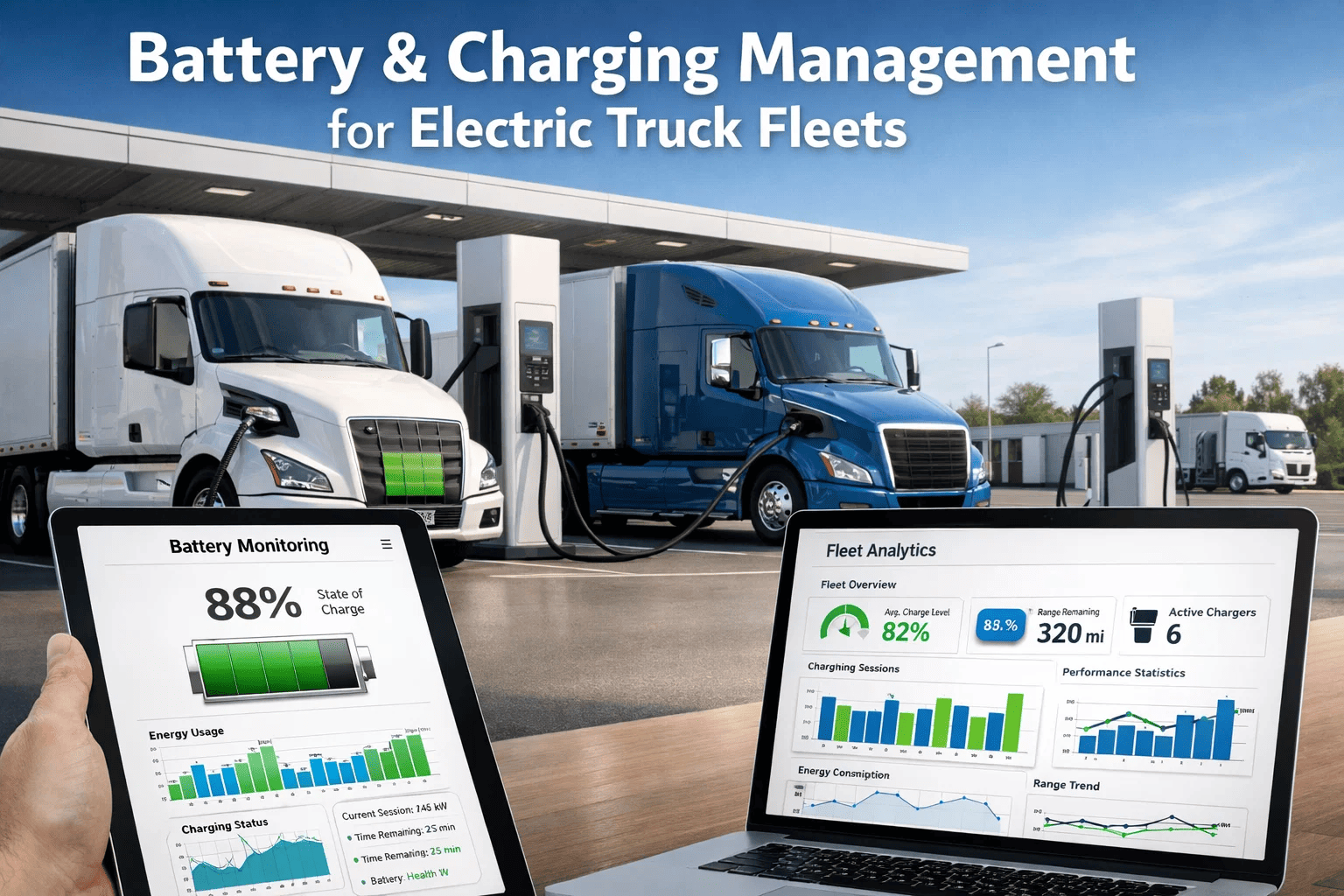
Commercial vehicle fleets transitioning to electric trucks face a management challenge that traditional fleet software was never designed to address: battery health is not analogous to fuel level, charging logistics are fundamentally different from fuel stop planning, and range management requires route-integrated decision-making that cannot be retrofitted onto scheduling systems built for diesel operations. Fleets deploying Class 6 to 8 electric commercial vehicles without a purpose-built EV fleet management strategy experience 30 to 45 percent higher operational costs per mile than projected — not because the vehicles underperform, but because the management infrastructure around them was designed for a different technology entirely. FleetRabbit's EV fleet management module is built for the operational reality of electric commercial vehicles in logistics environments — integrating battery management, charging optimization, and range-aware dispatch into a single platform alongside your existing ICE fleet operations. Book a demo to see FleetRabbit's EV fleet management capabilities for your operation.
EV Fleet Best Practices
Battery and Charging Management for Electric Truck Fleets: Optimizing Battery Health, Charging Strategy, and Range-Aware Operations for Commercial EV Fleets
ELECTRIC FLEET OPERATIONS GUIDE
Battery and Charging Management for Electric Truck Fleets: From Procurement to Profitable Operations
Battery degradation, charging infrastructure gaps, and range anxiety are not EV technology problems — they are fleet management problems. Organizations that implement systematic battery monitoring, charging optimization, and range-integrated dispatch achieve total cost of ownership advantages that justify EV investment. Those that manage EVs with diesel-era tools spend the advantage before capturing it.
30–40%
Battery capacity loss from improper charging management over 3 years
$180K
Cost of premature battery pack replacement due to avoidable degradation
94%
Battery lifespan extension from optimal charging window management
The Battery Management Fundamentals Every Fleet Operator Must Understand
01
State of Charge Window Management
Lithium-ion battery chemistry degrades significantly faster when regularly charged above 80% or discharged below 20%. Fleet operations that routinely charge to 100% for maximum range and deplete batteries to near-zero produce accelerated cell degradation — reducing battery lifespan from the manufacturer's 10-year specification to 5 to 6 years in operational practice. Systematic charging window management targeting 20 to 80 percent state of charge extends usable battery life while maintaining adequate operational range for most commercial routes.
02
Temperature's Impact on Battery Performance and Longevity
Battery performance and longevity are significantly temperature-dependent. Charging lithium-ion cells in extreme cold (below -10°C) causes permanent lithium plating that reduces capacity irreversibly. Operating in extreme heat (above 40°C) accelerates calendar aging. Fleet operations in climates with temperature extremes require battery thermal management monitoring as a core fleet management function — not an afterthought discovered during first winter operations.
03
DC Fast Charging Frequency and Battery Health
DC fast charging delivers energy at rates that generate significant heat within battery cells. Frequent DC fast charging as a primary charging strategy accelerates degradation. Optimal strategy for commercial fleets uses overnight AC Level 2 charging as the primary charge method — batteries replenished during vehicle downtime — with DC fast charging reserved for operational necessity, not convenience. FleetRabbit's charging management tracks the ratio of DC fast to AC Level 2 sessions per vehicle as a battery health indicator.
04
Battery State of Health vs. State of Charge
State of Charge (SoC) is the present energy level — the equivalent of a fuel gauge. State of Health (SoH) is the battery's current capacity relative to original specification — degrading over time and charge cycles. Fleet managers who monitor only SoC discover SoH degradation when range falls below operational requirements, rather than identifying declining health before it becomes a dispatch limitation. FleetRabbit monitors SoH trend longitudinally, flagging accelerating degradation before it produces operational failures.
How FleetRabbit Manages Battery Health Across Mixed EV Fleets
Manage Your Electric Fleet With the Same Intelligence You Apply to Your ICE Fleet
FleetRabbit's unified fleet management platform handles battery monitoring, charging optimization, range-aware dispatch, and EV cost tracking alongside your diesel and gas fleet operations — without requiring a separate EV management system. Book a demo to see FleetRabbit's EV fleet module.
Charging Infrastructure Strategy for Commercial EV Fleets
Charging infrastructure decisions made at fleet electrification planning determine total cost of ownership outcomes for the vehicle's entire service life. Depot charging infrastructure sized for current fleet EV count cannot accommodate growth. Public charging reliance creates driver time loss and higher per-kWh costs. Strategic charging infrastructure planning — sized for growth, structured for cost optimization, and integrated with fleet management software — is a foundation investment that compounds in return over the vehicle lifecycle.
Level 2 AC Depot Charging
6.2–19.2 kW per port
20–40 miles of range per hour
Primary charging method for overnight and multi-hour depot dwell time. Battery-friendly charging rate. Lowest cost per kWh. Optimal for predictable return-to-depot operations.
Recommended Primary Strategy
DC Fast Charging
50–350 kW per port
100–300+ miles of range per hour
En-route charging for long-haul operations beyond single-charge range. Higher per-kWh cost. Increased battery degradation with frequent use. Reserve for operational necessity — not convenience routing.
Strategic Supplemental Use
Opportunity Charging
7.2–22 kW typical
15–30 miles of range per hour
Customer site or intermediate depot top-up during loading, unloading, or break periods. Extends effective range without dedicated charging stops. Integration with FleetRabbit route planning maximizes opportunity charging utilization.
Route-Optimization Dependent
EV Total Cost of Ownership Tracking With FleetRabbit
Electricity Cost Per Mile
FleetRabbit calculates actual electricity cost per mile by integrating charging session energy consumption with time-of-use electricity rates. Fleet managers see true energy cost per route, per vehicle, and per driver — enabling comparison against diesel equivalents with accurate cost data rather than estimated kWh calculations.
Maintenance Cost Comparison
EV maintenance cost tracking captures actual service expenses across the fleet lifecycle. Brake pad longevity (extended through regenerative braking), reduced fluid service requirements, and elimination of combustion system maintenance tracked against equivalent ICE vehicle maintenance spend — documenting actual TCO advantage.
Battery Health Impact on Asset Value
FleetRabbit's SoH trending provides battery condition documentation for asset valuation, resale preparation, and lease return purposes. Battery health certificates generated from longitudinal monitoring data — providing objective condition evidence that maximizes residual value negotiation positions.
ChargeVehicle Downtime Tracking
Charging session duration logged against vehicle availability window. When charging extends beyond scheduled completion, dispatch is notified before route departure time impact occurs. Charging infrastructure reliability tracked — identifying station failures before they create repeated operational disruptions.
Frequently Asked Questions: EV Fleet Battery and Charging Management
QHow does FleetRabbit integrate with our depot charging infrastructure?
FleetRabbit integrates with OCPP-compliant charging management systems through API connection. Charging session data — start time, energy delivered, ending state of charge, and session cost — flows automatically into FleetRabbit without manual logging. Non-OCPP legacy charging infrastructure can integrate through manual session logging or third-party data connectors. Integration scope assessed during implementation planning with your specific hardware configuration.
QCan FleetRabbit manage mixed EV and diesel fleets in the same interface?
Yes. FleetRabbit's unified fleet management interface handles ICE, hybrid, and fully electric vehicles in a single operational view. Dispatchers see all vehicles regardless of powertrain type. EV-specific data fields (SoC, SoH, charging status, estimated range) appear for electric vehicles while standard fuel and maintenance fields apply to ICE vehicles. No separate platform required for mixed fleet management — simplifying operator training and eliminating data synchronization requirements across separate systems.
QWhat happens to EV range predictions when battery health degrades?
FleetRabbit's range calculations use current measured state of health rather than manufacturer specification capacity. As battery health decreases from 100% to 85% SoH, range estimates automatically adjust downward to reflect actual usable capacity. Dispatchers are never working from stale specification-based range assumptions — they see current actual range capability for each vehicle at each dispatch decision. Route assignments that were range-adequate at vehicle delivery are flagged as marginal when battery degradation creates practical limitations.
QHow should we plan charging infrastructure capacity for fleet EV growth?
Infrastructure should be sized for projected fleet EV percentage at Year 3, not current year EV count. Electrical service upgrades typically require 12 to 18 months of planning, permitting, and installation. Deploying 5 EVs with infrastructure sized for 5 EVs requires a full infrastructure expansion project to add the next 10. FleetRabbit's fleet electrification planning support helps operations model future charging load requirements at projected EV adoption rates and identifies infrastructure investment timing that avoids reactive upgrades.
Electric truck fleet management is not a modified version of diesel fleet management — it requires purpose-built tools for the operational realities of battery-powered commercial vehicles. The fleets achieving their projected EV total cost of ownership advantages are those that invest in battery monitoring infrastructure, charging optimization strategy, and range-aware dispatch tools from first vehicle deployment — not those that retrofit diesel-era management practices onto an incompatible technology.
FleetRabbit's EV fleet module provides the management layer that makes electric commercial vehicles operationally viable at scale — protecting battery assets worth $80,000 to $180,000 per vehicle through proactive SoH monitoring, optimizing charging costs that represent 35 to 40 percent of EV operating expenses, and preventing the range-insufficient dispatch decisions that erode driver confidence in electric operations before the technology demonstrates its cost advantages.
Optimize Your Electric Fleet From Battery Health to Profitable Operations
FleetRabbit's EV fleet management module protects battery assets, optimizes charging costs, and ensures range-sufficient dispatch — in the same platform managing your ICE fleet. No separate EV system. No data fragmentation. One platform for your entire fleet.
Battery Health Monitoring
Charging Optimization
Range-Aware Dispatch
Mixed Fleet Management
EV Cost Tracking
April 15, 2026
By Nathan Smith
All Posts