.png)
Fleet maintenance represents the single largest operational expense category for trucking companies, consuming 15 to 25 percent of total operating costs. Yet most trucking companies still manage maintenance through fragmented systems: paper work orders, spreadsheet tracking, disconnected service histories, and reactive repairs triggered by vehicle breakdowns rather than preventive schedules. This fragmentation creates persistent operational challenges: vehicles fail unexpectedly, creating unplanned downtime that stops revenue immediately. Maintenance costs spike through emergency repair premiums when breakdowns occur in the field. Regulatory compliance risks emerge when inspection and service records cannot be quickly consolidated for DOT audits. Driver satisfaction decreases when vehicle downtime creates unreliable equipment. The right fleet maintenance software transforms this reactive, expensive model into a proactive system where preventive maintenance is scheduled automatically, defects are identified before they become failures, service records are organized for instant compliance verification, and maintenance costs decrease 15 to 20 percent through the shift from emergency repairs to planned maintenance. This comprehensive guide evaluates the best fleet maintenance software options for trucking companies in 2026, comparing features, pricing models, implementation requirements, and ROI outcomes.
Find the Right Maintenance Software for Your Trucking Fleet
FleetRabbit's maintenance management platform combines digital DVIR inspections, automated work orders, predictive maintenance scheduling, and complete compliance documentation into one system designed specifically for trucking operations.
Why Fleet Maintenance Software Matters for Trucking Companies
Trucking companies depend on vehicle reliability. A single truck breakdown creates cascading operational failures: the driver is idle (and still being paid), the customer shipment is delayed, the trailer is stranded in the wrong location, and the breakdown might trigger missed delivery penalties. Preventing breakdowns through systematic maintenance is far less expensive than reacting to failures. Yet preventing breakdowns requires visibility into when maintenance is due, discipline to schedule preventive work before problems emerge, and the ability to track maintenance completion across dozens or hundreds of vehicles and drivers. Manual processes fail at this scale. Spreadsheets don't automatically track which vehicles are due for service. Paper work orders get lost or processed slowly. Service histories buried in shop files cannot be quickly retrieved for compliance audits. The financial impact of maintenance failures compounds across a fleet: each vehicle represents a separate maintenance failure risk, so a 50-vehicle fleet with only 80 percent maintenance compliance means 10 vehicles are at elevated failure risk at any moment.
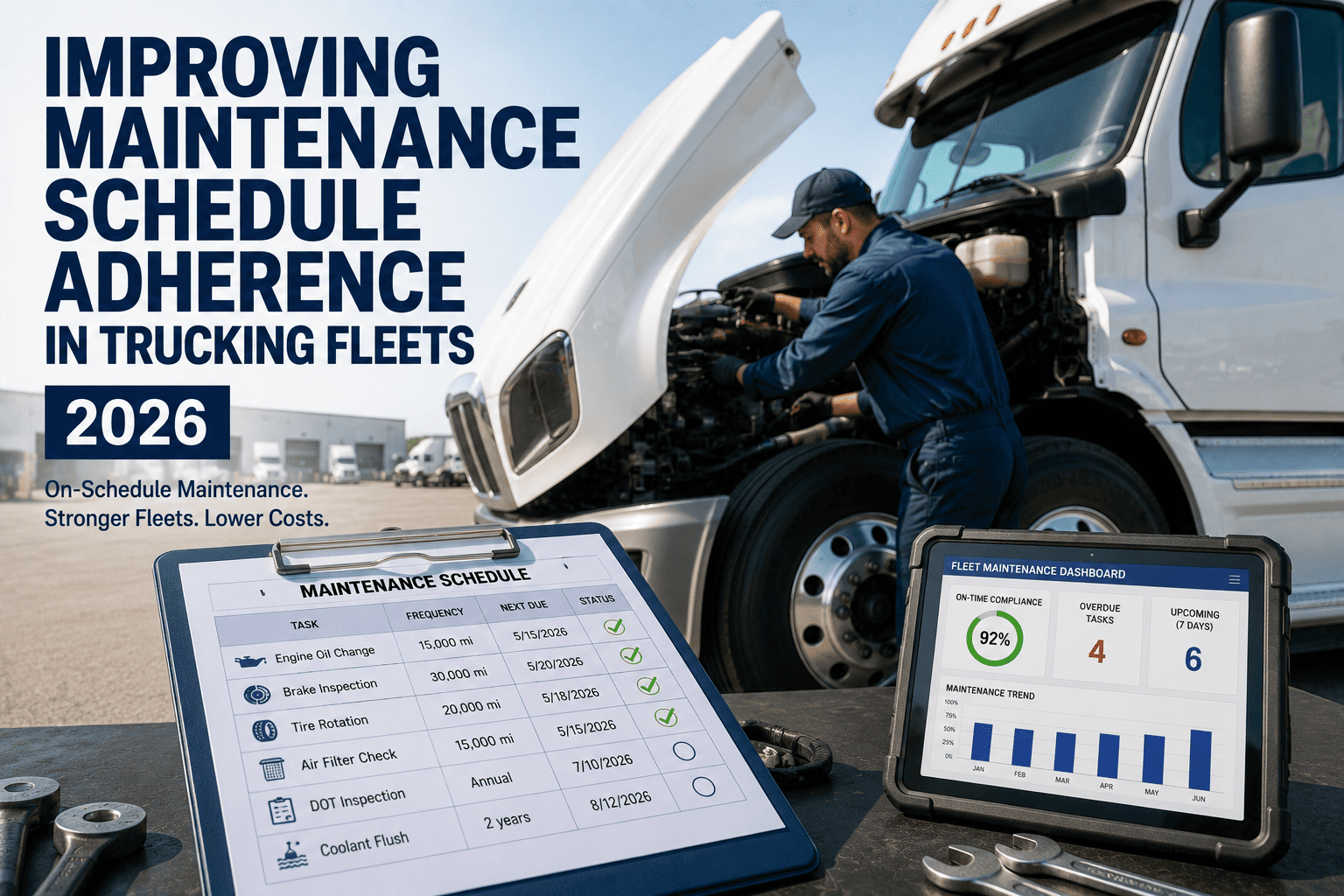
Fleet maintenance software transforms this equation. Preventive maintenance is automatically scheduled based on mileage, engine hours, or calendar intervals. Digital inspections immediately flag developing problems to maintenance teams. Work orders are generated automatically when vehicles reach service due dates. Service histories are organized for instant DOT audit compliance. Mechanics track repair completion, parts used, and labor hours through mobile apps. Parts inventory is managed automatically. Overall, properly implemented maintenance software reduces emergency repairs by 60 to 70 percent, decreases vehicle downtime by 30 to 40 percent, and improves vehicle uptime from 80 to 85 percent baseline to 95 to 98 percent post-deployment.
Comparing Fleet Maintenance Software Options for Trucking in 2026
The fleet maintenance software market in 2026 includes solutions ranging from basic work order tracking to comprehensive platforms integrating inspections, maintenance, compliance, and predictive analytics. Below is an objective comparison of the leading options for trucking companies.
| Software Platform | Core Price Range | Best For | Key Strengths | Considerations |
|---|---|---|---|---|
| FleetRabbit | $29-79/vehicle/month | Growing trucking fleets seeking all-in-one maintenance plus compliance | Digital DVIR + work orders + compliance docs. Automation-first. Quick deployment. No contracts. | Best for 10-500 vehicle fleets. Newer platform with rapid feature development. Free tier available. |
| Samsara | $35-99/vehicle/month | Large fleets requiring comprehensive telematics plus maintenance | Enterprise-grade platform. Advanced telematics. Predictive diagnostics. Multi-location support. | Requires 3-5 month implementation. Higher cost. Contracts typical. Overkill for small fleets. |
| Verizon Connect Fleet | $28-65/vehicle/month | Fleets already using Verizon services or prioritizing GPS tracking | Integrated with Verizon network. GPS tracking solid. Customer support available. Established platform. | Maintenance features less developed than competitors. GPS-focused rather than maintenance-focused. |
| Geotab Drive | $25-60/vehicle/month | Cost-conscious small to mid-size trucking fleets | Affordable. Telematics capable. Open API. Good GPS tracking. Supports custom integrations. | Maintenance module basic. Minimal compliance features. Fewer built-in automation features. |
| Omnitracs One | $40-95/vehicle/month | Trucking companies needing compliance-first solutions | Purpose-built for trucking. HOS features comprehensive. Compliance strong. Driver experience solid. | Higher cost tier. Maintenance not primary focus. Complex pricing model. Multi-year contracts. |
| Mechanic Legacy Systems (Dude Solutions, etc.) | $15-35/vehicle/month | Shops seeking traditional work order management | Affordable. Shop-focused interface. Established user base. Parts tracking available. | Older architecture. Limited mobile experience. No inspection integration. Poor compliance features. |
Critical Maintenance Software Features for Trucking Companies
Not all fleet maintenance software is created equal. Trucking companies evaluating solutions should prioritize these specific capabilities that directly impact operational and financial outcomes.
Implementation Approaches: From Quick Wins to Full-Scale Deployment
Fleet maintenance software implementation strategies vary based on fleet size, current processes, and business priorities. Most successful deployments follow a phased approach starting with highest-impact functionality.
Choose Maintenance Software That Fits Your Trucking Operation
The best fleet maintenance software depends on fleet size, budget, and operational priorities. See how FleetRabbit compares on features that matter most to trucking companies.
ROI Analysis: What to Expect from Fleet Maintenance Software
Trucking companies implementing fleet maintenance software typically achieve measurable financial returns within 3 to 6 months. The ROI comes from multiple sources: reduced emergency repair costs through preventive maintenance focus, reduced vehicle downtime through faster maintenance response, reduced administrative labor through work order automation, and prevented compliance violations that would incur penalties.
Selection Criteria: How to Choose the Right Maintenance Software
With multiple vendor options available, trucking companies should evaluate platforms against specific selection criteria that align with business priorities.
Must-Have Capabilities for Trucking Maintenance Software
Common Fleet Maintenance Software Questions
What's the difference between fleet maintenance software and a CMMS?
CMMS (Computerized Maintenance Management Systems) focus on equipment maintenance in stationary environments like factories or hospitals. Fleet maintenance software is designed for mobile vehicles where inspections happen in the field, repairs occur at distributed shops, and compliance documentation must be instantly portable. Fleet-specific software includes mobile inspection apps, GPS integration, and compliance export features that traditional CMMS lack. Book a demo to see fleet-specific capabilities.
Can fleet maintenance software prevent all vehicle breakdowns?
No. Software cannot prevent all failures, but it dramatically reduces emergency repairs. Proper preventive maintenance eliminates 60-70% of emergency repairs by addressing wear before failure. Some random failures will still occur, but systematic preventive maintenance makes them rare exceptions rather than regular occurrences.
How long does implementation take for a 75-vehicle trucking fleet?
Digital DVIR deployment typically takes 1-2 weeks: system setup (2-3 days), mobile app deployment (1 day), driver training (2-3 days), and go-live (1-2 days). Additional modules like work order automation, parts management, and compliance reporting add 1-2 weeks each if implemented in phases. Most fleets see initial value within 2-4 weeks of deployment. Start a free trial to evaluate timeline for your fleet.
What's the typical cost for fleet maintenance software at 75-100 vehicles?
Pricing varies: budget options ($15-30/vehicle/month) cost $1,350-3,000 monthly for 75 vehicles. Mid-market solutions ($30-65/vehicle/month) cost $2,250-4,875 monthly. Enterprise platforms ($65-100/vehicle/month) cost $4,875-7,500 monthly. Most trucking companies see best value in mid-market tier offering balance of features and cost.
Does fleet maintenance software integrate with my existing telematics system?
Most modern platforms support integration with major telematics providers (Samsara, Verizon Connect, Geotab, etc.) via API. This integration brings vehicle diagnostics, GPS data, and component health information into maintenance software. Before selecting software, verify it integrates with your specific telematics provider to avoid expensive custom integration work.
How does fleet maintenance software handle compliance documentation?
Compliant platforms automatically organize DVIR records, maintenance histories, and service documentation in formats required by FMCSA. Reports are generated one-click for audit submission. All required compliance elements included without manual assembly. Documentation completeness is validated automatically to prevent audit gaps.
Can fleet maintenance software track parts inventory?
Most comprehensive platforms include parts tracking: inventory levels monitored, usage per vehicle tracked, reorder alerts generated automatically, supplier integrations enable purchase orders. Parts cost per vehicle calculated for financial analysis. Inventory optimization reduces both obsolete parts holding costs and emergency parts sourcing expenses.
What's the difference between preventive maintenance and predictive maintenance?
Preventive maintenance services vehicles at fixed intervals (every 5,000 miles, quarterly, etc.) regardless of condition. Predictive maintenance uses data analytics and vehicle diagnostics to predict when components will fail and schedules maintenance just before failure. Predictive maintenance reduces service frequency compared to preventive maintenance, but requires more sophisticated software. Most trucking software offers preventive scheduling with optional predictive features.
How do I know if fleet maintenance software will improve ROI?
Calculate current maintenance costs (labor, parts, repairs, downtime), document current uptime percentage, and measure current audit preparation time. After 6 months on proper software, compare: maintenance costs typically decrease 15-20%, uptime typically increases 8-15%, and audit preparation time decreases 30-40 hours. ROI becomes clear within this timeline. Start a free trial to measure baseline metrics and project ROI for your fleet.
Fleet Maintenance Software Categories
Fleet Maintenance Features and Capabilities
Making Your Final Software Selection Decision
Trucking companies evaluating fleet maintenance software should follow a structured selection process: first, document current pain points and success metrics. Second, create a shortlist of platforms matching your must-have criteria. Third, schedule demos with top two or three vendors and evaluate mobile experience directly. Fourth, request references from trucking companies of similar size and ask specific questions about adoption challenges and support quality. Fifth, evaluate pricing against ROI projections and contract terms carefully. Finally, start with a pilot program on a subset of vehicles before fleet-wide deployment. Most successful implementations start with companies getting hands-on experience during a free trial period before making final vendor selection.
See How Fleet Maintenance Software Transforms Your Operations
FleetRabbit combines digital DVIR inspections, automated work orders, preventive maintenance scheduling, and compliance documentation into one platform designed for trucking. No contracts, month-to-month pricing, and free trial available.
Fleet Maintenance ROI and Benefits
Your Fleet Maintenance Software Decision: Next Steps
The best fleet maintenance software for your trucking company depends on fleet size, current processes, budget constraints, and operational priorities. All major platforms offer some form of free trial or demo. Use this trial period to evaluate software against your specific requirements: test mobile experience in the field, verify integration with your telematics provider, examine compliance documentation outputs, and assess support response quality. The platform that feels most natural to your team's workflow and delivers fastest initial value will likely become your long-term solution. Most successful trucking companies start with digital inspections to gain quick wins, then expand to additional modules as their team develops proficiency with the system. This phased approach reduces implementation risk, enables ROI realization within weeks rather than months, and gives your team confidence in the platform before expanding to more complex functions.