.png)
The world's leading trucking companies track 15 million vehicles daily through GPS-enabled fleet management systems. Yet 73% of trucking operations still lack real-time visibility into their fleet, relying on phone calls, manual logbooks, and delayed reports to understand where their trucks are and what condition they're in. Modern GPS tracking for trucking companies delivers three capabilities that older systems never could: updates every 10-30 seconds, automated geofencing with theft prevention, and integrated maintenance alerts that catch mechanical issues before they ground vehicles. This guide ranks the best GPS tracking solutions for trucking in 2026, explains what features actually matter, and shows you how to calculate ROI for your specific fleet size.
FleetRabbit's GPS tracking updates every 10-30 seconds with sub-meter accuracy. Plug into your OBD-II port or use existing telematics hardware. Free for 3 vehicles, $3/vehicle after that.
What GPS Tracking Actually Does for Trucking Companies
GPS tracking software uses satellite positioning and cellular connectivity to show you exactly where every truck, trailer, and piece of equipment is located in real-time. But describing it as "dots on a map" misses the real value. Modern trucking GPS tracking delivers four operational capabilities that improve safety, cut fuel costs, prevent theft, and reduce insurance premiums.
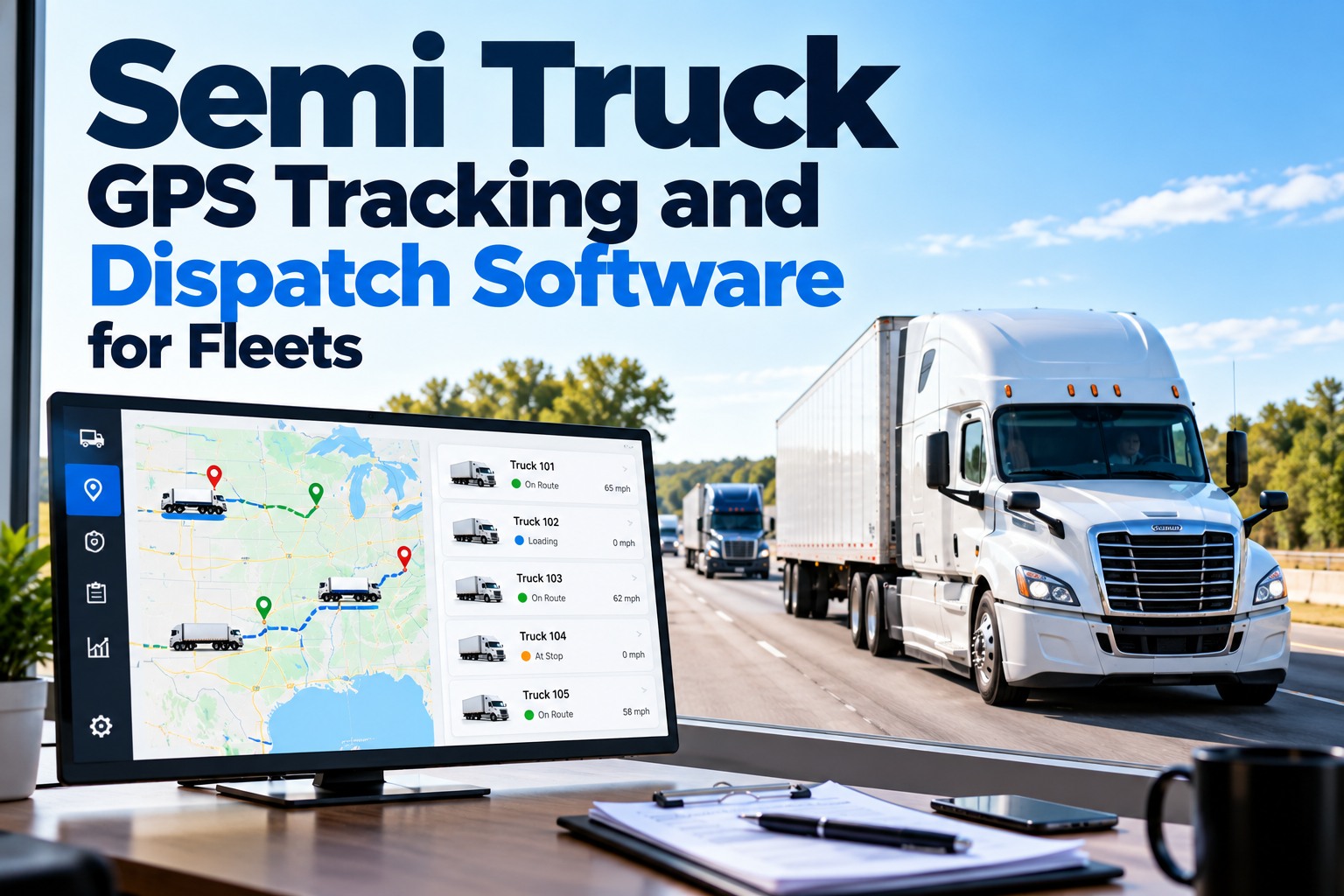
Location updates multiple times per minute, not once per 15 minutes like legacy systems. You see your fleet move in real-time with sub-meter GPS accuracy. Know exactly where every truck is, how fast it's traveling, and what direction it's heading. No more phone calls to drivers asking "Where are you?" The dashboard shows you instantly.
Review the complete path any truck took on any day with every stop, turn, and idle period timestamped and geotagged. See how long vehicles spent at each location, identify inefficient stops, and verify delivery confirmation against GPS waypoints. Route history is audit-ready for customer disputes and insurance claims.
Create virtual boundaries around job sites, customer locations, restricted areas, or delivery zones. Get instant alerts when vehicles enter or exit. Detect unauthorized after-hours movement within 30-90 seconds. Set different geofence rules for different vehicles, shifts, or days of the week.
Receive instant notifications for speeding, harsh braking, rapid acceleration, and distracted driving patterns. Track driver scorecards over time to identify coaching opportunities and reward safe drivers. Lower accident rates improve insurance discounts and reduce liability exposure.
Why GPS Tracking Matters More Than Headcount
Most trucking managers track vehicle count, fuel consumption, and dispatch schedules. But without real-time GPS visibility, you don't know if trucks are running efficiently, if drivers are following assigned routes, if equipment is being used after hours, or if cargo is at risk of theft. GPS tracking reveals operational blind spots that cost money every day.
Without route history, inefficient driving paths go unnoticed. Trucks take indirect routes, idle at locations longer than necessary, or deviate from optimal highways. Average fuel waste from poor routing: 8-12% of total fuel spend.
Trailers parked at truck stops, rest areas, or customer facilities are the most common theft targets. A single stolen trailer carrying electronics, pharmaceuticals, or high-value freight costs $25,000 to $75,000 in immediate loss. GPS tracking detects movement instantly.
Speeding and harsh braking increase accident risk and liability exposure. Without behavior monitoring, dangerous driving patterns go uncorrected until an accident happens. Insurance companies offer 5-15% discounts for tracked fleets with verified safe driving records.
Hours of Service violations are among the most frequent FMCSA enforcement actions. Real-time tracking verifies accurate HOS compliance, geofence data confirms delivery locations, and timestamped route history provides audit-ready documentation.
Without real-time tracking, delivery windows slip and ETA estimates are wrong. Customers can't track inbound shipments. Service calls waste hours in traffic because dispatchers don't know actual vehicle locations. Poor on-time delivery damages customer relationships.
When a truck breaks down, it takes hours to find a backup vehicle or arrange emergency maintenance because you don't know where available trucks are located. Downtime compounds the repair cost.
Seven Measurable Benefits of GPS Tracking for Trucking
Trucking companies that implement GPS tracking typically measure ROI across seven operational dimensions. Here's what best-in-class fleets achieve within 60-90 days of deployment.
Route optimization based on GPS data, idle time reduction from geofencing alerts, and driver coaching on acceleration habits combine to cut fuel spend. A 30-truck fleet burning 12,000 gallons monthly at $3.50/gallon saves $1,260 to $1,890 monthly just from fuel efficiency improvements.
GPS tracking detects unauthorized movement instantly. Live tracking links enable dispatcher-to-law-enforcement handoff in real-time. Tracked fleets recover stolen assets 87% of the time. Untracked fleets recover 12% of the time. Insurance companies offer 5-10% premium discounts for GPS-tracked commercial vehicles.
Insurers offer discounts for GPS-tracked fleets with verified safe driving records, geofence-based delivery confirmation, and dashcam integration. A 30-vehicle fleet with $18,000 annual insurance spend saves $900 to $2,700 annually. ROI breakeven on GPS tracking typically happens within 60 days.
Real-time visibility eliminates route guessing. Dispatchers route trucks around traffic in real-time, adjust ETA notifications based on actual progress, and reallocate loads from delayed trucks to available vehicles. Higher on-time rates improve customer retention and enable premium pricing for rush deliveries.
GPS tracking integrated with maintenance workflows shows fleet managers exactly which trucks are available and where they're located. Emergency breakdowns are diagnosed faster because technicians know the truck's location. Preventive maintenance scheduling based on actual engine hours reduces unnecessary service.
Geofence-triggered location stamps verify delivery locations automatically. Timestamped route history provides FMCSA audit-ready documentation. Real-time HOS monitoring prevents Hours of Service violations. GPS breadcrumbs serve as legal evidence in accident investigations and customer dispute resolution.
Driver scorecards show who is driving safely and who needs coaching. Behavior data combined with route history identifies specific problem areas for training. Safe drivers can be incentivized with bonuses. Fleets with structured driver coaching reduce accident rates by 18-25%.
GPS Tracking Solutions Ranked for Trucking Companies
Not all GPS tracking systems are built the same. Some excel at basic location tracking but lack maintenance integration. Others focus on compliance but don't help optimize routes. This comparison ranks solutions based on 12 critical features: update frequency, geofencing depth, integration breadth, maintenance connectivity, driver behavior monitoring, compliance automation, pricing flexibility, customer support quality, ease of deployment, mobile app functionality, reporting depth, and industry-specific tools.
| Solution | Update Frequency | Geofencing | Maintenance Integration | Compliance Features | Pricing | Best For |
|---|---|---|---|---|---|---|
| FleetRabbit | 10-30 seconds | Unlimited custom zones, entry/exit/dwell alerts | Full integration with work orders and PM scheduling | HOS monitoring, route history, delivery verification | Free (3 vehicles), $3/vehicle | Small to mid-size trucking fleets wanting unified platform |
| Samsara | 5-10 seconds | Advanced geofencing with custom triggers | Basic integration via API | Comprehensive HOS and ELD integration | $30-60/vehicle | Large enterprise fleets with complex compliance needs |
| Verizon Connect | 30 seconds | Standard geofencing with alerts | Limited, third-party dependent | Basic compliance documentation | $25-45/vehicle | Carriers wanting telecom-backed reliability |
| Geotab | 10 seconds | Advanced zoning with custom rules | Strong API for third-party integration | HOS and DVIR via marketplace | $15-35/vehicle | Fleets needing deep telematics and custom integration |
| Motive | 1-2 seconds | AI-powered geofencing with anomaly detection | Integrated maintenance management | Real-time compliance monitoring | $20-40/vehicle | Safety-first fleets with premium budgets |
Compare real-time tracking, geofencing capabilities, and route analysis across your current fleet. No credit card required. Live demo included.
How to Choose GPS Tracking for Your Trucking Fleet
Selecting GPS tracking software requires evaluating six critical dimensions: (1) how frequently location updates occur, (2) what geofencing capabilities exist beyond simple alerts, (3) whether maintenance data integrates directly or requires manual export, (4) how well compliance features support your specific regulatory obligations, (5) whether pricing scales with fleet size or locks you into minimums, and (6) whether customer support includes onboarding and ongoing training.
Most trucking companies need 10-30 second updates for real-time visibility. Some specialized operations (hazmat, high-value cargo) require updates every 5-10 seconds. Basic systems updating every 60-120 seconds create blind spots in traffic or dense urban areas. FleetRabbit delivers 10-30 second updates with sub-meter accuracy.
Standard geofencing allows entry/exit alerts. Advanced systems let you create multiple zones around a single customer location (dock area, parking area, office), set different rules for different times of day (geofence active 9-5 but not 6-8), and trigger escalating alerts (first alert to driver, second to dispatcher, third to manager if no acknowledgment). Define your geofence complexity before selecting software.
If you have an existing maintenance platform (Fleetio, Samsara), GPS tracking should integrate automatically. If you're building a unified platform from scratch, choose GPS software with native maintenance management (like FleetRabbit). Avoid point solutions that require exporting GPS data to email to your maintenance team.
Hours of Service monitoring is required for interstate trucking. Digital DVIR capability is required for vehicles over 10,001 lbs GVWR. Trailer tracking is required for hazmat carriers. Geofence-based delivery verification is required for certain customer contracts. Map your compliance needs and ensure your GPS solution supports them.
Compare not just per-vehicle monthly fees but also hardware costs, setup fees, contract minimums, and whether you're buying GPS-only or a unified platform. FleetRabbit charges $3/vehicle after the free tier with no contracts or hardware purchases required. Enterprise solutions often charge $30-60/vehicle plus $5,000-20,000 implementation fees.
Some systems take 6-8 weeks to implement. FleetRabbit deploys in minutes using existing telematics hardware. Evaluate not just speed of implementation but quality of onboarding. Does vendor send a technician to install devices, or do you handle installation yourself? Is training included or an extra service?
FleetRabbit GPS Tracking vs. Competitors
FleetRabbit's GPS tracking stands apart in three specific ways: real-time integration with maintenance and compliance workflows, transparent $3/vehicle pricing with no contracts, and fastest deployment of any major platform (live in 48 hours using your existing telematics hardware).
ROI Calculator: How Much Can You Save?
GPS tracking ROI varies by fleet size, current operations, and how aggressively you optimize based on data. Here's the math for different fleet sizes assuming you implement the tracked fleet optimizations documented in this guide.
30-Vehicle Fleet Typical Annual Savings
These calculations assume you actively optimize based on GPS data (fuel route changes, idle reduction, theft prevention). Conservative fleets may see 40-60% of these savings. Aggressive fleets optimizing every metric may exceed these estimates.
GPS Tracking Implementation: From Signup to Live in 48 Hours
The best GPS tracking system is useless if it takes 8 weeks to deploy. FleetRabbit goes live in two days using the telematics hardware already installed in your vehicles. Here's the exact process.
Create your FleetRabbit account at fleetrabbit.com (no credit card required). Enter your vehicles manually by VIN or license plate, or import from a spreadsheet. Device configuration and hardware setup takes 10-15 minutes per vehicle. Most fleets complete this step in under 2 hours.
Plug FleetRabbit's OBD-II device into your vehicle's diagnostic port (located under the steering column in most trucks). Devices automatically pair with the cloud platform via cellular connectivity. No app installation, no driver training required. Your fleet appears on the live map automatically as vehicles start moving.
Create geofences around your customer locations, job sites, and depot. Set up alerts for entry, exit, dwell time, and after-hours movement. Configure which users receive which alerts via email, SMS, or push notification. Test alerts with a test vehicle before rolling out to full fleet.
Brief your dispatch, maintenance, and safety teams on how to use the live dashboard, interpret route history, and respond to alerts. Review the first 24 hours of GPS data to identify obvious inefficiencies (long idle periods, route deviations). Implement first optimizations (revised dispatch procedures, driver coaching on specific routes).
No contracts. No implementation fees. No credit card required to start. See your first fleet on a live map tonight. Upgrade from free to paid when you exceed 3 vehicles.
Frequently Asked Questions About GPS Tracking for Trucking
FleetRabbit's GPS tracking integrates with maintenance, compliance, and driver management in a single unified platform. See your entire fleet on a live map with 10-30 second updates. Free for 3 vehicles, $3/vehicle after that. No contracts. No implementation fees. Deploy in 48 hours.