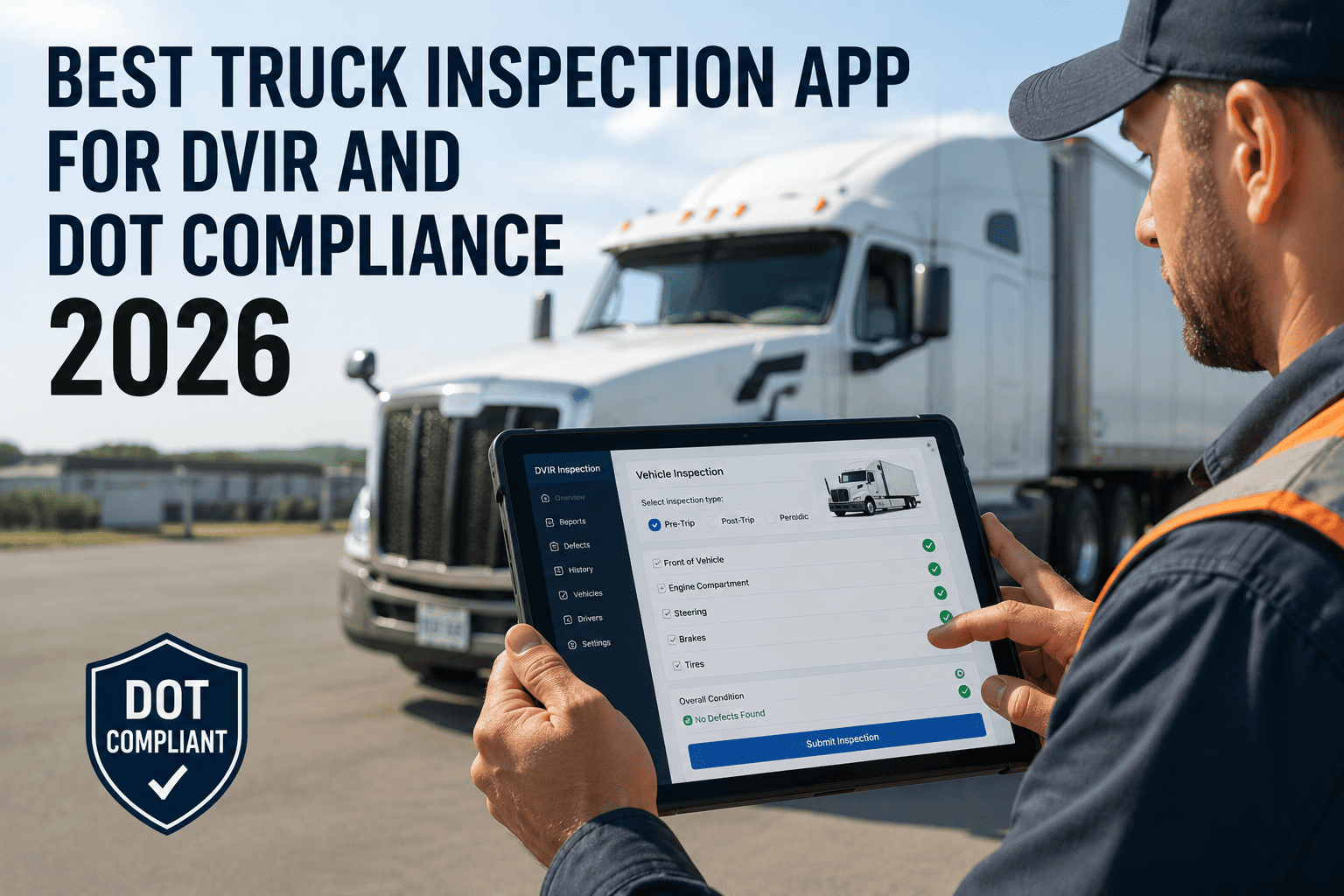
Every commercial fleet in the United States lives under one unavoidable rule: if it isn't documented, it didn't happen. A driver can complete a flawless pre-trip inspection, but if the report is scribbled on a carbon-copy pad that gets lost in a glove box, that inspection is worthless the moment a DOT officer or auditor asks for proof. This is the exact gap that a modern truck inspection app is built to close, and in 2026 that gap has gotten more expensive to ignore. FMCSA's new electronic DVIR final rule, a revised CSA scoring model, and rising violation penalties mean fleets running on paper are now carrying real financial and legal risk every single day.
The best truck inspection app for 2026 combines a digital DVIR built around all 11 FMCSA-required components, timestamped photo evidence, three-way electronic signatures, automatic defect-to-repair workflows, and audit-ready record retention. FleetRabbit brings all of this into one mobile-first platform so drivers finish inspections in under two minutes and fleet managers walk into every DOT audit fully prepared.
Why DOT Compliance Got Harder to Fake in 2026
For years, paper DVIR pads survived because enforcement was inconsistent and audits were infrequent. That cushion is disappearing. On February 19, 2026, FMCSA published its final rule under docket FMCSA-2025-0115 explicitly authorizing electronic creation, storage, and signing of Driver Vehicle Inspection Reports across 49 CFR 396.11 and 396.13, effective March 23, 2026. Electronic DVIRs were technically allowed since 2018 under 49 CFR 390.32, but inconsistent interpretation by different auditors left carriers exposed. That grey area is now closed, and FMCSA has been clear it will not soften the underlying requirement: every defect affecting safe operation still needs a documented chain from the driver who finds it, to the mechanic who certifies the repair, to the next driver who reviews it before dispatch.
At the same time, the CSA Safety Measurement System update split Vehicle Maintenance into two separate scoring categories in 2026, which means a single missed defect or incomplete DVIR record can now damage a fleet's public safety score in two places instead of one. Combined with roadside inspections citing DVIR issues in the majority of compliance reviews, the cost of running an inspection program on paper, memory, or spreadsheets has effectively doubled. A dedicated truck inspection app is no longer a nice-to-have efficiency tool. It is the difference between a clean CSA profile and a fleet that shows up red on federal safety dashboards.
The 11 Components Every DVIR Must Cover
Under 49 CFR 396.11(a)(1), every DVIR must address 11 specific parts and accessories, including service brakes and trailer brake connections, steering mechanism, lighting devices and reflectors, tires, horn, windshield wipers, rear vision mirrors, coupling devices, wheels and rims, emergency equipment, and any defect likely to cause a breakdown or affect safe operation. Property-carrying commercial vehicles only require a written DVIR when a defect is actually found, while passenger-carrying vehicles need one every day regardless of condition. Most experienced fleet managers still require a daily report either way, because a consistent "no defect found" record becomes powerful evidence during litigation and audits.
FleetRabbit digitizes the entire 11-point DVIR workflow, from driver inspection to mechanic certification, so nothing falls through the cracks before your next roadside stop or compliance review. Sign up free and get your first truck inspected digitally today.
What to Look For in a Truck Inspection App
Not every app that calls itself a "digital DVIR tool" actually covers what FMCSA requires. Many are little more than a photo of a paper form, which still leaves signature chains, retention windows, and defect tracking to manual follow-up. The table below breaks down the features that separate a genuinely compliant, audit-ready platform from a basic checklist app.
| Feature | Why It Matters | Impact If Missing |
|---|---|---|
| Full 11-Point Digital Checklist | Matches 49 CFR 396.11 component list exactly so nothing gets skipped | Incomplete DVIRs are among the most cited violations in DOT audits |
| Timestamped Photo Capture | Creates visual, dated evidence attached directly to the defect entry | Disputes over defect severity or repair timing become harder to resolve |
| Three-Way E-Signature Chain | Captures driver, mechanic, and next-driver sign-off required under 396.13 | Broken chain of custody is a common ground for out-of-service orders |
| Automated Defect-to-Repair Routing | Sends flagged defects straight to the maintenance queue in real time | Delayed repairs increase breakdown risk and unplanned downtime cost |
| Offline Mobile Capability | Lets drivers complete inspections in low-signal yards and rural routes | Missed or delayed reports create compliance gaps during travel |
| Exportable Audit Trail | Generates instant, organized records for DOT audits and CSA reviews | Manual record gathering during an audit wastes hours and invites errors |
How FleetRabbit Covers Every Requirement
FleetRabbit was built around the exact structure of 49 CFR 396.11 and 396.13, not a generic checklist template. Every inspection captures the full 11-component list, attaches geo-tagged and timestamped photos to any defect, and routes the entry straight into a repair workflow that mechanics can act on immediately. Once a defect is certified as repaired, the next driver reviews and signs digitally before the truck ever leaves the yard, completing the accountability chain that auditors examine most closely.
Photo Documentation and Defect Severity Flags
Drivers can tag a defect as minor, moderate, or safety-critical, and attach photo evidence in seconds. Safety-critical flags automatically alert dispatch and maintenance so the vehicle is held out of service until it's genuinely safe to operate again.
Automatic Retention and Recordkeeping
DVIRs are stored well past the federally required 3-month minimum, while annual inspection reports and maintenance history are retained automatically for the full periods FMCSA expects, removing the recordkeeping guesswork entirely.
Getting Your Fleet DOT-Ready in Weeks, Not Months
Fleets that switch from paper DVIRs to a structured digital process typically see dramatic improvement in audit readiness within the first 60 to 90 days. Historical inspection data becomes searchable instantly, defect trends across vehicles become visible before they turn into breakdowns, and drivers spend a fraction of the time on paperwork they used to spend hunting for a working pen. If your team is still relying on carbon-copy pads or unlinked spreadsheets, book a free demo to see exactly how quickly a fleet your size can transition.
Watch how a full inspection, from driver checklist to mechanic certification, gets captured, stored, and made audit-ready automatically. Most fleets are fully onboarded within a couple of weeks.
Frequently Asked Questions
FleetRabbit replaces paper DVIR pads and disconnected spreadsheets with one mobile-first inspection workflow built around exactly what FMCSA requires. Fewer violations, faster inspections, and records you can hand over the moment an auditor asks.