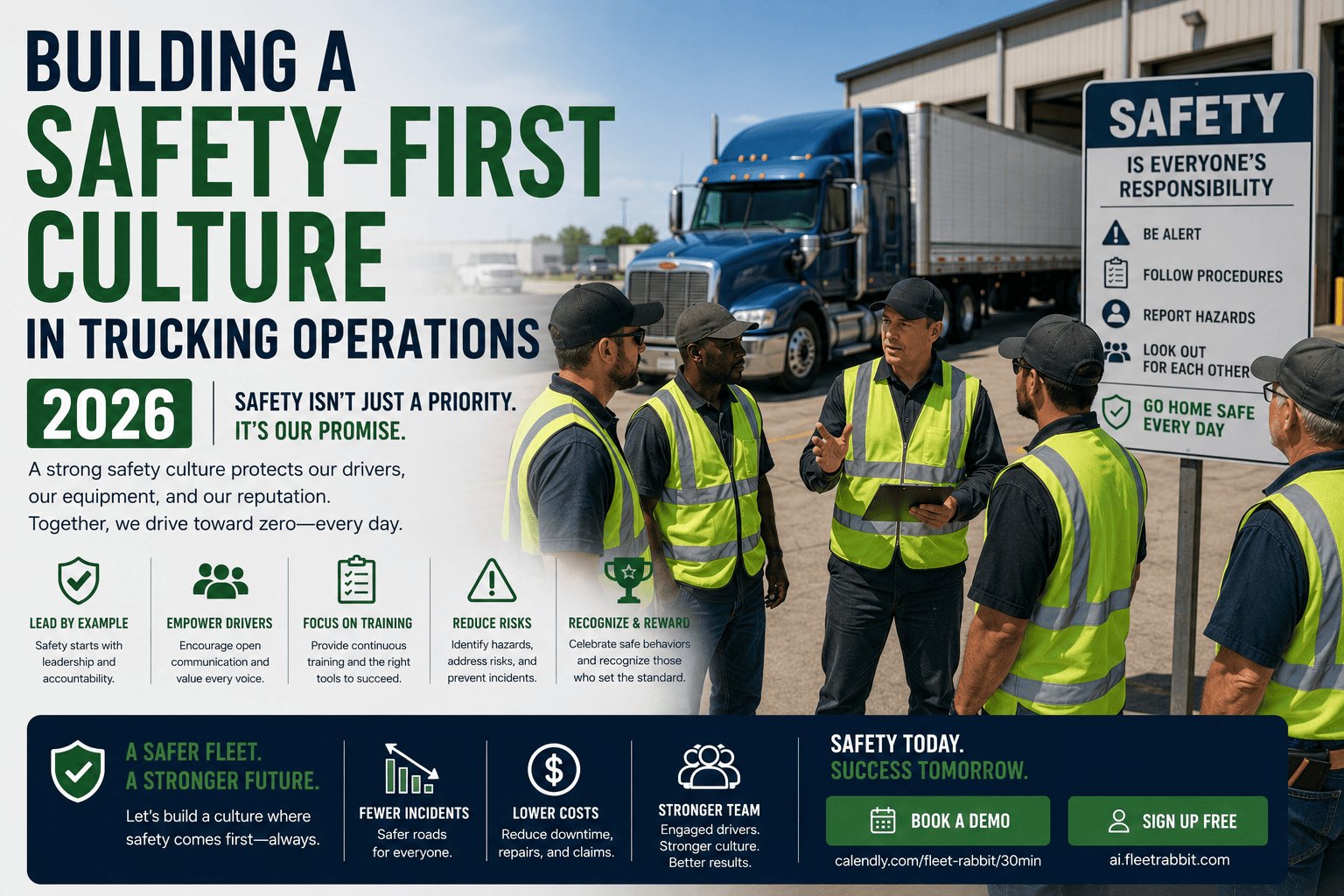
Safety in trucking is not built during a crash investigation. It is built in the thousands of ordinary moments before one, the hard brake that never gets coached, the speeding pattern that goes unnoticed for months, the near miss nobody logs because no one was watching. A real safety-first culture catches those moments while they are still small, before they show up as a violation, a claim, or a driver who no longer wants to work for you. Sign up for FleetRabbit to start turning everyday driving data into coaching moments, or book a demo to see how a proactive safety program fits your fleet.
Every registered carrier is scored on a public CSA percentile built from roadside inspections, violations, and crash history, and that single number can move insurance premiums, trigger FMCSA audits, and determine which loads a broker will trust you with. Fleets that catch risky behavior through real-time monitoring and structured coaching, rather than reacting after a citation or crash, consistently lower their CSA percentiles and cut preventable incidents over time.
Understanding the Scorecard Behind Every Safety Culture
Every safety-first culture in trucking eventually runs into the same public reference point: the CSA percentile maintained by the Federal Motor Carrier Safety Administration. It functions like a report card built from roadside inspections, recorded violations, and crash history, and it shapes decisions well beyond a single citation, from insurance renewal terms to which loads a broker is willing to assign a carrier.
The BASIC Categories That Drive the Score
CSA breaks carrier performance into behavior categories known as BASICs, covering areas like unsafe driving, hours-of-service compliance, vehicle maintenance, and driver fitness. Each violation carries a point weight, and severe violations, like driving 11 or more miles per hour over the limit or using a handheld device, carry the heaviest points and move a fleet's percentile fastest. Understanding which categories carry the most weight lets a safety program focus coaching where it moves the needle quickest.
Why This Becomes a Culture Problem, Not Just a Compliance Problem
A high CSA percentile rarely comes from one bad incident. It usually reflects a pattern, several drivers with recurring speeding events, a maintenance program that lets small defects slide, or a culture where near misses go unreported because nobody asks about them. Fixing the number means fixing the daily habits and reporting culture that produced it, not just responding to whichever violation triggered the last audit.
FleetRabbit surfaces speeding, harsh braking, and other risk indicators as they happen, so coaching can start before a pattern turns into a citation or a claim. Sign up to connect your fleet's telematics data, or book a demo to see the driver scorecard in action.
Where Safety Culture Efforts Pay Off Fastest
Not every safety category carries equal weight. Focusing coaching and monitoring effort where violations are most severe and most common moves a fleet's safety reputation faster than spreading attention evenly across every possible issue.
| Safety Category | What It Covers | Why It Matters Most | Coaching Focus |
|---|---|---|---|
| Unsafe Driving | Speeding, harsh braking, aggressive acceleration, handheld device use | Carries the highest point values and moves percentile fastest | Real-time alerts on speed and harsh events tied to individual drivers |
| Hours-of-Service Compliance | Driving time limits, required rest breaks, log accuracy | Directly linked to fatigue-related crash risk | ELD monitoring paired with proactive schedule adjustments |
| Vehicle Maintenance | Brake condition, lighting, tire wear, defect reporting | Preventable mechanical violations reflect on the whole fleet's record | Pre-trip inspection compliance tracking with photo documentation |
| Driver Fitness | Valid licensing, medical certification, qualification file completeness | Missing documentation is an easy, avoidable violation category | Automated credential expiration tracking with advance alerts |
| Crash Indicator | Reportable crash history and frequency over time | Heavily weighted by regulators when assessing overall carrier risk | Near-miss review and root-cause coaching before a crash occurs |
Building a Proactive Safety Culture, Not a Reactive One
The fleets with consistently strong safety records share a pattern: they treat safety data as an early warning system rather than a post-incident paperwork exercise. Building that culture comes down to a handful of concrete habits repeated consistently.
Make Driving Behavior Visible in Real Time
When drivers know speeding, harsh braking, and aggressive acceleration are visible to a supervisor as they happen, not just after a complaint or citation, behavior changes on its own well before formal coaching even starts.
Coach the Highest-Severity Behaviors First
Not every violation deserves the same urgency. Prioritizing coaching around the highest point-value behaviors, like significant speeding and handheld device use, improves a carrier's overall safety standing faster than addressing every minor issue equally.
Review Near Misses, Not Just Crashes
Harsh braking events and close calls that never result in a filed crash report still carry valuable coaching information. Reviewing them regularly surfaces developing patterns before they escalate into a reportable incident.
Screen New Hires and Set a Written Standard
Pulling a driver's history before hiring catches patterns that will otherwise carry straight into your carrier's own safety record. Pairing that screening with a clear, written safety policy covered in onboarding sets the expectation from day one rather than after the first incident.
What a Strong Safety Culture Actually Buys a Carrier
The benefits of a genuine safety-first culture extend well past avoiding fines. A stronger safety record often qualifies a carrier for lower insurance premiums and fewer roadside inspections, both of which save real operating cost over a year. Brokers and shippers increasingly favor carriers with clean safety records when awarding freight, especially for time-sensitive or high-value loads. Drivers themselves tend to stay longer at carriers that visibly invest in coaching and prevention rather than only handing out discipline after something goes wrong, which helps retention in an industry already strained by driver turnover.
Frequently Asked Questions
The fleets with the strongest safety records are not lucky. They are watching driving behavior in real time and coaching risk before it becomes a violation, a claim, or a lost contract. FleetRabbit brings that visibility into one place. Start your free trial with no credit card required, or book a demo to see your fleet's safety picture today.