A missed or incomplete Driver Vehicle Inspection Report costs your trucking fleet far more than the paperwork headache — it costs you compliance standing, audit credibility, and in FMCSA violation cases, up to $16,000 per infraction. Paper-based DVIR systems fail at every critical point: forms get lost in cabs, defects go unreported to avoid downtime, illegible handwriting creates audit gaps, and the time between a driver flagging a brake issue at 5 AM and a mechanic receiving that information stretches into hours or days. FleetRabbit's digital DVIR system eliminates every one of these failure points — replacing paper logs with a structured mobile workflow that routes defects to maintenance instantly, maintains a timestamped audit trail automatically, and prepares your fleet for FMCSA scrutiny at any moment. Book a demo to see FleetRabbit's digital DVIR system in action.
Quick Answer
Digital DVIR records help trucking fleets stay FMCSA-compliant by capturing pre-trip and post-trip inspections via driver mobile app — with photo-documented defects, digital signatures, automatic maintenance work order creation, and tamper-proof archiving. FleetRabbit's digital DVIR system eliminates paper log gaps, ensures every defect reaches the maintenance shop within minutes, reduces DOT audit preparation from days to under 30 minutes, and maintains a searchable 12-month inspection history accessible to fleet managers in real time.
Why Paper DVIR Systems Are a Compliance Liability
Federal Motor Carrier Safety Regulations (49 CFR Part 396.11 and 396.13) require drivers to complete a vehicle inspection report for every vehicle operated — documenting any defects or deficiencies that could affect safe operation. The regulation exists to ensure defects are found and fixed before they cause accidents. Paper systems fail this requirement in predictable ways that put fleets at serious compliance and safety risk.
High Risk
Lost or Incomplete Paper Forms
Paper DVIRs left in vehicle cabs, lost during load transfers, or simply forgotten after long shifts represent a direct FMCSA violation. A driver completing a route at 11 PM is unlikely to hand-deliver a paper inspection form to the office — and the next day, that form may no longer be locatable. Missing DVIR records during a DOT audit result in out-of-service orders and violation citations regardless of whether the vehicle was actually in good condition.
Regulatory cost: Up to $16,000 per violation for missing records
High Risk
Defective Vehicles Dispatched Before Repairs
Paper inspection forms submitted at the end of a shift may not reach the maintenance shop until the following morning — if at all. In the interim, a vehicle with flagged brake wear, lighting defects, or tire issues may be re-dispatched by a dispatcher who has no visibility into the outstanding defect. The FMCSA requires that drivers certify defects have been corrected or are not safety-affecting before signing off on the next trip — a certification that paper systems cannot enforce in real time.
Safety and financial cost: Out-of-service order, liability exposure, customer penalty
Moderate Risk
Illegible or Insufficient Documentation
Handwritten paper DVIRs frequently contain illegible defect descriptions, missing signatures, or incomplete vehicle identification information. During a DOT compliance audit, inspectors require clear, complete documentation of the inspection process — including defect description, certification of repair or non-safety designation, and driver signature. Illegible or incomplete records fail audit review even when the underlying inspection was performed correctly.
Paper systems cannot automatically link a defect flagged in a DVIR to the corresponding repair work order — creating a compliance documentation gap. When an FMCSA auditor asks to see the chain of evidence from a flagged defect through to certified repair and return-to-service, paper-based fleets struggle to produce the complete, timestamped trail that regulations require. Each gap in the chain represents a potential violation finding.
Compliance cost: Inadequate system findings, potential CSA score impact
How FleetRabbit Digital DVIR Works — End to End
FleetRabbit replaces the paper DVIR process with a structured digital workflow that guides drivers through inspection, routes defects to maintenance instantly, enforces return-to-service acknowledgment, and archives every record with full audit traceability — automatically.
1
Driver Opens Mobile App — Structured Inspection Checklist
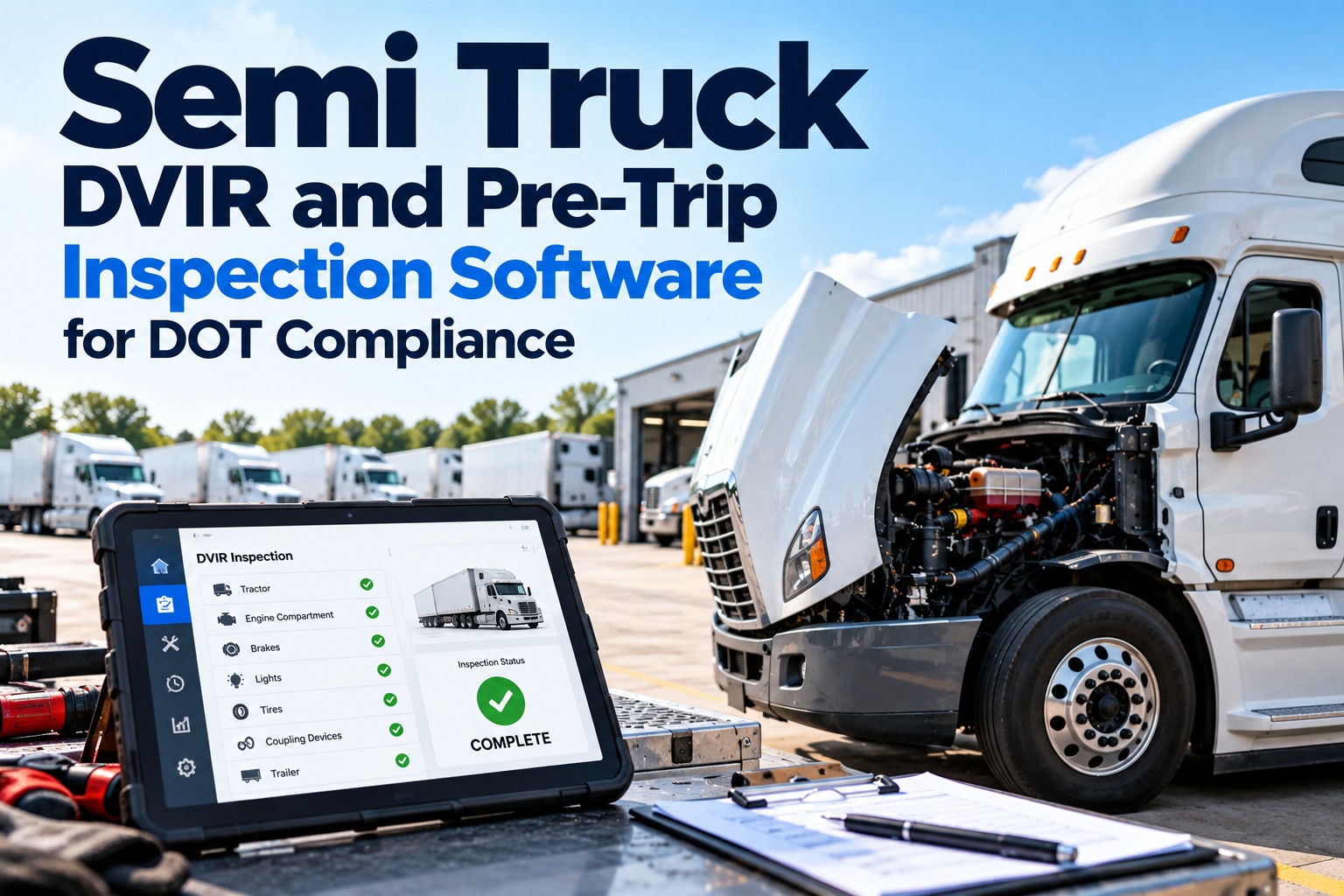
Driver selects the assigned vehicle and inspection type (pre-trip or post-trip). FleetRabbit displays a customizable inspection checklist covering all FMCSA-required inspection items — brakes, lights, tires, mirrors, coupling devices, emergency equipment, and any fleet-specific items. Each inspection item is marked pass, defect, or observation with mandatory photo documentation for any flagged item.
Flagged defects are classified by severity — critical (affects safe operation, vehicle cannot be dispatched), non-critical (requires repair but not immediately safety-affecting), or observation (monitor at next service). Critical defects trigger an immediate dispatch hold on the vehicle, preventing assignment until maintenance clearance is confirmed. Classification follows regulatory standards for out-of-service criteria.
Critical Defect — Dispatch Hold ActiveUnit #114 Grounded
3
Automatic Maintenance Work Order Creation
Defect submission triggers automatic work order creation in the maintenance module — pre-populated with vehicle ID, defect description, driver-submitted photos, and defect severity classification. Maintenance supervisor receives immediate push notification. Parts inventory is checked against the repair requirement. No manual data transfer required between inspection system and maintenance system.
Work Order WO-5591 CreatedParts: AvailableAssigned: Shop Supervisor
4
Repair Execution & Technician Sign-Off
Maintenance technician completes the repair and closes the work order via mobile or desktop — documenting repair actions taken, parts replaced, technician ID, and completion timestamp. Repair certification creates the regulatory-required documentation trail linking defect identification to repair completion. Fleet manager receives repair completion notification in real time.
WO-5591 Completed07:23 AM — Repair Duration: 1hr 36min
5
Driver Return-to-Service Acknowledgment
Before operating Unit #114 on the next trip, the driver reviews the completed repair documentation in the app and provides digital acknowledgment — satisfying the FMCSA requirement (49 CFR 396.13) that drivers certify defects have been corrected or are non-safety-affecting before the vehicle is returned to service. Dispatch hold is released only after acknowledgment is recorded.
Driver Acknowledgment RecordedDispatch Hold Released — 07:41 AM
6
Automatic Archive & Audit-Ready Record Retention
The complete inspection record — driver inspection data, defect photos, severity classification, work order, repair documentation, technician sign-off, and driver return-to-service acknowledgment — is automatically archived with timestamped audit trail. Records retained for the FMCSA-required minimum period and searchable by vehicle, driver, date range, or defect type. DOT audit package generated on demand in minutes.
Audit Record DVR-114-20250410: Pre-trip inspection complete. Defect flagged 05:47 AM, work order created 05:49 AM, repair completed 07:23 AM, driver acknowledgment 07:41 AM. Full documentation chain intact. FMCSA compliant.
Digital DVIR Compliance
From Paper Risk to Full Audit Readiness — Automatically
FleetRabbit's digital DVIR system eliminates paper log gaps, enforces the complete regulatory documentation chain, and keeps your fleet audit-ready at all times — without administrative overhead.
Federal regulations governing driver vehicle inspections are specific, enforceable, and frequently cited in DOT audits. FleetRabbit's digital DVIR system is built to satisfy each regulatory requirement with documented, timestamped digital evidence.
49 CFR § 396.11
Driver Vehicle Inspection Reports Required
Requires drivers to complete a written inspection report at the end of each day covering specified system components. FleetRabbit enforces structured inspection completion for every vehicle operated — with mandatory field completion and driver digital signature. No inspection can be submitted incomplete.
Fully Addressed Structured digital checklist + mandatory sign-off
49 CFR § 396.13
Driver Inspection of Motor Vehicles
Requires drivers to review the prior day's inspection report and certify that defects have been repaired or are non-safety-affecting before operating the vehicle. FleetRabbit enforces this acknowledgment digitally — drivers cannot proceed with departure until the prior inspection certification is completed in the app.
Fully Addressed Mandatory acknowledgment gate before dispatch clearance
49 CFR § 396.3
Inspection, Repair & Maintenance Records
Requires carriers to maintain records of inspections, repairs, and maintenance for each vehicle. FleetRabbit automatically archives all inspection and repair records with full traceability — linking defect identification, work order, repair completion, parts used, and technician sign-off into a single searchable document chain.
Fully Addressed Automatic record archive with full inspection-to-repair chain
Record Retention Requirements
12-Month Inspection Record Retention
FMCSA regulations require carriers to retain inspection and maintenance records for a minimum period. FleetRabbit retains all digital DVIR records well beyond the regulatory minimum — with records searchable by vehicle, driver, date range, defect type, and repair status. No physical filing, no storage space, no retrieval delays.
Fully Addressed Digital archive exceeding retention requirements
DOT Roadside Inspection
Immediate Record Availability for Officers
During a roadside inspection, DOT officers may request driver inspection records. Fleet managers can instantly retrieve and share digital DVIR records from the FleetRabbit dashboard — providing the complete documentation chain in seconds, not hours. Drivers can also access their inspection history directly from the mobile app.
Fully Addressed Instant digital record retrieval from any device
FMCSA Safety Audit
Comprehensive Audit Package Generation
FMCSA compliance audits require carriers to produce complete inspection history, defect documentation, and maintenance records for all vehicles under review. FleetRabbit generates a complete, organized audit package covering any requested time period and vehicle set — in minutes, without manual document retrieval or reconciliation.
Fully Addressed Automated audit package generation in <30 minutes
Beyond Basic DVIR — How FleetRabbit Turns Inspection Data Into Operational Intelligence
Digital DVIR records are not just a compliance tool — they are a real-time data source for maintenance planning, asset management, and driver performance evaluation. FleetRabbit converts inspection data into operational insight that helps fleet managers run a more proactive and cost-efficient operation.
Defect Frequency Analysis by Vehicle
FleetRabbit tracks which vehicles generate the most defect flags over time — identifying high-maintenance assets that may be approaching end of economical life. Fleet managers see recurring defect patterns before they become chronic reliability issues or cost overruns.
Driver Inspection Compliance Scoring
Completion rate, average inspection duration, defect reporting rate, and photo documentation compliance tracked per driver. Fleet managers identify drivers who may be skipping or rushing inspections — enabling coaching conversations before compliance issues develop into violations.
Predictive Maintenance Triggers from Inspection Data
Recurring defect flags for specific system components (brake wear, lighting, tire condition) feed into FleetRabbit's maintenance planning module — prompting proactive service scheduling before components fail completely. Inspection data and maintenance history connect automatically into a unified vehicle health profile.
FMCSA Compliance Intelligence
Every Inspection. Every Defect. Every Repair. Fully Documented.
FleetRabbit's digital DVIR system gives your fleet complete inspection-to-repair documentation, real-time defect routing, and on-demand audit readiness — replacing paper risk with digital compliance certainty.
"We went through a DOT compliance audit six months after switching to FleetRabbit DVIR. Our previous audit with paper records took three days of preparation and we still had documentation gaps. With FleetRabbit, I generated the complete inspection package in about 25 minutes — every inspection, every defect report, every repair record, timestamped and linked. The auditor actually commented that our records were some of the most organized he'd seen. We received a Satisfactory rating with zero driver or vehicle inspection violations. That change alone justified the entire FleetRabbit subscription for the next five years."
Fleet Compliance Manager
Commercial Trucking Fleet — 62 Vehicles — Texas, USA
Frequently Asked Questions
QDo drivers need special hardware to complete digital DVIRs with FleetRabbit?
No. FleetRabbit's driver app runs on standard iOS and Android smartphones or tablets — no proprietary hardware required. Drivers use the device they already carry. For fleets that prefer in-cab tablets, FleetRabbit is compatible with common commercial tablet configurations. App training takes approximately 20–30 minutes per driver with guided onboarding materials. See the driver app in a live demo.
QCan we customize the inspection checklist for our fleet's specific vehicle types?
Yes. FleetRabbit allows fleet managers to create customized inspection templates for different vehicle types — straight trucks, tractor-trailers, tankers, refrigerated units, specialty equipment — with vehicle-specific inspection points beyond the standard FMCSA-required items. Templates can also include fleet-specific items such as load securement checks, reefer temperature verification, or customer-required inspection documentation.
QWhat happens if a driver doesn't have cellular connectivity during an inspection?
FleetRabbit's driver app functions in offline mode — drivers complete the full inspection process including photo documentation without cellular connectivity. The completed inspection record syncs automatically to the fleet management system when connectivity is restored. For roadside areas with poor signal, this ensures inspection records are captured and submitted without gaps.
QHow does FleetRabbit prevent a vehicle with a critical defect from being assigned to a load?
When a driver flags a critical defect in the FleetRabbit app, the vehicle is automatically placed in a dispatch-restricted status visible to all dispatchers in real time. The vehicle cannot be assigned to any load until the maintenance technician closes the repair work order and the driver provides digital return-to-service acknowledgment. Dispatchers see a clear visual indicator of restricted vs. available vehicles in the assignment interface — preventing accidental assignment of non-compliant assets.
QHow far back do inspection records go and how do we search them during an audit?
FleetRabbit retains all digital inspection records beyond FMCSA retention minimums. Records are searchable by vehicle unit number, driver, date range, inspection type, defect category, or repair status. During a DOT audit, fleet managers generate a complete audit package for the requested vehicle set and time period from the dashboard — including all inspection reports, defect documentation, and repair records — in a formatted, downloadable package. Start your free trial to explore record management.
End Paper DVIR Risk — Achieve Full FMCSA Audit Readiness With FleetRabbit.
FleetRabbit's digital DVIR system captures every inspection, routes every defect to maintenance in under 5 minutes, enforces the complete regulatory documentation chain, and generates audit-ready record packages on demand — eliminating the compliance gaps that paper systems create and the violation costs they produce.