.png)
DOT compliance is one of the most complex and high-stakes responsibilities in transportation fleet management. Federal Motor Carrier Safety Administration regulations govern everything from driver hours-of-service and vehicle inspections to medical certifications and cargo documentation, and the consequences of non-compliance range from roadside out-of-service orders to civil penalties, safety rating downgrades, and in serious cases, operating authority revocation. For fleet managers, keeping every vehicle, driver, and document audit-ready every single day is an operational challenge that paper-based systems and disconnected spreadsheets consistently fail to meet. This DOT compliance checklist covers the five core compliance areas that FMCSA inspectors and safety auditors examine: Driver Vehicle Inspection Reports (DVIR), Hours of Service (HOS) records, driver qualification files, vehicle safety equipment, and maintenance documentation. Each section includes the specific items your fleet must verify, the recordkeeping requirements you must maintain, and the common violations that trigger out-of-service orders. Alongside this checklist, FleetRabbit's compliance management platform automates tracking across all five areas, sending alerts before certifications expire, generating audit-ready reports on demand, and connecting inspection defects directly to maintenance work orders so nothing slips through. Whether you are preparing for a scheduled FMCSA compliance review or building daily compliance discipline across your fleet, this checklist gives you the structured framework to stay ahead of violations rather than reacting to them.
2026 DOT Compliance Snapshot
FMCSA data shows that vehicle maintenance violations account for approximately 44 percent of all roadside out-of-service orders issued annually. Driver qualification file deficiencies and HOS violations collectively represent another 30 percent of compliance failures found during safety audits. Fleets with documented daily inspection processes and automated compliance tracking reduce audit findings by a significant margin compared to fleets relying on manual recordkeeping. Staying compliant is not a one-time effort — it requires consistent daily processes supported by reliable systems.
Keep Your Fleet Audit-Ready Every Day
FleetRabbit automates DOT compliance tracking across DVIR, HOS, driver qualifications, and vehicle inspections — so your fleet is always ready for roadside checks and FMCSA audits.
Section 1: Driver Vehicle Inspection Report (DVIR) Compliance
49 CFR Part 396.11 requires commercial motor vehicle drivers to complete a written vehicle inspection report at the end of each driving day if any defects were found, and Part 396.13 requires the next driver to review and sign the prior report before operating the vehicle. Incomplete, missing, or falsified DVIRs are among the most cited violations during FMCSA compliance reviews.
Daily DVIR Checklist Items
Pre-Trip Inspection Requirements: Driver must inspect and document condition of service brakes and brake connections, parking brake, steering mechanism, lighting devices and reflectors, tires and wheels, horn, windshield wipers and mirrors, coupling devices (if applicable), emergency equipment, and frame and body condition. Any defect affecting safe operation must be reported immediately.
Post-Trip DVIR Documentation: At the end of each driving day, the driver must complete a written or electronic DVIR noting any defects discovered during operation. The report must be signed by the driver, reviewed by the next driver before vehicle operation, and signed by a qualified mechanic certifying repairs were made or that no repairs were needed.
DVIR Recordkeeping: DVIR records must be retained at the motor carrier's principal place of business for a minimum of three months. During roadside inspections, the current trip's DVIR must be available for review. Electronic DVIR systems are FMCSA-compliant when they capture driver signature, defect identification, and mechanic certification.
DVIR Compliance Checklist
- Pre-trip inspection completed and documented before each driving shift
- All defects noted with description, location, and severity
- Driver signature on inspection report before vehicle operation
- Previous DVIR reviewed and signed by current driver
- Mechanic certification on file for any defects reported
- DVIR records retained for minimum three months at principal place of business
- Electronic DVIR system captures timestamp, geolocation, and photo documentation
Section 2: Hours of Service (HOS) Compliance Checklist
Hours of Service regulations under 49 CFR Part 395 set maximum driving time limits, mandatory rest requirements, and recordkeeping obligations for commercial vehicle drivers. HOS violations are a top enforcement priority during roadside inspections and compliance audits because fatigue-related crashes represent a significant safety risk.
Key HOS Rules for Property-Carrying Drivers
11-Hour Driving Limit: Drivers may drive a maximum of 11 hours after 10 consecutive hours off duty. This limit cannot be extended regardless of operational pressure.
14-Hour On-Duty Window: Drivers may not drive beyond the 14th consecutive hour after coming on duty, even if fewer than 11 hours of driving have been completed. Off-duty and sleeper berth time does not extend this window.
30-Minute Break Requirement: Drivers must take a 30-minute break after 8 cumulative hours of driving time. The break must involve no driving activity.
60/70-Hour Weekly Limit: Drivers may not drive after accumulating 60 hours on duty in 7 consecutive days or 70 hours in 8 consecutive days, depending on the carrier's schedule. The 34-hour restart provision allows drivers to reset this limit after 34 consecutive hours off duty.
HOS Compliance Checklist
- Electronic Logging Device (ELD) installed and functioning on all applicable CMVs
- ELD registered with FMCSA-certified provider
- Drivers trained on ELD operation and malfunction procedures
- 11-hour driving limit monitored and enforced daily
- 14-hour on-duty window tracked per driver per shift
- 30-minute break compliance verified after 8 hours of driving
- 60/70-hour weekly limits monitored with alerts before violations occur
- ELD records retained for minimum six months
- Driver logs available for roadside inspection on ELD or paper backup
Section 3: Driver Qualification File Checklist
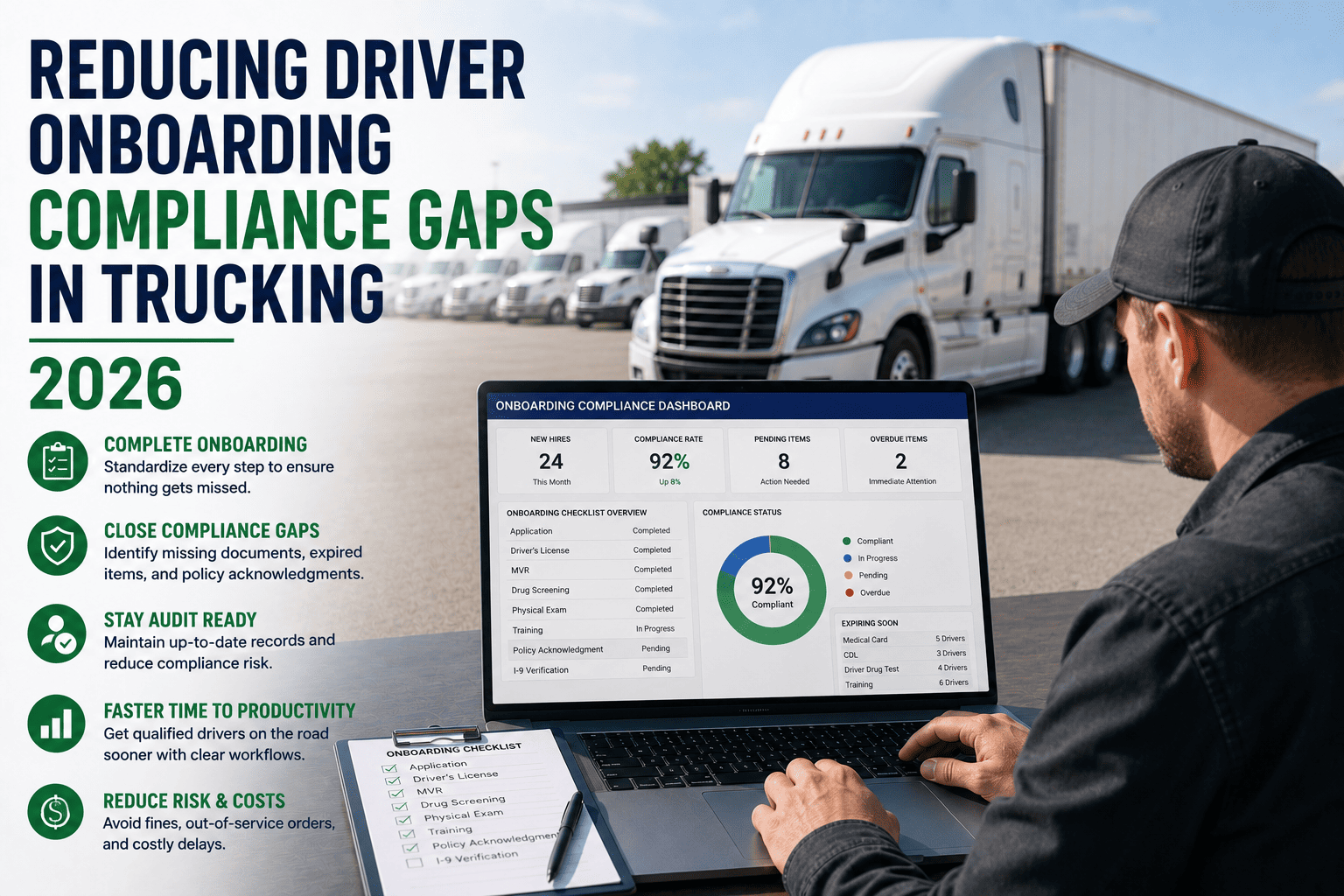
49 CFR Part 391 requires motor carriers to maintain a driver qualification (DQ) file for every commercial driver. These files must be current, complete, and available for review during FMCSA audits. Incomplete or expired qualification records are a frequent audit finding that can result in civil penalties and conditional safety ratings.
Required Documents in Every Driver Qualification File
- Driver Application: Completed employment application covering previous 10 years of employment history
- CDL Copy: Current commercial driver's license with appropriate endorsements for vehicle type
- MVR (Motor Vehicle Record): Obtained at hire and annually thereafter from all states where driver held a license in past 3 years
- Medical Examiner's Certificate: Current DOT physical certificate — standard validity is 24 months, shorter periods for drivers with certain medical conditions
- Medical Certificate on CDLIS: Verified on Commercial Driver's License Information System for CDL holders
- Road Test Certificate: Certificate of road test or equivalent required before operating assigned vehicle type
- Previous Employer Inquiries: Safety performance history requests sent to all DOT-regulated employers in past 3 years
- Clearinghouse Query: FMCSA Drug and Alcohol Clearinghouse pre-employment query result on file
- Annual Review of Driving Record: Documented annual MVR review with supervisor certification
- Violations Review Certification: Annual driver certification reviewing violations in prior 12 months
Driver Qualification File Retention Requirements
Active driver DQ files must be retained for the entire duration of employment plus three years after separation. MVR records must be kept for three years. Drug and alcohol testing records have separate retention requirements ranging from one to five years depending on the record type. Missing or expired documents during an audit can result in driver disqualification and operational restrictions.
Section 4: Vehicle Safety Equipment Inspection Checklist
49 CFR Parts 393 and 396 establish specific requirements for vehicle safety equipment that must be present, functional, and properly maintained on all commercial motor vehicles. These items are primary targets during Level I roadside inspections and account for a significant portion of out-of-service orders issued annually.
| Equipment Category | Required Items | Inspection Frequency | OOS Risk |
|---|---|---|---|
| Brakes | Service brakes, parking brake, brake linings within spec, air brake system pressure | Pre-trip daily, PM annually | High |
| Tires | Tread depth (4/32 front, 2/32 rear min), inflation, sidewall condition, no recaps on front | Pre-trip daily | High |
| Lighting | Headlights, tail lights, brake lights, turn signals, clearance lights, reflectors functional | Pre-trip daily | Medium |
| Emergency Equipment | Fire extinguisher (10 B:C min), 3 reflective triangles, spare fuses | Pre-trip daily | High |
| Steering | Steering wheel free play within limits, no looseness in steering components | Pre-trip, annual PM | High |
| Coupling Devices | Fifth wheel secure, kingpin engagement confirmed, safety chains connected | Pre-trip daily | High |
| Exhaust System | No exhaust leaks, system properly secured, no leaks near cab or sleeper | Pre-trip, annual PM | Medium |
| Windshield and Mirrors | No obstructing cracks, wipers functional, all required mirrors present and adjusted | Pre-trip daily | Medium |
Section 5: Preventive Maintenance and Inspection Records Checklist
49 CFR Part 396.3 requires motor carriers to systematically inspect, repair, and maintain all commercial motor vehicles under their control. Carriers must keep records of all inspections, repairs, and maintenance for each vehicle. These records must be available for FMCSA review and are examined during compliance audits to evaluate the effectiveness of the carrier's maintenance program.
Maintenance Records Compliance Checklist
- Scheduled preventive maintenance program documented and applied to every vehicle
- Annual vehicle inspection completed by qualified inspector per 49 CFR 396.17
- Annual inspection report retained at principal place of business or vehicle
- Inspection sticker current and displayed on vehicle as required by operating states
- All repair work orders retained with parts used, labor performed, and completion date
- Recall status checked for all vehicles — open recalls documented and tracked
- Maintenance records retained for one year at location vehicle is housed, plus six months after disposal
- DVIR defect repair documented and signed by qualified mechanic
- Lubrication, fluid levels, belt condition, and filters documented at each PM interval
Section 6: Drug and Alcohol Program Compliance Checklist
49 CFR Part 382 requires motor carriers operating CMVs requiring a CDL to implement a DOT-compliant drug and alcohol testing program. The FMCSA Drug and Alcohol Clearinghouse, fully operational since January 2020, requires carriers to query driver records before hire and annually for current drivers. Testing program gaps are among the most serious compliance deficiencies found during audits.
Drug and Alcohol Program Checklist
- Written drug and alcohol testing policy distributed to all CDL drivers
- Pre-employment drug test completed and negative result on file before first drive
- FMCSA Clearinghouse pre-employment full query result documented
- Annual Clearinghouse limited query completed for all current CDL drivers
- Random testing program enrolled with C/TPA meeting minimum annual testing rates (50% drug, 10% alcohol)
- Post-accident testing completed within required timeframes after qualifying incidents
- Return-to-duty and follow-up testing records current for any drivers returning after violations
- DER (Designated Employer Representative) trained and contact information documented
Section 7: FMCSA Safety Audit Preparation Checklist
FMCSA conducts two primary types of carrier reviews: Compliance Safety Accountability (CSA) interventions triggered by safety measurement scores, and New Entrant Safety Audits required within the first 12 months of operating authority. Both reviews examine the same core compliance areas. Being prepared means having complete, organized records ready for immediate review — not scrambling to locate documents after an audit notice arrives.
| Audit Area | Documents Required | Retention Period |
|---|---|---|
| Driver Qualifications | DQ files, MVRs, medical certificates, CDL copies | 3 years post-employment |
| HOS Records | ELD records, supporting documents, 8-day recap | 6 months |
| Vehicle Inspections | Annual inspection reports, DVIR files, repair records | 1 year active, 6 months post-disposal |
| Drug and Alcohol | Test results, Clearinghouse queries, policy acknowledgments | 1 to 5 years by record type |
| Accident Register | All accidents for past 3 years meeting reporting criteria | 3 years |
| Operating Authority | MC number registration, insurance certificates (BMC-91), UCR receipt | Current and accessible |
How FleetRabbit Automates DOT Compliance Tracking
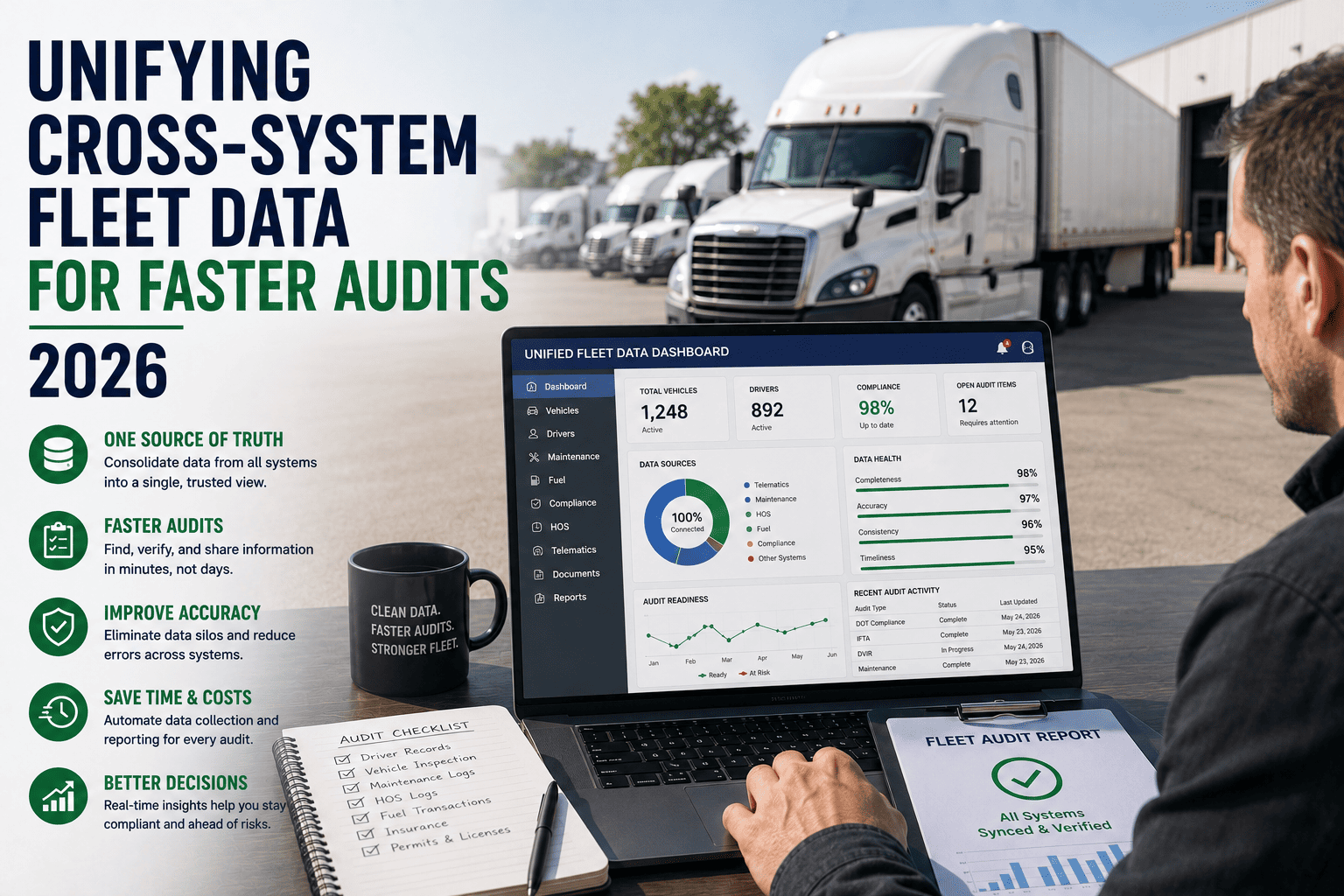
Managing compliance manually across dozens of vehicles, drivers, and expiring documents is how violations happen. FleetRabbit's compliance management module centralizes every compliance requirement in one platform, sends automated alerts before deadlines, and generates audit-ready reports in minutes rather than days.
FleetRabbit Compliance Features
- Digital DVIR on Mobile: Drivers complete FMCSA-compliant inspections with photo documentation on smartphones. Defects route automatically to maintenance work orders. No paper, no delays, no missed defect routing.
- Driver Qualification Tracking: Store and track all DQ file documents with automated expiration alerts for medical certificates, CDLs, and MVR review dates. Never miss a renewal deadline.
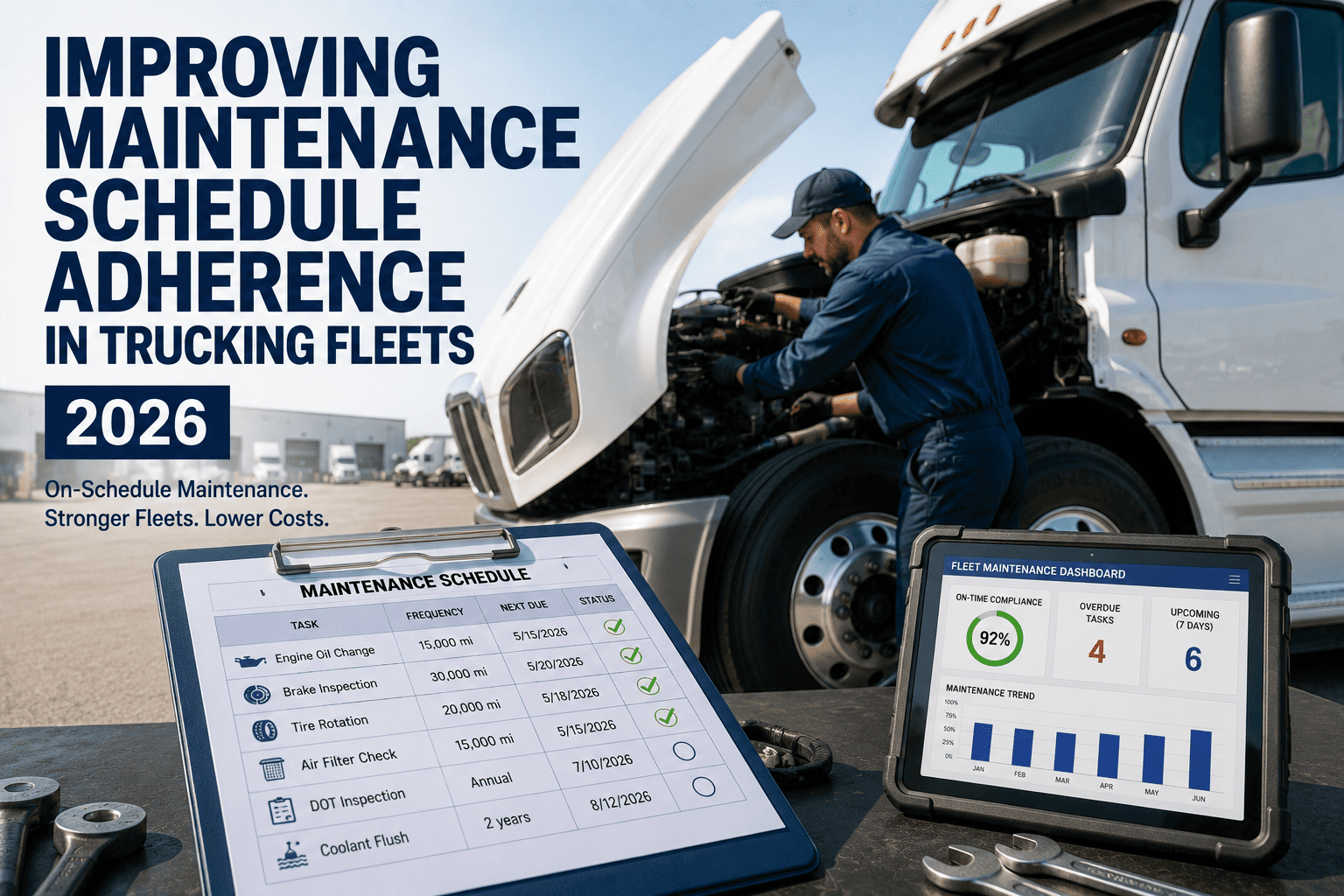
- Maintenance Record Management: All work orders, PM completions, and repair records stored digitally with vehicle-level history. Annual inspection documentation tracked and accessible for roadside inspections.
- Vehicle Status Dashboard: Real-time view of every vehicle's compliance status — upcoming inspections due, open defects, recall status, and maintenance schedule adherence in one screen.
- Audit-Ready Reports: Generate compliance reports covering any date range for any vehicle or driver in minutes. Structured for FMCSA review format to reduce audit preparation time.
- Recall Monitoring: Track open NHTSA recalls across your fleet with automated alerts when new recalls are issued for your vehicle makes and models.
Automate Compliance Tracking Across Your Entire Fleet
FleetRabbit gives your team real-time compliance visibility, automated expiration alerts, and instant audit-ready reports — so you spend less time chasing paperwork and more time running your operation.
Frequently Asked Questions: DOT Compliance for Fleet Managers
Q: How often must driver vehicle inspection reports (DVIRs) be completed?
Drivers must complete a post-trip DVIR at the end of each day they operate a CMV and find a defect. The next driver must review and sign the previous DVIR before operating the vehicle. Start a free trial to manage DVIRs digitally or book a demo to see how it works.
Q: What documents must be in a driver qualification file?
A DQ file must include the driver application, CDL copy, current medical certificate, MVR at hire and annually, road test certificate, previous employer safety performance history, and Clearinghouse query results. All documents must remain current throughout employment.
Q: How long do carriers need to keep maintenance and inspection records?
Annual inspection reports must be retained for one year at the location the vehicle is based, plus six months after the vehicle leaves the fleet. DVIR records must be kept for three months. Repair and maintenance records must be retained for one year while the vehicle is in service.
Q: What triggers an FMCSA compliance review?
FMCSA initiates compliance reviews based on elevated CSA BASIC scores, crash history, driver or shipper complaints, or random selection. New carriers automatically receive a New Entrant Safety Audit within 12 months of receiving operating authority.
Q: What are the most common reasons vehicles receive out-of-service orders?
The most frequent OOS violations involve brake defects, tire condition issues, lighting failures, and missing emergency equipment. Brake violations alone account for approximately 44 percent of vehicle OOS orders issued during roadside inspections each year.
Q: Does every commercial vehicle require an Electronic Logging Device?
ELDs are required for most CMV drivers subject to HOS regulations. Exemptions exist for vehicles manufactured before model year 2000, short-haul drivers who qualify for the timecard exception, drivers using paper logs no more than 8 days in a 30-day period, and drive-away/tow-away operations.
Q: How do I check if my vehicles have open NHTSA recalls?
You can check recall status by VIN at NHTSA.gov or through fleet management platforms that integrate recall monitoring. Unrepaired recalls on commercial vehicles can be cited during DOT inspections. Sign up free to track recalls fleet-wide or book my demo for a walkthrough.
Q: What is the FMCSA Drug and Alcohol Clearinghouse and what are my obligations?
The Clearinghouse is a federal database of CDL driver drug and alcohol program violations. Carriers must conduct a full pre-employment query before each new hire and an annual limited query for all current CDL drivers. Non-compliance with Clearinghouse requirements is a significant audit finding.
Q: Can FleetRabbit help me prepare for an FMCSA compliance audit?
FleetRabbit centralizes DVIR records, maintenance documentation, driver qualification tracking, and vehicle inspection history in one platform. You can generate audit-ready compliance reports for any date range in minutes. Start a free trial or book my demo to see the compliance dashboard.
Stop Managing Compliance on Paper
FleetRabbit's compliance platform keeps your fleet audit-ready every day — automated alerts, digital DVIRs, driver qualification tracking, and instant compliance reports all in one place.