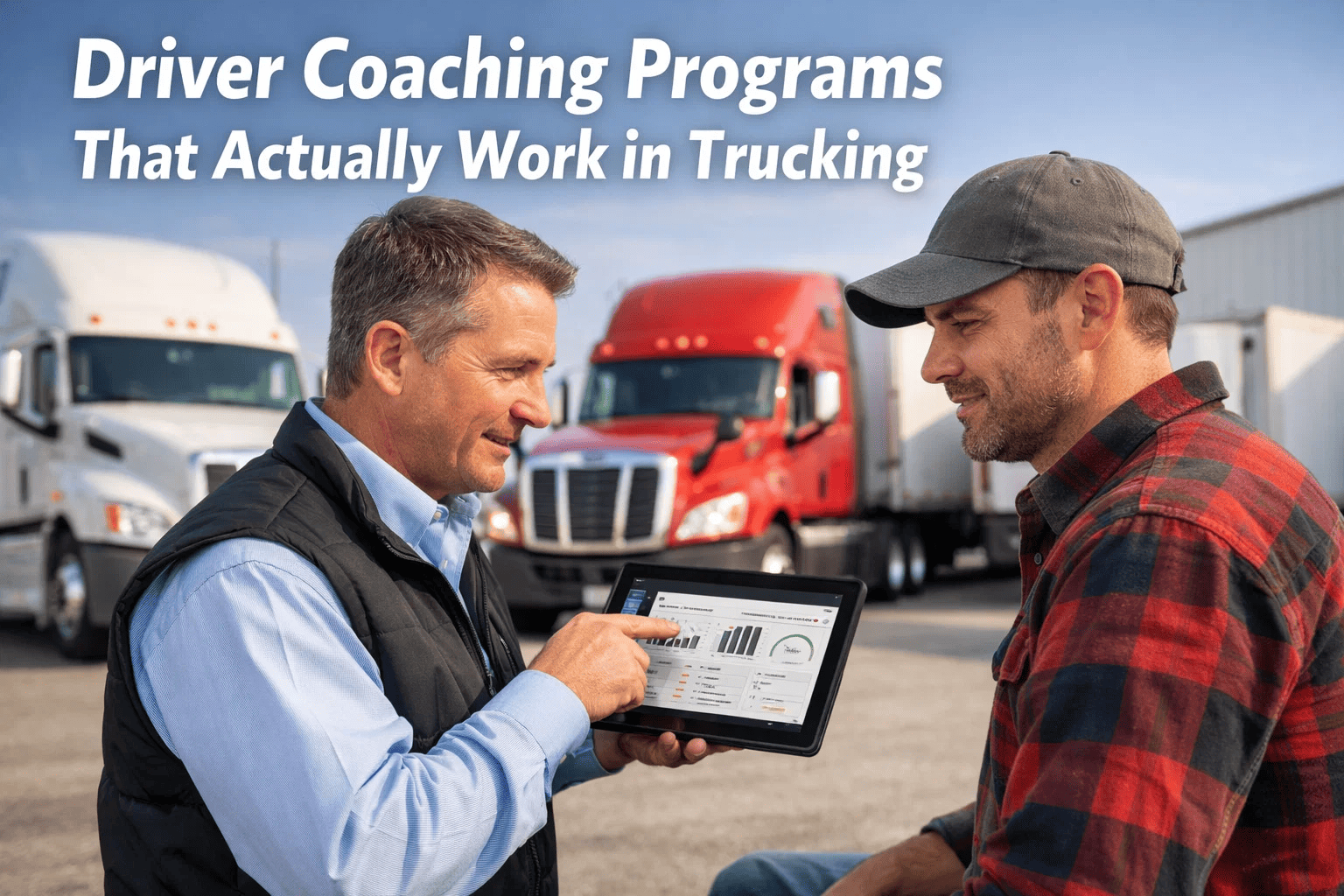
Driver coaching programs in commercial trucking have a well-documented reputation problem: they are among the most commonly implemented safety initiatives in the industry and among the most commonly resented by the drivers they are designed to improve. Exit interview data from driver turnover studies consistently identifies "did not like being watched" and "coaching felt punitive" as top-ten departure reasons at carriers where safety coaching programs are active — which suggests that a significant portion of the coaching investment being made by trucking companies is producing driver dissatisfaction alongside whatever safety improvement the program achieves. The resolution to this paradox is not to stop coaching — the evidence that structured, data-supported coaching programs improve safety outcomes is robust enough that abandoning the practice would be an overcorrection with real safety costs. The resolution is to understand precisely why most coaching programs fail to produce the engagement and retention-compatible outcomes that well-designed programs achieve, and to redesign accordingly. This guide examines the structural elements of driver coaching programs that actually work — defined here as programs that produce measurable, sustained improvement in the safety metrics they target without simultaneously accelerating driver departure and resentment. It covers the behavioral science behind effective coaching design, the data sources and frequency patterns that distinguish high-performing programs from surveillance-style monitoring, how to train safety managers and terminal supervisors to deliver coaching conversations that drivers engage with rather than dread, and how FleetRabbit's driver performance infrastructure provides the data foundation that effective coaching programs require. Book a demo to see how FleetRabbit's driver performance tools support safety coaching programs at your fleet.
Defining the Standard
What "Actually Works" Means in This Guide
A driver coaching program that "actually works" in the context of this guide meets all three of the following criteria simultaneously — not just one or two:
01
Produces measurable, statistically significant improvement in the targeted safety behaviors — speed events, harsh braking, HOS compliance, or DVIR completion — within a defined measurement period, not just a regression to the mean following an observation period.
02
Sustains the improvement beyond the coaching window — the safety behavior improvement persists at the 12-month measurement even when coaching frequency has normalized from the intensive early-program cadence to the standard ongoing frequency.
03
Does not produce measurable increases in driver departure rates among coached drivers — the program does not achieve its safety metric goals at the cost of accelerating turnover of the drivers it improves.
The Industry Baseline
67%
of fleets with active safety coaching programs report measurable improvement in targeted metrics within 6 months
41%
sustain the improvement at 12 months without metric regression when coaching is maintained at the full-program frequency
28%
report increased driver departure rates among actively coached drivers — indicating coaching program design, not coaching practice, is the differentiating variable
The Behavioral Science Behind Effective Coaching Design
Behavior change research supports a clear model of what produces durable improvement in safety-relevant driving behavior versus what produces temporary compliance during an observation period followed by regression when attention is removed. The distinction matters enormously for coaching program design because many trucking safety coaching programs are structured — often unintentionally — around the conditions that produce temporary compliance rather than durable behavior change. Understanding the behavioral science is the precondition for making the design changes that shift a program from compliance-producing to behavior-changing.
Surveillance Without Agency
When drivers experience the coaching program primarily as observation and judgment without control over the outcome — "you did X and that is unacceptable" rather than "here is what the data shows, what was happening, and how might we address it" — they improve their behavior during periods when they believe they are being watched and relax it when they believe they are not. This is the compliance-without-ownership pattern that produces the regression-at-12-months outcome.
Negative-Only Reinforcement
Coaching programs triggered exclusively by below-threshold performance condition drivers to associate safety monitoring data with negative consequences. The conditioned response is avoidance — drivers do not engage with safety data because they have learned that the only thing safety data produces is a coaching event they experience as punitive. Positive reinforcement at or above threshold performance eliminates the avoidance conditioning and builds engagement with the data that makes durable behavior change possible.
Event-Level Focus Without Root Cause
Citing specific telematics events without seeking to understand the operational context that produced them — "you had 7 speed events on I-40 Tuesday" without asking what the traffic, weather, and load situation were — treats behavior as context-free in a context-saturated environment. Drivers who know that their operating conditions are not being considered in the evaluation of their behavior experience the coaching as unfair, which is the precondition for resentment rather than engagement.
Driver Ownership of the Data
When drivers have access to their own performance metrics — their safety score, their specific event history — before the coaching conversation occurs, they arrive at the conversation with context and often with their own assessment of what produced the events being discussed. Self-generated awareness of behavior patterns produces deeper engagement with the coaching process and stronger ownership of the improvement commitment that the conversation produces.
Recognition as a Coaching Tool
Recognition of positive performance — specifically, recognizing improvement from a prior period even when absolute performance is still developing — is not a feel-good add-on to an effective coaching program. It is the primary mechanism by which drivers learn that safety data produces positive outcomes as well as negative ones, which is the precondition for engaging voluntarily with that data rather than avoiding it. Programs that deliver recognition as consistently as they deliver corrective coaching produce the engagement that shifts from compliance to ownership.
Collaborative Goal Setting
Improvement targets that are set collaboratively between the safety manager and the driver — where the driver contributes to defining what the realistic improvement looks like for their specific routes, conditions, and behavioral starting point — produce stronger commitment than targets set unilaterally by the carrier. Collaborative goals also produce more accurate targets because the driver's operational knowledge often contains route-specific or condition-specific context that makes the carrier-set target either too easy (insufficient to drive improvement) or too aggressive (set up to fail and produce the resentment that precedes departure).
The Seven Elements of a Coaching Program That Drivers Engage With
Driver Transparency — Showing Drivers Their Own Data
Before any coaching conversation occurs, the driver should have received access to their own performance data in a format they can review independently — their safety score, their event history, and their peer comparison benchmarks. FleetRabbit's driver performance module supports this through driver-facing performance summaries that can be shared digitally or printed for review before the coaching meeting. When a driver arrives at a coaching conversation already aware of what the data shows, the conversation begins from a shared understanding rather than a confrontation — and the driver's own pre-session review often surfaces the operational context that explains the events before the safety manager has to inquire about it.
Context-First Conversation Protocol
The most effective coaching conversations follow a protocol that asks for the driver's account of the operating conditions that produced each flagged event before the safety manager provides any assessment or instruction. This context-first approach serves two functions: it ensures that the coaching assessment accounts for legitimate operational factors that the telematics data cannot capture on its own, and it communicates to the driver that their professional judgment and experience are respected rather than subordinated entirely to an algorithm. Safety managers who use context-first protocols consistently report more engaged drivers and more accurate event assessments than those who present the data as a predetermined finding and require the driver to respond to a judgment already made.
Peer Comparison as a Positive Frame
Showing a driver where they rank in the fleet creates a competitive frame that many drivers find motivating — but the competitive frame must be presented as an opportunity rather than as an accusation. "Your speed event rate is twice the fleet average" is an accusation. "The top quarter of our fleet averages 2 events per 1,000 miles — you are currently at 6, and the drivers in that top quarter tend to get the premium-load assignments. Here is what they are doing differently on the same routes." The second framing presents the same data as a pathway to a concrete professional benefit, which produces aspiration where the first framing produces defensiveness. FleetRabbit's fleet-wide safety ranking provides the peer comparison data in a format that supports this positive framing without requiring the safety manager to manually compile comparative statistics.
Cadence and Frequency Design
Effective coaching programs have deliberate frequency designs that differ for different driver population segments — and that front-load coaching intensity for new hires and recently promoted drivers, where the behavioral patterns being established are most plastic and therefore most responsive to coaching input. A typical high-performing program structure runs monthly coaching for all drivers in the bottom quartile of safety performance, quarterly coaching for all drivers in the middle two quartiles, and semi-annual recognition conversations for drivers in the top quartile. This frequency structure directs coaching effort toward the drivers where the safety return on coaching time is highest while ensuring that even top-performing drivers receive regular positive engagement with the safety program.
Documented Commitment with Driver-Set Targets
Every coaching conversation should end with a documented commitment — the specific metric the driver is committing to improving, the timeline for the improvement, and the driver's own assessment of how they will achieve it. The commitment is documented in FleetRabbit's driver record as a coaching note that becomes the starting point for the next coaching conversation, enabling the follow-up conversation to begin with a review of the driver's own prior commitment rather than a new evaluation from the safety manager's perspective. Drivers who set their own targets and see them referenced in subsequent coaching conversations report significantly higher program engagement than those whose improvement targets are set unilaterally by the career.
Progress Recognition at Specified Improvement Milestones
Recognition should not be reserved for reaching a final performance standard — it should be structured into the improvement trajectory itself. A driver who reduces their speed event frequency from 12 per 1,000 miles to 7 per 1,000 miles has made a 42% improvement that deserves recognition even though they have not yet reached the fleet average of 4 per 1,000 miles. Recognizing improvement milestones rather than only final destinations tells drivers that the organization is paying attention to their effort and trajectory, not just their current position relative to a standard they may still be several coaching cycles from achieving. This recognition-of-progress practice is the specific behavioral design choice that most clearly separates programs that retain coached drivers from programs that accelerate their departure.
Safety Manager Training and Coaching Calibration
The quality of a safety coaching program is ultimately bounded by the quality of the coaching conversations delivered by the safety managers and terminal supervisors who conduct them. A technically sound program with well-structured data, appropriate frequency, and good documentation will still produce resentment and poor outcomes if the delivery is punitive, dismissive, or conducted by managers who have not been trained in the program's conversational protocols. Programs that invest in coaching-the-coaches — training safety managers how to conduct the context-first conversation, how to use FleetRabbit's performance data as a collaborative tool rather than as an accusation, and how to deliver recognition as naturally as they deliver corrective feedback — consistently outperform programs that train only on the technology and assume the conversational quality will emerge naturally from well-intentioned managers.
FleetRabbit Driver Analytics
The Data Foundation That Makes These Programs Work
FleetRabbit provides the driver safety ranking, event history, peer comparison, and coaching documentation tools that support every element of an effective coaching program — from transparency to recognition to documented progress.
Coaching Program Design by Driver Segment
One of the most consequential errors in trucking safety coaching program design is treating the driver population as a homogeneous group that should receive the same coaching intervention with the same frequency and the same content focus. In practice, the new hire in their first 90 days requires a fundamentally different coaching approach than the seven-year driver who has drifted into above-average speed event frequency after running a new route for six months. Segmented coaching — designing the intervention to match the driver's tenure, current performance trajectory, and behavioral change stage — produces better outcomes per coaching hour invested than undifferentiated programs applied uniformly to the full driver population.
Coaching Objectives
Establish the behavioral baseline early — new hire driving patterns in the first 30 days tend to persist as established habits if not shaped by early coaching input
Introduce the ELD, DVIR, and safety data systems directly — first coaching conversations should make the driver fluent with FleetRabbit's driver-facing tools before discussing performance metrics
Build psychological safety for reporting concerns — new hires who learn in the first 30 days that DVIR defect reports are welcomed and acted upon develop the reporting discipline that produces compliance-level DVIR rates throughout their tenure
Frequency
Week 1, Week 3, Day 45, Day 75, Day 90 — then monthly for first year
Coaching Objectives
Reference the driver's historical performance to contextualize the current drift — "your speed event rate was 2.1 per 1,000 miles in Q2 and is now 5.8 — something has changed operationally or personally, let us understand what"
Identify the specific route, schedule, or stress-related context that triggered the drift — experienced drivers rarely develop new bad habits without an identifiable operational trigger that the coaching conversation can surface and address
Set the improvement target relative to the driver's own prior best performance, not the fleet average — telling a driver who was previously averaging 2.1 events that they need to get back to their own standard is more motivating than telling them they need to match someone else's standard
Frequency
Monthly during drift resolution period — step down to quarterly when restored to prior baseline
Coaching Objectives
Deliver structured recognition of specific metric achievements — name the metrics, name the period, name the rank relative to peers, and explain the business value the driver's performance creates for the operation
Engage top-quartile drivers in peer influence program design — asking them what they do differently and whether they would participate in a peer mentoring component for new hires creates both professional engagement and a scalable coaching resource
Discuss advancement and development opportunities explicitly — top-performing drivers are the most likely candidates for driver trainer, lead driver, and operations transition roles, and having that conversation early is the strongest retention signal the organization can send
Frequency
Quarterly recognition coaching — plus ad-hoc acknowledgment when specific milestone achievements occur
Coaching Objectives
Ensure every coaching interaction is documented in FleetRabbit's driver record with specific metric data, the driver's response, and the agreed improvement commitment — documenting the coaching history creates the progressive discipline record required if the performance does not improve to a point requiring separation
Offer specific, concrete behavioral tools — not general instructions to "slow down" — such as route-specific speed limit reference cards, specific deceleration distance habits for highway ramps, or load-specific braking point references that give the driver an executable technique rather than a vague mandate
Involve the terminal manager in the escalated coaching stage — so that the documented coaching history demonstrates multi-level organizational concern and support before any further escalation in the progressive discipline process
Frequency
Bi-weekly for 60 days — then monthly if improvement trend is established, escalation to PIR if no improvement in 60 days
Building the Coaching Conversation: A Protocol for Safety Managers
Most safety managers in trucking have not received formal training in either motivational interviewing or coaching psychology — they have been given access to telematics data and told to talk to drivers about it. Without a structured conversational protocol, the coaching conversation defaults to what the safety manager is most comfortable with — which, for most people evaluating a data report that shows underperformance, is some variation of "here is the problem, please fix it." The following protocol is derived from the practices of highest-performing safety coaching programs and is explicitly designed to produce the engagement and ownership that durable behavior change requires.
The Six-Step Coaching Conversation Protocol
Step 1
Open With Appreciation, Not Accusation
Begin the conversation with a genuine acknowledgment of the driver's contribution — a specific delivery record, a customer compliment, their DVIR completion record, or any demonstrably positive recent performance. This opening communicates that the coaching conversation is a development conversation, not a disciplinary hearing, and substantially changes the emotional register with which the driver receives the data discussion that follows.
Example Opening
"Marcus, before we get into the performance data from last month, I want to acknowledge that your DVIR completion rate has been 100% for six consecutive months. That is exactly the standard we need from every driver on this terminal, and I want to make sure you know it is noticed. Now let us look at your speed data together."
Step 2
Share the Data — Then Ask for the Driver's Reading
Present the specific telematics data — speed events, harsh braking frequency, idle time, DVIR completion rate, or whichever metric is the focus — and then ask the driver to describe what they see in the data before you offer any interpretation. "What do you notice about this pattern?" is a more productive question than "Why did you have 8 speed events last week?" because it activates the driver's analytical engagement with the data rather than their defensive response to what sounds like an accusation.
Example Transition
"Here is your speed event chart from FleetRabbit over the past 90 days. I want to hear your read on what you see before I share my thoughts. What do you notice?"
Step 3
Explore the Context — What Was Happening Operationally?
After the driver has described their reading of the data, ask the contextual questions — what routes were producing the events, what load conditions or weather factors were present, whether there were schedule pressures or dispatch instructions that they perceived as creating time pressure that drove faster-than-usual speeds. The context exploration is not an opportunity for the driver to excuse the events — it is an opportunity for you both to understand whether the events are driven by behavioral choice, environment, equipment, scheduling, or some combination, because the improvement strategy differs for each root cause.
Step 4
Provide Peer Context in a Positive Frame
Share the peer comparison benchmarks from FleetRabbit's driver safety ranking — but frame them as an opportunity reference, not a judgment. The top quartile of the fleet running similar routes as a performance model is more useful than the fleet average as a target, because the top quartile represents what is achievable in the same operational context rather than what is average across a mixed fleet portfolio. For drivers who are in the bottom quartile, showing the path to the second quartile — not claiming the first quartile as the immediate target — produces more realistic commitment and avoids the "impossible target" dynamic that produces disengagement.
Step 5
Collaborative Commitment — The Driver Proposes the Target
Ask the driver to propose the improvement target for the next coaching period rather than assigning it. "Given what we have looked at today, what do you think is a realistic improvement in your speed event frequency over the next 30 days — given the routes you are running and the conditions you have described?" The driver's self-proposed target should be validated against what the data shows is realistic (you can challenge a target that is too conservative or too ambitious), but the driver's authorship of the commitment is the behavioral mechanism that produces follow-through rather than compliance.
Step 6
Document and Close with a Forward Look
Record the coaching conversation, the driver's proposed target, and any specific behavioral commitments in FleetRabbit's driver record. Close the conversation by confirming the next review date — "We will look at your speed data again on March 15th and see how the pattern is tracking against what you committed to today." This closing provides the accountability structure that makes the commitment real without framing the next conversation as a potential negative event.
How FleetRabbit Supports Every Stage of the Coaching Program
Before the Conversation
Driver Safety Risk Ranking
FleetRabbit ranks all drivers by composite safety risk score from telematics data — giving safety managers an automatic priority queue showing which drivers most need coaching attention in the current period without manual data compilation.
90-Day Event History Report
Detailed event history per driver — speed events, harsh braking, idle time, DVIR completion — for the coaching period, with route-level breakdowns that enable the context-first conversation protocol by identifying which routes and time periods produced the flagged events.
Peer Comparison Benchmarks
Fleet-wide and peer-group comparison metrics that the safety manager can use in the positive framing conversation — showing the driver where they rank and what the top-quartile performance standard looks like for the routes they operate.
During the Conversation
Live Dashboard Access
Safety managers can access FleetRabbit's driver performance view during the coaching conversation itself — enabling real-time review of specific events, dates, and route segments as the context discussion develops, rather than relying on printed reports that may not capture the level of detail the conversation requires.
Historical Coaching Record Access
Prior coaching notes for the driver — including previous commitments and whether they were met — are visible in the driver's FleetRabbit record during the current coaching conversation, enabling the safety manager to open the conversation with reference to the driver's prior commitment and progress.
After the Conversation
Coaching Note Documentation
Every coaching conversation is documented in the driver's FleetRabbit record — with date, metrics reviewed, driver response and context notes, committed improvement target, next review date, and manager attribution. This documentation creates the audit trail required for progressive discipline support and the coaching history continuity that makes the next conversation more productive.
Automated Progress Alerts
FleetRabbit can be configured to generate an automated progress alert for the safety manager when a coached driver's metrics cross a defined milestone either reaching the committed target improvement or deteriorating below the starting baseline enabling intervention before the scheduled follow-up date when the trajectory requires earlier attention.
Program-Level Analytics
Fleet-wide coaching program analytics showing which drivers have been coached in the current cycle, which are overdue for review, and what the aggregate safety metric trend is for coached versus uncoached driver segments — giving safety directors the program management visibility to evaluate coaching ROI and identify safety managers whose coaching is producing different outcomes from peers.
Executive Reporting
Safety Program KPI Dashboard
VP of Safety and ownership-level reporting showing coaching program coverage rate, fleet safety metric trends, CSA BASIC score trajectory, and top-performing driver recognition program metrics — providing the executive-level visibility that makes the business case for continued coaching program investment without requiring the safety director to manually compile the supporting data.
Measuring What Your Coaching Program Is Actually Producing
The measurement framework for a driver coaching program must include both the safety metrics the program is designed to improve and the operational metrics that function as leading indicators of the program's side effects — specifically, the driver retention and satisfaction metrics that tell you whether the coaching is building organizational commitment or eroding it. A program measured only on safety metric improvement will optimize for safety metric improvement, which may or may not be compatible with the retention and satisfaction outcomes that matter equally in a driver-shortage environment.
Primary Safety Metrics
Speed Event Rate per 1,000 Miles
Source: FleetRabbit telematics integration
Fleet target: Below 3.0 per 1,000 miles for coached drivers at 6 months
Harsh Braking Events per 1,000 Miles
Source: FleetRabbit telematics integration
Fleet target: Below 2.0 per 1,000 miles — improvement trend more important than absolute level in the first 90 days
DVIR Completion Rate
Source: FleetRabbit DVIR completion tracking
Fleet target: 95% or above for all coached drivers — minimum threshold for acceptable compliance
CSA BASIC Percentile Position — Unsafe Driving and HOS
Source: FMCSA SMS data — tracked monthly by safety director
Fleet target: Below 60th percentile in Unsafe Driving BASIC — sustained trend below intervention threshold
Program Health Indicators
Coaching Coverage Rate
Source: FleetRabbit coaching note documentation rate
Target: 100% of priority drivers coached on schedule — gaps indicate safety manager capacity or prioritization issue
Commitment Follow-Through Rate
Source: Coaching note review — committed target versus actual at follow-up
Target: Above 70% of coached drivers meet or exceed their committed improvement target at follow-up review
Coach-Related Departure Rate
Source: Exit interview coding in FleetRabbit by safety program category
Target: Below 15% of coached driver departures cite coaching program experience as primary or secondary departure reason
Recognition Coverage Rate
Source: FleetRabbit coaching note review — recognition events vs total coaching interactions
Target: Recognition-type coaching interactions represent at least 35% of all documented coaching notes fleet-wide
Frequently Asked Questions: Driver Coaching Programs in Trucking
How should a carrier handle situations where a driver disputes the accuracy of the telematics event data being used in a coaching conversation?
Driver disputes of telematics accuracy should be taken seriously and investigated rather than dismissed — because a driver who disputes data accuracy and receives a dismissive response has learned that raising legitimate concerns is professionally futile, which erodes exactly the psychological safety that high-performing coaching programs depend on. FleetRabbit's GPS tracking record can be cross-referenced against the telematics event data to validate whether the speed event occurred at the reported location and speed — which in many cases resolves the dispute on the data's terms. In cases where the driver's account of the situation (for example, a brief speed over the posted limit in a construction zone where traffic was moving at the higher speed) is consistent with the GPS context and the event profile, acknowledging the contextual explanation does not invalidate the event — it validates the driver's experience and maintains the coaching relationship. Disputes that cannot be resolved through data cross-reference should be noted in the coaching record with the driver's stated concern documented, so that if the dispute pattern with a specific driver becomes chronic, it can be reviewed analytically rather than accumulating an unreviewed pattern of dismissed grievances.
What is the minimum telematics data needed to conduct effective driver coaching, and is a more expensive multi-sensor system necessary?
The minimum effective data set for driver safety coaching is vehicle speed relative to posted limit, harsh braking event frequency, and GPS position track — three data streams available from virtually all modern ELD and telematics systems at entry-level pricing. Advanced multi-sensor systems that add forward collision warning camera footage, lane departure data, and eye-tracking distraction monitoring provide additional evidence granularity for the coaching conversation — specifically the ability to show the driver video of the event rather than just the data point. The video evidence substantially increases the coaching conversation's ability to overcome driver denial of events and create the shared reality necessary for engagement. However, the program design elements — context-first protocol, recognition inclusion, collaborative goal setting, and documentation discipline — matter more for outcome quality than the sensor sophistication of the data source. A basic ELD telematics data set used with the six-step protocol consistently outperforms premium camera data used in a punitive program design.
How long does it typically take for a newly implemented driver coaching program to produce measurable CSA score improvement?
CSA BASIC scores reflect roadside violation history on a rolling 24-month basis — meaning that even a coaching program that immediately eliminates all future violations requires 24 months of clean operation to fully flush prior violations from the score calculation. In practice, measurable CSA score improvement typically becomes visible at 6 to 12 months after program implementation for fleets whose prior scores were elevated by violation patterns that are directly addressed by the coaching program's behavior focus. The Unsafe Driving BASIC is most responsive to coaching programs focused on speed and harsh braking behavior. The HOS Compliance BASIC responds to coaching programs combined with dispatch-level HOS monitoring improvements that reduce the load assignment patterns that produce near-limit violations. Vehicle Maintenance BASIC improvements require both driver coaching (for DVIR completion discipline) and shop-level PM compliance improvements that reduce the equipment defects that appear on roadside inspection reports.
The Bottom Line
Coaching Programs Fail at the Conversation, Not the Technology
The telematics data is available. The safety metrics are measurable. What separates the programs that actually work from the programs that produce resentment alongside safety improvement is the quality of the human conversation that sits between the FleetRabbit dashboard and the driver's behavior change. Build the program around the conversation — and give your safety managers the protocol, the data, and the practice to have it well — and the metrics will follow.
Driver Coaching
Safety Program Design
Telematics Coaching
Driver Retention
CSA Score Improvement
Fleet Safety Management
April 18, 2026
By Jason Smith
All Posts