Driver Qualification File Management Best Practices

driver-qualification-file-management

The Driver Qualification File is the single most frequently cited documentation deficiency in FMCSA compliance reviews and DOT safety audits of commercial motor carrier operations. For every driver operating a commercial motor vehicle in interstate commerce, the FMCSA requires the employing carrier to establish, maintain, and make available for inspection a complete qualification file containing a specific set of documents that collectively verify that the driver is legally qualified to operate the vehicle type assigned. The requirements governing DQF content and currency are specific, the consequences of non-compliance during a Compliance Review are severe, and the administrative burden of maintaining complete, current files for a large driver workforce — particularly in operations with high driver turnover or multi-terminal organizational structures — is substantial enough that DQF gaps are endemic across the trucking industry even among carriers that are operationally strong in their safety performance metrics. FleetRabbit's compliance management capabilities, including its team management and driver record organization features, provide fleet managers with the digital infrastructure to structure DQF management as a systematic, auditable process rather than a reactive paper-filing exercise. Book a demo to see how FleetRabbit structures driver qualification file management for your fleet's compliance and audit-readiness requirements.

Regulatory Framework: FMCSA DQF Requirements at a Glance
Primary Regulation
49 CFR Part 391 — Qualifications of Drivers and Longer Combination Vehicle (LCV) Driver Instructors
Retention Period
3 years for active drivers; 3 years after separation for terminated drivers with certain documents retained indefinitely
Audit Inspection Authority
FMCSA Compliance Reviews, State DOT Safety Audits, New Entrant Safety Audits, Focused Investigations
Common Deficiency Types
Missing MVR, expired medical certificate, incomplete application, missing annual review, absent prior employer verification
Compliance Consequence
Federal civil penalties up to $19,933 per violation, Conditional or Unsatisfactory safety rating, Driver out-of-service order
FleetRabbit Capability
Digital DQF organization, Expiration alert management, Document upload and archiving, Audit-ready retrieval
$19,933
maximum federal civil penalty per DQF violation per instance
63%
of FMCSA compliance reviews that identify violations — DQF nonconformance is among the most cited categories
12+ docs
minimum documents required per driver in a complete, FMCSA-compliant qualification file
Annual
frequency of required MVR pull and driving record review for each active qualified driver

The Complete FMCSA Driver Qualification File Requirements

Understanding what a complete DQF contains is the essential starting point for any fleet manager building or auditing their driver qualification documentation program. The FMCSA's requirements under 49 CFR Part 391 specify a defined set of documents that must be present in each driver's qualification file, with currency requirements — expiration dates and renewal intervals — that make the DQF a living document rather than a static collection assembled at hire.

Required Document Regulatory Basis Renewal Requirement Fleet Manager Action Trigger
Application for Employment 391.21 One-time at hire; must be complete and verified Alert if incomplete fields or missing prior employer addresses at file creation
Commercial Driver's License — CDL Verification 391.11, 391.23 Copy retained; CDL expiration must be tracked and renewed Alert at 90 days and 30 days before CDL expiration date
Medical Examiner's Certificate 391.43, 391.45 2-year maximum; shorter intervals for conditional certifications Alert at 60 days and 14 days before expiration; automatic out-of-service flag at expiration
Motor Vehicle Record — MVR 391.23, 391.25 Annual review required; initial MVR at hire Alert when annual MVR review is approaching and when it becomes overdue
Annual Review of Driving Record 391.25 Annual — must be signed by reviewing authority Alert when annual review date approaches based on prior year completion date
Prior Employer Safety Performance History 391.23 Completed within 30 days of hire; retroactive requests must be documented Alert if prior employer response outstanding beyond 30 days of initial request
Road Test Certificate or Equivalent 391.31, 391.33 One-time at hire; CDL with appropriate endorsement may substitute Alert at file creation if road test certificate is absent and CDL equivalency is not documented
Certificate of Violations 391.27 Annual — driver self-certification of all violations in prior year Annual expiration alert tied to the prior year submission date
CDLIS Motor Vehicle Record — CDLIS MVR 391.23(a) Obtained at hire from state of CDL issuance Alert if CDLIS pull not documented within required hire timeframe
Drug and Alcohol Testing Records — Pre-Employment 391.23(e), Part 382 Pre-employment negative test required before driving; annual random test scheduling ongoing Alert when pre-employment test is missing from new hire file; integrate with drug testing program calendar
Clearinghouse Registration and Query Results 391.23, Part 382 Subpart G Full query at hire; annual limited query for active drivers Annual alert for limited query requirement; new hire alert for full query documentation
HazMat Endorsement Training Records 49 CFR Part 172 Subpart H Required for drivers operating hazmat shipments; periodic recertification Alert for drivers in hazmat operations when training certification approaches expiration

Why DQF Management Fails in Practice: The Root Causes

Fleet managers at carriers who have experienced DQF deficiency findings at DOT compliance reviews almost universally describe the same underlying causes — not a lack of awareness that the documents are required, but structural failures in the administrative processes that were supposed to assemble and maintain them. The following analysis maps the most common root causes to the specific DQF failure patterns that appear most frequently in FMCSA compliance review outcomes.

Paper-Based Files Cannot Trigger Proactive Renewal Alerts
A physical DQF folder contains documents with expiration dates — medical certificates, CDLs, annual review due dates — but the folder itself cannot notify anyone that an expiration is approaching. The alert function in a paper-based system depends entirely on a person periodically reviewing each driver's file and calculating days remaining on each time-sensitive document. In operations where the administrative coordinator responsible for DQF maintenance manages 50 or more driver files alongside other HR and compliance responsibilities, the periodic manual review discipline breaks down understandably under workload pressure — and the result is expired documents discovered during audits rather than renewed before expiration.
Multi-Terminal Operations Distribute Files Across Locations
Carriers operating multiple terminals frequently maintain DQFs at the terminal where the driver is assigned — a logistically sensible approach when files are paper-based, but one that makes fleet-wide DQF compliance assessment impossible without physically visiting each terminal or requesting file extracts from each location's administrative coordinator. Compliance officers and VP-level executives managing multi-terminal safety programs report that the compliance status of driver files at terminals they do not regularly visit is effectively unknown until an audit is scheduled — at which point emergency file remediation becomes a high-stress, high-risk compliance firefighting exercise.
High-Turnover Driver Populations Create Continuous File Creation Pressure
Regional and truckload carriers operate in a driver market where annual turnover rates of 50 to 100 percent or higher are common. Each new hire requires a complete DQF to be assembled from scratch within a compressed onboarding timeline — and the 30-day deadline for prior employer safety performance history requests means that file completion is an ongoing process, not a hire-day event. In high-turnover operations, the administrative team is perpetually managing files at different stages of completion for drivers who may be partially through their qualification documentation while already operating vehicles — a situation that creates structural DQF incompleteness that shows up consistenly in compliance reviews.
Annual Requirements Create Simultaneous File Deficiency Spikes
Several DQF components have annual renewal requirements — the annual MVR review, the Certificate of Violations, and the FMCSA Drug and Alcohol Clearinghouse limited query. When a carrier hires a significant cohort of drivers at similar times — for example, during a seasonal capacity expansion — those drivers' annual file requirements all come due at approximately the same time each year, creating a workload spike for the administrative team responsible for DQF maintenance that is predictable and yet frequently underestimated, resulting in a backlog of overdue annual updates that makes the fleet temporarily non-compliant on a large percentage of its driver population simultaneously.

How FleetRabbit Structures Digital Driver Qualification File Management

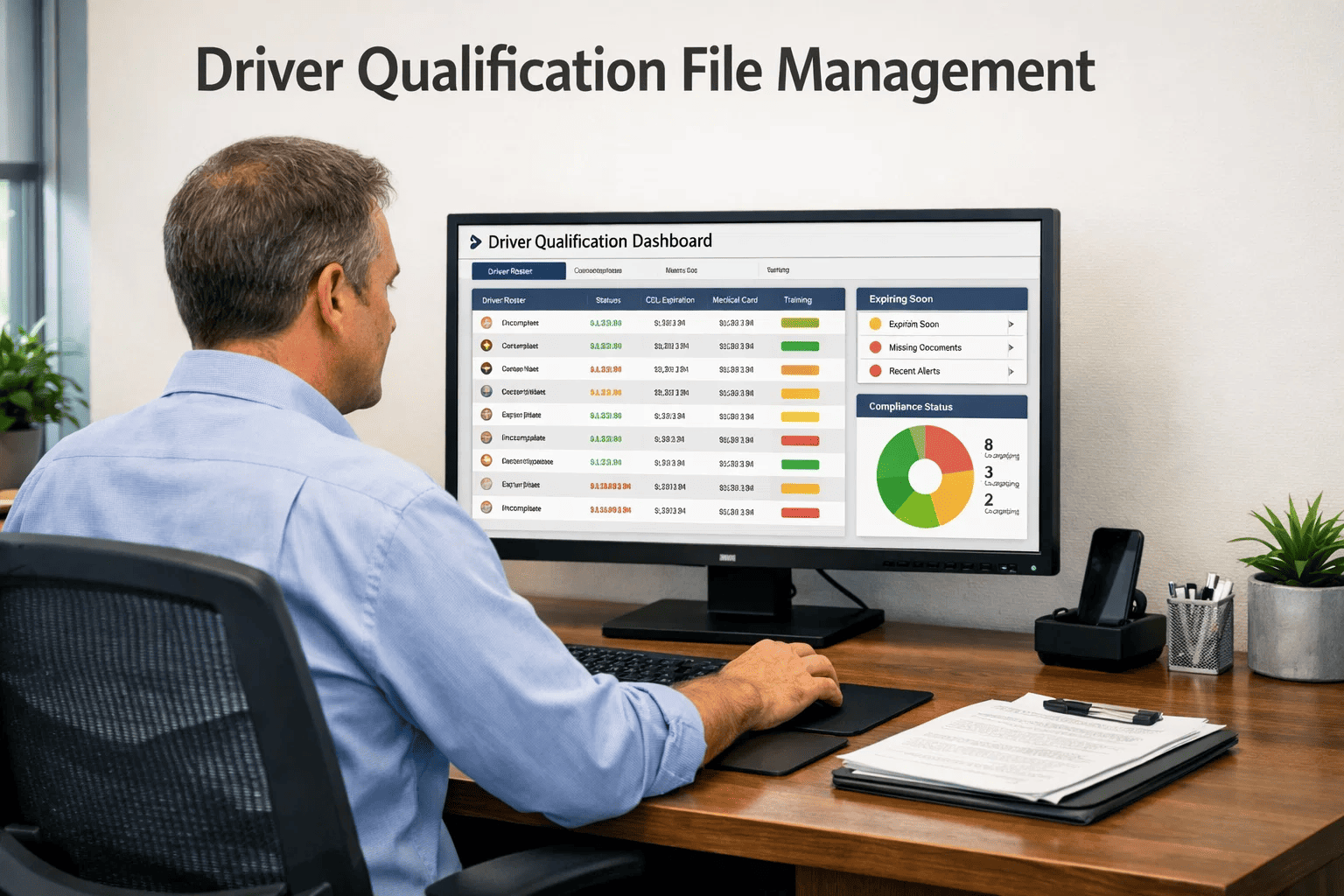
FleetRabbit's approach to driver compliance management is integrated into the platform's team management and compliance infrastructure, providing fleet managers with a digital DQF management environment that replaces the paper-folder paradigm with an organized, alert-driven, auditable digital system. Every driver registered in FleetRabbit has a compliance profile that tracks the required qualification documents, their currency status, their expiration dates, and the completeness of the file at any given point — without requiring a manual review cycle to identify deficiencies.

The fundamental change that digital DQF management in FleetRabbit creates relative to paper-based alternatives is the shift from reactive audit-driven compliance assessment to proactive alert-driven compliance maintenance. In a paper-based system, the fleet manager learns that a document is expired when someone looks at the file. In FleetRabbit, the system generates an alert before the document expires, giving the compliance coordinator time to renew the document before it creates a deficiency — which means that the fleet's compliance status is maintained continuously rather than repaired episodically after an audit finding.

Driver Compliance Profile Management
Document Tracking by Driver
Every driver in FleetRabbit has a compliance profile that lists each required DQF document, its current status — present and current, present and expiring, expired, or missing — the document's expiration date where applicable, and the date the most recent version was uploaded to the system. Fleet managers reviewing a driver's profile can see their complete compliance status at a glance without opening multiple file folders or requesting records from multiple administrative staff.
Document Upload and Storage
DQF documents are uploaded to FleetRabbit's driver profile as digital files — scanned copies of physical documents or documents received in digital format from medical examiners, MVR providers, or drug testing administrators. Uploaded documents are stored in the platform with version history, ensuring that both the current document and any prior versions are accessible and that the date each version was uploaded is recorded in the audit trail.
Expiration Alert and Notification System
Configurable Pre-Expiration Alerts
Fleet managers configure alert lead times for each document type in the compliance profile — for example, 90-day and 30-day pre-expiration alerts for medical certificates, 60-day alerts for CDL renewals, and annual review alerts timed to the anniversary of the prior year's completion date. Alerts are delivered to configured recipients through email and appear on the compliance dashobard, ensuring that renewal actions are initiated with sufficient lead time to complete the renewal before the expiration date.
Missing Document Alerts
When a new driver is created in FleetRabbit, the system immediately identifies which required documents have not yet been uploaded and generates a missing document alert checklist for the compliance coordinator. This prevents the common scenario where a driver completes basic onboarding and begins operating vehicles before their DQF is complete, producing a compliance deficiency that may not be discovered until the next file review or audit.
Fleet-Wide Compliance Dashboard
Portfolio-Level DQF Status View
The FleetRabbit compliance dashboard presents a fleet-wide view of DQF status across all active drivers — showing the percentage of driver files that are fully compliant, the number of drivers with expiring documents within the next 30 and 90 days, and the number of drivers with currently expired or missing required documents. This executive-level view allows compliance directors and VP of Safety officers to assess the fleet's overall qualification file status without reviewing individual driver records.
Terminal and Group-Level Compliance Segmentation
For multi-terminal carriers, the compliance dashboard can be segmented by terminal, region, or user-defined driver group — allowing corporate compliance officers to compare DQF compliance rates across terminals and identify locations where compliance processes are less effective without requiring manual report collection from each terminal's administrative coordinator. This visibility enables proactive remediation of compliance gaps before they produce audit findings.

Best Practices for Building a DQF Program That Survives a DOT Audit

Fleet managers who have successfully navigated FMCSA Compliance Reviews without DQF deficiency findings consistently point to four structural practices that distinguish their programs from those that produce compliance citations. These practices are systematically enabled by the FleetRabbit platform and are not reliably achievable through paper-based file management alone at scale.

01
Complete the File Before the Driver Drives
The single most important DQF best practice is establishing a hard administrative stop that prevents a new driver from being dispatched on a first load until the minimum required qualification documents are confirmed present in the file system. FleetRabbit's new driver compliance profile makes this discipline programmatic — the compliance coordinator can see at the hire date which documents are present and which are outstanding, and the dispatch status can be configured to reflect a driver's qualification file completeness alongside their operational availability. This structural enforcement of pre-drive file completion eliminates the most common single source of DQF deficiency findings: drivers who were put on loads before their documentation was assembled.
02
Treat Annual Requirements as Calendar Events, Not Anniversary Surprises
The annual MVR review, Certificate of Violations, and FMCSA Clearinghouse limited query have fixed due dates tied to the anniversary of each driver's prior completion — which means they come due on different dates for every driver, creating an administrative calendaring challenge that manual systems handle poorly. FleetRabbit's alert system converts annual renewal requirements into proactive calendar events that trigger notifications at configured lead times before each driver's individual renewal date — regardless of how many drivers are in the fleet and how distributed their anniversary dates are. The alert function replaces the calendar discipline that individual administrators cannot reliably sustain for large driver populations.
03
Document the Prior Employer Request Process Completely
Safety performance history inquiries to prior employers are required within 30 days of hire, and the documentation of both the request and the response — or the documented failure to respond after a good-faith request — must be in the DQF. Auditors routinely cite missing prior employer request documentation even when the carrier did send the request but failed to maintain a copy in the file. FleetRabbit's document management allows the original request letter and any prior employer responses to be uploaded directly to the driver's qualification profile, creating a complete documented record of the request cycle that satisfies the regulatory documentation requirement even when prior employers fail to respond.
04
Conduct Quarterly Internal File Audits Before the Regulator Does
Quarterly self-audits of DQF completeness and currency across the entire driver population are the most effective mechanism for identifying and correcting deficiencies before they appear in a DOT compliance review. FleetRabbit enables these internal audits by generating a compliance status report that lists every active driver alongside the status of each required document — present and current, expiring within 30 days, expired, or missing. This report can be produced in minutes from the compliance dashboard and serves as the working document for a quarterly compliance review meeting with the carrier's safety director, terminal managers, and compliance coordinator.

DQF Compliance in a High-Turnover Trucking Environment

The trucking industry's structural driver turnover challenge creates a specific DQF management pressure that fleet managers at stable-workforce industries do not face. When a carrier routinely replaces 50 to 100 percent of its driver workforce annually, the DQF administrative team is continuously managing files at every stage of completion — new hires with partially assembled files, active drivers with documentation renewals due, and terminated drivers whose records must be retained in the proper format for the prescribed retention period. This multi-state file pipeline is where paper-based systems break down most severely, because the administrative capacity required to track every document across a constantly changing driver population exceeds what a human calendar review system can reliably deliver.

FleetRabbit addresses the high-turnover DQF environment by automating the alert function for every stage of the driver lifecycle. When a new driver is created in the system, the missing document checklist is immediately generated. When documents are uploaded and expiration dates are recorded, the forward-looking alert schedule is automatically set based on configured lead times. When a driver is terminated, the system flags the file for proper retention processing and can generate a retention reminder at the appropriate interval before required documents can be disposed. This lifecycle-based alert automation means that the compliance coordinator's attention is directed to specific, timely actions rather than consumed by calendar-watching and file-checking that a technology system can handle more reliably.

Medical Certificate Management: The Most Time-Sensitive DQF Component

The medical examiner's certificate has the most operationally consequential expiration dynamic of any DQF document. When a driver's medical certificate expires without renewal, the driver is legally prohibited from operating a commercial motor vehicle in interstate commerce — creating both an operational disruption and a serious compliance liability if the driver is inadvertently dispatched after the certification lapses. The standard 2-year medical certification period, combined with the 1-year and shorter intervals required for drivers with certain medical conditions, creates a continuous renewal management requirement across the full driver population.

FleetRabbit's medical certificate tracking manages this requirement by recording the expiration date for each driver's current medical certification and generating tiered alerts — at 90 days, 60 days, and 30 days before expiration — that give compliance coordinators and driver managers sufficient lead time to schedule the physical examination and ensure the new certificate is uploaded before the prior one expires. For drivers with annual or shorter-than-standard certification periods due to medical conditions including hypertension, diabetes, vision conditions, or sleep apnea monitoring requirements, FleetRabbit tracks the individualized renewal interval and calibrates the alert schedule to the specific driver's certification duration rather than assuming a standard 2-year period. This individualized tracking eliminates the compliance gap that occurs when a driver renewing on a shorter-than-standard cycle is managed under the same calendar assumption as a driver with full 2-year certification.

Build an Audit-Ready Driver Qualification File Program with FleetRabbit

FleetRabbit provides fleet managers and compliance officers with the digital DQF infrastructure — document organization, expiration alerts, fleet-wide compliance dashboards, and audit-ready reporting — required to maintain complete, current qualification files for every driver in the fleet without relying on manual calendar reviews. Book a demo to review how FleetRabbit structures DQF compliance for your fleet's driver population and turnover environment.

Managing DQF Compliance During an FMCSA Compliance Review

When FMCSA investigators conduct a Compliance Review — the most comprehensive form of DOT safety audit — they typically request DQF records for a sample of randomly selected drivers, with the sample size determined by the carrier's fleet size. Investigators may also request records for specific drivers involved in accidents or roadside violations that triggered the audit. The carrier is required to produce the requested records within a defined period, and in on-site reviews, the records must be organized and accessible for immediate review.

The difference in audit experience between carriers using FleetRabbit digital DQF management and carriers relying on paper-based files is primarily a function of retrieval speed and document completeness. A compliance officer at a carrier using FleetRabbit can produce a complete, organized driver qualification file package for any selected driver in minutes by downloading the driver's compliance profile documents from the platform — a process that takes less time than locating the physical folder in a filing cabinet and considerably less time than locating a file that has been partially stored at the terminal and partially in the corporate office. Document completeness is also higher in digital DQF systems because the compliance dashboard identifies missing documents before the audit arrives, giving the compliance team the opportunity to address gaps rather than discovering them simultaneously with the investigator.

Carriers who have transitioned from paper-based DQF management to FleetRabbit's digital system consistently report that subsequent FMCSA compliance reviews are less stressful and produce fewer deficiency findings than pre-transition audits — not because the regulatory requirements changed, but because the systematic alert and organization infrastructure of the platform maintained file completeness continuously rather than relying on human calendar discipline that paper-based systems cannot mechanize.

Drug and Alcohol Testing Records in the DQF Context

Drug and alcohol testing documentation represents one of the most complex components of commercial driver qualification management, requiring coordination between the DQF documentation function and the Part 382 drug and alcohol testing program management function. At hire, the pre-employment negative drug test result must be documented in the DQF before the driver operates a commercial motor vehicle. Ongoing random testing results, post-accident testing outcomes, reasonable suspicion testing records, and return-to-duty records following a drug or alcohol violation each have specific documentation and retention requirements under Part 382 that interact with the DQF retention requirements under Part 391.

FleetRabbit's driver compliance profile can store drug and alcohol testing documentation alongside the traditional DQF documents, ensuring that both the pre-employment test result and subsequent testing records are maintained in the same organized digital environment as the medical certificate, CDL copy, and MVR records. The FMCSA Drug and Alcohol Clearinghouse query documentation — both the full query conducted at hire and the annual limited query required for active drivers — can also be uploaded and tracked within the driver's compliance profile, with the annual limited query generating its own renewal alert in the system.

Frequently Asked Questions About Driver Qualification File Management

What is the penalty for incomplete DQF records found during an FMCSA Compliance Review?
Federal civil penalties for DQF violations are assessed per violation instance under 49 CFR Part 386, with maximum civil penalties of $19,933 per violation per day for general driver qualifications violations. Beyond civil penalties, DQF deficiencies contribute to the carrier's FMCSA safety fitness determination — carriers with significant DQF non-compliance may receive a Conditional safety rating, which triggers additional regulatory scrutiny and can affect commercial insurance positioning and customer qualification requirements. The combination of financial penalties and safety rating impact makes DQF compliance one of the highest-consequence regulatory obligations that fleet managers face under the FMCSA regulatory framework.
Is there a grace period for medical certificate renewal if the driver's certificate expires before the new examination is scheduled?
No. Under FMCSA regulations, a driver whose medical certificate expires is no longer legally qualified to operate a commercial motor vehicle in interstate commerce from the date of expiration — there is no regulatory grace period. The practical implication for fleet managers is that medical certificate renewals must be completed before the prior certificate expires, not after, and the scheduling of medical examinations must account for the time required to complete the examination and process the new medical certificate documentation. FleetRabbit's 90-day and 30-day recurring pre-expiration alerts for medical certificates are specifically designed to provide enough lead time for examination scheduling to be completed before the expiration date creates an out-of-service situation.
How should a carrier document a prior employer who does not respond to a safety performance history request within the required period?
When a prior employer fails to respond to a safety performance history request within the required period, the carrier must document the attempt — including the date of the initial request, the method of communication, any follow-up attempts, and the failure of the prior employer to respond. FMCSA regulations require that the carrier make a good-faith effort to obtain the information and document the effort even when the information is not provided. In FleetRabbit, the documentation of the request letter, follow-up correspondence, and non-response can be uploaded to the driver's qualification profile, creating a complete documented record of the good-faith attempt that satisfies the regulatory documentation requirement while protecting the carrier from the regulatory consequence of a missing response that was outside the carrier's control.
How long must a carrier retain the DQF for a driver after that driver leaves the company?
Under 49 CFR 391.51, carriers must retain driver qualification files for three years after driver separation for most DQF components. However, the annual record of violations must be retained for one year after the driver's employment ends, and certain training records associated with hazmat transportation have extended retention requirements. FleetRabbit's digital document retention system maintains the records in the driver's archived profile with the separation date recorded, allowing compliance officers to manage the retention period digitally rather than requiring physical file storage for the three-year post-separation period — after which the records can be disposed of in accordance with the carrier's established document destruction policy.
Can FleetRabbit support DQF document collection from drivers through the mobile application?
Yes. FleetRabbit's mobile application allows drivers and field coordinators to photograph and upload documents directly from a mobile device, linking the uploaded document to the specific driver's qualification profile in the platform. This capability is particularly valuable for onboarding drivers who are away from the terminal during the new hire process — medical certificate uploads, CDL photos, and road test documentation can all be captured and submitted through the mobile app by the driver or the recruiting coordinator, feeding directly into the driver's FleetRabbit compliance profile without requiring a physical file assembly process at a central location.

DQF Compliance Is Not Optional — and Manual Systems Are No Longer Adequate

The administrative complexity of maintaining complete, current driver qualification files for a full commercial driver workforce — across multiple terminals, high turnover conditions, and multi-document annual renewal cycles — exceeds the reliable capacity of paper-based and spreadsheet-based management systems. FleetRabbit gives fleet managers and compliance officers the digital DQF infrastructure required to maintain continuous compliance across any size driver population, with alert-driven renewal management that addresses the most common source of DQF deficiency findings before they appear in a DOT audit.

FMCSA DQF Compliance Medical Certificate Tracking MVR Annual Review Alerts CDL Expiration Monitoring Clearinghouse Query Tracking DOT Audit-Ready Records

April 18, 2026 By Jason Smith
All Posts

Share This Story, Choose Your Platform!

Latest Posts

Scroll