A single missing signature in a driver qualification file can turn a routine roadside stop into an out-of-service order, and it can turn a routine FMCSA compliance review into a rating downgrade. Driver qualification files, commonly called DQ files, are the first thing an auditor asks to see, and incomplete files remain one of the most frequently cited violations in the industry. The good news is that DQ file compliance is entirely predictable once you know exactly what belongs in each file and when each document expires.
Every motor carrier must maintain a driver qualification file for each driver operating a commercial motor vehicle under 49 CFR Section 391.51, covering everything from the initial application through annual reviews and current medical certification. Files must be retained for the length of employment plus three years. Automated expiration tracking is the difference between a routine renewal and a scramble when an auditor walks in.
Who Needs A Driver Qualification File
Every driver operating a commercial motor vehicle under your USDOT number needs a DQ file, and that requirement does not stop at your full-time employees. Part-time drivers, seasonal drivers, owner-operators leased to your authority, and drivers supplied through a staffing agency all need a file maintained by your carrier. The carrier is the one held responsible for the file, regardless of who technically employs the driver day to day.
The Documents That Belong In Every File
At the core, every DQ file needs to show the driver's completed employment application, evidence that the carrier investigated the driver's prior employment safety history, a valid road test certificate or accepted CDL equivalency, a current medical examiner's certificate or CDLIS MVR showing certification status, and a documented annual review of the driver's driving record. Depending on the driver's history, files may also need a medical variance or Skill Performance Evaluation certificate and documentation of any safety violations reported over the prior twelve months.
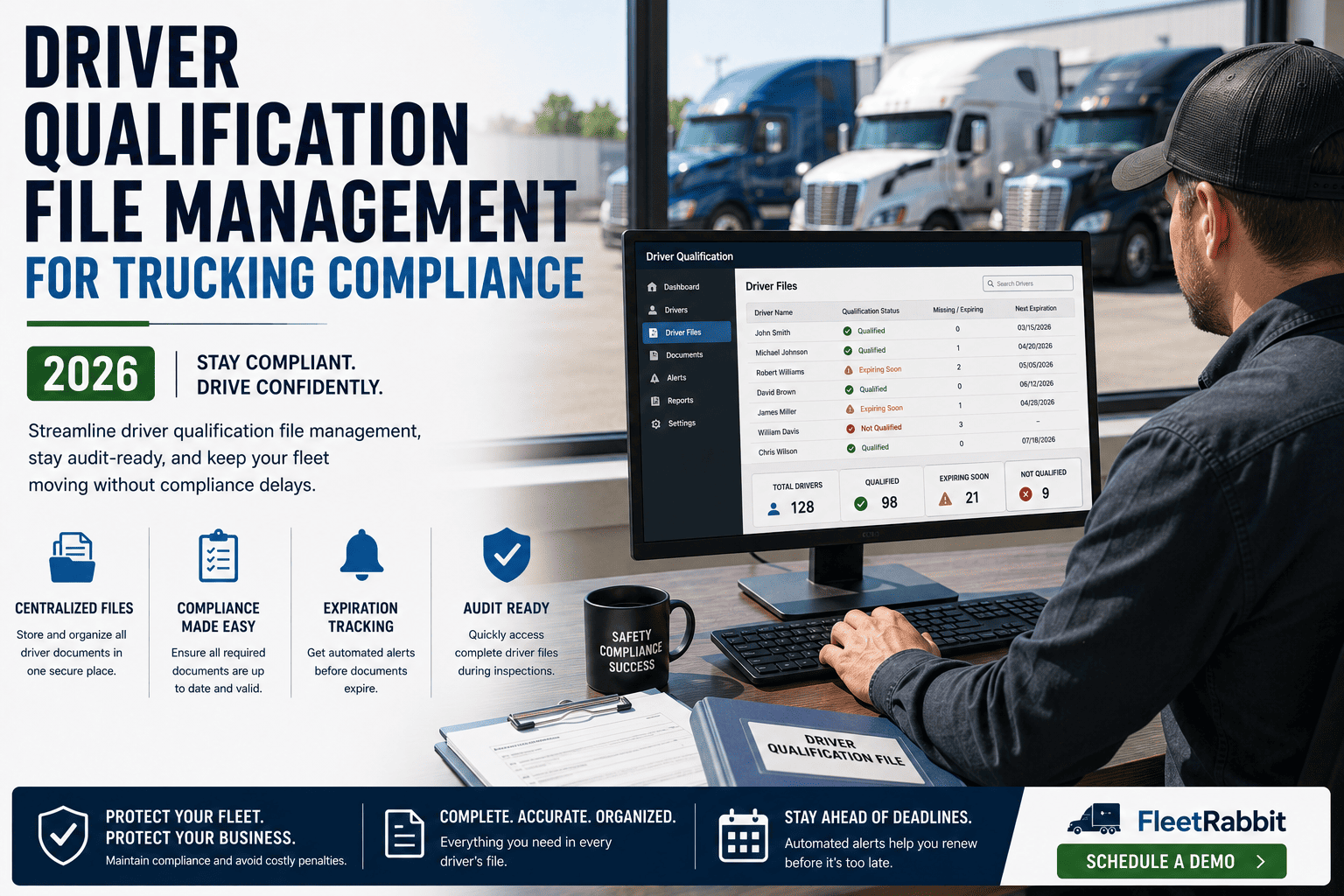
FleetRabbit monitors every driver's medical certificate, MVR review, and annual documentation in one place, alerting your team before anything lapses. Sign up free to build compliant files in minutes, or book a demo to see your fleet's current compliance gaps.
Core Document Checklist And Common Failure Points
Most DQ file violations trace back to a small handful of documents that get overlooked, expire quietly, or never make it into the file in the first place. The table below breaks down what auditors check most closely and where fleets typically fall short.
| Document | Regulatory Purpose | Common Failure Point | How Automation Helps |
|---|---|---|---|
| Employment Application | Captures 3-year work history, license status, and signed driver certification | Missing signature or incomplete 3-year employment history | Digital intake forms block submission until every required field is complete |
| Prior Employer Investigation | Verifies safety performance history within 30 days of the driver's first day | No documented contact attempts when a prior employer never responds | Workflow tracking logs every contact attempt with dates automatically |
| Road Test Or CDL Equivalency | Confirms the driver can safely operate the specific vehicle type assigned | CDL on file with no documented equivalency decision behind it | Guided onboarding prompts the equivalency record at the right step |
| Medical Examiner's Certificate | Confirms the driver is medically fit to operate a commercial vehicle | Certificate expires unnoticed, often the single most cited DQF violation | Expiration alerts fire weeks in advance of every certificate deadline |
| Annual MVR Review | Documents a yearly assessment of each driver's driving record | MVR pulled but no documented reviewer name or safety determination | Generates the review record with reviewer, date, and outcome automatically |
Keeping Files Current Throughout The Year
Building a compliant file at onboarding is only half the job. Medical certificates, MVR reviews, and Clearinghouse queries all run on their own separate clocks, and a file that was perfect on day one can quietly go non-compliant six months later if nobody is tracking the deadlines.
Medical Certificate Expirations
Most medical certificates are valid for up to 24 months, but a medical examiner can shorten that window to six or twelve months for certain conditions. Every certificate needs to be checked against the National Registry of Certified Medical Examiners, and fleets running paper tracking often discover an expired certificate only after a roadside inspection flags it.
Annual Reviews And Clearinghouse Queries
Every CDL driver needs a documented driving record review within the past twelve months, along with ongoing Clearinghouse queries confirming the driver has not been flagged for a drug or alcohol violation. Both are easy to complete on time and easy to quietly miss without a system prompting the deadline.
Personnel Changes And Reassignments
When a driver moves between divisions, changes vehicle types, or returns after a leave of absence, files need a fresh look to confirm nothing has lapsed in the interim. Treating reassignment as a compliance checkpoint, not just an HR event, closes a gap that manual systems frequently miss.
FleetRabbit centralizes every driver's documents, tracks medical certificate and MVR deadlines automatically, and flags gaps before they become violations. Start your free sign up today, or book a 30-minute demo to see your driver files in one place.
Preparing For A Compliance Review
An FMCSA compliance review pulls DQ files before almost anything else, and reviewers work through a defined checkpoint list rather than a general impression of your recordkeeping. The most defensible position is a file that would survive a surprise review on any random day of the year, not just at renewal time. Running a quarterly internal audit against the same checkpoints an FMCSA reviewer uses, rather than waiting for an official review to find the gaps, is the single most effective habit a compliance manager can build.
Fleets that stay ahead of this typically build one recurring habit: pulling a random sample of driver files every quarter and checking them against the same core checklist an auditor would use, then correcting anything found immediately rather than filing it away for later.
Making Driver Compliance A Non-Event
Driver qualification file management is one of the rare compliance areas where a small operational habit removes almost all the downside risk. Once every document is centralized and expiration dates are tracked automatically, an FMCSA compliance review stops being a source of dread and becomes a formality your files are already prepared for.
FleetRabbit tracks medical certificates, MVR reviews, and onboarding documents for every driver in one dashboard, so nothing expires quietly and no file is ever incomplete when an auditor asks.