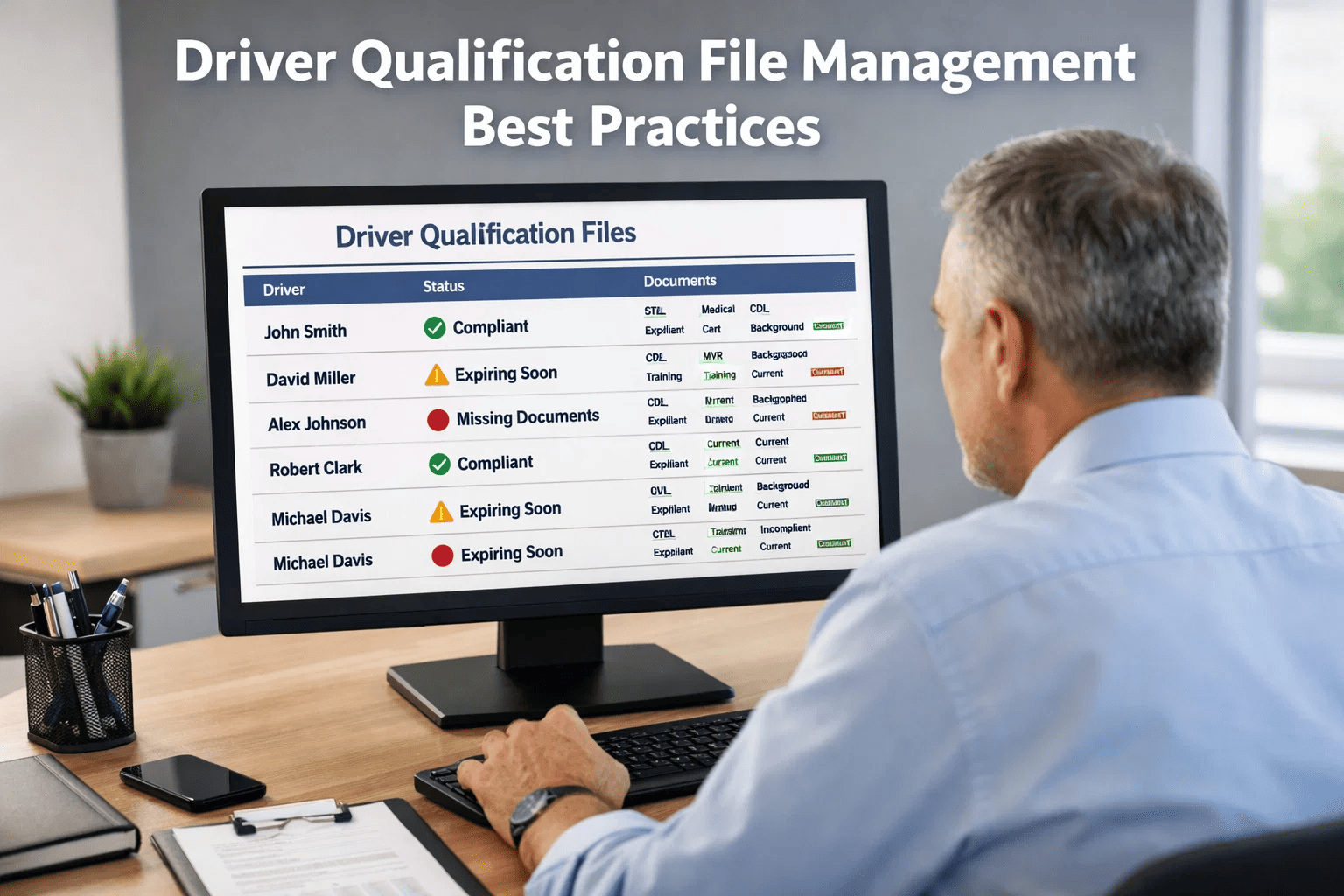
Driver Qualification Files represent 12% of all FMCSA violations — over 62,000 citations in the past five years alone. For transportation and logistics operators, an incomplete or disorganized DQ file is not a paperwork inconvenience; it is a federal compliance failure that triggers deeper audits, fines up to $16,000 per violation, and potential operating authority suspension. In 2026, with new Medical Examiner Certificate verification requirements and intensified Clearinghouse enforcement, maintaining audit-ready driver files has never been more operationally critical.
This guide covers every component of FMCSA-compliant driver qualification file management, the most common gaps that trigger citations, and how FleetRabbit's compliance management platform automates DQ file tracking for fleets of every size operating in regulated transportation and logistics.
Driver Qualification File Management
Complete Best Practices for FMCSA Compliance — From Hire to Termination
What Is a Driver Qualification File and Who Requires One?
Under 49 CFR Part 391, every motor carrier operating commercial motor vehicles in interstate commerce must maintain a Driver Qualification File for each employed CDL driver. The DQ file is a cumulative compliance record that must be initiated before the driver's first dispatch and maintained for the duration of employment plus a mandatory retention period after termination. FMCSA auditors treat the DQ file as a primary indicator of carrier compliance culture — incomplete files signal systemic management failures that justify deeper investigation.
Carriers Required to Maintain DQ Files
- Carriers operating CMVs with GVWR over 10,001 lbs in interstate commerce
- Carriers transporting 9+ passengers for compensation
- Carriers transporting 16+ passengers (not for compensation)
- Carriers transporting hazardous materials requiring placards
- New entrant carriers undergoing 18-month safety monitoring
2026 Regulatory Update: MEC Verification
- Paper Medical Examiner Certificates (MEC) waiver expired January 2026
- CDL driver medical status must be verified through state MVR only
- Stop collecting paper MECs from CDL drivers immediately
- Non-CDL drivers still require paper MEC in DQ file
- 30-day MVR pull cycle recommended for active CDL drivers
The Complete DQ File: Every Required Document
FMCSA regulations specify exactly which documents must be present at the time of hire, which require periodic renewal, and how long each must be retained. This checklist covers all requirements under 49 CFR Part 391 with 2026 updates applied.
Employment Application (FMCSA-Compliant)
Must include 10-year employment history with all gaps explained, contact information for previous employers, list of all CMV-related accidents in past 3 years, and list of all traffic violations in past 3 years regardless of vehicle type. Standard HR applications do not satisfy this requirement.
Motor Vehicle Report (MVR) — Pre-Employment
Obtained from each state where the driver held a license in the past 3 years. Must be reviewed by a qualified reviewer and compared against the company's minimum driver qualifications policy. For CDL drivers, also serves as the medical certificate verification mechanism in 2026.
Drug & Alcohol Pre-Employment Test Results
Negative pre-employment drug test result required before first drive. Also includes Clearinghouse full query result confirming no prohibited status. MRO verification documentation must be retained. For drivers with previous employer violations, return-to-duty documentation required.
Road Test Certificate or Valid CDL Waiver
If road test was administered: Include the examiner's certificate confirming the driver passed. If CDL serves as road test waiver: Copy of CDL must be retained in file. Road tests must cover the specific vehicle type the driver will operate.
Previous Employer Safety Performance History
Must contact all DOT-regulated employers from the past 3 years within 30 days of hire. Includes accident history, drug/alcohol violations, and refusal to test. Document all contact attempts and responses. Written consent from driver required before requesting.
Medical Examiner Certificate (Non-CDL Drivers Only)
For CDL drivers, verify medical certification through MVR only. For non-CDL CMV drivers, paper MEC must be in file. Certificates are valid for up to 24 months but may be shorter based on examiner recommendation. Expiration must be tracked and renewed proactively.
Annual MVR Review
A driving record must be obtained from each state where the driver is licensed annually. The MVR must be reviewed, compared against the carrier's driver qualification standards, and documented. Missing annual MVRs are one of the most frequently cited DQ file violations during FMCSA audits.
Clearinghouse Limited Query
Annual limited query for all CDL drivers required under 49 CFR Part 382. If the query returns a record, a full query must be completed immediately. The limited query serves as confirmation that no new violations have been added since the pre-employment full query.
Annual Driver Qualification Review & Certification
Carrier must annually review the driver's qualifications and certify in the DQ file that the driver continues to meet all FMCSA requirements. This includes reviewing the employment application, current MVR, medical status, and any reported accidents or violations during the year.
Random Drug & Alcohol Testing Records
Documentation of inclusion in consortium or carrier-managed random testing pool at federally mandated rates (50% of driver count for drugs, 10% for alcohol as of 2026). Individual test results for any driver selected must be retained in the DQ file.
Automate Your DQ File Management
FleetRabbit tracks every driver document, renewal deadline, and Clearinghouse query across your entire fleet — with automated alerts before anything expires.
The 8 Most Common DQ File Violations During FMCSA Audits
FMCSA audit data reveals eight recurring DQ file failures that account for the majority of Part 391 citations. Understanding these patterns helps fleet managers prioritize their compliance review process and focus resources where violations are most likely to occur.
DQ File Audit Readiness: What FMCSA Auditors Actually Look For
Audit preparation is not about assembling documents the day before an audit notice arrives — it is about maintaining continuous readiness. FMCSA compliance reviewers are trained to identify specific patterns of systemic failure, not just isolated missing documents. Understanding the auditor's perspective helps fleet managers build systems that are continuously compliant rather than periodically scrambled.
Systematic File Organization
Auditors look for logical organization: chronological arrangement, clearly labeled sections for each document category, and consistent formatting across all drivers. Disorganized files are treated as evidence of inadequate compliance management.
Consistent Date Documentation
Every document must be dated at time of creation or receipt. Backdated documents — even when the underlying compliance was maintained — are treated as falsification and trigger significantly escalated penalties.
Cross-Reference Consistency
Auditors compare DQ file contents against ELD records, accident registers, and roadside inspection history. Discrepancies between systems — such as a driver with roadside violations not documented in the DQ file — indicate systemic information management failures.
Complete Driver Coverage
Every CDL driver in the carrier's system must have a complete DQ file. Seasonal or short-term drivers are frequently missing from compliance systems. FMCSA can pull driver lists from IRP, UCR, and state licensing databases to cross-check carrier records.
How FleetRabbit Automates Driver Qualification File Management
Manual DQ file management fails at scale. A transportation operation with 50 drivers has hundreds of individual document renewal deadlines occurring on different dates throughout the year — an administrative complexity that paper-based and spreadsheet-based systems cannot reliably handle. FleetRabbit's compliance management platform eliminates this complexity through automated tracking, proactive alerts, and centralized digital file storage.
Automated Expiration Tracking & Alerts
FleetRabbit tracks every expiration date across all driver documents — MVRs, medical certificates, Clearinghouse query schedules, and annual review deadlines. Automated email and dashboard alerts trigger 90, 60, and 30 days before expiration, ensuring proactive renewal rather than reactive scrambling.
Centralized Digital File Repository
All DQ file documents stored in a secure, searchable digital repository accessible from any device. During remote audits with 48-hour response windows, fleet managers can generate complete driver compliance packages in minutes rather than days — without locating physical files across multiple locations.
Compliance Status Dashboard
Real-time fleet-wide DQ compliance dashboard shows exact completion status for every driver. Color-coded indicators identify expired documents, missing items, and upcoming renewals. Fleet managers can assess company-wide compliance posture in a single screen without reviewing individual files.
Instant Audit Package Generation
Generate a complete, audit-ready DQ file package for any driver or for the entire fleet with one click. Packages include all required documents in properly formatted, chronologically organized digital files — eliminating the risk of missing documents under audit time pressure.
DQ File Best Practices by Fleet Size
The right DQ file management approach depends on fleet size, operational complexity, and internal administrative capacity. These best practices are calibrated by operational scale to provide practical, implementable guidance.
- Designate a single compliance owner with dedicated weekly DQ review time
- Use a master tracking spreadsheet supplemented by calendar alerts for renewals
- Digitize all documents at hire using phone scanning — do not rely on paper filing
- Complete Clearinghouse limited queries during the same month each year for all drivers
- Build DQ file completion into new hire onboarding as a hard gate before first dispatch
- Implement a dedicated fleet compliance software platform — manual tracking fails at this scale
- Assign DQ compliance to a dedicated safety manager with monthly audit responsibilities
- Conduct quarterly internal DQ file audits on a rotating 25% sample of the driver base
- Establish a 90-day pre-expiration renewal workflow for all time-sensitive documents
- Integrate DQ tracking with dispatch systems to block unqualified driver assignments automatically
- Deploy enterprise-grade fleet compliance platform with multi-location, multi-supervisor access
- Establish a dedicated Safety Director overseeing DQ compliance program and internal audit cycles
- Implement real-time API integration between DQ management system and driver dispatch/payroll
- Conduct annual comprehensive DQ file audit on 100% of driver files — not a sample
- Maintain legal counsel on retainer for FMCSA audit response and corrective action planning
Frequently Asked Questions: Driver Qualification Files
Keep Every Driver File Audit-Ready — Automatically
FleetRabbit's compliance platform tracks every document, renewal, and Clearinghouse requirement across your entire driver base. Generate complete audit packages in minutes, not days.
Free for 3 vehicles | $3/vehicle/month | No contracts