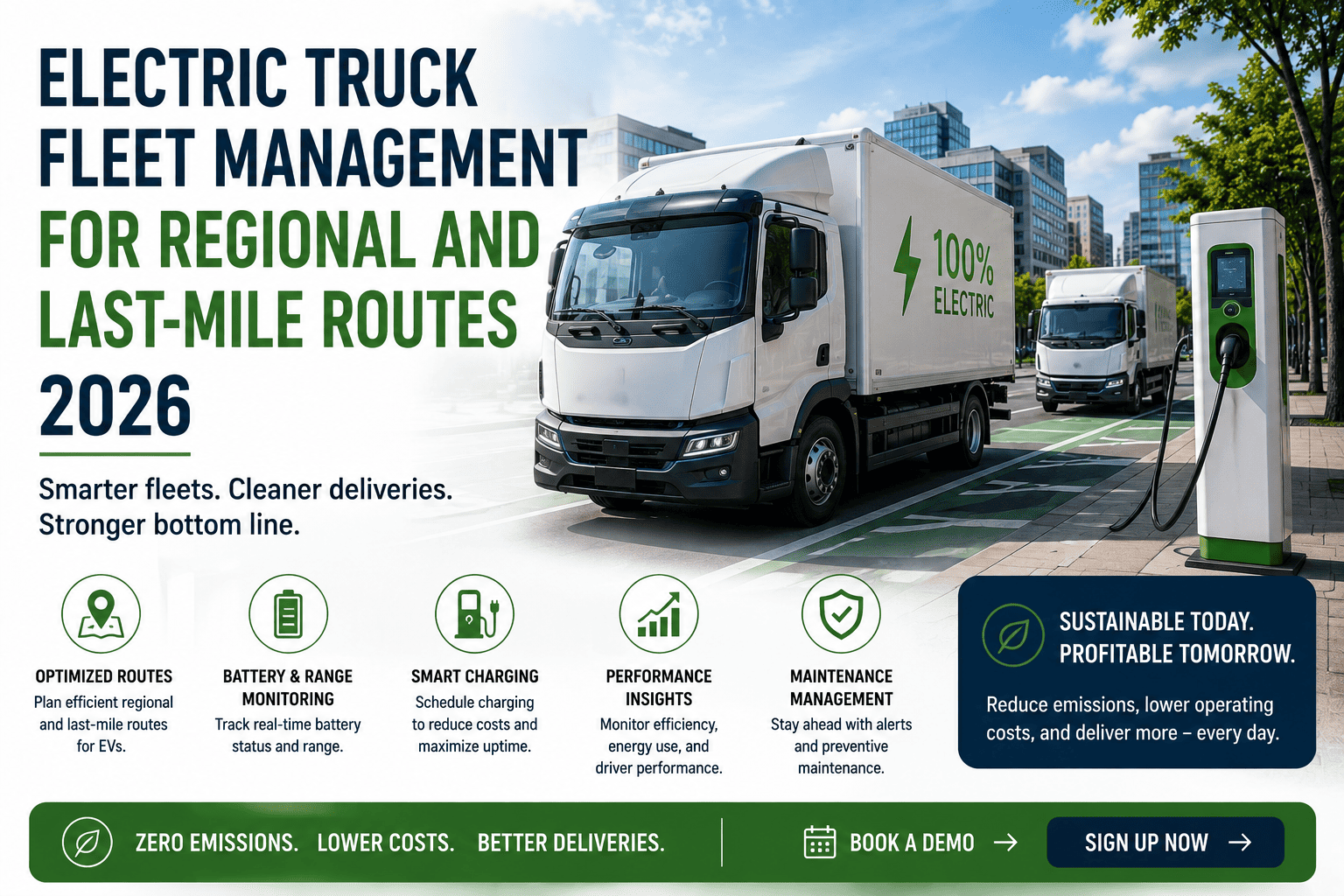
Somewhere in a regional distribution yard tonight, a row of electric trucks is quietly charging at 30 percent of the noise and none of the diesel fumes of the fleet they're replacing. But ask the fleet manager how confident they are in tomorrow's range, and the answer gets a lot less quiet. Electric trucks are no longer a pilot program footnote in 2026 — they are a daily dispatch decision. The trucks that make regional and last-mile sense on paper only deliver on that promise when charging, battery health, and route planning are managed with the same discipline fleets once reserved for fuel and mileage logs.
Electric trucks perform best on regional and last-mile routes under 200 miles daily, where depot-based overnight charging covers the full range need. Battery health monitoring extends usable service life from 6 years to 10 years, avoiding 80000 to 120000 dollars in premature replacement cost per vehicle. Fleets that integrate EV data into maintenance software report 31 percent lower EV maintenance costs, while driver behavior alone accounts for 15 to 20 percent of real-world range variation.
Why Regional and Last-Mile Routes Are the EV Sweet Spot
Electric trucks and long-haul freight are still working out their relationship, largely because charging infrastructure along highway corridors remains thin outside a handful of established routes. Regional and last-mile operations face no such constraint. Urban delivery, beverage distribution, food service, and waste hauling routes typically return vehicles to the same depot every night, which makes overnight charging simple, predictable, and cheap. This is exactly why most fleet operators evaluating electric truck management software are starting with these route types rather than long-haul lanes.
Matching Vehicle Class to Route Distance
Not every electric truck fits every regional route, and matching class to distance is the first decision that determines whether the switch pays off. Light electric pickups configured for fleet use typically deliver 200 to 280 miles per charge. Medium-duty electric trucks usually cover 150 to 200 miles under load, comfortably handling the bulk of local and regional delivery work. Heavier regional distribution units with larger battery packs extend that range further, but the fundamental rule holds across every class: routes under 150 miles daily are the strongest EV candidates, while anything approaching 200 miles needs careful charging-window planning.
Reading Your Own Route Data First
Before committing to any electric truck purchase, pull 90 days of GPS history and look at average daily mileage per vehicle. Vehicles consistently running under 150 miles a day are ready for electrification today. Vehicles regularly exceeding 200 miles with few charging opportunities either need a phased transition or a larger battery configuration than the base model offers.
FleetRabbit pulls your existing GPS history and flags which vehicles are strong electric candidates based on real daily mileage, not manufacturer estimates. Sign up for a free trial and see your fleet's EV suitability report in minutes.
Depot Charging vs. En-Route Charging
Charging strategy is the single decision that determines whether an electric truck fits your operation smoothly or becomes a daily scheduling headache. Most regional and last-mile fleets rely primarily on one model, with the other used only as backup for unusual routes.
| Charging Model | How It Works | Best Fit | Key Consideration |
|---|---|---|---|
| Depot Charging | Overnight charging at terminals using 50 to 150 kW chargers | Last-mile and regional routes with nightly depot return | Requires scheduling charge sessions during off-peak electricity rates |
| En-Route Charging | Mega-watt charging stations along established corridors | Medium-haul routes approaching 300 to 500 miles | Coverage still concentrated on a limited number of corridors |
| Smart Charge Scheduling | Software-managed sessions balancing energy cost and dispatch readiness | Any fleet running multiple EVs from a shared depot | Prevents demand charge spikes when many vehicles charge simultaneously |
Battery Health: The Metric That Determines Asset Value
In a diesel fleet, engine hours and mileage tell you most of what you need to know about an asset's remaining life. In an electric fleet, battery state of health is the equivalent metric, and it behaves very differently depending on how disciplined your charging and thermal management practices are.
The Ten-Year vs. Six-Year Divide
A fleet electric truck losing roughly 2 percent battery capacity per year reaches 80 percent of its original range, the point most fleet managers consider the effective end of useful service life, at around year ten. The same truck operated without thermal management discipline, with frequent fast-charging beyond 80 percent state of charge, and no ongoing state-of-health monitoring reaches that same threshold by year six instead. Across a 50-unit electric fleet, that four-year gap represents 80000 to 120000 dollars in accelerated replacement cost per vehicle.
Making Battery Health a Daily Workflow, Not an Engineering Report
Battery health monitoring only pays off when it lives inside the maintenance manager's daily workflow rather than sitting in a separate engineering dashboard nobody checks. Fleets that integrate battery state-of-health, charging cycle data, and thermal management alerts directly into their maintenance software report 31 percent lower EV maintenance costs than fleets tracking this data manually or not at all.
Cold Weather and Driver Behavior: The Overlooked Range Factors
Two variables catch new EV fleet operators off guard every winter. Cold weather reduces commercial EV range by 20 to 40 percent depending on battery chemistry and cabin heating demand, which means routes that work comfortably in summer need a wider safety margin from November through March. Separately, driver behavior accounts for 15 to 20 percent of real-world range variation on its own, making regenerative braking habits and efficient HVAC use a training priority worth as much attention as charging infrastructure.
Avoid six-figure replacement costs from silent battery degradation. Book a demo to see how FleetRabbit tracks state of health, charging cycles, and thermal alerts alongside the rest of your fleet maintenance.
Managing Mixed Diesel and Electric Fleets Together
Very few fleets flip a switch and go fully electric overnight. Most operate diesel, hybrid, and electric vehicles side by side for years, which means the software managing them needs to treat both powertrains as first-class citizens rather than bolting EV features onto a diesel-first platform as an afterthought.
One Dashboard, Every Powertrain
A properly built unified fleet dashboard shows diesel vehicles by fuel consumption and engine health while showing electric vehicles by battery state of health, charge level, range projection, and energy cost per mile, all inside the same view. Maintenance scheduling, compliance tracking, driver performance scoring, and reporting work identically across every powertrain type, so fleet managers are running one operation instead of juggling two disconnected systems.
Planning the Transition in Phases
Start by electrifying the vehicles your own route data already flags as strong candidates. As pilot data confirms real-world performance, expand deployment and refine route assignments so the highest-range vehicles get the highest-mileage routes. Automating sustainability reporting alongside this rollout, including emissions reduction per route, turns the transition into a documented business outcome rather than a quiet operational shift.
Frequently Asked Questions
Electric trucks pay off when charging, battery health, and route assignments are managed with real discipline, not guesswork. FleetRabbit gives regional and last-mile fleets one dashboard for battery monitoring, smart charge scheduling, and mixed-powertrain analytics, so every electric truck earns its place in the fleet. Start your free trial with no credit card required, or talk to our team about your specific rollout.