An audit notice does not usually arrive with much warning, and it does not care whether your driver files are in a filing cabinet, a shared drive, or scattered across three different spreadsheets. Only about 7 percent of motor carriers pass a DOT audit without a single violation, and the remaining 93 percent face fines, corrective action plans, or worse. The carriers that pass are rarely the ones who scrambled hardest in the two weeks before the auditor arrived. They are the ones whose records were already organized before the notice ever showed up.
FMCSA conducted over 8,340 investigations through mid-2025 alone, generating more than 62,000 violations across 865 different codes. Driver Qualification File deficiencies remain the single most cited category, followed closely by Hours of Service and vehicle maintenance findings. Auditors expect requested records produced within 48 hours, and fleets running centralized digital systems routinely turn that window into minutes instead of days.
Why Audit Prep Usually Starts Too Late
Most carriers only think about audit readiness once a notice actually lands, and by then the clock is already running. Carriers typically get about two weeks of notice before a comprehensive compliance review, and new entrants receive an automatic audit within 12 to 18 months of getting their operating authority, whether they are ready or not. Two weeks sounds like enough time until you actually try to pull six months of ELD supporting documents, ninety days of DVIRs for every vehicle, and a complete driver qualification file for every driver on the roster, all at once.
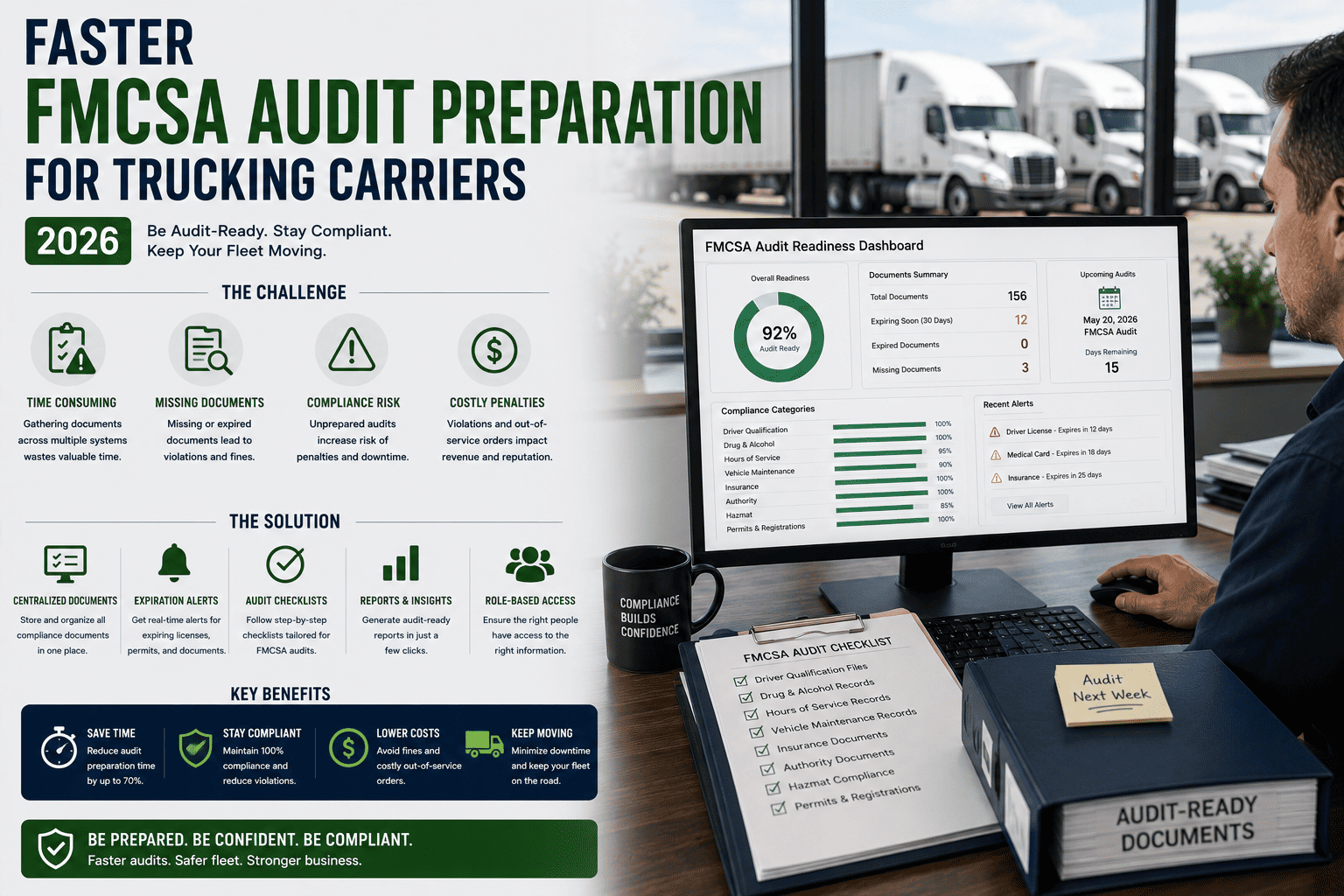
The documents auditors ask for are not a mystery. The categories are the same every time: Driver Qualification Files, Hours of Service records, DVIRs and maintenance history, drug and alcohol testing records, the accident register, and proof of insurance. What separates a smooth review from a corrective action plan is not the regulations themselves, it is whether those six categories can be produced quickly and completely the moment they are requested.
The Real Cost of Being Unprepared
A single missing document does not stay a small problem for long. Fines average around 7,155 dollars per case, with penalties reaching as high as 125,000 dollars for serious or repeated gaps, and an out-of-service vehicle violation alone can run 19,277 dollars. Beyond the direct fines, a Conditional or Unsatisfactory safety rating follows a carrier into every insurance renewal and shipper conversation for years afterward.
The Six Record Categories Auditors Pull First
Every FMCSA audit, whether a new entrant safety audit or a full compliance review, works through the same set of document categories. Knowing exactly what belongs in each one, and how long it needs to be retained, is the foundation of faster preparation.
| Record Category | What Auditors Check | Retention Requirement | Most Common Finding |
|---|---|---|---|
| Driver Qualification Files | Application, MVRs, medical certificate, road test, Clearinghouse query | Employment duration plus 3 years | Expired medical certificates and missing annual MVRs |
| Hours of Service / ELD Records | RODS data, supporting documents like fuel receipts and bills of lading | 6 months minimum | Supporting documents that do not match ELD data |
| DVIRs and Maintenance Records | Daily inspection reports, repair records, annual inspection certificates | DVIRs 3 months minimum, annual inspections 14 months | Defects recorded with no matching repair record |
| Drug and Alcohol Testing | Random pool records, pre-employment results, Clearinghouse queries | 1 to 5 years depending on result type | Random testing rate shortfalls and missing MRO documentation |
| Accident Register | Date, location, injuries, fatalities, and citation details per incident | 3 years | Incomplete detail on recordable incidents |
| Insurance and Authority | Current certificate of insurance, MCS-90, operating authority verification | Ongoing, current at time of review | Coverage below federal minimum for cargo class |
FleetRabbit keeps DQ files, HOS records, DVIRs, drug and alcohol documentation, and maintenance history in one always-current system, so a document request during an audit becomes a search instead of a scramble. You can sign up free and see your own compliance records organized in minutes.
What Faster Audit Prep Actually Looks Like
Speed during an audit is not about working faster under pressure, it is about removing the search step entirely before the pressure starts. The fleets that move through a review the fastest share three habits, each one addressing a different point where paper-based systems typically break down.
A Practical Timeline If Notice Arrives Tomorrow
Even with a strong system in place, it helps to know exactly what to do the moment a notice lands. Start by pulling every Driver Qualification File and checking for missing MVRs, expired medical certificates, or unsigned safety performance history verifications. In parallel, export the last six months of ELD data and spot-check supporting documents like fuel receipts and bills of lading for at least one driver per vehicle. Pull the last ninety days of DVIRs for every vehicle and confirm each recorded defect has a matching repair record with a certifying mechanic's identification and date.
The 30-Minute Mock Audit
Before the real review, time your team retrieving each required document category from scratch. If any single document takes more than thirty minutes to locate, that is the exact gap to close first. This one exercise reveals more about true audit readiness than any written policy document ever will.
Why Digital Records Change the Outcome
Paper-only compliance systems fail the majority of modern FMCSA audits, largely because the retention windows are long, the document volume is high, and the 48-hour production requirement assumes a level of organization that manual filing rarely delivers at scale. Fleets that move to digital DVIRs with timestamps and photo evidence report significant reductions in DVIR-related audit findings, simply because a disputed defect or repair record becomes provable instead of a matter of memory.
The retrieval speed difference is not a minor convenience. A fleet searching physical files for a specific driver's documentation across a 50-vehicle operation can lose the better part of a day to a single request. The same search in a centralized digital system, organized by driver, vehicle unit number, or date range, typically takes under ten minutes, and that speed is exactly what auditors read as evidence of genuine systematic compliance rather than a fleet that happened to get lucky.
FleetRabbit's compliance gap analysis runs continuously, flagging expiring credentials and missing documents before they ever become audit findings, so your team responds to a review from a position of documented confidence. Reach out and book a demo to see how your fleet's records would look to an auditor today.
Frequently Asked Questions
Key Takeaways
Faster FMCSA audit preparation is not about working harder in the two weeks after a notice arrives, it is about never needing that scramble in the first place. The six record categories auditors check are consistent and predictable, and the carriers who pass without a single violation are the ones whose driver qualification files, HOS records, DVIRs, and maintenance history were already organized, current, and searchable long before the letter showed up. Building that system now is far cheaper than a corrective action plan later.
FleetRabbit consolidates driver qualification files, HOS records, DVIRs, drug and alcohol documentation, and maintenance history into one always-current, searchable system, so any audit request becomes a quick export instead of an emergency. Start your free trial today with no credit card required, or book a demo to see your compliance dashboard in action.