A truck doesn't sit idle in the shop because the repair itself takes long. Most of the time, the wrench is only actually turning for a fraction of the hours a vehicle spends off the road. Recent fleet benchmark data shows a median 31-minute gap just between a work order being created and a technician starting on it, with the average vehicle waiting 6.7 days from the moment an issue is flagged to the moment a technician begins work. Multiply that lag across a fleet's full repair volume and the real cost of turnaround time isn't the mechanical work, it's everything happening, or not happening, around it: waiting for parts, waiting for approval, waiting for a tech to be free, and waiting for someone to notice the truck is even ready to be worked on.
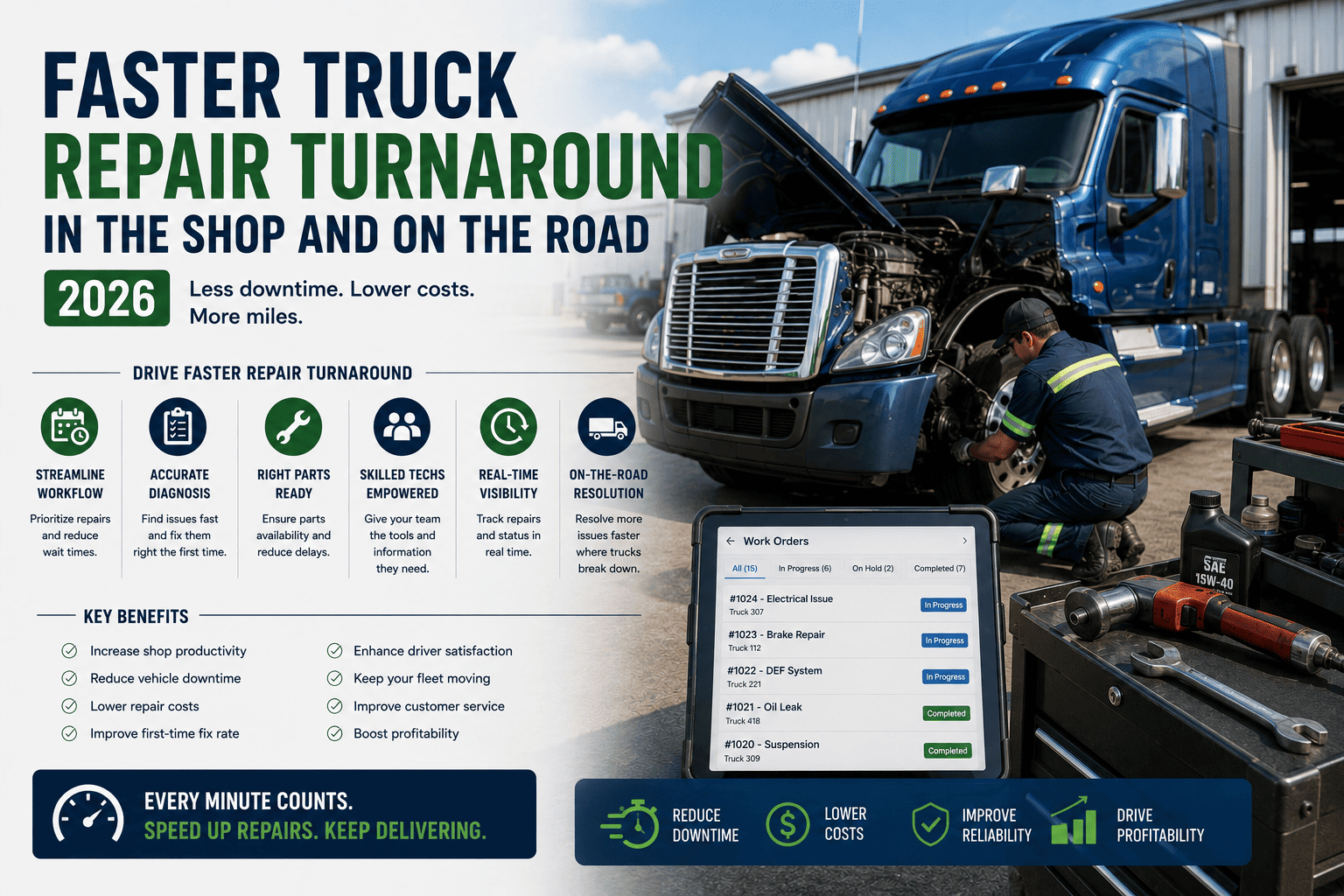
Faster truck repair turnaround comes from closing the gaps between each stage of the repair process, not from rushing the repair itself. The biggest wins come from digital work orders that reach technicians instantly, parts ordered during diagnosis instead of after, clear technician scheduling that avoids bay overbooking, and repair history that's available the moment a truck rolls in. Fleets that tighten these handoffs typically raise technician wrench time from around 32 percent of the day to 55 to 65 percent. You can sign up for FleetRabbit to see a digital repair workflow running on your own fleet.
Where Repair Time Actually Disappears
Ask most shop managers where time is lost and they'll point to a specific hard repair. In practice, the data tells a different story. Industry benchmarking shows the average fleet technician spends only about 32 percent of the workday on productive repair work, with the rest consumed by parts retrieval, approval waits, searching for vehicle history, and paperwork. The repair itself usually isn't the bottleneck. The handoffs around it are.
The 31-Minute Gap That Costs Days
A 31-minute median delay between work order creation and technician start sounds minor until it repeats across every repair, every week, on every truck. That gap exists because work orders sit in an inbox, a clipboard, or a whiteboard instead of routing directly to the technician best positioned to take the job. Closing it is one of the fastest wins available to most shops.
The Four Bottlenecks That Slow Every Shop Down
Across shops of every size, the same four friction points show up again and again. Fixing all four rarely requires new bays or more technicians, just a workflow that closes the gaps between steps.
| Bottleneck | Why It Happens | What Fixes It |
|---|---|---|
| Work Order Lag | Issues sit in a paper log or inbox before reaching a technician | Digital work orders that route instantly to the right technician |
| Parts Delay | Parts are only ordered after diagnosis is complete | Ordering parts the moment a likely cause is identified |
| Bay Overbooking | Multiple jobs scheduled without visibility into technician load | Real-time scheduling that shows bay and technician capacity |
| Missing History | Technicians spend time searching for prior repair records | Full repair history attached to the vehicle, visible instantly |
FleetRabbit turns a driver-reported defect into a routed work order instantly, attaches full repair history to every vehicle, and gives shop managers a real-time view of technician and bay capacity. See it running on your fleet by choosing to start a free trial or book a short demo.
Why Parts Availability Decides More Than People Expect
Downtime rarely increases because a repair is mechanically difficult. It increases because a needed part can't be sourced quickly enough. When parts are ordered only after a technician fully diagnoses the problem, the truck sits waiting in the bay for a delivery that could have started hours earlier. Shops that define likely parts needs at intake, or the moment a probable cause emerges during diagnosis, keep trucks moving through the shop instead of parked mid-repair.
Building a Repair Workflow That Doesn't Rely on Memory
The shops with the fastest turnaround times aren't necessarily the ones with the most technicians. They're the ones where nobody has to remember what happens next. A technician finishing one job should already know their next assignment. A service manager should be able to see bay and technician load without walking the floor. That kind of visibility is what separates a shop that manages 8 to 10 hours of avoidable admin time per week from one that's already automated it.
Technician Scheduling Without Overbooking
Overbooking a bay or a technician looks efficient on a schedule but creates immediate bottlenecks in practice, since work gets interrupted and restarted instead of flowing through cleanly. Real-time scheduling that reflects actual technician productivity, not just theoretical capacity, keeps work distributed evenly instead of creating idle bays in one area and backlogs in another.
What to Look For in Repair Management Software
Not every shop management tool actually shortens turnaround. The platforms that move the needle share a few specific capabilities.
Getting Started Without a Major Overhaul
Improving turnaround time doesn't require replacing your entire shop process overnight. Most shops start by digitizing work order creation so defects route directly to technicians, then layer in repair history and parts visibility once that first change is running smoothly. Within a few weeks, the reduction in idle bay time and admin hours usually becomes obvious on its own.
Turning Faster Turnaround Into Fleet-Wide Uptime
Every hour shaved off the gap between a reported defect and a repaired truck is an hour that vehicle spends earning revenue instead of sitting in a bay. The fleets that treat turnaround time as a workflow problem, not a technician speed problem, consistently see the biggest gains. You can start closing those gaps by choosing to sign up for a free trial today.
The wrench time was never the problem. FleetRabbit closes the gaps between a reported defect, a routed work order, and a technician ready to start, so your trucks spend less time waiting and more time earning.