A flatbed load doesn't fail because a driver forgot to care. It fails because cargo securement math got skipped under time pressure at the dock. Federal rules under 49 CFR Part 393 are exact about how many tie-downs a load needs, how strong they must be, and how often they get rechecked once the truck is moving. Get any one of those wrong and an inspector does not issue a warning. They issue a citation, and in serious cases, an out-of-service order that parks the truck until it is fixed.
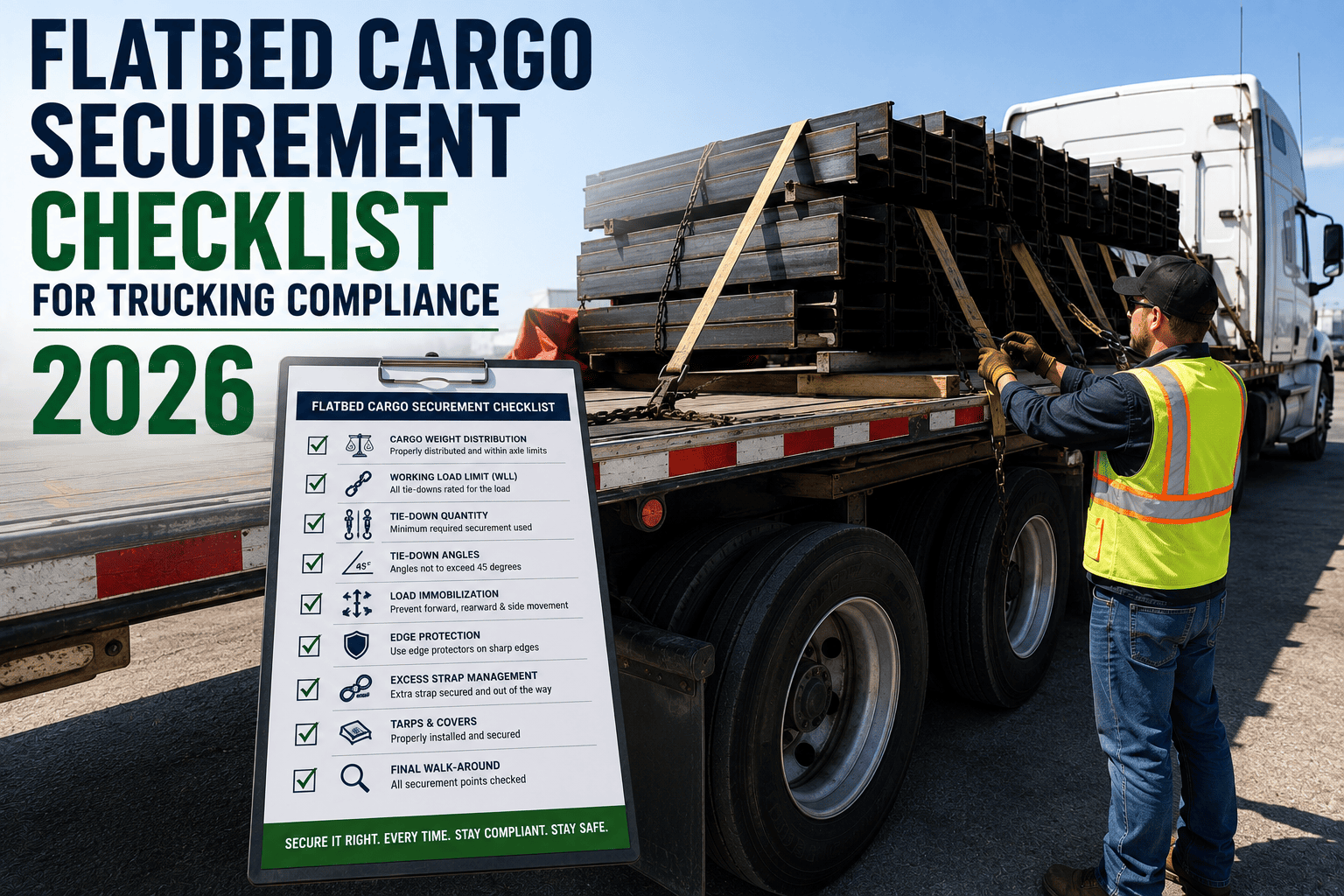
Flatbed cargo securement compliance rests on two non-negotiable rules: the tie-down count must match the cargo's length and weight, and the combined working load limit of all tie-downs must equal at least half the cargo's total weight. Add edge protection wherever a strap or chain contacts a sharp corner, and recheck every tie-down within the first 50 miles and again every 150 miles or three hours after that. Fleets logging these checks digitally with photo proof are the ones passing roadside inspections without delay.
The Two Rules That Decide Every Roadside Inspection
Almost every securement violation traces back to one of two miscalculations: not enough tie-downs for the cargo's length, or not enough combined strength for its weight. Both rules apply at the same time. Satisfying one does not excuse ignoring the other.
Doing the Math Before You Roll
Take a flatbed hauling 40,000 pounds of lumber with an indirect tie-down method. The load needs a combined working load limit of at least 20,000 pounds across all straps. If each strap is rated at 5,400 pounds, four straps deliver 21,600 pounds of aggregate capacity, which clears the 50 percent threshold and satisfies the length-based count at the same time. Drop to three straps and the same load falls short on both rules simultaneously.
The weakest link rule applies on top of this. A 6,600 lb chain paired with a 4,000 lb binder is only as strong as its lowest-rated component, so the securement line counts as 4,000 lbs, not 6,600. Inspectors calculate aggregate WLL using each line's weakest link, not its strongest one.
| Cargo Length | Minimum Tie-Downs | Additional Requirement | Common Failure Point |
|---|---|---|---|
| Under 5 feet | 1 tie-down, if under 1,100 lbs | Must still meet 50% aggregate WLL | Assuming light cargo needs no calculation at all |
| 5 to 10 feet | 2 tie-downs, any weight | Both tie-downs must be undamaged and rated | Using one strap because the item "feels balanced" |
| Every 10 feet beyond | +1 tie-down per 10 ft or fraction | Round up on partial lengths, never down | Rounding down on an 11-foot load and using only 2 straps |
| Heavy machinery over 5,000 lbs | Minimum 4 independent tie-downs | Direct tie-down to rated anchor points required | Relying on the machine's own locking devices alone |
FleetRabbit's flatbed inspection module walks drivers through tie-down count, aggregate WLL verification, and edge protection checkpoints, with photo evidence attached to every record. Sign up for a free trial and put this checklist on your drivers' phones today.
What a DOT Inspector Actually Checks
Roadside inspectors do not just count straps. They evaluate condition, tension, and documentation, and they know exactly where fleets tend to cut corners.
Tension, Damage, and Hardware Condition
Every strap gets tested by hand for tension. Any tie-down with visible cuts, cracks, corrosion, or knots that reduce its working load limit is treated as unusable, even if it looks fine from a distance. Damaged hardware is one of the fastest routes to an out-of-service order.
Blocking and Bracing for Irregular Loads
Cylindrical or irregularly shaped cargo needs blocking material in addition to tie-downs to prevent rolling. Tie-downs alone do not satisfy the rule if the load can still shift laterally between straps.
The Cost of Getting It Wrong
Combined state and federal penalties for securement failures can exceed 8,000 dollars per incident, and repeat violations escalate fast. A second out-of-service order for cargo securement within 12 months puts the carrier on FMCSA's monitoring radar, and a third can trigger a full compliance review with the carrier's operating authority at risk. Detention time from an out-of-service order alone averages well over a thousand dollars in lost productivity per incident.
Why Paper Checklists Keep Failing Fleets
A driver walking a flatbed with a clipboard checks boxes from memory, and that memory rarely holds up during a Level I inspection. Electronic Driver Vehicle Inspection Reports have been explicitly authorized under 49 CFR 396.11 and 396.13, with digital signatures now fully replacing wet-ink requirements. A photo-verified, timestamped inspection record is simply more defensible than a signature on a form filled out after the fact.
Carriers that can produce structured, photo-backed securement records are increasingly winning shipper contracts that paper-based fleets get filtered out of before the conversation starts. Book a demo to see how FleetRabbit builds that record automatically.
Frequently Asked Questions
Flatbed cargo securement is one of the few areas of trucking compliance where the rule is exact and the math is not negotiable. A load is either secured to at least half its weight, across the correct number of tie-downs, with edge protection and undamaged hardware, or it is a violation waiting to be found. Sign up for FleetRabbit to move this checklist onto your drivers' phones, or book a demo to see it running on your own flatbed routes.
FleetRabbit guides drivers through tie-down counts, WLL calculations, and edge protection checks, then builds a photo-verified compliance record automatically. Start free, no credit card required.