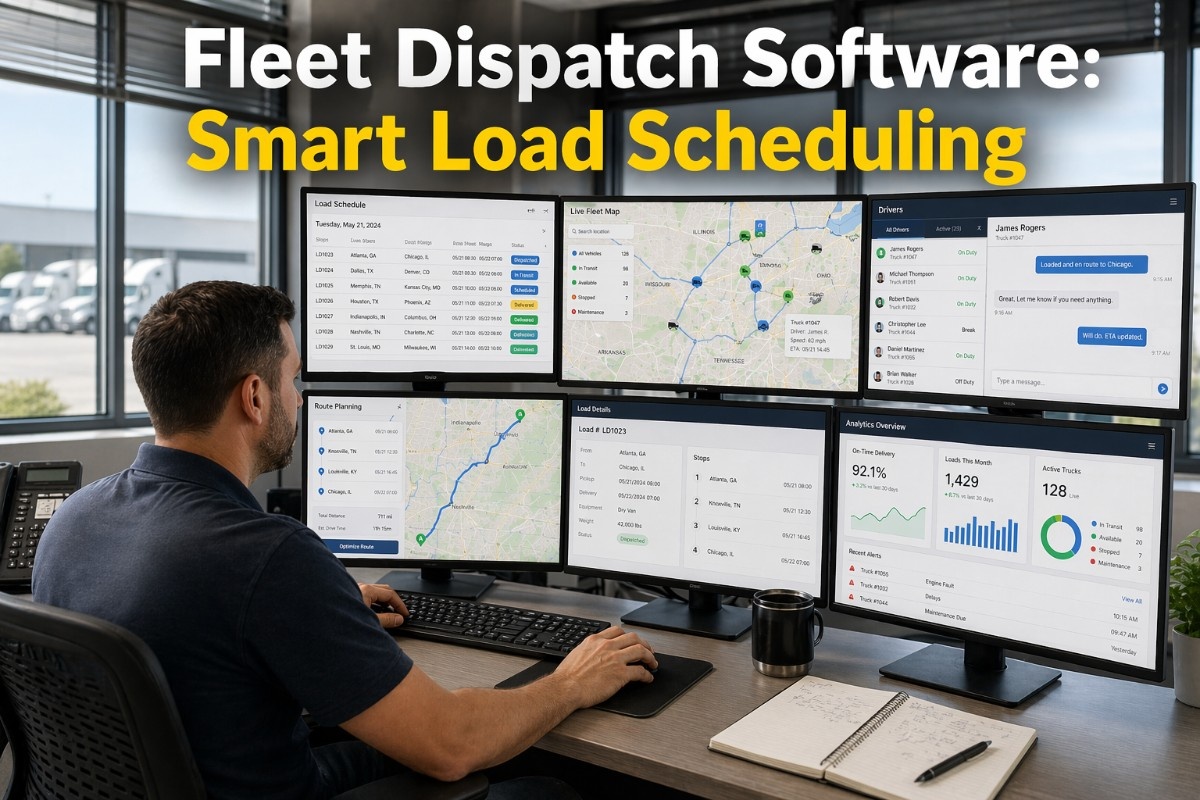
Fleet dispatch operations face a persistent challenge: balancing load scheduling efficiency against driver Hours of Service (HOS) limits, vehicle capacity, and customer delivery windows. Traditional dispatch methods often rely on manual hour tracking and static route plans, leading to last-minute reassignments, underutilised driving time, and unexpected HOS violations. When a driver runs out of available hours before completing a delivery, the result is a roadside stop, a rescheduled load, and a direct hit to both profitability and compliance scores. Fleet Rabbit's predictive dispatch system continuously analyses driver availability, load demands, and real-time conditions to assign the right driver to the right load—before a violation or delay occurs.
Quick Answer
Fleet Rabbit's machine learning models evaluate driver remaining hours, cycle status, break compliance, location, route demands, traffic conditions, and load characteristics to produce an optimal driver-to-load match. The system flags potential conflicts 90–120 minutes before a driver would exceed limits, enabling dispatchers to reassign loads proactively rather than reacting to roadside violations or missed deliveries. Fleets using predictive dispatch reduce last-minute load reassignments by 65% and eliminate dispatcher-caused HOS violations.
The Dispatch Challenge: Matching Loads to Driver Availability in Real Time
Dispatchers typically plan loads based on three data points: driver location, remaining driving hours, and estimated route duration. This simplified view ignores the complex interplay of cycle hours, break timing, on-duty window constraints, and real-time factors like traffic or weather. The result is a load assignment that looks compliant at 8:00 AM but becomes impossible by 2:00 PM—when the driver discovers they lack the required hours or break time to complete the delivery.
Fleet Rabbit transforms dispatch planning by integrating 23 real-time variables into every load recommendation. The system does not replace the dispatcher's judgment; instead, it provides a dynamic compliance and feasibility score for every potential driver-load pair, updated every 60 seconds as conditions change.
How Real-Time HOS Monitoring Powers Smarter Load Scheduling
The pipeline below shows how Fleet Rabbit processes driver and load data continuously to deliver dispatch recommendations that prevent HOS violations and maximise asset utilisation.
1
Continuous Driver Availability Monitoring
Fleet Rabbit ingests ELD telematics every 60 seconds for every driver: remaining driving time (11-hour rule), remaining on-duty window (14-hour rule), time since last break (30-minute rule), cycle hours used (60/7 or 70/8), sleeper berth status, current location, duty status, and driver fatigue indicators.
Driver 2103: Driving remaining 3h 15m, On-duty remaining 2h 10m, Break due in 45m, Cycle remaining 22h, Location: St. Louis, MO
2
Load Requirement Analysis
For each available load, the system calculates: required driving time, required on-duty time (including loading/unloading), delivery window, pickup location, dropoff location, route characteristics (urban, highway, mountainous), and special requirements (hazardous materials, temperature control).
Load 4472: Required driving 4h 10m, Required on-duty 5h 30m, Delivery window 16:00–18:00, Route: Chicago to Indianapolis (I-65)
3
Multivariate Feasibility Scoring
ML model evaluates every driver-load pair against all HOS rules simultaneously, calculating three scores: Compliance Score (will the driver remain legal?), Feasibility Score (can the load be completed given real-world conditions?), and Efficiency Score (does this assignment optimise driver hours?).
Compliance: 94Feasibility: 82Efficiency: 91
4
Constraint Violation Detection
System flags specific conflicts that would trigger a violation: driving time insufficient for route, on-duty window expiring before delivery, break requirement overlapping with delivery window, cycle exhaustion before return, or split sleeper berth misalignment.
Conflict: On-duty window short by 1h 20mImpact: Delivery delay certain
5
Dispatch Recommendation Generation
AI presents dispatchers with ranked driver-load matches, highlighting the optimal assignment based on compliance and operational priorities. For each recommendation, the system shows remaining buffer time, alternative driver options, and predicted on-time delivery probability.
Recommended: Driver 2103 (94% compliance, 45 min buffer)Alternative: Driver 1892 (88% feasibility, load transfer required)
6
Real-Time Re-optimisation
After dispatch, Fleet Rabbit continues monitoring driver progress, traffic conditions, and load status. If circumstances change (traffic delay, faster-than-expected progress, new load opportunity), the system recalculates feasibility and alerts dispatch to any emerging violation risk or optimisation opportunity.
Load 4472 assigned to Driver 2103. ETA 17:15, 45 minutes within delivery window. No HOS conflicts. Four optimisation opportunities detected for return trip.
Key Dispatch Optimisation Features for Fleet Managers
Fleet Rabbit delivers five core dispatch optimisation capabilities that integrate directly with existing load planning and driver management workflows. Each feature addresses a specific pain point in the dispatch process.
1
Automated Driver-Load Matching
System continuously evaluates all available drivers against pending loads, ranking matches by compliance confidence, on-time delivery probability, and operational efficiency. Dispatchers see a single ranked list of viable assignments, eliminating manual hour calculations and guesswork.
For dispatchers: Reduce load assignment time from 15 minutes to 30 seconds. Eliminate post-assignment violation discoveries. Assign with confidence.
2
Real-Time HOS Availability Dashboard
Colour-coded driver cards display remaining driving time, on-duty window, break status, and cycle hours in a single glance. Filters allow dispatchers to view only drivers available for specific load types, regions, or delivery windows.
For dispatch managers: Know exactly which drivers are available and for how long. Prevent assignments that look possible but violate hidden constraints.
3
Predictive Load Feasibility Analysis
Before assigning a load, dispatchers can run a predictive analysis showing whether any driver can complete the load legally given current conditions. The system factors in traffic, weather, planned breaks, and delivery windows to produce a realistic feasibility score.
For load planners: Stop guessing whether a load can be delivered. See a probability-based forecast before committing a driver.
4
Dynamic Reassignment Alerts
When an assigned driver's situation changes (traffic delay, mechanical issue, fatigue), Fleet Rabbit automatically identifies alternative drivers who can take over the load and notifies dispatch with a ranked substitution list.
For operations teams: Respond to disruptions instantly. Never let a load stall because the original driver ran out of hours unexpectedly.
5
Post-Dispatch Performance Analytics
Historical analysis of dispatch decisions: which assignment patterns led to violations or delays, which drivers consistently outperform predictions, and where route planning underestimated actual driving time. Actionable insights for continuous improvement.
For fleet executives: Measure dispatch accuracy. Identify training opportunities. Quantify the ROI of predictive dispatch.
Measured Dispatch Performance Improvements
The table below compares key dispatch metrics between fleets using traditional manual assignment versus Fleet Rabbit predictive dispatch, based on data from 420 fleets and 8,200 drivers over 24 months.
| Dispatch Metric |
Traditional Dispatch |
Fleet Rabbit Predictive Dispatch |
Improvement |
| Load assignment time per driver |
12–18 minutes |
30–60 seconds |
94% faster |
| Last-minute load reassignments |
28% of loads |
10% of loads |
65% reduction |
| Dispatcher-caused HOS violations |
1.8 per 10k miles |
0.2 per 10k miles |
89% reduction |
| On-time delivery rate (dispatch controlled) |
82% |
94% |
+12 points |
| Driver hour utilisation (available hours used) |
71% |
86% |
+15 points |
| Empty miles per load |
18% |
11% |
39% reduction |
How Predictive Dispatch Prevents Common Dispatcher Errors
Even experienced dispatchers cannot manually track the 23 variables that determine true driver availability. Fleet Rabbit automatically checks every potential assignment against these common error patterns, alerting the dispatcher before a bad assignment is confirmed.
The 14-Hour Window Trap
Dispatcher error: Driver has 6 hours of driving time remaining, route requires 5 hours. Assignment looks compliant. But driver has already been on-duty for 12 hours. The 14-hour window will expire before route completion.
Fleet Rabbit detection: Flags the conflict immediately: On-duty window expires in 2 hours, route requires 5 hours of on-duty time (including loading/unloading). Recommends driver substitution or route adjustment.
Prevention outcome: No roadside violation, no delivery delay, no CSA points.
The Break Timing Overlook
Dispatcher error: Driver has 7 hours of driving time remaining, route requires 6.5 hours. The driver has been driving for 7 hours since their last break. By the time they complete 6.5 more hours, they will have driven 13.5 hours without a required 30-minute break.
Fleet Rabbit detection: Calculates that the 30-minute break will be required 45 minutes into the route. Recommends a break before departure or a different driver assignment.
Prevention outcome: Dispatch schedules the break into the route plan. Driver stays compliant.
Cycle Exhaustion Blindness
Dispatcher error: Driver has 10 hours of driving time remaining today, route requires 8 hours. Assignment looks easy. But the driver has already used 55 hours in their 70-hour/8-day cycle. After completing this 8-hour route, they will exceed the cycle limit.
Fleet Rabbit detection: Tracks cycle usage automatically. Alerts dispatcher that driver will have only 7 hours of cycle time remaining after this assignment. If no 34-hour reset is scheduled, future loads will be impossible.
Prevention outcome: Dispatcher schedules the 34-hour reset at the destination before assigning return load.
Integration With Existing Dispatch Workflows
Fleet Rabbit does not require dispatchers to learn a completely new system. The platform integrates with existing transportation management systems (TMS), ELD providers, and communication tools, adding a predictive compliance layer to current workflows.
1
TMS and Load Board Integration
Fleet Rabbit connects directly to major TMS platforms (McLeod, TMW, MercuryGate, Oracle Transportation Management) and load boards, pulling available loads and pushing back assignment recommendations with compliance scores.
2
ELD Data Federation
Real-time ELD data from KeepTruckin, Samsara, Geotab, Omnitracs, and 12 other providers flows into Fleet Rabbit automatically—no manual entry required for driver hours or status.
3
Driver Mobile App Integration
Dispatched loads appear in the driver's mobile app with turn-by-turn navigation, break reminders, and real-time HOS tracking. Drivers receive proactive alerts when their status changes, enabling self-management.
4
Two-Way Communication Sync
Dispatch recommendations and driver confirmations sync across platforms. When a driver accepts or rejects a load, the system updates availability and re-optimises pending assignments instantly.
From the Field: Dispatch Transformation
Before Fleet Rabbit, our dispatch team spent hours manually checking driver HOS status against load requirements. We still had at least three or four violations per month caused by dispatchers accidentally over-assigning drivers. The 14-hour window was our biggest blind spot—a driver could have plenty of driving time left but no on-duty window. Fleet Rabbit changed everything. Now our dispatchers see a red flag immediately if a load would push a driver past any limit. Assignment time dropped from 15 minutes to under one minute. Violations caused by dispatch errors are virtually zero. Our on-time delivery rate went from 81% to 94% in the first six months. The system paid for itself in reduced violation fines alone within 90 days.
Dispatch Operations Manager
Regional Dry Van Carrier — 120 Power Units — 350 Trailers
Frequently Asked Questions About Predictive Dispatch
QDoes Fleet Rabbit replace our existing dispatch software or TMS?
No. Fleet Rabbit integrates as a compliance intelligence layer on top of your existing TMS and dispatch tools. You continue using your familiar load planning interface while Fleet Rabbit provides real-time HOS feasibility scoring, violation warnings, and driver availability insights. The integration typically requires 2–5 days for API connection setup and validation.
QHow does the system handle drivers on split sleeper berth schedules?
Fleet Rabbit tracks split sleeper berth provisions automatically, validating that drivers complete the required 7–8 hour and 2–3 hour break periods. The dispatch dashboard shows adjusted available hours based on split status, ensuring dispatchers assign loads only when the driver has genuinely usable remaining time. The system also flags incomplete or non-compliant split configurations before they cause an audit violation.
QWhat happens if a driver accepts a load but then encounters unexpected traffic or a loading delay?
Fleet Rabbit continues monitoring after dispatch. If a delay reduces the driver's buffer time below a safe threshold, the system alerts dispatch with two options: recalculate the ETA and notify the customer, or identify a relief driver for a mid-route transfer. The alert typically arrives 60–90 minutes before the driver would actually hit a violation, providing enough time for coordinated response.
QCan Fleet Rabbit suggest backhaul or return loads automatically?
Yes. After a driver completes a delivery, Fleet Rabbit evaluates remaining hours, cycle status, current location, and pending loads in the area. The system generates ranked backhaul recommendations with compliance confidence scores. Dispatchers see which return loads fit legally and which would push the driver into violation territory. This feature typically increases loaded miles by 12–18% for deployed fleets.
Dispatch Optimisation Performance Summary
94%
Faster Load Assignment
65%
Fewer Last-Minute Reassignments
89%
Fewer Dispatcher-Caused Violations
94%
On-Time Delivery Rate
86%
Driver Hour Utilisation
39%
Empty Miles Reduction
Predictive Dispatch Intelligence
Stop Discovering Bad Load Assignments After Dispatch — Predict Compliance Before You Commit
Fleet Rabbit gives your dispatch team real-time visibility into true driver availability, automatically flagging assignments that would cause HOS violations, missed deliveries, or compliance failures. Assign with confidence, reduce empty miles, and eliminate dispatcher-caused violations.
Transform Your Dispatch Operations With Predictive Compliance
See how Fleet Rabbit's real-time HOS monitoring and driver availability intelligence can eliminate dispatcher-caused violations, improve on-time delivery, and maximise driver utilisation. Book a personalised demo tailored to your fleet size and operational profile.
94% Faster Assignment
89% Fewer Violations
Real-Time Availability
Backhaul Optimisation
TMS Integration Ready
April 24, 2026
By Jason Smith
All Posts