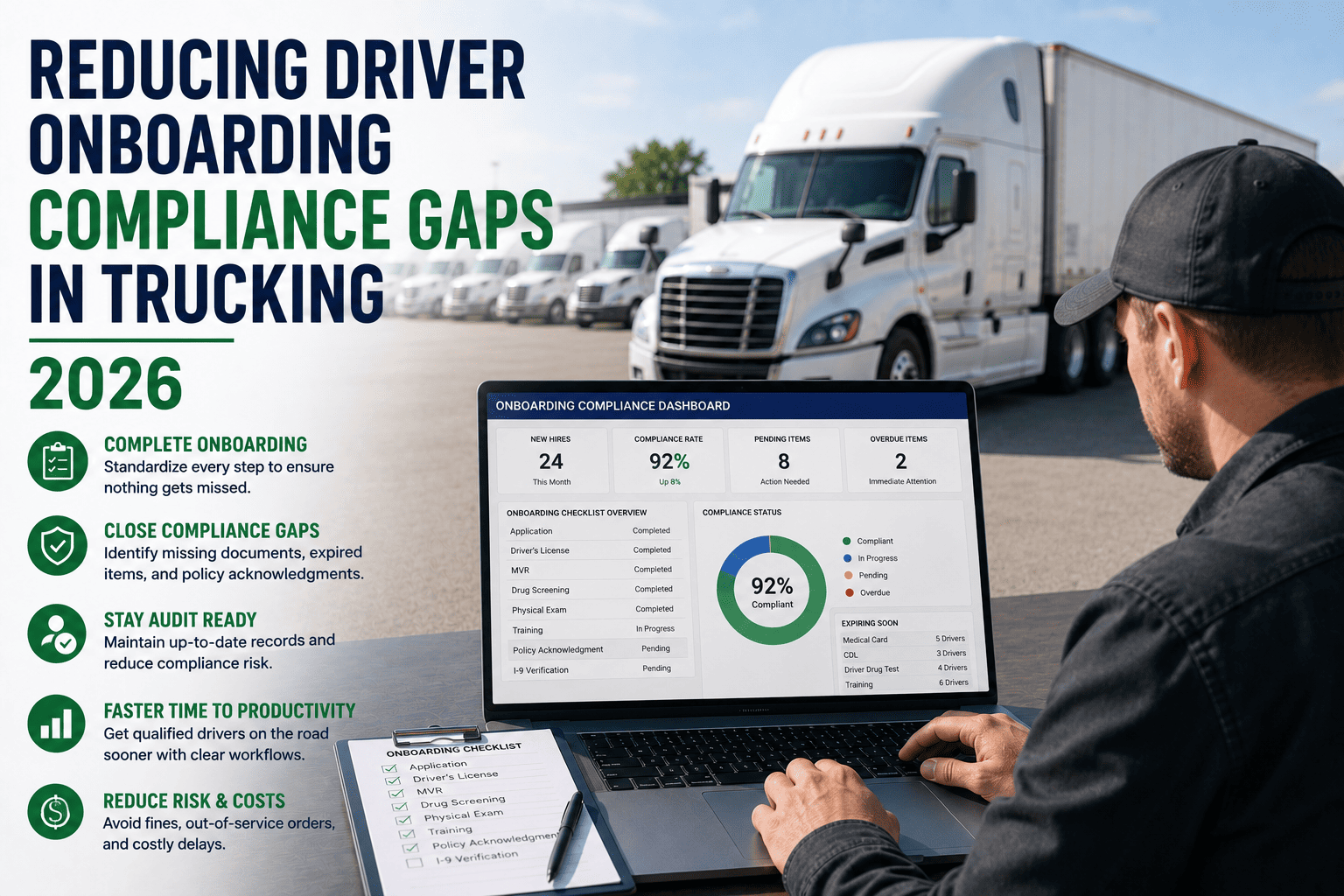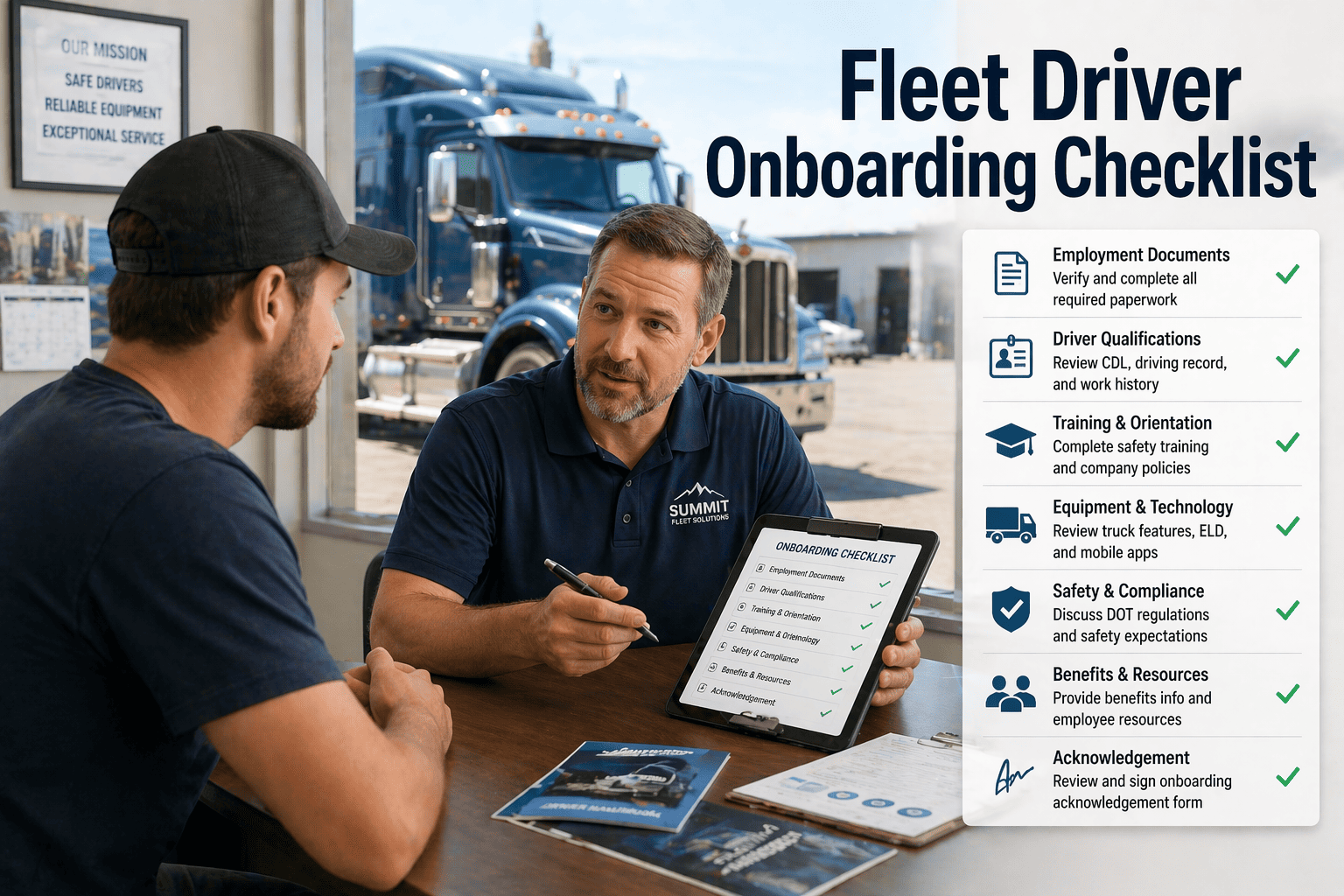
Fleet driver onboarding determines whether new commercial drivers start their employment with the knowledge, documentation, and safety habits required to operate safely from day one. Incomplete onboarding creates gaps in driver qualification files, increases crash risk during the critical first 90 days of employment, and leaves fleets exposed to regulatory penalties during compliance reviews. A single missing document in a driver qualification file can result in civil penalties during a DOT audit. Poorly trained new drivers experience higher crash rates during their first six months compared to experienced drivers with structured onboarding. This fleet driver onboarding checklist provides safety managers, fleet owners, and HR professionals with a complete framework for bringing new commercial drivers into the fleet with fully compliant files, complete safety training, and documented verification of every credential and skill required for safe operation. The checklist covers pre-hire verification, qualification file documentation, safety training completion, vehicle familiarization, technology training, and post-hire compliance monitoring.
Fleet Driver Onboarding Checklist
Complete Framework for New Commercial Driver Qualification and Training
Why Structured Driver Onboarding Reduces Turnover and Crash Risk
Fleets with formal driver onboarding programs reduce first-year driver turnover by up to 30 percent and experience 25 percent fewer preventable crashes involving drivers in their first 90 days of employment compared to fleets without structured onboarding. Beyond safety outcomes, complete onboarding documentation protects fleets during DOT audits, reduces insurance disqualification risk for new hires, and creates defensible records when driver qualification is challenged in litigation. This checklist builds a complete onboarding framework across pre-hire verification, qualification file documentation, safety training, and post-hire compliance monitoring.
Driver Onboarding by Category: 6-Point Qualification Framework
Systematically evaluate each area of driver onboarding responsibility from pre-hire verification through post-hire compliance monitoring. The framework below organizes onboarding requirements by functional phase.
Critical Driver Onboarding Requirements for Compliance and Safety
FMCSA regulations establish specific timelines and documentation requirements for driver onboarding. The requirements below represent mandatory compliance items plus best practices proven to reduce new driver crash risk.
The regulation requires investigation of a driver's safety performance history from all employers during the previous three years. The investigation must cover accidents and alcohol or controlled substances testing violations. For employers from the previous three years, documentation of the investigation request and response or good faith effort to obtain information must be placed in the driver qualification file within 30 days of the driver's first day of work. Fleets that skip prior employer verification face compliance review penalties and hire drivers with unrevealed safety problems.
FMCSA 391.21 requires the driver application for employment to include the driver's name, date of birth, social security number, address, and complete employment history for the previous three years including contact information for each employer. The application must request information about accidents, license suspensions, and drug or alcohol testing violations. The driver must sign and certify that all information is true and complete. Missing information or unsigned applications create qualification file deficiencies that trigger DOT citations during audits.
Before allowing a driver to operate a commercial motor vehicle without a trainer, the fleet must either administer a road test or accept a valid skills performance evaluation certificate or prior employer road test documentation. The road test must include pre-trip inspection, basic vehicle control, and on-road driving observation documented on FMCSA Form 391.3 or equivalent. Drivers who cannot demonstrate safe operation during road testing require additional training before solo dispatch regardless of prior experience.
Fleets must conduct a full Clearinghouse query before hiring a driver and then conduct an annual query for each driver every 12 months after the hire date. The pre-hire full query requires driver consent and reveals any drug or alcohol program violations from previous employment. Drivers with unresolved violations cannot operate until completing the return to duty process. Fleets that fail to conduct required queries face civil penalties up to 6875 dollars per violation and potential operating authority suspension.
Every commercial driver operating in interstate commerce must have a valid medical examiner certificate and any required medical variance. The fleet must verify certificate validity on the National Registry of Certified Medical Examiners before dispatch and track expiration dates. Certificates expire based on the medical examiner's determination up to 24 months after examination, but drivers with certain medical conditions may have shorter certification periods. Operating with an expired certificate creates serious violation status during roadside inspections.
While FMCSA does not specify minimum orientation hours, leading fleets provide at least 16 hours of structured orientation for experienced drivers and 40 hours for drivers with less than one year of experience. Orientation content must cover fleet specific safety policies, hours of service requirements, cargo securement procedures, accident reporting, and vehicle familiarization. Orientation documentation with signoff on each topic creates defensible records showing the fleet provided adequate training before solo dispatch.
Driver Qualification File Document Retention Requirements
Fleets must maintain driver qualification files according to FMCSA retention schedules. The table below shows required retention periods for each document type in the driver qualification file.
| Document Type | Retention Requirement | Retention Start Date | Regulatory Reference |
|---|---|---|---|
| Driver application for employment | Duration of employment plus 3 years | Date of hire | 391.21 |
| Medical examiner certificate and variance | Duration of employment plus 3 years | Date of certification | 391.43 |
| Road test certificate or equivalent | Duration of employment plus 3 years | Date of road test | 391.31 |
| Annual driver qualification review | Duration of employment plus 3 years | Date of review | 391.49 |
| Prior employer safety performance investigation | Duration of employment plus 3 years | Date of investigation | 391.23 |
| Motor vehicle record | Duration of employment plus 3 years | Date MVR obtained | 391.25 |
| FMCSA Clearinghouse query documentation | Duration of employment plus 3 years | Date of query | 382.701 |
Scroll horizontally on mobile to view all columns
Automate Driver Onboarding Compliance with FleetRabbit
FleetRabbit digital driver qualification file system automates onboarding document collection, expiration tracking, and compliance deadline management. The platform sends automated alerts when medical certificates approach expiration, generates annual driver qualification review forms with pre-populated driver information, and maintains complete qualification files with audit ready organization. Built in FMCSA compliance checking validates documents against regulatory requirements before files are marked complete.
New Driver Orientation Training Content Requirements by Experience Level
Orientation content should vary based on driver experience level. The comparison below shows recommended training hours and content focus for experienced drivers versus drivers with less than one year of experience.
| Training Component | Experienced Driver (1 plus years) | Entry Level Driver (less than 1 year) |
|---|---|---|
| Total orientation hours | 16 to 24 hours | 40 to 60 hours |
| Fleet safety policy review | 2 hours with policy acknowledgment | 4 hours with scenario based training |
| Hours of service and ELD training | 1 hour focusing on fleet specific ELD | 4 hours with hands on logging practice |
| Pre-trip inspection training | 1 hour on fleet specific vehicle differences | 8 hours with demonstrated competency assessment |
| Behind the wheel evaluation | 2 hours on road with safety manager | 8 hours on road plus additional trainer ride along days |
| Cargo securement training | 1 hour cargo type specific review | 4 hours including hands on securement lab |
| Safety technology familiarization | 1 hour on fleet deployed systems | 2 hours including camera and collision mitigation training |
Scroll horizontally on mobile to view all columns
Frequently Asked Questions
1. How long does the fleet driver onboarding process typically take?
Complete driver onboarding including pre-hire verification, qualification file completion, and safety orientation typically takes 3 to 7 business days for experienced drivers with clean records and complete documentation. Entry level drivers or drivers with complex employment histories may require 10 to 14 days including additional training hours. Fleets that rush onboarding often miss critical verification steps and expose themselves to compliance violations and increased crash risk.
2. What documents must be in the driver qualification file before dispatch?
Before solo dispatch, the driver qualification file must contain signed driver application, valid medical examiner certificate, road test certificate or accepted equivalent, pre-employment drug test negative result, FMCSA Clearinghouse full query result, prior employer safety investigation documentation for the previous three years, and copy of commercial driver license. Insurance requirements may add other documents before dispatch.
3. What are the consequences of missing driver qualification file documents during a DOT audit?
DOT auditors cite missing qualification file documents as violations under FMCSA 391 and 382 regulations. Each missing document typically carries a civil penalty between 1000 and 6875 dollars. Multiple missing documents across several driver files can result in five figure penalty assessments. Severe or repeated violations may trigger a compliance review upgrade or proposed operating authority suspension.
4. How often must driver qualification files be reviewed after onboarding?
Annual driver qualification review is required within 12 months of the driver's hire date and every 12 months thereafter. The review must confirm the driver has a valid commercial driver license, valid medical certificate, no disqualifying license suspensions, and an acceptable motor vehicle record. Between annual reviews, fleets must monitor medical certificate expirations and conduct FMCSA Clearinghouse annual queries.
5. What is the FMCSA Clearinghouse limited query versus full query requirement?
A limited query reveals whether a driver has any drug or alcohol program violation record in the Clearinghouse without showing violation details. A full query shows full violation details and requires driver electronic consent. Fleets must conduct a pre-hire full query before hiring a driver. After hire, fleets must conduct an annual limited query for each driver at minimum, with a full query required if the limited query indicates the presence of a violation record.
6. How should fleets handle drivers with out of state commercial driver licenses?
Fleets must obtain motor vehicle records from every state where the driver held a commercial driver license during the previous three years. Out of state license verification takes longer than in state requests. Fleets should begin out of state MVR requests at offer acceptance to avoid delaying dispatch. Drivers with multiple previous licenses require MVRs from each licensing jurisdiction.
7. What training documentation must be retained for new drivers?
Fleets should retain signed acknowledgments for each training topic covered during orientation including safety policy acknowledgment, hours of service training completion, distracted driving policy acknowledgment, cargo securement training verification, and vehicle familiarization signoff. While FMCSA does not specify all these documents, they become essential evidence in litigation to show the fleet provided adequate training before an accident.