.png)
Preventive maintenance is the most cost-effective strategy for fleet management, yet many transportation companies still rely on manual spreadsheets, handwritten notes, or memory to track when vehicles need service. Without a structured maintenance schedule, fleets experience unexpected breakdowns, missed preventive maintenance intervals, compliance violations, and inflated repair costs. A comprehensive fleet maintenance schedule ensures every vehicle receives required service at proper intervals, creates audit-ready documentation for FMCSA compliance, prevents catastrophic failures through early detection, and extends vehicle lifespan by years. This guide provides a free, downloadable fleet maintenance schedule template in both Excel and digital formats, explains how to customize templates for your fleet's specific needs, shows how to implement preventive maintenance programs, and discusses why digital maintenance tracking systems outperform spreadsheets at scale. Whether you manage 5 trucks or 500, a structured maintenance schedule is foundational to fleet profitability and safety.
Fleet Maintenance Statistics 2026
Fleets with documented preventive maintenance programs experience 25 to 40 percent fewer mechanical breakdowns compared to fleets without structured schedules. The average roadside breakdown costs 800 to 1,500 dollars in towing, service, lost revenue, and driver delays. A single prevented breakdown annually justifies comprehensive maintenance scheduling across 10 to 20 vehicles. Industry data shows that every dollar spent on preventive maintenance saves 4 to 6 dollars in emergency repairs. Fleets operating without maintenance schedules spend 35 to 50 percent more on repairs annually than disciplined fleets. Roadside out-of-service orders for maintenance violations represent 44 percent of all FMCSA citations issued during inspections, making compliance through scheduled maintenance a regulatory and financial priority.
Download Your Free Maintenance Schedule Template Now
Access our proven fleet maintenance schedule template in Excel format plus digital versions for immediate use. Customize for your vehicles and start tracking maintenance today. No credit card required.
What Is a Fleet Maintenance Schedule?
A fleet maintenance schedule is a documented plan specifying when each vehicle in your fleet requires preventive maintenance service. The schedule lists every vehicle, defines maintenance intervals (typically based on mileage, engine hours, or calendar days), specifies what service is required at each interval, assigns responsibility for scheduling and completion, and tracks whether work has been completed on time. Effective schedules account for vehicle make and model differences, regional operating conditions (severe dust/heat requires more frequent filter changes), manufacturer recommendations, and regulatory requirements.
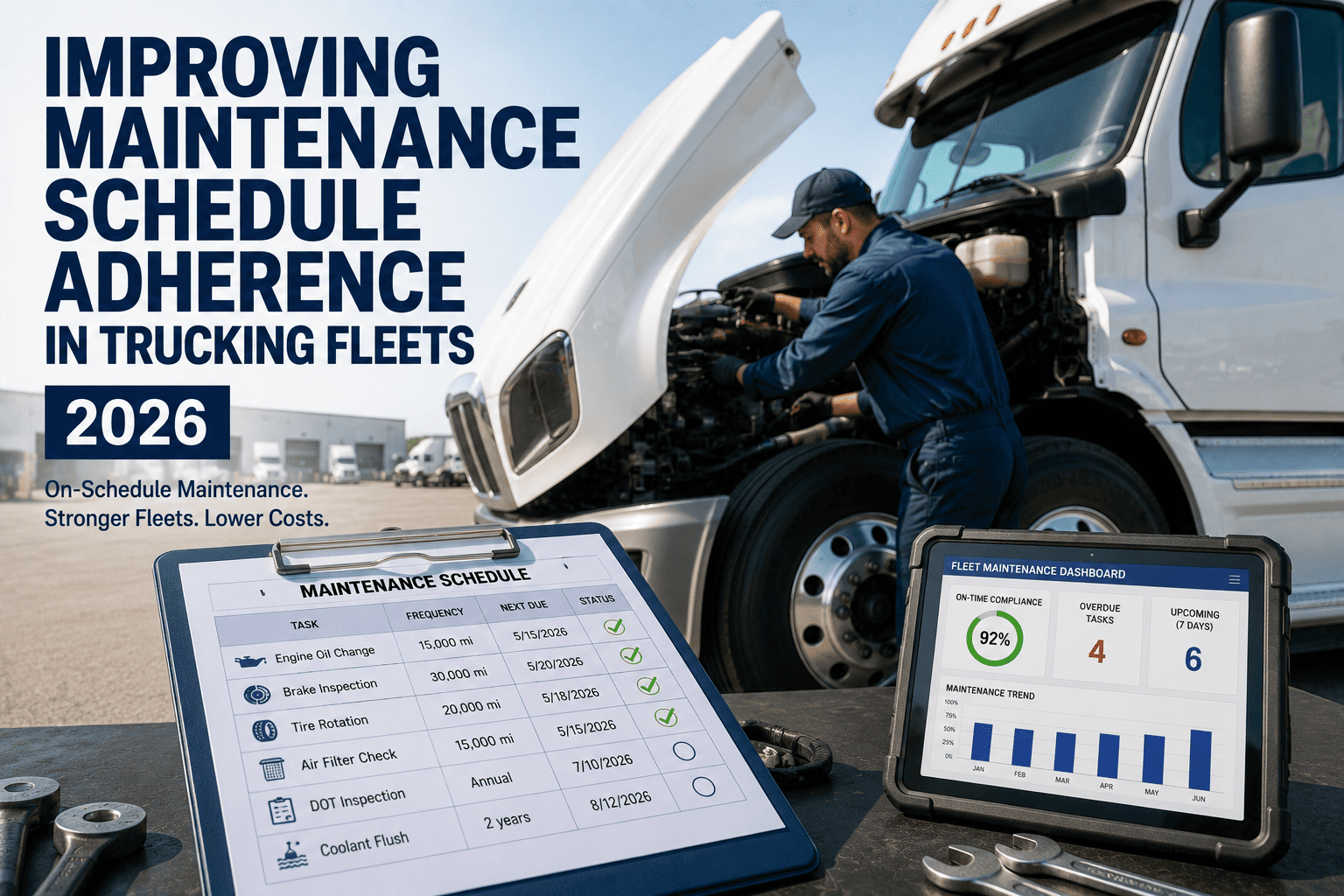
Core Components of a Maintenance Schedule: Vehicle information (VIN, unit number, make, model, year, acquisition date). Current mileage and engine hours. Service intervals (oil changes every 15,000 miles, tire rotation every 25,000 miles, brakes every 50,000 miles, transmission service every 100,000 miles, etc.). Scheduled service date based on current mileage projection. Assigned mechanic or service facility. Work order tracking. Completion date and actual mileage at service. Cost tracking. Next service due date. Digital systems also capture mechanic notes, parts replaced, and photos of any issues discovered during service.
Why Fleet Maintenance Schedules Are Critical
Prevents Catastrophic Breakdowns
Maintenance schedules catch developing problems before they become roadside failures. An engine oil analysis reveals bearing wear months before bearing failure occurs. Brake inspection identifies lining wear enabling replacement before total brake loss. Transmission fluid analysis detects contamination indicating gear damage will follow. A structured schedule ensures these early warning systems work by getting vehicles into maintenance bays on schedule rather than running them until failure forces roadside repair.
Extends Vehicle Lifespan
Preventive maintenance extends vehicle lifespan by 3 to 5 years compared to reactive repair approaches. A truck maintained on schedule reaches 750,000 to 1 million miles before major rebuild is needed. A neglected truck fails catastrophically at 400,000 to 500,000 miles with repair costs exceeding residual value. For a fleet with average 75,000-mile annual usage, extending vehicle life 4 years equals 300,000 additional miles of service. At current truck acquisition costs of 80,000 to 120,000 dollars, extending useful life by 4 years delays replacement purchases worth 3.2 to 4.8 million dollars for a 50-truck fleet.
FMCSA Compliance and Audit Readiness
49 CFR Part 396 requires motor carriers maintain all vehicles systematically and keep detailed maintenance records available for FMCSA review. Maintenance schedules with completion records prove you are meeting this requirement. Without documented schedules, auditors assume maintenance is reactive and may find vehicles with deferred service issues, triggering citations and conditional safety ratings.
Reduces Total Cost of Ownership
Preventive maintenance costs 25 to 40 percent less than emergency repairs. A 50-dollar oil change every 15,000 miles costs 250 dollars over 150,000 miles. Engine damage from skipped oil changes requiring rebuild costs 5,000 to 8,000 dollars. The choice is obvious economically. Schedules ensure preventive work happens rather than getting deferred until breakdown occurs.
Fleet Maintenance Schedule Template Sections
A comprehensive maintenance schedule template should include vehicle inventory, service intervals, scheduled vs. actual tracking, cost management, and compliance documentation.
Section 1: Vehicle Inventory
List every vehicle with unit number, VIN, make, model, year, purchase date, current mileage, current engine hours, acquisition cost, and expected replacement date. This section serves as master reference for all other sections. Track which vehicles are in service, in maintenance, or out of service.
Section 2: Service Interval Matrix
Create a matrix showing all service types (oil change, filter replacement, transmission service, brake inspection, tire rotation, coolant flush, etc.) with intervals for each service type. List the interval in both miles and months to capture both high-mileage and low-mileage vehicles. Intervals should match manufacturer specifications plus any fleet-specific requirements based on operating conditions.
Section 3: Scheduled Maintenance Calendar
Project when each service is due for each vehicle based on current mileage and monthly usage patterns. For example, if a truck averages 6,000 miles per month and is due for oil change at 15,000 miles, calculate the projected due date 2.5 months forward. This forward-looking schedule allows dispatch to plan maintenance proactively rather than discovering overdue service when the vehicle arrives for routine work.
Section 4: Work Order and Completion Tracking
Record work order number, scheduled date, assigned mechanic, parts needed, estimated cost, actual completion date, actual mileage at service, actual cost, parts replaced, and mechanic notes. This section creates the compliance documentation showing that maintenance actually occurred on schedule.
Section 5: Cost Tracking and Analysis
Track maintenance spending by vehicle, service type, and time period. Identify which vehicles generate highest maintenance costs, which service types consume most budget, and whether actual costs are trending up (sign of developing problems) or remaining stable. Cost analysis informs fleet replacement decisions.
How to Create Your Own Maintenance Schedule Template
Step 1: Gather Vehicle Information Compile a complete list of all vehicles with VIN, make, model, year, current mileage, and acquisition date. Include expected service life based on your typical fleet replacement cycle. Most commercial trucks run 6 to 8 years in service before retirement.
Step 2: Define Service Intervals Obtain manufacturer service manuals for each vehicle type. List all recommended maintenance with mileage intervals and calendar intervals. Add any fleet-specific intervals based on your operating conditions (heavy dust environment requires air filter changes more frequently). Conservative intervals (more frequent service) reduce breakdown risk and extend vehicle life.
Step 3: Calculate Current Service Due Dates For each vehicle, determine what service is currently due or overdue based on current mileage. Schedule overdue service immediately. Calculate next due date for each service type based on current mileage and service interval.
Step 4: Project Future Service Dates Based on historical monthly mileage for each vehicle, project when future services will be due over the next 12 months. This forward view allows maintenance planning and parts procurement. Share 30-day and 60-day lookahead reports with dispatch and maintenance to ensure adequate capacity and parts availability.
Step 5: Establish Tracking Process Define how work will be assigned, tracked, and verified. Will all maintenance go through a centralized maintenance team? Will roadside repairs be used for emergency service? How will out-of-service vehicles be managed? Create a standard work order form capturing all required information.
Step 6: Schedule Regular Review Review maintenance schedule monthly with maintenance managers and dispatch to verify actual vs. scheduled service, identify bottlenecks, and project upcoming workload. Adjust projections based on actual mileage and usage patterns.
Excel vs. Digital Maintenance Schedule Systems
| Aspect | Excel Template | Digital System |
|---|---|---|
| Initial Cost | Free or low cost | Monthly subscription fee |
| Setup Time | Hours to days manual entry | Minutes to hours with import |
| Data Entry | Manual, error-prone | Automated with validations |
| Real-time Updates | No, manual updates only | Yes, instant across team |
| Mobile Access | Limited, spreadsheet view issues | Full mobile app functionality |
| Alerts | Manual, easy to miss | Automated alerts via email/SMS |
| Reporting | Manual report creation, time-consuming | One-click dashboard reports |
| Scalability | Breaks down beyond 20-30 vehicles | Scales to 1000s of vehicles |
| Compliance Proof | Manual compilation for audits | Instant audit-ready reports |
| Team Collaboration | Multiple versions, conflicts | Single source of truth, real-time |
Common Maintenance Schedule Mistakes to Avoid
Ignoring Manufacturer Intervals: Following generic intervals instead of manufacturer recommendations risks voiding warranties and missing critical service windows. Manufacturer manuals specify exact mileage and time intervals. Use these as baseline, then adjust upward conservatively for your operating conditions.
Not Accounting for Operating Conditions: Trucks in dusty environments need air filter changes every 15,000 miles instead of 30,000. Heavy towing increases transmission fluid degradation. Frequent idling accelerates oil sludge buildup. Effective schedules account for your specific operating conditions, not generic templates.
Deferring Overdue Service: Scheduling maintenance is useless without executing it. Deferred maintenance compounds. A deferred 15,000-mile oil change becomes a 30,000-mile overdue service, then 45,000, until engine damage results. Treat scheduled maintenance as non-negotiable as payroll.
Lack of Responsibility and Tracking: Unclear accountability leads to missed services. Assign specific mechanics to specific vehicles. Use work orders. Verify completion. Without accountability, schedules become theoretical exercises.
Not Tracking Actual vs. Scheduled Costs: Comparing actual service costs against budgeted amounts reveals trends. Sudden cost increases indicate developing problems. Vehicles with consistently higher costs may need replacement sooner. Fleet managers making replacement decisions without this cost history make poor decisions.
Template Customization for Your Fleet
A generic template provides structure, but effectiveness comes from customization to your fleet. Adjust service intervals based on vehicle make/model, operating conditions, and your experience. Add service types specific to your fleet (specialized equipment requiring unique maintenance). Adjust cost tracking to match your accounting systems. Define work order procedures matching your operational structure. The template is starting point, not end state.
If managing more than 30 vehicles, Excel templates become difficult to maintain. Data errors multiply. Updates become inconsistent. Collaboration breaks down. Digital systems become cost-effective because manual processes become unmanageable. A 50-truck fleet spending 5 dollars per truck monthly on digital maintenance scheduling (250 dollars) avoids one prevented breakdown worth 1,000 dollars in costs, creating 4x ROI in first month.
Move Beyond Spreadsheets to Digital Maintenance Management
FleetRabbit's preventive maintenance module automates scheduling, sends alerts before service is due, captures work completion with photos and mechanic notes, and generates compliance reports instantly. Stop managing maintenance on paper.
Frequently Asked Questions: Fleet Maintenance Schedules
Q: What is a typical maintenance schedule for commercial trucks?
Oil changes every 15,000 to 25,000 miles, tire rotation every 25,000 miles, transmission service every 100,000 miles, brake inspection every 50,000 miles, coolant flush every 150,000 miles. Exact intervals vary by manufacturer and operating conditions. Always reference your truck's service manual.
Q: How often should I review and update my maintenance schedule?
Review maintenance schedule monthly to identify service due soon, verify completed work, and project upcoming workload. Update vehicle mileage after each vehicle returns from road. Adjust intervals annually based on actual operating patterns and maintenance history.
Q: Can I use the same maintenance schedule for all vehicles in my fleet?
No. Different makes, models, and years have different maintenance requirements. Vehicles operating in severe conditions (dust, extreme heat) need more frequent service. Create schedule templates by vehicle type, then customize per individual vehicle based on operating history.
Q: What should I do if a vehicle exceeds its scheduled maintenance interval?
Schedule service immediately. Overdue maintenance increases breakdown risk exponentially. Prioritize overdue service before scheduling new preventive work. Identify why the vehicle fell behind and adjust scheduling process to prevent recurrence.
Q: How do I handle maintenance during peak operating seasons?
Schedule preventive maintenance during low-utilization periods when possible. Communicate maintenance schedule to dispatch so they plan around scheduled downtime. Never defer scheduled maintenance to meet operational demands, as this creates breakdown risk that costs more than lost revenue.
Q: How can I prove maintenance compliance to FMCSA auditors?
Maintain documented maintenance schedules and work order records showing what was done, when it was done, by whom, and at what mileage. Digital systems generate this documentation automatically. Paper records require manual compilation. Try free to see audit-ready reporting.
Q: Should I perform routine maintenance or outsource to service facilities?
Small fleets often outsource routine maintenance to trusted service facilities. Large fleets usually operate internal maintenance shops for cost control. Hybrid approach uses internal staff for standard items and outsources major overhauls. What matters is consistent execution on schedule, not who performs the work.
Q: Does FleetRabbit provide maintenance schedule templates?
Yes. FleetRabbit includes pre-built maintenance schedules for common truck types and allows customization for your specific fleet. The platform automates interval calculations, sends due alerts, and tracks completion. Book a demo to see templates for your vehicles.
Get Your Free Template and Start Maintenance Management Today
Download our maintenance schedule template for Excel, or upgrade to FleetRabbit's digital system that tracks service, generates alerts, and proves compliance automatically. Choose your path to better maintenance.
Key Takeaways: Fleet Maintenance Schedule Templates
A structured fleet maintenance schedule is foundational to safe, compliant, profitable fleet operations. Preventive maintenance prevents catastrophic breakdowns, extends vehicle lifespan by 3 to 5 years, reduces total cost of ownership by 25 to 40 percent, and satisfies FMCSA regulatory requirements. Effective schedules specify vehicle information, define service intervals based on manufacturer recommendations and operating conditions, project upcoming maintenance, track work orders and completion, and analyze costs to inform replacement decisions. Excel templates provide low-cost starting point suitable for fleets up to 30 vehicles. Digital systems scale to larger fleets, eliminate manual data entry errors, provide real-time updates across teams, send automated alerts, and generate compliance documentation instantly. Whether using templates or digital platforms, the critical success factor is disciplined execution: scheduling maintenance on time and actually completing it rather than deferring service when operational pressure arises. A 50-truck fleet that prevents two roadside breakdowns annually through disciplined preventive maintenance saves 2,000 to 3,000 dollars while also improving safety and customer satisfaction. Maintenance schedules deliver measurable ROI that justifies the administrative overhead required to maintain them.