.png)
DOT compliance audits expose gaps that cost fleets thousands in penalties and operational disruption. Missing DVIRs, incomplete driver qualification files, outdated maintenance records, or vehicle documentation deficiencies create violations with direct penalty exposure ranging from $1,000 to $10,000 per violation. A comprehensive pre-audit checklist catches critical compliance issues before inspectors do, giving your fleet time to remediate problems and demonstrate good faith compliance efforts. This 20-item fleet management audit checklist covers every major compliance category auditors verify during DOT inspections, organized by documentation type with verification steps for each category.
Fleet Management Audit Checklist 2026
20 Critical Items to Verify Before Your DOT Inspection
20-Item Fleet Management Audit Checklist: Complete DOT Inspection Preparation
Systematically verify each audit component before your DOT inspection to identify compliance gaps, remediate deficiencies, and demonstrate comprehensive regulatory adherence.
Automated Audit Preparation and Compliance Tracking
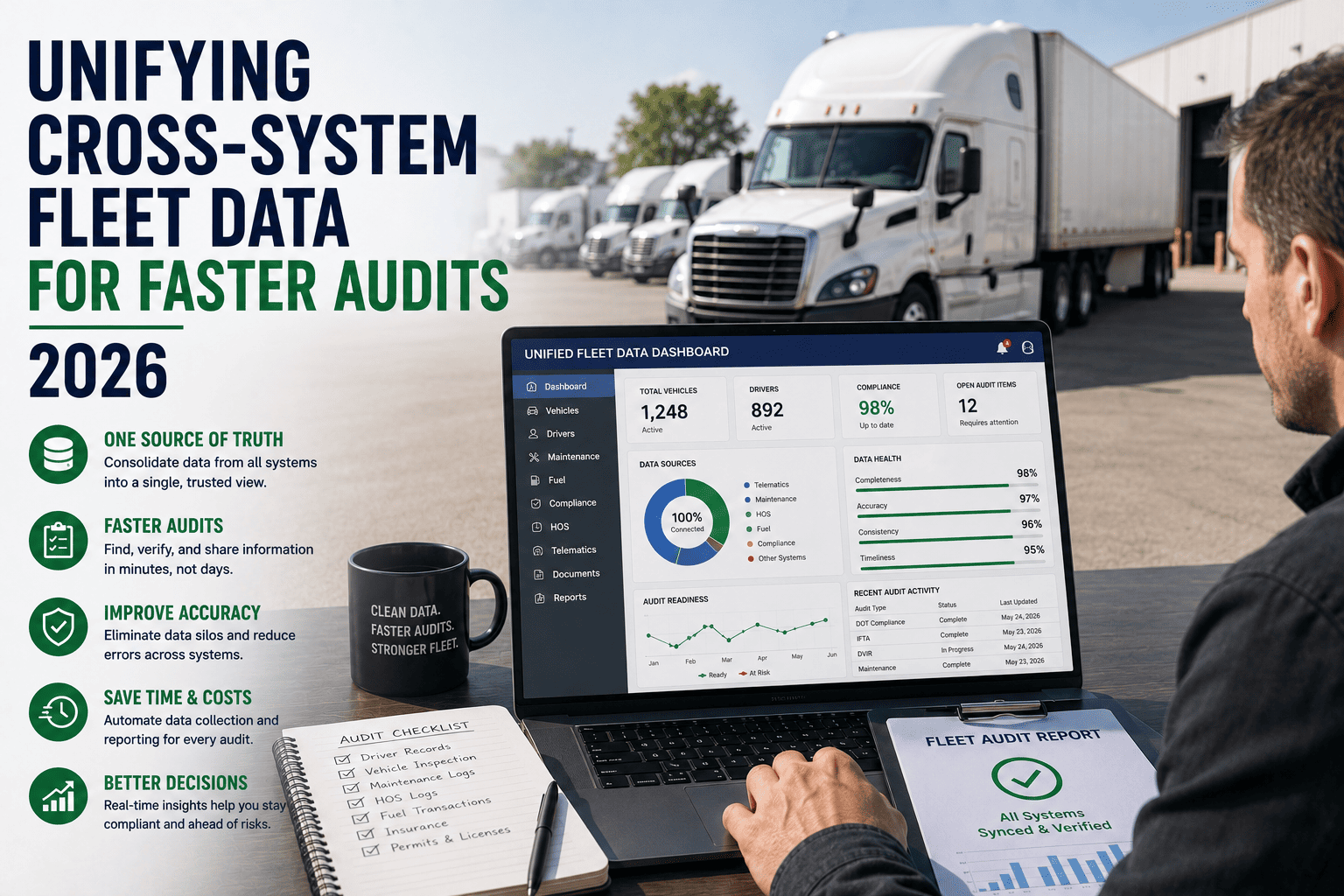
Fleet Rabbit's compliance management platform automates audit preparation by maintaining current DVIR records, driver qualification files, maintenance documentation, and vehicle registration in one organized system. The platform generates audit-ready reports, flags expired certifications, tracks annual review due dates, and provides instant access to all compliance documentation during DOT inspections. Audit preparation that once took weeks of manual file review now takes minutes.
Critical FMCSA Audit Standards: What Inspectors Verify
During a DOT audit, inspectors systematically review documentation across these compliance categories. Understanding what auditors look for helps you prioritize remediation and demonstrate regulatory knowledge.
Commercial motor vehicle drivers must complete DVIRs documenting vehicle condition including brakes, steering, lights, coupling, tires, and safety-critical components. Maintenance personnel must certify repairs made or declare defects unnecessary. Next drivers must review and acknowledge previous DVIRs before operating. Auditors verify complete chain of custody with original signatures, dates, defect severity documentation, and repair follow-up. Missing or incomplete DVIRs create immediate violations with each missing report counting as a separate violation.
Every driver must have a complete DQF containing application with 3-year employment history, medical certificate, CDL copy, motor vehicle records from all states, prior employer investigation, road test documentation, and annual reviews. Auditors verify each document is present, current, and properly signed. Missing documents, expired certifications, or incomplete investigations create violations. Each missing document counts separately, and multiple missing documents across several drivers result in escalated findings.
Medical certificates must be current and verified on the National Registry of Certified Medical Examiners. Auditors pull the registry during inspections to confirm certificate validity. Operating with an expired certificate is a serious violation regardless of driver performance. Medical variances and restrictions must be documented in the DQF with clear evidence that the fleet manager verified compliance with any restrictions or limitations.
Current MVRs from every state where the driver held a CDL during the prior 3 years must be in the DQF. Auditors compare driver licenses to MVR coverage, identify out-of-state licenses, and request MVRs for any states not documented. Annual MVR reviews must be completed with documented verification that no disqualifying suspensions, revocations, or serious violations exist. Failure to obtain or review MVRs creates violations for every driver with incomplete state coverage.
Full Clearinghouse queries must be completed pre-hire with driver consent. Annual limited queries are the minimum post-hire requirement. Auditors verify query dates and results in the DQF. No disqualifying violations can exist in the Clearinghouse. Fleets must document evidence that drivers have been cleared by the Clearinghouse before dispatch. Missing Clearinghouse queries or queries showing unaddressed violations create serious audit findings.
All drivers must have road test documentation or accepted skills evaluation certificate. Testing must cover pre-trip inspection, vehicle control, and on-road observation per FMCSA Form 391.3 standards. Prior road test documentation is acceptable only with written verification that it met FMCSA standards. Auditors verify test documentation dates, examiner signatures, and form completion. Missing or undocumented road tests prevent drivers from operating and create violations.
20-Item Fleet Audit Checklist: Quick Reference by Category
Use this reference table to verify each audit component is complete before your DOT inspection. Check all boxes to ensure comprehensive compliance across every audit category.
| Audit Item | Category | Verification Method | Compliance Deadline |
|---|---|---|---|
| Daily DVIR completion for defects | Inspections | Review DVIR records and driver signatures | Ongoing daily requirement |
| Maintenance repair sign-off on DVIR | Inspections | Verify maintenance certification and repair completion dates | Before next driver dispatch |
| 3-month DVIR retention and next-driver acknowledgment | Inspections | Check DVIR archive with signatures and defect severity status | 3-month minimum retention |
| Driver application with 3-year history | Driver Qualifications | Review signed application in DQF with employment dates | Duration of employment plus 3 years |
| Prior employer investigation within 30 days | Driver Qualifications | Verify investigation request and response documentation dates | 30 days from first day of work |
| Annual driver qualification review | Driver Qualifications | Confirm review documentation within 12-month rolling period | Every 12 months from hire date |
| Valid medical examiner certificate | Medical and Licensing | Verify certificate in DQF and check National Registry validity | Current at all times during employment |
| Active commercial driver license | Medical and Licensing | Compare CDL copy to state records, verify class and endorsements | Current at all times during employment |
| Medical variances or restrictions documented | Medical and Licensing | Review DQF for variance documents and compliance verification | Documented upon issuance |
| Motor vehicle records from all prior states | Motor Vehicle Records | Verify MVRs from each licensing state for 3-year history | No older than 90 days at hire |
| Annual motor vehicle record review | Motor Vehicle Records | Confirm current MVR review with suspension/revocation status checked | Annual minimum requirement |
| Pre-hire Clearinghouse full query | Drug and Alcohol | Verify query completion with driver consent and negative results | Before first dispatch |
| Annual Clearinghouse limited query | Drug and Alcohol | Confirm annual query dates within calendar year | Minimum once per year |
| Road test or skills evaluation certificate | Road Test | Verify FMCSA Form 391.3 or accepted certificate with examiner signature | Before solo dispatch |
| Prior employer road test acceptance documentation | Road Test | Confirm written verification that test met FMCSA standards | Documented in DQF at hire |
| Preventive maintenance schedule established | Maintenance | Review PM intervals by mileage, engine hours, or time with schedule approval | Documented and current |
| Complete maintenance records with work orders | Maintenance | Verify work orders with technician ID, dates, and parts documentation | Retained for vehicle ownership |
| Functional ELD with records retained | Hours of Service | Confirm FMCSA-registered ELD active on all applicable vehicles | Minimum 30-day record retention |
| Current vehicle registration and title | Vehicle Documentation | Verify registration copies in file with renewal tracking | Current throughout operation |
| Safety policy and compliance documentation | Management Systems | Review written safety manual with employee acknowledgment dates | Current and accessible to all drivers |
Scroll horizontally on mobile to view complete table
Organize Your Audit Documentation with Digital Compliance Tools
Stop searching through file cabinets and spreadsheets during audit preparation. Fleet Rabbit centralizes all audit documentation, generates compliance reports instantly, tracks deadline compliance, and provides auditors with organized, searchable records. When your DOT inspection begins, every required document is organized, current, and audit-ready for immediate review.
Audit Compliance Tags
Organize your audit checklist by these key compliance categories. Click each tag to focus on specific audit components.
Frequently Asked Questions About Fleet Audits and DOT Inspection Preparation
What documents do DOT auditors request during compliance reviews?
Auditors request DVIRs, driver qualification files, medical certificates, motor vehicle records, maintenance records, HOS logs, and vehicle registration. They systematically verify each category against regulatory requirements to identify compliance gaps and violations. Book a demo to learn how digital organization speeds audit response.
How long should driver qualification files be retained for audit compliance?
FMCSA requires DQF retention for the duration of employment plus 3 years after driver separation. Digital storage with secure backup ensures records are accessible during audits and litigation. Start your free trial for automated retention tracking and archival.
What happens if auditors find missing or incomplete documentation during inspection?
Each missing document creates a separate violation with civil penalties from $1,000 to $10,000 per deficiency. Multiple violations can trigger escalated compliance reviews or proposed operating authority suspension. Prompt remediation shows good faith compliance efforts.
Can auditors request electronic copies of DVIR records during audit inspections?
Yes, auditors accept digital DVIR records with electronic signatures. Electronic records with timestamps and GPS data often provide better audit defense than handwritten forms. Digital systems prevent the pencil-whipping and forged signature issues that traditional paper DVIRs face during audit scrutiny.
How should drivers complete DVIRs to meet audit standards?
Drivers must document specific defects with severity levels, include photos of safety-critical issues, sign and date the report, and submit within the same duty period. Maintenance must repair critical defects before the next driver operates the vehicle with repair certification documented on the original DVIR.
What audit red flags indicate deeper compliance problems to inspectors?
Identical handwriting on multiple DVIRs, suspiciously identical completion times, missing next-driver acknowledgments, unsigned maintenance certifications, and expired medical certificates signal systematic compliance failures. Digital systems eliminate these red flags automatically.
Can fleets remediate audit violations after the inspection concludes?
Some violations can be corrected with prompt remediation and documentation of good faith efforts. Missing documents can sometimes be obtained retroactively. However, some violations like expired medical certificates at time of operation cannot be remediated and result in final penalties. Book a demo for proactive compliance strategies.
How often should fleets conduct internal audit preparation reviews?
Quarterly internal compliance audits using this 20-item checklist catch issues before DOT inspectors do. Monthly reviews of DVIR completion and annual review tracking maintain ongoing compliance. Start your free trial for continuous compliance monitoring.
What documentation proves compliance efforts during audit remediation meetings?
Email records requesting missing documents, tracking sheets showing corrective action steps, updated policies with implementation dates, and training records demonstrate good faith compliance efforts. Digital systems automatically generate these records for audit defense.
Simplify DOT Audit Preparation with Compliance Automation
Stop spending weeks preparing for DOT audits. Fleet Rabbit automates compliance documentation, maintains audit-ready records, tracks all 20 critical items in real-time, and generates complete audit reports in minutes. When inspectors arrive, your fleet is documented, organized, and compliant.