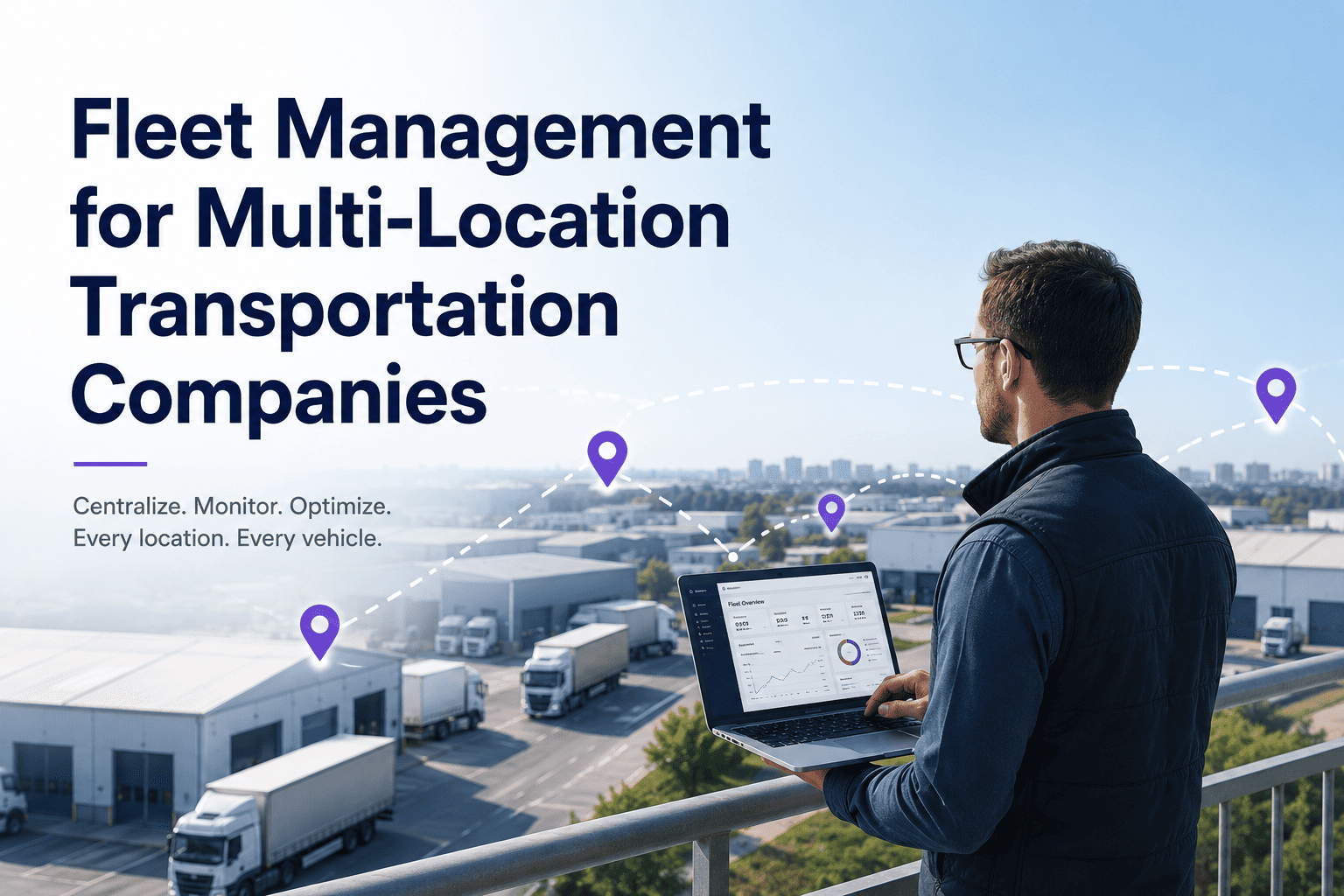
Managing a fleet across multiple locations is one of the most operationally complex challenges in transportation. When vehicles are spread across several depots, branches, or regions, fleet managers lose the single-source visibility that makes day-to-day operations efficient and compliant. Maintenance schedules drift apart, compliance documentation becomes inconsistent, and cost tracking requires manual reconciliation across systems that do not talk to each other. The result is a fleet that operates at a fraction of its potential efficiency.
Transportation companies with vehicles at multiple sites face a different category of challenge than single-depot operators. The volume of data, the number of stakeholders, and the pace of decisions all multiply. Without a centralized platform, each location runs its own informal system, creating inconsistencies that compound over time into serious operational and compliance risk. Fuel spend varies by location with no cross-site visibility. Maintenance quality depends on who manages each depot. Driver records and HOS data live in separate systems that require manual consolidation for any audit or management review.
This guide explains how transportation companies managing fleets across multiple depots, branches, or regions can establish centralized visibility, standardize maintenance and compliance workflows, and reduce operational costs. Learn how unified fleet management platforms like FleetRabbit bring all locations under a single dashboard without compromising site-level flexibility.
FleetRabbit helps transportation companies unify vehicle maintenance, DVIR inspections, and compliance tracking across all depot locations from one centralized platform.
Why Multi-Location Fleet Management Requires a Different Approach
Single-depot fleets operate with direct visibility. The fleet manager is physically present, knows every vehicle, and can walk to the maintenance bay to check status. As soon as a company adds a second or third location, that direct visibility breaks down. Information must travel through people, spreadsheets, or phone calls. By the time data reaches a central decision maker, it is already outdated.
Multi-location fleets also face compounding compliance risk. Each location may interpret HOS regulations, DVIR requirements, and preventive maintenance schedules differently. Without standardized workflows enforced through a single platform, compliance becomes dependent on individual site managers rather than systemic controls. This inconsistency is exactly what DOT auditors look for when evaluating carrier safety ratings.
The operational advantage of a properly managed multi-location fleet is significant. Companies that centralize fleet data across depots can redistribute vehicles between locations based on utilization data, share maintenance resources across sites, negotiate better fuel contracts with aggregated spend visibility, and enforce uniform safety standards company-wide. These advantages are only achievable when all locations operate from a single system of record.
Core Challenges in Managing Fleets Across Multiple Locations
Each depot maintains its own records using different tools, spreadsheets, or local software. Consolidating data for company-wide reporting requires manual effort and introduces errors. Decision makers lack a real-time view of total fleet status across all locations.
Without centralized maintenance scheduling, each location follows its own preventive maintenance cadence. Some sites run vehicles past service intervals. Others over-service. The result is uneven vehicle health, variable downtime rates, and inconsistent maintenance costs per vehicle.
DVIR records, HOS logs, and inspection reports stored at individual sites create documentation gaps during audits. When auditors request records across all locations, paper-based or siloed digital records require days of manual compilation to produce a complete compliance picture.
Fuel spend, maintenance labor, parts procurement, and vehicle downtime costs tracked separately by location make it impossible to benchmark performance across depots or identify sites with cost overruns. Budget planning relies on estimates rather than actual cross-site data.
Without cross-depot visibility into vehicle utilization rates, some locations run vehicles at full capacity while others have idle assets. Rebalancing the fleet between depots becomes a reactive decision based on urgent need rather than proactive data-driven optimization.
Multi-location fleets require different access levels for corporate managers, regional supervisors, and site-level drivers. Managing who sees what data across which locations without a proper role-based access system creates either data overload or information silos at every level of the organization.
When a driver reports a defect at a remote depot, the maintenance team at that location may not have the parts, tools, or expertise to resolve it quickly. Without centralized visibility into defect status and repair priority across all sites, critical defects can sit unresolved while vehicles stay off the road.
Driver qualification files, hours of service records, and training documentation managed separately by location create carrier-wide compliance risk. A driver transferred between depots may have records split across two systems with no complete file accessible in one place.
DOT audits can target any location or request records from the entire carrier operation. Companies without centralized documentation require weeks to compile a compliant audit response. Centralized systems produce complete audit-ready documentation for any location within minutes.
Single-Depot vs Multi-Location Fleet Management Comparison
| Management Area | Single-Depot Operation | Multi-Location Without Central Platform | Multi-Location With Central Platform |
|---|---|---|---|
| Fleet Visibility | Full visibility, in-person oversight | Fragmented, site-specific reports only | Real-time unified view across all sites |
| Maintenance Scheduling | Managed locally with direct oversight | Varies by location, inconsistent intervals | Standardized schedules enforced across all depots |
| Compliance Documentation | Stored at one site, easy to retrieve | Scattered across depots, hard to compile | Centralized, retrievable for any location instantly |
| Cost Tracking | Single budget, clear cost attribution | Separate budgets, no cross-site benchmarking | Aggregated cost view with per-site breakdowns |
| Vehicle Utilization | Known by observation | Unknown across sites, imbalanced allocation | Utilization data per vehicle enables rebalancing |
| Audit Readiness | Records at one location, manageable | Requires days of manual compilation per site | Audit reports generated in minutes for any location |
| DVIR Management | Local process, direct follow-up | Inconsistent processes, delayed defect resolution | Digital DVIRs with centralized defect tracking |
| Fuel Management | Single account, straightforward tracking | Multiple accounts, manual consolidation | Aggregated fuel data with per-depot analysis |
How FleetRabbit Supports Multi-Location Transportation Companies
FleetRabbit is designed to bring multiple fleet locations under a single unified dashboard without requiring each depot to change how it operates on the ground. The platform centralizes vehicle records, maintenance schedules, inspection documentation, and compliance tracking in a cloud-based system that is accessible from any location at any time. Site managers retain control over day-to-day operations while corporate managers gain the cross-depot visibility they need for strategic decisions.
The platform handles the most common pain points of multi-depot operations through structured workflows. Preventive maintenance schedules are set at the company level and automatically applied to vehicles at any location. Digital DVIR inspections completed by drivers at any depot are immediately visible to both site managers and corporate fleet administrators. Defects flagged at remote locations are routed to the appropriate maintenance team with priority classification and repair tracking. Every action is timestamped and stored in a centralized audit trail accessible from headquarters.
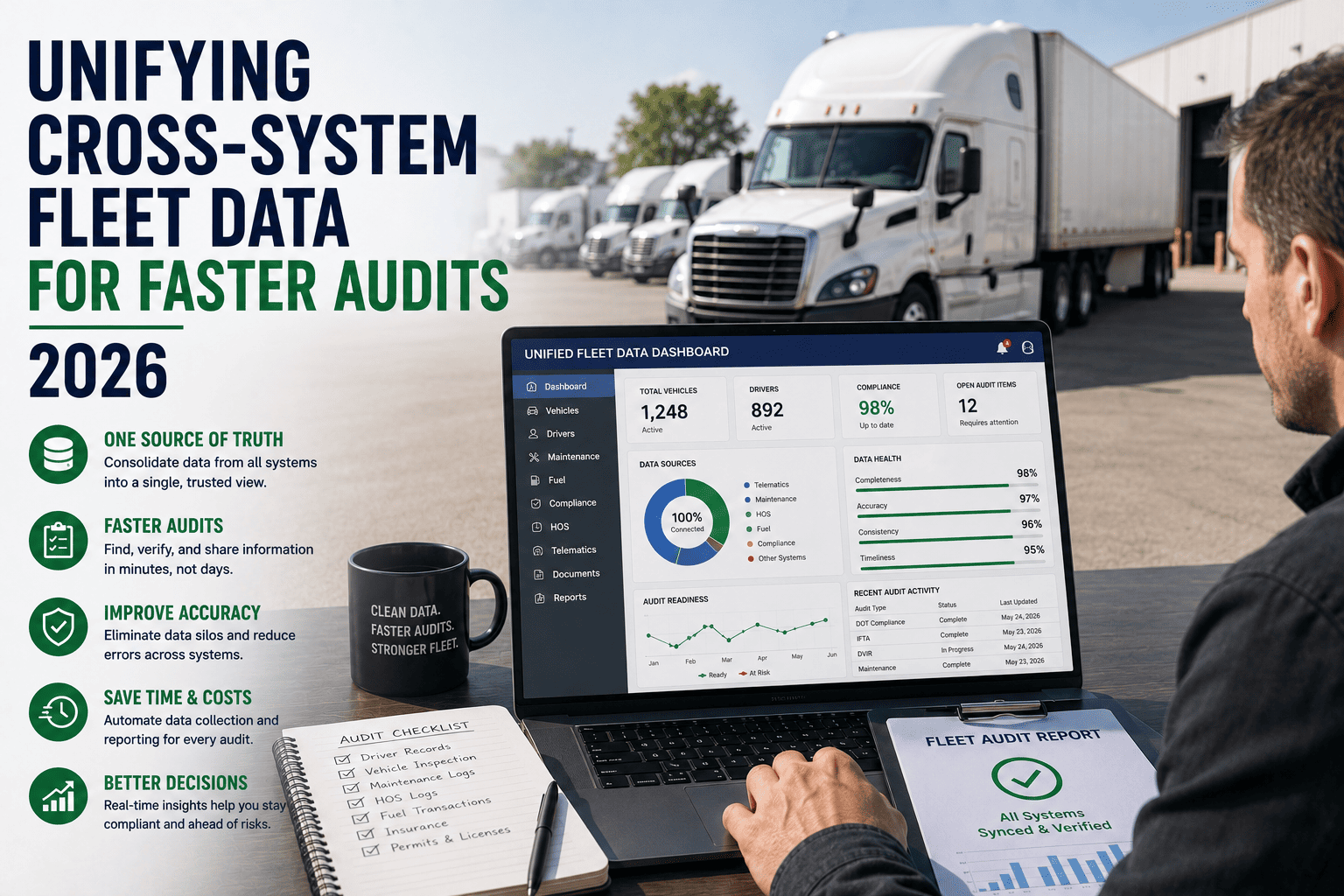
All vehicles across all depot locations appear on a single management dashboard. Filter by location, vehicle type, compliance status, or maintenance due date without switching between systems or contacting site managers.
Drivers at any location complete structured digital inspection reports through the FleetRabbit mobile app. Defects are automatically routed to the responsible maintenance team with photo documentation and resolution tracking.
Define preventive maintenance intervals at the company level. FleetRabbit applies and tracks those schedules automatically for every vehicle regardless of which depot it is assigned to, ensuring consistent vehicle health standards.
Filter and export compliance documentation by specific depot or across the entire fleet. Audit-ready reports covering DVIR records, maintenance history, and inspection results are available instantly for any date range and any location.
Assign different access levels to corporate managers, regional supervisors, site managers, and drivers. Each user sees relevant data for their scope without exposing confidential information or creating data overload.
Receive automatic notifications when maintenance is overdue at any location, when a defect is reported at a remote depot, or when a vehicle inspection fails. No manual monitoring required to stay current across all sites.
Best Practices for Implementing Centralized Fleet Management Across Multiple Locations
FleetRabbit gives corporate fleet managers the centralized visibility and control they need while keeping site managers productive with tools built for day-to-day depot operations.
Key Features to Look for in Multi-Location Fleet Management Software
| Feature | Why It Matters for Multi-Location Fleets | Impact Without This Feature |
|---|---|---|
| Multi-Site Dashboard | View all vehicles, maintenance status, and compliance data across every depot in one screen without switching between location-specific systems | Corporate managers rely on manual reports from each site with significant time lag |
| Role-Based Access Control | Corporate admins, regional managers, site supervisors, and drivers each need different data access levels appropriate to their responsibilities | Either everyone sees everything (data overload) or data stays siloed by location |
| Standardized Maintenance Workflows | Company-defined PM schedules enforced automatically across all vehicles regardless of location eliminate inconsistency and compliance gaps | Each depot follows informal schedules leading to variable vehicle health and unplanned downtime |
| Digital DVIR with Central Visibility | Inspection records from any driver at any location are immediately visible to both site and corporate management with photo documentation | Defect records are local, paper-based, and inaccessible to corporate management until manually compiled |
| Centralized Compliance Reporting | Produce audit-ready compliance documentation covering all locations within minutes for any date range requested by auditors | Audit preparation takes days of manual compilation with risk of missing records from remote sites |
| Cross-Location Cost Analytics | Compare fuel costs, maintenance spend, and vehicle utilization across depots to identify outliers and benchmark best-performing locations | Budget decisions are based on aggregated totals with no visibility into which location drives specific costs |
| Mobile App for Remote Drivers | Drivers at any location complete inspections, log defects, and access vehicle information through a consistent mobile interface without location-specific hardware | Remote drivers use different tools or paper processes creating inconsistent data quality across sites |
| Automated Alerts by Location | Receive targeted notifications when specific depots have overdue maintenance, failed inspections, or pending defect repairs requiring attention | Corporate managers must actively request status updates from each site manager to know what requires attention |
Cost and ROI of Centralized Fleet Management for Multi-Location Operations
Common Problems in Multi-Location Fleet Management and How to Solve Them
Problem: One location performs preventive maintenance consistently while another runs vehicles past service intervals. Vehicle health and downtime rates differ dramatically between sites and corporate management has no visibility until breakdowns occur.
Solution: Implement company-wide PM schedules through a centralized platform with automated alerts when service intervals are approaching at any location. Require work order documentation for all maintenance activity at every depot so corporate managers can monitor compliance with maintenance standards, not just audit after failures.
Problem: A driver reports a defect at a location 300 miles from headquarters. The site manager logs it on paper. The corporate maintenance team does not know it exists until the weekly status call, by which time the vehicle has been parked for three days waiting for a repair decision.
Solution: Digital DVIR systems that immediately notify the appropriate maintenance team regardless of location eliminate the communication delay. Defects are classified by severity at time of reporting, routed automatically, and tracked to resolution. Corporate management sees defect status for all locations in real time without requiring site managers to report manually.
Problem: A DOT auditor requests six months of inspection records and maintenance documentation for all locations. Paper records at three depots, a local database at a fourth, and a spreadsheet at the fifth require a week of manual compilation that still produces incomplete documentation.
Solution: Centralized cloud-based records that store all inspection reports, maintenance work orders, and compliance documentation in a single system produce complete audit responses in minutes. No physical retrieval, no manual compilation, no risk of missing records from remote sites.
Problem: When a vehicle moves from one depot to another, its maintenance history and inspection records are either left behind in the originating location's system or require manual transfer. The receiving depot treats the vehicle as a new asset with no service history.
Solution: Cloud-based centralized records follow the vehicle regardless of which depot it is assigned to. The receiving site immediately sees complete maintenance history, upcoming service dates, and all prior inspection records from previous locations. Vehicle transfers become operational moves rather than data migration events.
Problem: Monthly fleet cost reports show total spending across all locations but cannot identify which depots are performing efficiently and which are experiencing cost overruns. Budget decisions are made on averages that hide location-level problems.
Solution: Cost analytics that break down maintenance spend, parts usage, fuel consumption, and downtime by specific location allow direct comparison between sites. When one depot consistently shows higher per-vehicle costs, managers can investigate root causes: aging vehicle assignments, maintenance quality issues, or operational inefficiencies specific to that location.
Key Insight for Multi-Location Fleets: The difference between a well-run multi-location fleet and a fragmented one is not the number of vehicles or depots. It is whether a single decision maker can access complete, accurate, and current data for every location at any moment. Centralized fleet management platforms provide that single source of truth. Without it, every management decision carries the risk of being based on incomplete information from only some of your locations.
Building a Multi-Location Fleet Management Technology Stack
Transportation companies at different stages of growth need different levels of technology sophistication. A company managing two depots with 20 vehicles has different integration requirements than an enterprise carrier with 10 locations and 500 vehicles. Understanding which technology layers matter at each stage helps prioritize investment and avoid over-engineering early-stage operations.
Priority: Centralized vehicle records, digital DVIR, and standardized maintenance scheduling. At this stage, the goal is eliminating paper processes and creating a single database for all vehicle and inspection data. Cloud-based platforms accessible from all locations are sufficient. Integration with telematics can wait until core data quality is established.
Priority: Cross-location cost analytics, automated compliance reporting, and role-based access management. At this scale, the data volume justifies analytics investment. The focus shifts from data collection to using data for decisions. Fuel card integration and ELD data connections add operational visibility that drives measurable cost reduction.
Priority: API integration with dispatch systems, TMS platforms, and HR software. At enterprise scale, fleet management data must flow to and from other operational systems automatically. Manual data entry between systems is not sustainable. The fleet management platform becomes a data hub connecting compliance, maintenance, and operational systems across the entire organization.
Frequently Asked Questions
See how FleetRabbit brings all your depot locations under one unified dashboard for maintenance, inspections, and compliance. No hardware required. Start managing every location from one platform.
Making the Right Decision for Your Multi-Location Fleet
The transition from fragmented, site-specific fleet management to centralized operations is not a technology decision alone. It requires standardizing workflows, aligning site managers around shared data systems, and committing to using cross-location data as the basis for operational decisions. Companies that treat centralized fleet management as a reporting upgrade rather than an operational transformation consistently underutilize the platform and fail to capture available savings.
The most successful multi-location fleet implementations share a common approach: they start with clear goals for what centralization must achieve, involve site managers in the deployment process rather than imposing it from corporate headquarters, and measure outcomes against defined KPIs from the first month. Whether your fleet spans two locations or twenty, the fundamental requirement is the same: one system, one source of truth, and visibility for every decision maker at every level of the organization.
Evaluate fleet management platforms based on their ability to scale with your location count without requiring architectural changes. The platform you choose for two depots should be capable of managing ten without requiring a system migration. Assess role-based access structures, cross-location reporting capabilities, mobile app quality for remote drivers, and the depth of maintenance workflow standardization features before making a selection.
FleetRabbit is built to scale with your fleet across locations. From two depots to twenty, the platform provides the centralized visibility, maintenance standardization, and compliance documentation your team needs to operate efficiently.