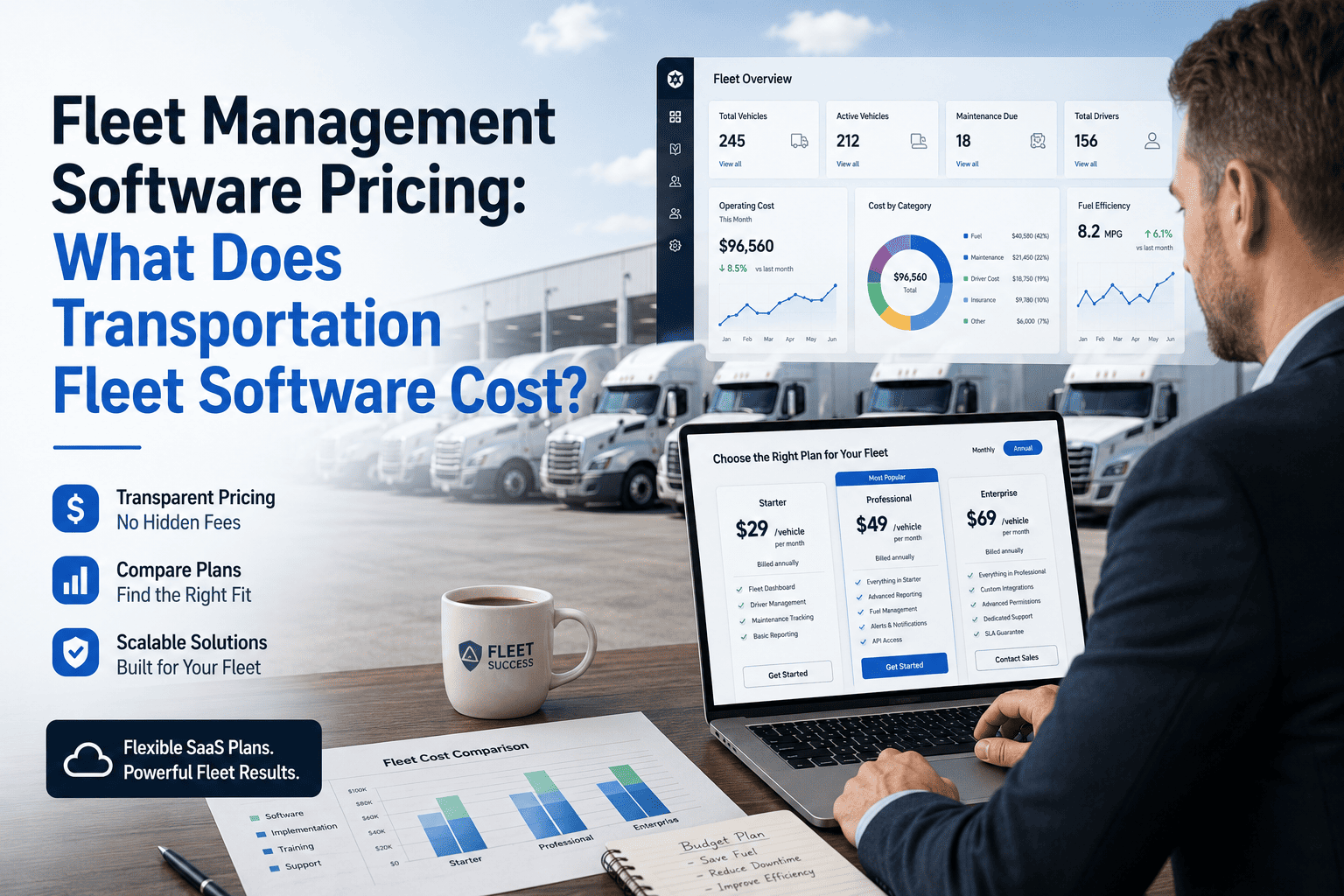
Understanding fleet management software pricing is essential for transportation companies seeking to optimize operations without overspending on technology. Fleet software costs vary widely based on features, fleet size, deployment model, and vendor pricing structures. Some solutions charge per vehicle per month, others offer flat-rate subscriptions, and enterprise platforms provide custom pricing based on specific requirements. This comprehensive guide breaks down fleet management software pricing models, reveals hidden costs, calculates ROI expectations, and provides actionable strategies for budgeting transportation technology investments. Whether you manage 10 vehicles or 1,000, understanding what you should pay for fleet software will help you select the right solution at the right price.
Learn how to calculate fleet software ROI and choose the right pricing model for your operation. Join our FREE Webinar on January 7, 2025, to master fleet technology investment strategies!
1. Understanding Fleet Management Software Pricing Models
Fleet management software vendors employ several distinct pricing models, each suited to different fleet sizes, operational needs, and budget structures. Understanding these models is the first step toward making an informed purchasing decision that aligns with your organization's financial requirements.
Per-Vehicle Monthly Subscription represents the most common pricing model in the fleet software industry. Under this structure, you pay a recurring monthly fee for each active vehicle in your fleet. Typical per-vehicle costs range from $15 to $60 per month, depending on features included. Basic GPS tracking solutions often start around $15 to $25 per vehicle monthly, while comprehensive fleet management platforms with maintenance scheduling, ELD integration, and advanced analytics typically cost $30 to $60 per vehicle monthly. The primary advantage of per-vehicle pricing is scalability, you pay only for vehicles you actually operate, and costs grow predictably as your fleet expands. The disadvantage is that per-vehicle costs can become significant for large fleets with hundreds or thousands of vehicles.
Flat-Rate Subscription charges a fixed monthly or annual fee regardless of fleet size, within certain limits. This model works well for smaller fleets with 5 to 30 vehicles, where per-vehicle pricing might seem expensive relative to the number of vehicles. Flat-rate subscriptions typically range from $100 to $500 monthly for basic packages, up to $1,000 to $3,000 monthly for enterprise features. The advantage is predictable monthly costs and potentially lower per-vehicle rates as fleet size grows within the flat-rate tier. The disadvantage is that very small fleets may pay more under flat-rate than per-vehicle pricing, and you may exceed tier limits as your fleet grows, requiring an upgrade to a higher-priced tier.
Per-User Subscription charges based on the number of people accessing the fleet software rather than the number of vehicles. This model is less common in pure fleet management but appears in logistics platforms and TMS solutions where multiple dispatchers, managers, and administrators use the system. Per-user costs typically range from $50 to $200 monthly per user, with unlimited vehicles included. This model benefits fleets with many vehicles but few administrative users, as adding vehicles doesn't increase software costs. However, fleets with many users accessing the system can find per-user pricing expensive.
Tiered Feature Packages offer different pricing levels based on included features. A typical tiered structure might include Basic (tracking only) at $20 per vehicle monthly, Professional (tracking plus maintenance and fuel) at $35 per vehicle monthly, and Enterprise (everything plus analytics and API access) at $50 per vehicle monthly. Tiered pricing allows you to start with lower-cost packages and upgrade as your needs evolve. The challenge is ensuring that lower tiers include essential features without forcing upgrades for capabilities you genuinely need.
Annual Prepay Discounts are offered by most fleet software vendors, typically providing 10 to 20 percent savings compared to month-to-month billing. Paying annually requires larger upfront investment but reduces total cost of ownership. Some vendors offer even deeper discounts for multi-year commitments, such as 15 percent off for annual prepay plus an additional 10 percent for a three-year contract. For established fleets confident in their software choice, annual prepay provides significant savings.
Enterprise Custom Pricing applies to large fleets with 500+ vehicles or those requiring custom features, dedicated support, or on-premise deployment. Enterprise pricing is rarely published, instead negotiated based on specific requirements. Custom pricing typically includes implementation fees, training costs, and service level agreements. For large fleets, enterprise pricing often reduces per-vehicle costs significantly compared to standard published rates, sometimes reaching $8 to $15 per vehicle monthly for comprehensive platforms.
Fleet Management Software Pricing Model Comparison
| Pricing Model | Typical Cost Range | Best For | Pros | Cons |
|---|---|---|---|---|
| Per-Vehicle Monthly | $15 - $60/vehicle/month | All fleet sizes, especially variable fleets | Scalable, pay for what you use | Costs grow with fleet size |
| Flat-Rate Subscription | $100 - $3,000/month | Small fleets (5-30 vehicles) | Predictable cost, simple budgeting | May overpay for very small fleets |
| Per-User Subscription | $50 - $200/user/month | Fleets with many vehicles, few users | Unlimited vehicles included | Expensive for many users |
| Tiered Feature Packages | $20 - $60/vehicle/month | Fleets with varying feature needs | Start small, upgrade as needed | Essential features may require expensive tier |
| Enterprise Custom | $8 - $30/vehicle/month (negotiated) | 500+ vehicle fleets | Lowest per-vehicle cost, custom features | Complex negotiation, implementation fees |
2. FleetRabbit Pricing Structure and Plans
FleetRabbit offers transparent, per-vehicle monthly pricing designed to provide exceptional value for fleets of all sizes. Understanding exactly what you get at each pricing tier helps you select the right plan for your operational needs and budget.
Starter Plan provides essential fleet management capabilities for small fleets or those new to fleet software. Priced at $15 per vehicle monthly with annual billing ($18 month-to-month), the Starter Plan includes basic vehicle tracking, maintenance reminders, digital driver vehicle inspection reports (DVIR), and compliance documentation storage. This plan supports up to 25 vehicles and includes mobile apps for drivers and technicians. The Starter Plan is ideal for fleets just beginning their digital transformation journey or those with very basic fleet management requirements.
Professional Plan represents the most popular offering for established fleets requiring comprehensive management capabilities. Priced at $30 per vehicle monthly with annual billing ($36 month-to-month), the Professional Plan includes everything in Starter plus preventive maintenance scheduling, automated work orders, parts inventory management, fuel card integration, and advanced reporting dashboards. This plan supports unlimited vehicles and includes API access for custom integrations. The Professional Plan delivers the features most fleets need for effective operations without unnecessary complexity or cost.
Enterprise Plan provides complete fleet management capabilities for large or complex operations. Priced at $45 per vehicle monthly with annual billing ($54 month-to-month), the Enterprise Plan includes everything in Professional plus telematics integration, predictive maintenance analytics, custom report builder, dedicated account manager, and priority support with 99.9% uptime SLA. This plan supports unlimited vehicles, unlimited users, and includes all integration options. The Enterprise Plan is designed for fleets requiring maximum automation, customization, and support.
Annual Billing Advantage applies to all FleetRabbit plans, reducing monthly costs by 16 to 20 percent compared to month-to-month billing. For a 50-vehicle fleet on the Professional Plan, annual billing saves $3,600 annually compared to monthly billing, representing significant savings that can be reinvested in other fleet initiatives. Multi-year contracts (2 or 3 years) provide additional discounts, typically 5 to 10 percent beyond annual prepay rates.
Implementation and Onboarding costs vary by plan and fleet size. Starter Plan includes self-service onboarding with online tutorials and knowledge base access at no additional cost. Professional Plan includes virtual onboarding sessions (2 hours) and data migration assistance. Enterprise Plan includes dedicated implementation project management, on-site training options, and custom data migration. Implementation fees for Enterprise customers range from $1,000 to $5,000 depending on complexity, though these fees are often waived for multi-year commitments.
FleetRabbit Pricing Plans
Choose the plan that fits your fleet size and operational needs with transparent, per-vehicle monthly pricing.
3. Hidden Costs in Fleet Management Software
Beyond the base subscription price, fleet management software often carries additional costs that can significantly impact total cost of ownership. Understanding these hidden costs before signing a contract prevents budget surprises and helps you make accurate ROI calculations.
Hardware Costs represent the most significant hidden expense for GPS tracking and telematics solutions. While the software subscription covers data processing and reporting, you must purchase GPS tracking devices for each vehicle. Hardware costs typically range from $50 to $200 per device for basic GPS trackers, up to $300 to $600 for advanced devices with engine diagnostics and driver behavior monitoring. Some vendors bundle hardware costs into monthly subscription fees through equipment leases, but these leases often result in higher total costs over time. FleetRabbit integrates with existing telematics hardware, allowing you to use devices you already own rather than purchasing new hardware.
Installation and Activation Fees vary widely between vendors. Some include basic installation guidance at no cost, while others charge $50 to $150 per vehicle for professional installation. For fleets with 100 vehicles, installation fees alone could reach $10,000 to $15,000. Self-installation is possible for many devices, reducing or eliminating this cost, but requires technician time and expertise. FleetRabbit provides free installation documentation and support, with optional professional installation available through partner networks at competitive rates.
Cellular Data Plans for GPS tracking devices represent ongoing operational costs separate from software subscriptions. Most GPS devices require cellular connectivity to transmit location and diagnostic data to the cloud. Data plans typically cost $5 to $15 monthly per device, sometimes billed separately by the hardware provider or included in an all-inclusive subscription. Over a fleet of 100 vehicles over 5 years, data plan costs alone could reach $30,000 to $90,000. FleetRabbit does not mark up cellular data plans, allowing you to use your preferred provider or leverage devices with included data.
Integration and API Fees can surprise fleets requiring connections between fleet software and existing systems like ERPs, TMS platforms, or accounting software. Some vendors charge setup fees for integrations ($500 to $5,000) plus ongoing monthly API access fees ($100 to $500 monthly). Others limit integration capabilities to higher-priced tiers, forcing upgrades beyond your base feature needs. FleetRabbit includes API access in Professional and Enterprise plans with no additional integration fees for standard connections.
User Licensing Overages affect fleets using per-user pricing models that limit the number of users accessing the system. Adding extra users beyond the plan limit often triggers additional monthly fees of $20 to $100 per user. For fleets where multiple dispatchers, managers, and administrators need access, user overages can significantly increase costs. FleetRabbit includes unlimited users in all plans, eliminating user-based pricing surprises.
Training and Support Tiers vary between vendors, with basic support often limited to email and knowledge bases while phone support and dedicated account managers cost extra. Premium support tiers can add 10 to 20 percent to subscription costs. Training sessions beyond basic onboarding often incur hourly fees of $100 to $300. FleetRabbit includes phone, email, and chat support in all plans, with free online training resources and discounted professional training available for Enterprise customers.
Contract Termination Fees can trap fleets in unsatisfactory software relationships. Many vendors charge termination fees equal to remaining contract value if you cancel early. Others require 30 to 90 day notice periods, during which you continue paying for unused services. Some vendors claim ownership of your data after termination, charging extraction fees to retrieve your historical fleet information. FleetRabbit requires no long-term contracts (month-to-month available) and provides free data export in standard formats upon termination.
Questions to Ask Before Signing Any Fleet Software Contract
4. Calculating Fleet Software ROI
Understanding the return on investment from fleet management software helps justify the purchase to stakeholders and select the right solution based on financial impact rather than just upfront cost. Calculating ROI requires quantifying both the costs of the software and the savings it generates.
Quantifiable Savings Categories provide the foundation for ROI calculation. Fuel savings typically range from 5 to 15 percent through reduced idling, optimized routing, and improved driver behavior. Maintenance savings range from 10 to 25 percent through preventive maintenance scheduling and early problem detection. Labor productivity improvements save 5 to 10 percent through automated data entry and reduced manual tracking. Compliance violation reduction saves fines and out-of-service costs. Insurance premium reductions often reach 5 to 15 percent through documented safety programs. When aggregated, these savings typically total $2,000 to $5,000 per vehicle annually for fleets implementing comprehensive fleet management software.
Fuel Savings Calculation Example demonstrates potential returns. A fleet of 50 trucks each driving 100,000 miles annually at 6 miles per gallon consumes 833,333 gallons of fuel. At $3.50 per gallon, annual fuel spend is $2,916,666. A 10 percent fuel efficiency improvement from fleet software saves 83,333 gallons worth $291,667 annually. With fleet software costing $30 per vehicle monthly ($18,000 annually for 50 vehicles), the fuel savings alone deliver 16x ROI. Even a conservative 5 percent fuel improvement saves $145,833 annually, still 8x ROI before considering other savings categories.
Maintenance Savings Calculation Example shows additional returns. The same 50-vehicle fleet averages $15,000 annual maintenance cost per vehicle ($750,000 total). Preventive maintenance scheduling and early problem detection typically reduce maintenance costs by 15 percent, saving $112,500 annually. Combined with fuel savings of $145,833 (5 percent conservative estimate), total identified savings reach $258,333 annually against software costs of $18,000, delivering over 14x ROI before considering labor productivity, compliance, and insurance savings.
Labor Productivity Savings add further returns. Fleet managers and administrative staff typically spend 10 to 20 hours weekly on manual data entry, report generation, and maintenance tracking. At $30 per hour loaded labor cost, this represents $15,600 to $31,200 annual cost per affected employee. Fleet software reducing this time by 75 percent saves $11,700 to $23,400 annually per employee. For a fleet with two administrative staff, labor savings of $23,400 to $46,800 annually are realistic.
ROI Payback Period calculation helps compare software investments. Using the conservative example above (50 vehicles, $30 per vehicle monthly software cost, 5% fuel savings, 15% maintenance savings, 2 administrative staff), total annual savings approximate $258,333 (fuel) + $112,500 (maintenance) + $35,000 (labor) = $405,833. Annual software cost is $18,000. Net annual savings are $387,833, meaning the software pays for itself in approximately 17 days. Even fleets achieving half these savings see payback in under two months.
Fleet Software ROI Calculator Inputs
Number of vehicles in operation
Average miles driven per vehicle annually
Current average fuel cost per gallon
Average annual maintenance per vehicle
Loaded hourly cost for administrative staff
Monthly subscription cost per vehicle
5. Comparing Fleet Software Costs by Vendor
Understanding how different vendors price their solutions helps you evaluate options and negotiate effectively. While exact pricing changes frequently and varies based on fleet size and features, understanding typical market ranges provides a baseline for comparison.
GPS Tracking Focused Solutions typically cost $15 to $35 per vehicle monthly. These solutions emphasize real-time location, geofencing, and basic reporting. Advanced features like driver behavior monitoring, engine diagnostics, and maintenance tracking often require higher-tier plans or add-on fees. Vendors in this category include Samsara (starting around $25 per vehicle monthly), Verizon Connect ($20 to $40 per vehicle monthly), and GPS Insight ($25 to $35 per vehicle monthly). Hardware costs are typically additional, ranging from $100 to $300 per device with $5 to $15 monthly cellular data plans.
Comprehensive Fleet Management Platforms including maintenance, compliance, and operations features typically cost $30 to $60 per vehicle monthly. These solutions integrate GPS tracking with preventive maintenance scheduling, DVIR management, fuel card integration, and ELD connectivity. FleetRabbit falls into this category, with Professional Plan at $30 per vehicle monthly (annual billing). Other comprehensive platforms include Fleetio ($27 to $45 per vehicle monthly), RTA Fleet ($35 to $55 per vehicle monthly), and AssetWorks (custom pricing typically $40+ per vehicle monthly).
ELD and Compliance Focused Solutions range from $15 to $30 per vehicle monthly for basic compliance, with additional fees for fleet management features. ELD-only solutions provide hours of service tracking and basic vehicle inspection reports but lack maintenance management, fuel tracking, and advanced analytics. Vendors include KeepTruckin (now Motive) at $20 to $30 per vehicle monthly, Garmin ELD at $15 to $25 monthly, and Rand McNally at $18 to $28 monthly. Adding fleet management features typically increases costs to $35 to $50 per vehicle monthly.
Enterprise Fleet Management Solutions for large fleets (500+ vehicles) use custom pricing typically ranging from $8 to $25 per vehicle monthly depending on features, contract length, and implementation complexity. These solutions include Chevin Fleet Solutions, Agile Fleet, and Mercury Associates. Enterprise pricing often includes dedicated account management, custom reporting, and on-site training. Implementation fees for enterprise solutions typically range from $10,000 to $50,000 depending on scope.
Open Source and Self-Hosted Options represent a small market segment where you pay for hosting and support rather than software licensing. Open source fleet management platforms cost $0 for software but require technical expertise to deploy and maintain. Hosting costs (cloud or on-premise servers) typically run $500 to $5,000 monthly depending on fleet size. Support and maintenance contracts add $10,000 to $50,000 annually. Open source options work best for organizations with in-house development teams willing to manage the technology stack.
Fleet Software Vendor Pricing Comparison (Typical Ranges)
| Vendor Category | Example Vendors | Typical Cost Per Vehicle/Month | Hardware Included? | Best Fleet Size |
|---|---|---|---|---|
| GPS Tracking Focused | Samsara, Verizon Connect, GPS Insight | $20 - $40 | No ($100-$300 device + $5-$15 data) | All sizes |
| Comprehensive Platform | FleetRabbit, Fleetio, RTA Fleet | $25 - $55 | No (integrates with existing hardware) | 10 - 500 vehicles |
| ELD Compliance Focused | Motive, Garmin, Rand McNally | $15 - $30 | Usually included in subscription | All sizes |
| Enterprise Solutions | Chevin, Agile Fleet, Mercury | $8 - $25 (negotiated) | Varies | 500+ vehicles |
| Open Source | OpenFleet, Traccar | $0 software + hosting costs | No | Technical teams only |
6. Fleet Software Pricing by Fleet Size
The optimal pricing model and expected costs vary significantly based on fleet size. Understanding what similar-sized fleets typically pay helps you benchmark vendor quotes and identify outliers.
Very Small Fleets (1 to 10 vehicles) face unique pricing challenges because per-vehicle minimums and setup fees disproportionately impact small operations. Many vendors require minimum monthly fees of $50 to $150 even if your per-vehicle calculation would be lower. Some vendors decline service for fleets under 5 vehicles entirely. Flat-rate subscriptions often work best for very small fleets, with typical costs of $100 to $300 monthly regardless of vehicle count. Per-vehicle pricing for very small fleets ranges from $20 to $60 per vehicle monthly but may be subject to minimums. FleetRabbit accommodates very small fleets with no minimums and affordable per-vehicle pricing starting at $15 per vehicle monthly with annual billing.
Small Fleets (11 to 50 vehicles) benefit from economies of scale that reduce per-vehicle costs. Typical per-vehicle pricing for small fleets ranges from $15 to $35 monthly for GPS tracking solutions, $25 to $45 for comprehensive platforms. Flat-rate subscriptions become less attractive at this size unless capped at very low per-vehicle effective rates. Annual prepay discounts provide meaningful savings, typically 15 to 20 percent. Small fleets should expect to pay $300 to $1,500 monthly total for quality fleet management software, depending on features selected.
Medium Fleets (51 to 250 vehicles) achieve significant per-vehicle cost reductions through volume discounts. Typical per-vehicle pricing for medium fleets ranges from $12 to $25 monthly for GPS tracking, $20 to $35 for comprehensive platforms. Most vendors offer tiered pricing where per-vehicle costs decrease as vehicle count increases. Medium fleets should negotiate based on total contract value rather than per-vehicle rates. Expected monthly total costs range from $1,000 to $6,000 depending on features and vendor.
Large Fleets (251 to 1,000 vehicles) qualify for enterprise pricing negotiations even with vendors that don't typically offer custom pricing. Per-vehicle costs for large fleets typically range from $8 to $18 monthly for comprehensive platforms. Large fleets should request dedicated account management, custom reporting, and discounted training as part of negotiations. Implementation planning and data migration become significant considerations at this scale, with costs often included in negotiated contracts rather than billed separately.
Very Large Fleets (1,000+ vehicles) should expect significant volume discounts and custom pricing arrangements. Per-vehicle costs for very large fleets typically range from $5 to $12 monthly for comprehensive platforms. Very large fleets often require custom features, multi-tenant architecture, and dedicated support teams. Request proof of scalability and references from similarly sized fleets before committing. Implementation timelines for very large fleets typically span 3 to 12 months depending on complexity.
Typical Monthly Software Investment by Fleet Size
7. Free vs. Paid Fleet Management Software
Free fleet management software options exist but come with significant limitations that may cost more in operational inefficiencies than paid solutions save in subscription fees. Understanding the trade-offs helps you decide whether free tools suffice or paid solutions justify their cost.
True Free Options are rare in fleet management. Most free offerings are actually limited-time trials (typically 14 to 30 days) or severely restricted feature sets. Some GPS hardware vendors provide basic tracking software at no additional cost when you purchase their devices, but these solutions typically lack maintenance management, compliance features, and advanced reporting. Open source fleet management software is technically free but requires technical expertise to deploy, host, and maintain, with hosting and support costs often exceeding paid solution subscriptions.
Freemium Models offer basic functionality at no cost with paid upgrades for advanced features. For fleet management, freemium might include manual vehicle tracking (entering odometer readings manually) for up to 5 vehicles with no automation. Paid upgrades unlock automatic GPS integration, ELD connectivity, maintenance scheduling, and reporting. Freemium works for very small fleets with minimal needs but becomes insufficient quickly as fleets grow or require automation.
Hidden Costs of Free Software often exceed visible subscription savings. Time spent manually entering data that paid software would automate represents real labor cost. Missing maintenance due to lack of automated scheduling leads to expensive breakdowns. Lack of compliance documentation increases audit risk and potential fines. Poor reporting capabilities prevent identification of cost-saving opportunities. When calculating total cost of ownership, free software often costs more than paid solutions when these hidden costs are considered.
When Free Software Makes Sense includes very specific scenarios. Fleets with 1 to 3 vehicles may find manual tracking sufficient. Organizations just beginning fleet management and wanting to test processes before committing to paid software can use free options temporarily. Non-commercial fleets (charities, volunteer organizations) with minimal regulatory requirements may function adequately with free tools. For any fleet where vehicle operating costs, regulatory compliance, or operational efficiency matters, paid software typically provides positive ROI.
Trial Periods as Risk-Free Evaluation represent the best approach to testing fleet software before committing. Most vendors, including FleetRabbit, offer 14 to 30 day free trials with full feature access. Use trial periods to test with actual vehicles, train your team, and calculate realistic ROI for your operation. Unlike perpetually free options, trials provide complete functionality so you can accurately evaluate whether paid software delivers value for your specific operation.
Try FleetRabbit Free for 30 Days
Experience comprehensive fleet management with no credit card required. Test all features with your actual vehicles and data.
8. Negotiating Fleet Software Contracts
Fleet management software contracts are negotiable, especially for medium to large fleets. Understanding negotiation leverage points helps you secure better pricing and terms without damaging vendor relationships.
Volume Discounts represent the most straightforward negotiation lever. Most vendors have unpublished pricing tiers based on vehicle count. Ask explicitly for volume discount pricing for your fleet size. Common discount tiers include 5-10 percent off for 50+ vehicles, 10-15 percent off for 100+ vehicles, and 15-25 percent off for 250+ vehicles. If your fleet is close to a threshold, negotiate at the higher tier with commitment to reach that vehicle count within a defined period.
Annual Prepay Negotiation typically offers 10-20 percent savings over month-to-month billing. Use annual prepay as leverage for additional concessions like waived implementation fees, free training hours, or upgraded support tiers. Vendors prefer annual commitments because they improve cash flow and reduce churn risk, creating room for negotiation beyond standard published annual discounts.
Multi-Year Contracts provide vendors with predictable revenue, justifying deeper discounts. Typical multi-year discounts add 5-10 percent beyond annual prepay for 2-year contracts, and 10-15 percent for 3-year contracts. However, multi-year contracts lock you into the vendor even if service deteriorates or your needs change. Negotiate favorable termination clauses, such as the ability to cancel without penalty if service level agreements are consistently missed, or if the vendor is acquired by another company.
Feature-Based Negotiation allows you to pay only for functionality you actually need. If you don't require advanced analytics or API access, negotiate a custom plan excluding those features at reduced cost. If you need only GPS tracking and maintenance, don't pay for ELD compliance features. Vendors often bundle features to increase average revenue per customer, but most are willing to unbundle for determined negotiators.
Implementation and Training Concessions represent significant value that costs vendors little but saves you substantially. Request waived implementation fees ($1,000 to $5,000 value). Ask for additional training hours beyond standard onboarding ($200 to $300 per hour value). Request dedicated implementation project management at no additional cost. These concessions don't reduce vendor profit margins as much as subscription discounts but provide real value to your organization.
Service Level Agreement Negotiations ensure you receive promised performance. Standard SLAs might guarantee 99.5 percent uptime, but negotiate for 99.9 percent with service credits when missed. Request defined response times for support tickets (4 hours for critical issues, 24 hours for standard issues). Specify data backup and recovery procedures with guaranteed recovery time objectives. These protections become more important as you rely more heavily on the software for critical operations.
9. Total Cost of Ownership Over Time
Understanding total cost of ownership across the expected life of your fleet software investment helps you compare options and budget appropriately. TCO includes initial costs, recurring fees, and potential upgrade expenses over 3 to 5 years.
Year 1 Costs typically include the highest total spend due to implementation, hardware purchases, and training. For a 50-vehicle fleet implementing comprehensive fleet software at $30 per vehicle monthly, Year 1 costs include $18,000 subscription, $5,000 hardware (assuming $100 per vehicle), $2,000 installation, and $3,000 training and implementation, totaling approximately $28,000. Some vendors bundle these costs into monthly subscriptions, spreading Year 1 expenses across the contract term but potentially increasing total cost.
Years 2-3 Costs decrease significantly as one-time implementation and hardware costs are amortized. Subscription costs remain the primary expense at $18,000 annually for a 50-vehicle fleet. Hardware replacement and upgrades may add $1,000 to $2,000 annually. Training for new staff and refresher training for existing staff adds $1,000 to $2,000 annually. Years 2-3 total annual cost typically runs $20,000 to $25,000 for a 50-vehicle fleet, representing the ongoing operational cost of the software.
Years 4-5 Costs may increase as hardware reaches end of life. GPS tracking devices typically last 3 to 5 years before requiring replacement. Hardware replacement in Year 4 or 5 adds $5,000 to $10,000 for a 50-vehicle fleet, concentrated in a single year. Subscription costs continue at $18,000 annually. Years 4-5 average annual cost runs $23,000 to $28,000 depending on replacement timing. Plan for hardware refresh cycles in your TCO model to avoid budget surprises.
Migration and Switching Costs represent the expense of changing vendors if you become dissatisfied. Data extraction fees ($500 to $5,000) may apply. New hardware purchase if incompatible with new vendor ($5,000 to $15,000 for 50 vehicles). Implementation and training for new system ($3,000 to $10,000). Overlap period paying both old and new vendors during transition (1-3 months). Migration costs often reach $10,000 to $30,000 for a 50-vehicle fleet, making vendor lock-in a real concern. Negotiate favorable data export terms and avoid proprietary hardware when possible to reduce switching costs.
5-Year TCO Example for a 50-vehicle fleet using comprehensive fleet software at $30 per vehicle monthly illustrates total investment. Years 1-5 subscription costs: $18,000 x 5 = $90,000. Hardware purchase Year 1: $5,000. Hardware replacement Year 4: $5,000. Implementation and training Year 1: $5,000. Ongoing training Years 2-5: $4,000. Total 5-year TCO: $109,000 or $2,180 per vehicle over 5 years ($436 per vehicle annually). Compare this to expected savings (fuel, maintenance, labor) of $400,000+ over 5 years, demonstrating positive ROI even with conservative savings estimates.
5-Year TCO Breakdown for 50-Vehicle Fleet
$28,000 total
$18,000 subscription
$5,000 hardware
$5,000 implementation
$20,000 total
$18,000 subscription
$1,000 training
$1,000 misc
$20,000 total
$18,000 subscription
$2,000 training/hardware
$25,000 total
$18,000 subscription
$5,000 hardware replacement
$18,000 total
$18,000 subscription
$0 major expenses
10. Budgeting for Fleet Management Software
Effective budgeting ensures your organization allocates appropriate resources for fleet software while maintaining flexibility for growth and changing needs. These budgeting strategies help you plan for both predictable and variable costs.
Operational Budget vs. Capital Budget treatment affects how you account for fleet software expenses. SaaS subscriptions are typically operational expenses (OpEx), deductible in the year incurred. Hardware purchases (GPS devices, tablets) are typically capital expenses (CapEx), depreciated over useful life. Understanding this distinction helps with tax planning and internal budgeting approval processes. Some organizations prefer OpEx treatment for predictable monthly costs, while others prefer CapEx for hardware to match expenses with asset useful life.
Contingency Allocation protects against unexpected costs. Budget an additional 10-15 percent above quoted subscription costs for implementation overages, additional training, or unexpected hardware needs. For a projected $18,000 annual subscription, budget $20,000 to $21,000 total. This contingency prevents budget shortfalls when projects inevitably encounter unexpected requirements or delays.
Scalability Planning ensures your software budget accommodates fleet growth. If you plan to add 10 vehicles annually, contract for that growth with vendors to lock in per-vehicle rates. Ask vendors to include growth provisions allowing you to add vehicles at the same per-vehicle rate without renegotiating. Avoid contracts that penalize growth by requiring higher per-vehicle rates as you add vehicles or forcing upgrades to more expensive tiers prematurely.
Annual Budget Review Process should include fleet software line items. Review actual versus budgeted spending quarterly. Track cost per vehicle monthly to identify unusual increases. Benchmark your per-vehicle costs against industry averages annually. Use this review process to identify opportunities for optimizing software spend, such as removing inactive vehicles from billing or negotiating better rates as your fleet grows.
Get Transparent Fleet Software Pricing
No hidden fees, no long-term contracts, no surprises. FleetRabbit provides clear, upfront pricing based on your actual fleet size.
Frequently Asked Questions
1. How much does fleet management software typically cost per vehicle?
Fleet management software typically costs $15 to $60 per vehicle monthly depending on features. Basic GPS tracking starts around $15 to $25 per vehicle monthly. Comprehensive platforms with maintenance, compliance, and fuel management range from $25 to $45 per vehicle monthly. Enterprise solutions for large fleets can drop to $8 to $15 per vehicle monthly with volume discounts.
2. Are there upfront costs beyond the monthly subscription?
Yes, common upfront costs include GPS hardware ($50 to $200 per vehicle), professional installation ($50 to $150 per vehicle), implementation fees ($1,000 to $5,000), and training costs ($500 to $3,000). Some vendors bundle these into monthly subscriptions, while others charge separately. Always ask about all potential upfront costs before signing.
3. What is the typical ROI timeline for fleet software?
Most fleets achieve positive ROI within 3 to 6 months of implementing comprehensive fleet management software. Fuel savings alone often pay for the software within the first year. Fleets with significant maintenance issues or compliance challenges may see ROI even faster, sometimes within 1 to 2 months.
4. Can I negotiate fleet software pricing?
Yes, fleet software pricing is negotiable, especially for fleets with 50+ vehicles or those willing to sign multi-year contracts. Negotiation levers include volume discounts (5-25 percent), annual prepay (10-20 percent savings), multi-year commitments (additional 5-15 percent), and waived implementation fees ($1,000 to $5,000 value).
5. Is free fleet management software worth using?
Free fleet management software is generally not worth using for commercial fleets. The hidden costs of manual data entry, missed maintenance leading to breakdowns, compliance violations, and lack of reporting typically exceed the subscription cost of paid software. Free options may work for very small non-commercial fleets but rarely for professional transportation operations.
6. How does FleetRabbit pricing compare to competitors?
FleetRabbit offers competitive pricing at $15 to $45 per vehicle monthly depending on plan, with no per-user fees, no long-term contracts, and transparent annual billing discounts. Compared to comprehensive competitors charging $30 to $60 per vehicle monthly, FleetRabbit provides similar or better features at 20-30 percent lower cost for equivalent functionality.