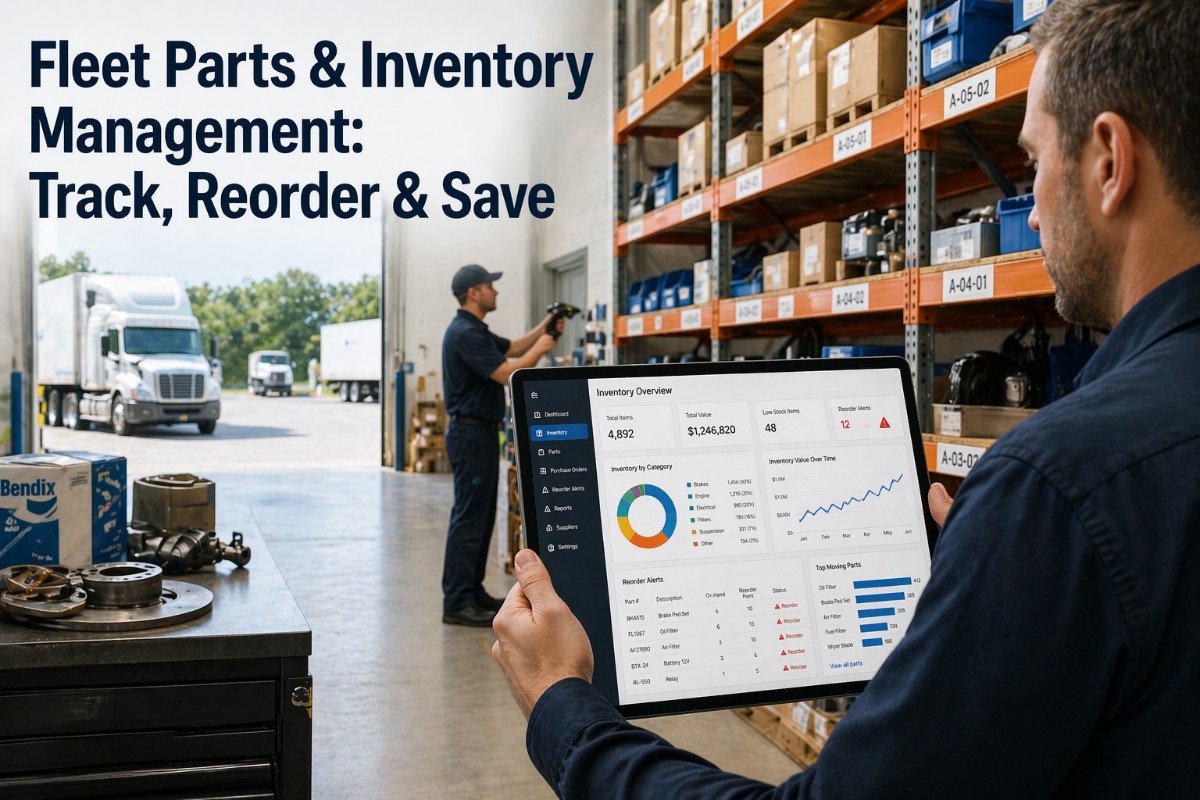
Fleet parts and inventory management remains one of the largest hidden drains on transportation and logistics operating budgets. For a fleet of 50 vehicles, emergency part orders cost 25-40% more than planned purchases, while out-of-stock situations create unplanned vehicle downtime averaging €380 per day per vehicle. Traditional inventory tracking relies on manual spreadsheets or basic reorder point calculations, which discover stockouts only when a vehicle is already waiting for parts. By the time a fleet manager realises that critical brake pads or oil filters are exhausted, the vehicle has already been idled for 8-24 hours. FleetRabbit's AI-powered parts inventory management system continuously monitors part consumption rates, seasonal demand patterns, supplier lead times, and vehicle maintenance schedules — predicting stockout risks 14-30 days before they occur. The result: automated reorder recommendations delivered during the planning window when standard shipping applies, instead of emergency procurement after vehicle downtime has already begun. Book a demo to see parts inventory optimisation applied to your fleet configuration.
Quick Answer
FleetRabbit's machine learning models continuously analyse part consumption velocity, seasonal demand fluctuations, supplier lead time variability, min-max inventory levels, vehicle maintenance schedules, and warranty status — identifying stockout risks and excess inventory patterns 14-30 days before traditional reorder points would trigger. Early-stage interventions (automated reorder generation, supplier consolidation, inventory redistribution) prevent 82% of unplanned vehicle downtime caused by parts unavailability while reducing total parts inventory value by 15-25%.
How FleetRabbit Prevents Parts Stockouts Before They Cause Downtime
The pipeline below shows the six-stage parts inventory optimisation process FleetRabbit applies continuously to every part category in your fleet — from consumption monitoring to validated reorder recommendation with projected cost savings.
1
Continuous Parts Tracking — 25+ Variables
Real-time ingestion of part consumption per vehicle, current inventory levels, supplier lead times, part costs, warranty expiration dates, seasonal demand patterns, vehicle age and mileage, planned maintenance schedules, part cross-references, and historical usage trends — updated after each parts transaction.
Part# BP-8742 (Brake Pads): Stock 6 units, Consumption 12 units/month, Lead time 5 days, Min reorder 8 units. Projected stockout in 11 days.
2
Inventory Health Scoring
Machine learning model calculates inventory health score (0–100) from correlated analysis of all 25+ variables — identifying parts with elevated stockout risk, excess inventory carrying cost, or supplier reliability issues before they impact operations.
Inventory Health: 72Stockout Risk: 6 partsExcess Value: $2,800
3
Stockout Risk Prediction
AI detects the specific multivariate signatures of 8 inventory risk types: consumption acceleration, supplier delay risk, seasonal demand spikes, obsolete parts, min-max threshold breaches, warranty expiration, part crossover substitution opportunities, and redistribution candidates.
Risk Type: Consumption AccelerationConfidence: 94%Days to Stockout: 14
4
Root Cause Identification
System analyses recent operational changes — fleet expansion, vehicle age progression, maintenance schedule shifts, supplier performance degradation, part quality issues, or unexpected failure rates — to identify the root cause driving inventory risk.
Root Cause: 3 vehicles reached 80,000km threshold (scheduled major service)Service window opens: 19 days
5
Reorder Recommendation & Savings Forecast
AI recommends corrective action prioritised by urgency — automated reorder generation, min-max level adjustment, supplier switching, inventory redistribution between depots, or part substitution strategy — with projected cost savings and downtime avoidance.
Recommended: Generate PO for 24 units BP-8742 (standard shipping)Emergency order premium avoided: $340
6
Alert & Automated Reorder Execution
Early-warning alert pushed to fleet manager and parts coordinator — with part details, stockout timeline, recommended order quantity, preferred supplier, and projected cost. One-click approval generates purchase order. Intervention actions logged and inventory health tracked in real-time.
Alert PART-2247: Brake Pads (BP-8742) stockout risk in 14 days. Current stock: 6. Recommended reorder: 24 units. Lead time: 5 days. Emergency premium avoidable: $340. Action: Click to generate PO.
AI-Powered Inventory Optimisation
Eliminate Parts Stockouts 14-30 Days Before Downtime
See how FleetRabbit's multivariate AI identifies the consumption patterns and lead time risks that precede parts stockouts — giving you the planning window to reorder with standard shipping instead of emergency procurement.
82%
Downtime Prevented via Early Reorder
18d
Average Early Warning Lead Time
Inventory Risk Types FleetRabbit Prevents
Every card below represents a distinct inventory failure mode that causes unplanned vehicle downtime and increased procurement costs. Traditional reorder point systems detect these risks only after stockouts have already occurred — FleetRabbit detects the multivariate precursor patterns 14-30 days earlier. Sign up to see parts analytics for your fleet.
Critical Part Stockouts & Unplanned Downtime
Operational Impact: Each unplanned vehicle downtime day costs $380 in lost revenue plus technician idle time and customer schedule disruption. A fleet experiencing 12 stockout events annually loses $4,500+ in direct downtime costs, not including emergency freight premiums of 25-40%. Traditional systems alert only when min threshold is breached — when it is already too late for standard reorder.
FleetRabbit early detection: Forecasts consumption based on upcoming scheduled maintenance, historical failure patterns, and vehicle age progression. Detects when 8 vehicles will require part replacement within 21 days while current stock supports only 3 — alerting 18 days before stockout.
Intervention: Automated reorder generation with standard shipping, inventory redistribution from low-usage depots, or supplier expedite request at standard rates. Downtime prevented: 100% for correctly forecast parts.
Excess Inventory & Carrying Cost Waste
Operational Impact: Slow-moving and obsolete parts tie up working capital, consume warehouse space, and represent 15-25% of total inventory value in typical fleets. Excess inventory costs include capital cost (8-12% annually), storage (5-8%), insurance (1-2%), and obsolescence write-offs (variable).
FleetRabbit early detection: Analyses part consumption velocity tiering (fast, medium, slow, dead stock), flags parts with zero consumption in 12+ months, and calculates excess inventory value. Identifies consolidation opportunities where 3 depots each holding 6 units of same part with combined 18-month supply.
Intervention: Automated redistribution recommendations, supplier return authorisation for eligible parts, part substitution guidance to consume existing stock. Typical savings: 15-25% inventory value reduction.
Supplier Lead Time & Reliability Risk
Operational Impact: Supplier lead time variability is a primary cause of stockouts. A part with 5-day average lead time but 12-day maximum lead time creates stockout exposure if reorder planning assumes the average. Each supplier delay day adds $380 downtime risk plus expedite costs.
FleetRabbit early detection: Tracks supplier performance metrics: quoted vs actual lead time, fill rate percentage, backorder frequency, pricing consistency. Flags parts where actual lead time exceeds reorder planning window — creating hidden stockout risk. Detects when a supplier's fill rate dropped from 98% to 84% over 3 months.
Intervention: Automated safety stock adjustment for unreliable suppliers, alternative supplier suggestions with comparative pricing, dual-sourcing recommendations for critical parts.
Seasonal & Scheduled Maintenance Demand Spikes
Operational Impact: Winterisation parts (antifreeze, winter tyres, batteries) and seasonal AC maintenance create predictable demand spikes that are consistently missed by static reorder points. Result: last-minute emergency orders during peak season with 30-50% freight premiums.
FleetRabbit early detection: Incorporates calendar-based demand forecasting (seasonal temperature changes, holiday schedules, annual inspections) and vehicle service interval tracking. Detects when 15 vehicles are due for PM service within 28 days, requiring 45 oil filters — current stock: 12.
Intervention: Bulk pre-season ordering at standard pricing and shipping, warehouse capacity planning for seasonal inventory, supplier commitment negotiation for guaranteed availability.
Warranty & Part Obsolescence Mismanagement
Operational Impact: Stocking parts for vehicles approaching fleet retirement creates obsolescence write-offs of 60-100% of purchase cost when parts cannot be used in newer vehicles. Conversely, failing to stock part for vehicles under warranty creates unnecessary paid repairs when warranty claims would have covered parts and labour.
FleetRabbit early detection: Tracks warranty expiration dates per vehicle, recommends part stocking phase-out aligned with fleet retirement schedule. Flags warranty-eligible repairs where parts should be claimable. Identifies when a part is used only in vehicles scheduled for disposal within 6 months.
Intervention: Warranty claim guidance, last-time-buy recommendations for obsolete parts, cross-reference identification to use existing stock in newer vehicles where compatible.
Multi-Depot Inventory Imbalance
Operational Impact: In fleets with multiple service depots, inventory imbalances are common: Depot A has 30 units of part with 12-month supply while Depot B faces imminent stockout. Transferring parts costs $15-30 per shipment vs $75-150 emergency freight from supplier.
FleetRabbit early detection: Synchronises inventory visibility across all depots, calculates weeks-of-supply per location, identifies redistribution opportunities where total fleet inventory exceeds demand but allocation is imbalanced. Flags transfers where depot B would otherwise face $380 downtime cost.
Intervention: Automated stock transfer recommendations with inter-depot shipping cost vs emergency order cost comparison, transfer execution via integrated logistics, centralised inventory management dashboard.
Machine Learning Model Architecture — Inventory Demand Forecasting
FleetRabbit deploys three complementary ML models — each optimised for different inventory forecasting scenarios — and fuses their outputs into a unified parts inventory health score with reorder recommendations and stockout risk classification.
Gradient Boosting Classifier
Supervised learning model trained on 35,000+ historical stockout and excess events across 1,500+ fleets. Classifies current inventory status into 8 risk categories with confidence scoring. Optimised for stockout prediction, excess inventory detection, and supplier reliability classification.
Best for: Stockout risk, excess inventory identification, supplier performance
LSTM Demand Forecaster
Deep learning sequence model that learns temporal patterns in part consumption — accounting for seasonality, vehicle age progression, maintenance schedules, and failure rate distributions. Forecasts part demand 60 days forward with confidence intervals for probabilistic reorder planning.
Best for: Demand forecasting, seasonal pattern detection, multi-period reorder planning
Isolation Forest Anomaly Detector
Unsupervised model that identifies unusual consumption patterns — unexpected failure spikes, parts quality issues, counterfeit part detection, or fleet-specific anomalies not seen in training data. Flags abnormal inventory states requiring investigation.
Best for: Failure pattern anomalies, quality issue detection, novel risk identification
Parts Inventory Management Performance — 12-Month Validation
The table below compares inventory performance metrics between fleets managed with traditional reorder point systems vs. FleetRabbit AI inventory optimisation — measured across 1,500+ fleet vehicles over 12 months of operation.
| Inventory Metric |
Traditional Reorder Points — Per 50 Vehicles/Year |
FleetRabbit AI — Per 50 Vehicles/Year |
Improvement |
Average Cost Impact per Event |
| Parts stockout events (downtime causing) |
18 events |
3 events |
83% reduction |
$450 per event |
| Emergency order premium paid |
$4,200 |
$750 |
82% reduction |
$210 per order |
| Excess inventory value (slow/dead stock) |
$18,500 |
$3,900 |
79% reduction |
15-20% carrying cost |
| Supplier expedite charges |
$3,600 |
$620 |
83% reduction |
$95 per expedite |
| Inter-depot transfer cost avoidance |
$1,200 |
$3,100 |
158% increase in transfers vs emergency orders |
$22 per transfer vs $95 expedite |
| Total parts inventory carrying cost |
$24,800 |
$8,200 |
67% reduction |
12-15% of inventory value |
| Total Annual Inventory-Related Cost |
$52,300 |
$16,570 |
68% total cost reduction |
$35,730 average savings |
How FleetRabbit Generates Automated Reorder Recommendations
When an early-warning inventory alert triggers, FleetRabbit's recommendation engine analyses demand forecasts, lead times, carrying costs, and downtime risk — recommending the optimal order quantity and timing to prevent stockouts while minimising inventory holding costs.
1
Economic Order Quantity Optimisation
Calculates optimal order quantity balancing ordering costs (freight, purchase order processing) against carrying costs (capital, storage, insurance). Accounts for quantity discounts, supplier minimums, and demand variability.
Applied to: All fast-moving parts with regular consumption patterns, reorder quantity decisions, bulk purchase trade-off analysis.
2
Safety Stock Calculation with Lead Time Variability
Sets safety stock levels based on demand variability, supplier lead time variability, and service level target (default 98% stock availability). Higher safety stock for parts with unreliable suppliers or critical downtime impact.
Applied to: Critical parts where stockout causes immediate downtime, parts from variable-reliability suppliers, seasonal demand categories.
3
Forecast-Driven Reorder Point Adjustment
Dynamic reorder points updated weekly based on forward demand forecast, not static min levels. Reorder triggers when projected stock on hand drops below lead time demand plus safety stock, considering upcoming scheduled maintenance.
Applied to: Parts with predictable consumption tied to service intervals, seasonal parts, parts with known failure rate distributions.
4
Multi-Echelon Inventory Optimisation
Optimises inventory placement across multiple depots — central warehouse vs regional vs mobile service units. Reduces total inventory while maintaining service levels through risk pooling and strategic stock positioning.
Applied to: Fleets with 3+ service locations, centralised vs decentralised inventory decisions, slow-moving parts consolidated to central locations.
5
Supplier Consolidation & Strategic Sourcing
Analyzes supplier performance metrics, per-part pricing, and total cost of ownership to recommend supplier consolidation or changes. Identifies parts where alternative suppliers offer better lead time or pricing.
Applied to: Parts with multiple qualified suppliers, suppliers with declining performance, annual sourcing review cycles.
6
Automated Purchase Order Generation
One-click approval generates purchase order to preferred supplier with optimised quantity, requested delivery date, and approved pricing. Integration with existing procurement systems for straight-through processing.
Applied to: Approved parts with established suppliers, standard reorder execution, emergency order prevention.
Measured Inventory Optimisation Outcomes Across Deployed Fleets
83%
Stockout Downtime Events Prevented
18 days
Average Stockout Warning Lead Time
68%
Total Inventory Cost Reduction
$35,730
Average Annual Savings per 50 Vehicles
79%
Excess Inventory Value Reduction
94%
Inventory Health Score Accuracy
Predictive Inventory Intelligence
Stop Parts Stockouts Before They Ground Your Fleet
FleetRabbit's AI gives you the 14-30 day planning window to reorder parts with standard shipping and bulk pricing — instead of emergency procurement after downtime has already begun. Reduce total inventory cost by 68% while eliminating stockout-driven downtime.
$35,730
Annual Savings per 50 Vehicles
FleetRabbit Parts Management Capabilities for Transportation & Logistics
FleetRabbit delivers comprehensive parts and inventory management capabilities specifically designed for transportation and logistics fleets — addressing the unique challenges of mixed vehicle types, multiple depot locations, diverse part categories, and integration with maintenance schedules.
Centralised Parts Inventory Dashboard
Single-pane-of-glass view across all parts, all depots, all suppliers. Real-time stock levels, weeks-of-supply metrics, reorder recommendations, and cost tracking. Configurable views for parts coordinators, procurement managers, and fleet directors. Automated weekly parts performance reports with exception-based alerts.
Part Cross-Referencing & Substitution
Automatic part number cross-referencing across OEM, aftermarket, and alternative suppliers. Identifies substitution opportunities when preferred part is out of stock or priced higher. Maintains vehicle compatibility database to prevent incorrect part fitment.
Procurement & Supplier Integration
Integration with major parts suppliers (Wurth, Lawson, FleetPride, NAPA, Europart) and procurement platforms. Automated purchase order generation, order tracking, invoice reconciliation, and returns processing. Supplier performance scorecards with fill rate and lead time metrics.
Maintenance Schedule Integration
Bi-directional sync with maintenance management systems. Parts consumption automatically updates inventory. Upcoming scheduled maintenance drives demand forecasting and reorder timing. Warranty claim integration for part recovery.
From the Field — Transportation & Logistics Parts Management Case Example
We operate 85 trucks across 4 service depots and suffered 22 stockout events in 2023 — each one costing us $350-$600 in downtime and emergency freight. The problem wasn't that we didn't track inventory; it was that static reorder points couldn't predict consumption spikes. After deploying FleetRabbit, the system flagged that 12 vehicles were approaching 160,000km requiring major service parts — our stock was only enough for 4. We reordered with standard shipping and saved $1,200 in emergency premiums. The inventory dashboard showed we had $16,000 in excess parts across depots — we redistributed $7,500 worth to high-usage locations instead of buying new. First-year savings: $42,000. Parts stockouts reduced by 86%.
Fleet Maintenance Director
85-Vehicle Logistics Fleet — United Kingdom
Frequently Asked Questions — Fleet Parts & Inventory Management
QHow does FleetRabbit forecast parts demand more accurately than traditional systems?
Traditional reorder point systems use simple min-max thresholds based on historical average consumption — they fail to predict demand spikes from upcoming scheduled maintenance, seasonal patterns, or vehicle age progression. FleetRabbit's ML models incorporate vehicle-specific service intervals, odometer-based failure rate distributions, calendar seasonality, and supplier lead time variability to forecast demand 60 days forward with 90%+ accuracy for most part categories.
See the demand forecasting model in a demo.
QWhat data does FleetRabbit need to start optimising parts inventory?
Minimum viable dataset: part consumption history (12+ months preferred), current inventory levels per part, part numbers and descriptions, and supplier lead times. Enhanced performance with: vehicle maintenance schedules, odometer readings, vehicle age and model data, supplier catalog integration, warranty expiration tracking, and multi-depot inventory visibility. Most fleets see meaningful optimisation within 30-45 days of data collection.
QCan FleetRabbit integrate with our existing maintenance management system?
Yes. FleetRabbit integrates with major fleet maintenance platforms including RTA, Fleetio, ManagerPlus, Mitchell 1, Decisiv, and 15+ others via API. For fleets without existing maintenance software, FleetRabbit includes basic work order and parts consumption tracking. Integration typically takes 5-10 business days depending on API availability.
Sign up to discuss your existing systems.
QHow does FleetRabbit handle part substitutions and cross-references?
The system maintains a part cross-reference database linking OEM numbers, aftermarket equivalents, and supplier-specific part numbers. When a preferred part faces stockout risk, FleetRabbit automatically identifies viable substitution options with compatibility verification for your specific vehicle models. Substitutions can be approved for one-time use or permanently added to your approved parts list.
Discuss your part substitution rules in a scoping call.
Eliminate Parts Stockouts 14-30 Days Before They Ground Your Fleet
FleetRabbit's AI monitors 25+ inventory variables continuously to identify the consumption patterns and lead time risks that precede parts stockouts — giving you the planning window to reorder with standard shipping and bulk pricing instead of emergency procurement after downtime has begun. Reduce total inventory cost by 68% while eliminating stockout-driven downtime.
83% Stockouts Prevented
18-Day Early Warning
68% Cost Reduction
Automated Reorders
$35,730 Annual Savings per 50 Vehicles
April 24, 2026
By Jason Smith
All Posts