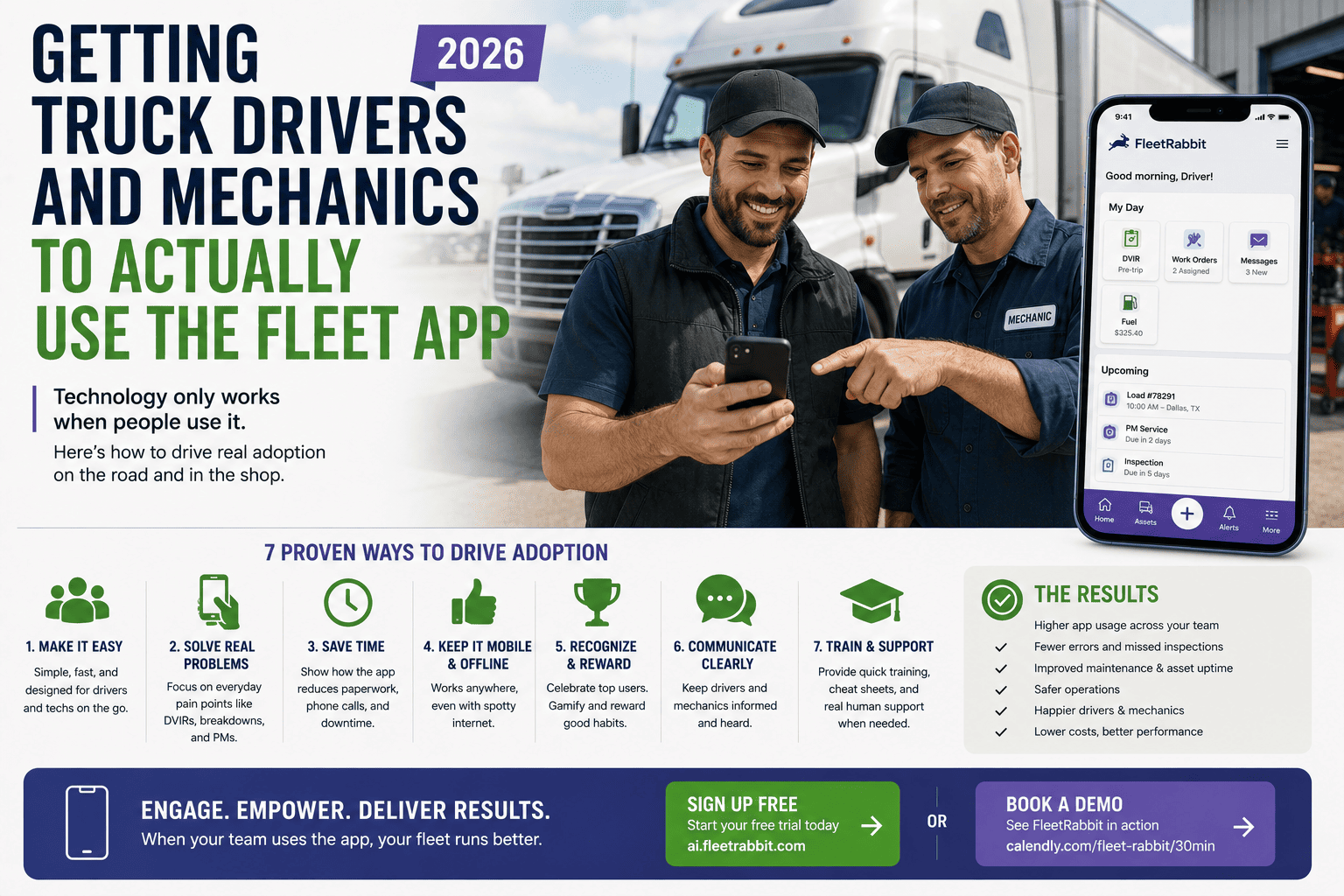
Buying fleet software is the easy decision. Getting a driver to actually tap through a digital inspection instead of scribbling on a paper form, or getting a mechanic to update a work order from a phone instead of a clipboard, is the part that determines whether the investment pays off at all. Industry data shows roughly 40 percent of fleet mobile app deployments struggle with adoption rates below 60 percent, which means the technology exists but nobody in the field is actually using it. The fix has almost nothing to do with more features and everything to do with how the app respects the way drivers and mechanics actually work. Sign up for FleetRabbit to see a driver and mechanic app built around real adoption, not just a feature checklist.
About 40 percent of fleet app rollouts see adoption stay below 60 percent, effectively wasting the software spend. Fleets that design around simple, tap-based workflows and offline access see 83 percent of drivers complete their first inspection the same day it is introduced, with 91 percent using the app consistently within a week.
Why Drivers And Mechanics Actually Avoid The App
Low adoption rarely comes from drivers or mechanics being resistant to technology in general. It comes from specific, fixable friction points baked into how the app was designed.
What Actually Gets Drivers And Mechanics Using The App
The fleets that succeed with adoption tend to fix the same handful of things, in roughly the same order, regardless of fleet size or vehicle type.
Tap-Through Workflows Instead Of Data Entry
Guided checklists, condition toggles, and two-tap defect reporting let a driver complete a full pre-trip inspection in under four minutes with almost no typing. Photo capture with automatic GPS and timestamp removes the need to describe anything in words at all.
Offline-First, Not Just Mobile-Friendly
The app needs to complete full inspections and work order updates with zero signal, then sync automatically the moment connectivity returns. Anything less pushes people back to paper the first time they hit a dead zone.
A Defect That Becomes A Work Order In Under A Minute
When a driver flags a defect and it reaches the mechanic's phone, with photo and severity attached, in under 60 seconds, the app proves its value immediately. That closed loop is often the single biggest driver of continued use on both sides.
Test It On A Small Group First
Hand the app to two or three drivers and one or two mechanics for a week before a full rollout, with minimal training. If it takes more than 30 minutes to figure out unassisted, the wider fleet will struggle the same way.
| Role | What They Need From The App | What Kills Adoption |
|---|---|---|
| Drivers | Fast tap-through DVIRs, photo capture, offline completion, clear proof their report reached someone | Long forms, no signal support, defects that vanish with no follow-up |
| Mechanics | Work orders that arrive instantly with defect photos and severity, mobile status updates, parts visibility | Manually re-entering driver reports, no photo context, desktop-only work order updates |
| Fleet Managers | Real completion-rate visibility, defect-to-repair time tracking, compliance-ready records | Low-quality data from pencil-whipped paper forms and inconsistent app use |
FleetRabbit's mobile app is tap-through, works fully offline, and turns a flagged defect into a mechanic's work order in under 60 seconds, so both sides see the payoff immediately instead of extra digital paperwork.
Rolling Out The App Without Triggering Resistance
How the app gets introduced matters almost as much as how it is built. A top-down mandate with no context is one of the most reliable ways to trigger quiet non-compliance.
Lead With What It Fixes For Them, Not For Management
Framing the app around less paperwork, faster repairs, and protection from false liability claims gets far more genuine engagement than framing it as a monitoring requirement. Drivers who see the app protect their record in a dispute often become its strongest advocates.
Pilot Small, Then Expand With Real Feedback
Run the app with a small group for one to two weeks, gather direct feedback on friction points, and fix what surfaces before the full fleet rollout. This single step prevents the most common adoption failures from ever reaching the wider team.
Book a demo through FleetRabbit's scheduling page to see how a pilot rollout is structured for a fleet your size.
What Low Adoption Is Actually Costing You
Fleets running desktop-only or low-adoption apps see 30 to 50 percent lower data completion rates simply because drivers and mechanics are rarely at a desk when the events they need to log actually happen. Every skipped inspection or delayed defect report adds directly to the gap between a paper trail and what your equipment is actually doing on the road, and that gap is exactly where compliance exposure and preventable repair costs accumulate unnoticed.
Key Takeaways On Fleet App Adoption
The gap between a fleet app that pays for itself and one that becomes expensive shelfware is almost never about missing features. It is about whether a driver can complete an inspection in under four minutes without typing, whether the app still works with zero signal, and whether a flagged defect visibly turns into action within a minute instead of disappearing into a queue nobody checks.
Fleets that design and roll out the app around these realities see 83 percent of drivers using it the same day it is introduced and 91 percent still using it consistently a week later. The technology decision is easy. Getting the people who actually touch the app every day to trust it is what determines whether the investment was worth making at all.
FleetRabbit is built tap-first, works fully offline, and turns every flagged defect into a mechanic's work order in under a minute. See why drivers and mechanics adopt it on day one instead of falling back to paper.