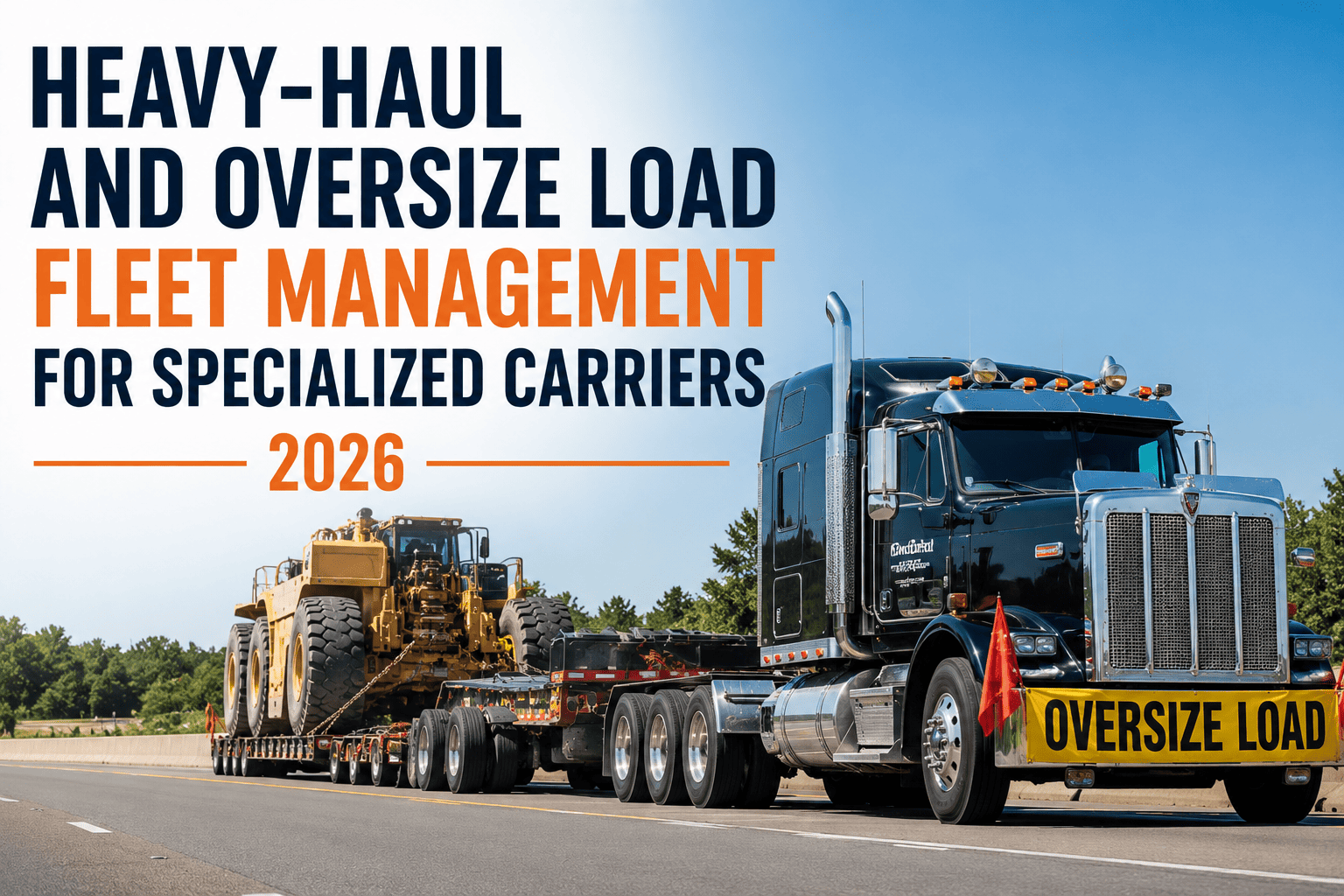
Moving a wind turbine blade, a 200-ton transformer, or a modular home down the interstate is nothing like dispatching a standard dry van. One wrong permit, one missing escort vehicle, or one uninspected hydraulic axle can shut down a heavy haul job before it ever leaves the yard. Specialized carriers juggle multi-state permits, pilot car scheduling, bridge clearances, and steerable trailer maintenance all at once, and a single mistake in any of those areas can trigger fines, delayed deliveries, or a load stuck on the shoulder waiting for a police escort that was never booked. In 2026, the fleets pulling ahead are the ones that stopped managing oversize loads on spreadsheets and started managing them with purpose-built systems.
Heavy haul and oversize load fleet management means coordinating permits, escort vehicles, route surveys, and specialized maintenance across every state a load crosses. Escort vehicles are typically required once a load exceeds 12 feet wide, 14.5 feet high, or roughly 90 to 100 feet long, and rules change from state to state. Carriers using dedicated fleet management software cut permit errors, missed escort bookings, and route violations significantly while keeping superloads moving on schedule.
Permit Management: The Biggest Bottleneck for Specialized Carriers
Permit management sits at the center of every heavy haul job. Before a single mile is driven, dispatchers must secure the correct oversize or overweight permit for every state on the route, matched precisely to the load's dimensions, axle configuration, and total weight. A load that is legal in one state can require an entirely different permit class two hours down the interstate. Fleets still tracking this manually through email chains and paper folders routinely discover a mismatched permit only after a trooper flags it at a weigh station, and by then the load is already sitting still and racking up cost.
State-by-State Permit Variations
Width, height, length, and weight thresholds vary by state, and so do travel-window restrictions, which often limit oversize movement to daylight hours or block travel entirely on weekends and holidays. Some states also require advance notice of 24 to 72 hours before a permit is issued, which means last-minute route changes can derail an entire schedule. This is exactly why signing up for FleetRabbit gives dispatchers a single view of every permit status, expiration date, and state-specific requirement instead of hunting through separate portals for each jurisdiction.
| Load Dimension Trigger | Typical Requirement | Why It Matters |
|---|---|---|
| Width over 12 feet | One or two pilot cars depending on state | Two-lane roads often require a lead and a chase car once width passes this mark |
| Height over 14.5 feet | Lead escort with a height pole | Pole vehicles verify bridge and overpass clearance before the load arrives |
| Length over 90 to 100 feet | Rear escort, sometimes front and rear | Longer loads need more room to turn and more warning distance for traffic |
| Width over 16 to 18 feet | Police escort in many states | Superloads at this width often require law enforcement coordination and lane closures |
| Weight over 200,000 lbs | Police escort and bridge analysis | Structural engineers may need to certify bridges before the load can cross |
FleetRabbit centralizes permit tracking, expiration alerts, and route-specific requirements so dispatchers never send a load out with the wrong paperwork. Book a demo and see how a single screen replaces a dozen state portals.
Escort Vehicle Coordination Without the Guesswork
Pilot cars are the eyes and ears of a heavy haul convoy. They check bridge heights, hold traffic at narrow points, and warn other drivers well before the oversize load arrives. Getting escort coordination wrong does not just risk a fine, it risks the load itself if a bridge or overpass clearance was never verified.
When Pilot Cars Are Required
Most states require at least one escort once a load passes roughly 12 feet in width, 14.5 feet in height, or 90 to 100 feet in length. Wider or heavier loads often call for both a lead and a chase vehicle, and every escort vehicle needs its own certification, insurance, and equipment: rotating amber lights, oversize load signage, and communication radios that keep the escort and driver connected at all times.
Police Escorts for Superloads
Once a load crosses into superload territory, generally above 16 to 18 feet wide or 200,000 pounds, many states require a police escort in addition to certified pilot cars. Coordinating a police escort means submitting requests well in advance and confirming the exact travel window, since law enforcement resources are limited and schedules can shift with little notice.
Convoy Rules for Multiple Loads
Some states allow multiple oversize loads to travel together in a convoy and share escort vehicles, but only within strict spacing rules, often requiring loads to stay within 1,000 to 2,000 feet of one another. Getting this spacing wrong turns a compliant convoy into a violation in a matter of seconds.
Route Planning and Compliance in Real Time
A route that looks fine on a standard GPS app can hide a low bridge, a weight-restricted county road, or a construction zone that closes the only lane wide enough for the load. Heavy haul routing has to account for truck-legal paths, verified clearances, and permit-approved corridors, not the shortest distance between two points.
FleetRabbit connects permit data, route surveys, and live GPS tracking so every superload travels on a path that's actually cleared for it. Book a demo and walk through your own routes with our team.
Maintenance Built for Heavy Haul Equipment
Heavy haul trailers are not standard flatbeds. Multi-axle lowboys, steerable dollies, and hydraulic suspension systems carry loads that can weigh hundreds of thousands of pounds, and every one of those systems needs inspection routines that go beyond a typical DOT checklist.
Steerable Axles and Hydraulic Systems
Steerable axles let a long trailer navigate tight turns without dragging tires or overstressing the frame, but the hydraulic steering system needs regular fluid checks and seal inspections. A leak that goes unnoticed on a standard trailer is an inconvenience. On a hydraulic multi-axle trailer under a 150-ton load, it can mean an axle that stops steering mid-route.
Axle Weight Distribution
Getting weight evenly distributed across every axle keeps a heavy haul rig within legal limits and prevents uneven tire wear that leads to blowouts under extreme load. Digital weight tracking tied to maintenance records helps crews spot an axle carrying more than its share before it becomes a road failure.
Metrics That Matter for Specialized Carriers
Standard trucking KPIs like cost per mile only tell part of the story for heavy haul operations. Permit lead time, escort booking accuracy, and route survey completion rate reveal whether a fleet's oversize operation is running smoothly or constantly firefighting.
Heavy haul and oversize load operations do not forgive small mistakes. A permit filed for the wrong state, an escort vehicle booked a day late, or a bridge clearance that was never verified can turn a routine move into a costly delay. The carriers thriving in 2026 are the ones replacing scattered spreadsheets and phone calls with a connected system that tracks permits, escorts, routes, and specialized maintenance in one place, giving dispatchers the confidence to move superloads without the guesswork.
FleetRabbit brings permit tracking, escort coordination, route verification, and specialized maintenance scheduling into one platform built for heavy haul carriers. See it in action before your next oversize job hits the road.