Nobody gets a warning call before an FMCSA auditor knocks. You get a letter, a portal notification, or a knock on the terminal door, and then a very short window to prove your fleet has been doing everything right all along. The carriers that walk out of that audit clean aren't the ones scrambling through filing cabinets. They're the ones whose driver files, inspection reports, and maintenance logs were already connected, current, and one click away.
Only 7 percent of motor carriers pass an FMCSA audit without a single violation, and most failures trace back to missing documents rather than unsafe operations. Connected, digital records eliminate the retrieval gap that causes the majority of findings. You can sign up for a free trial and see how an audit-ready record system looks before an auditor ever asks for one.
Why So Many Fleets Fail Audits They Didn't Have To
FMCSA conducted more than 8,340 investigations through mid-2025 alone, generating over 62,000 violations across 865 different codes. The pattern behind those numbers is consistent: auditors aren't usually catching unsafe carriers. They're catching disorganized ones. A missing medical certificate, an MVR that was never reviewed, or a DVIR defect with no repair record on file all count as violations, even when the underlying safety practice was fine.
What Actually Triggers An FMCSA Audit
Audits aren't random for most carriers. They're the result of specific signals in your safety data. Knowing what raises your profile helps you prioritize where connected records matter most.
Poor CSA Safety Measurement Scores
Carriers scoring above intervention thresholds in any BASIC category are the most common audit trigger. The CSA scoring overhaul now splits Vehicle Maintenance into two separate categories, meaning even a modest run of DVIR gaps can push a fleet over the line faster than in prior years.
New Entrant Status
Every new motor carrier automatically receives a safety audit within 12 to 18 months of activating a USDOT number. This one is not optional and not random, so new fleets should treat their first year as a standing audit countdown from day one.
Crash History And Complaints
High-profile accidents, elevated crash rates, and citizen complaints all move a carrier up the audit queue. FMCSA increasingly runs focused audits that target the specific compliance area where the data already shows a problem, meaning the auditor often arrives knowing exactly where to look.
The 5 Record Categories Auditors Check First
Not every document carries equal weight during a review. These five categories cover the overwhelming majority of what an auditor requests, and they're the same categories a connected fleet platform should keep current at all times.
| Record Category | What Gets Reviewed | Retention Window |
|---|---|---|
| Driver Qualification Files | Application, MVR, medical certificate, road test, Clearinghouse query, prior employer check | Employment plus 3 years |
| Hours of Service / ELD Logs | Records of duty status, supporting documents, malfunction handling | 6 months minimum |
| DVIRs | Daily pre-trip and post-trip inspections, defect notes, repair certification | 3 months minimum, 12 recommended |
| Vehicle Maintenance Records | PM schedules, repair orders, annual inspection reports, inspector qualifications | 12 months, plus 14 for annual reports |
| Drug & Alcohol Program | Testing policy, pre-employment results, random selection records, Clearinghouse registration | 1 to 5 years depending on record type |
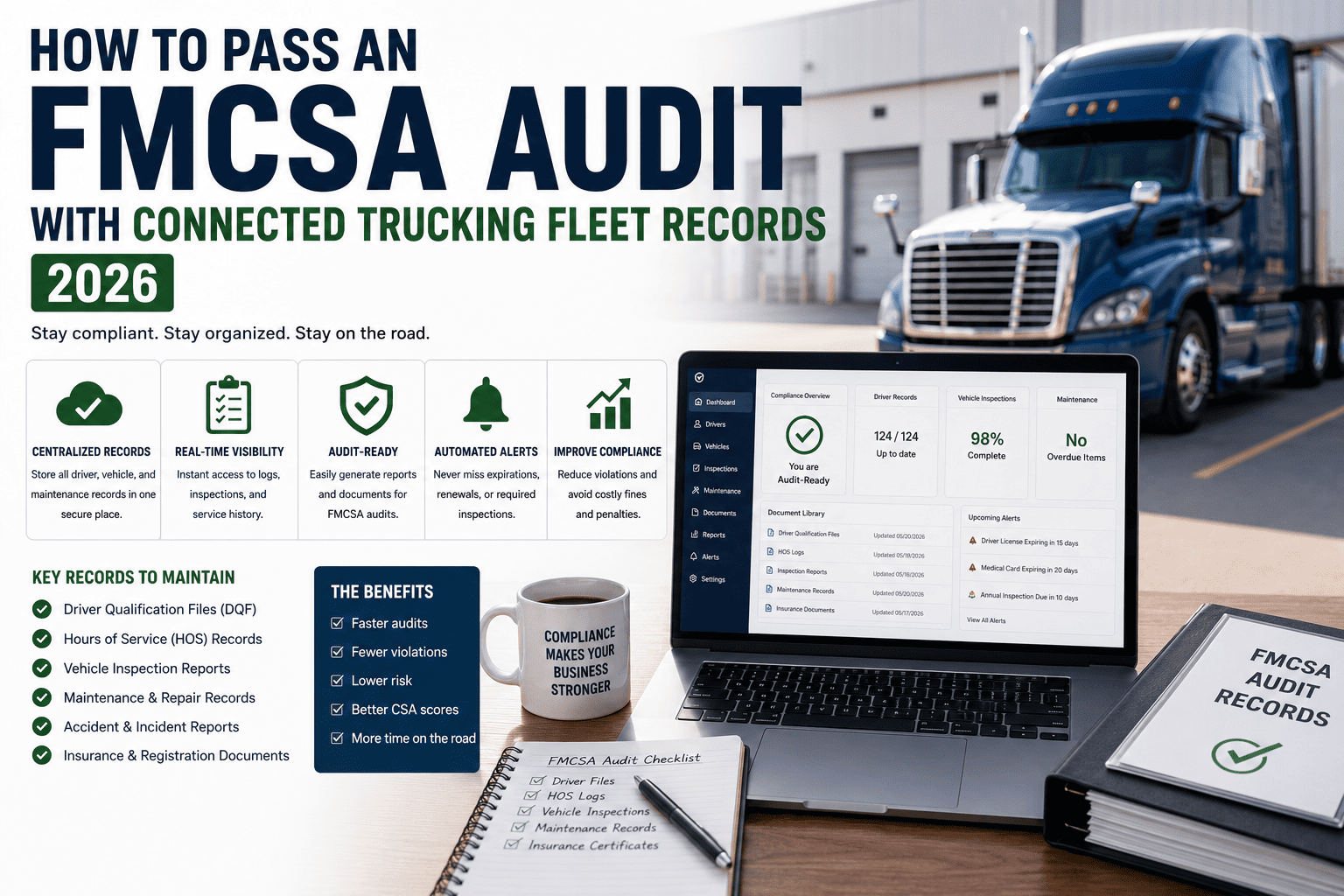
FleetRabbit keeps driver qualification files, DVIRs, HOS logs, and maintenance records connected on one platform, so when an auditor asks for a file, the 48-hour deadline becomes a 48-second task instead of a scramble.
Why Paper Records Keep Losing To The Clock
The math behind the 48-hour production rule was never designed around filing cabinets. Paper-only compliance fails the majority of modern FMCSA audits, not because the underlying safety work is bad, but because the retention windows are long, the document volume is high, and manual retrieval simply can't keep pace with the deadline.
The Retrieval Gap
A driver qualification file alone contains a dozen or more separate documents, each with its own expiration or renewal schedule. Multiply that across every driver, then add DVIRs, maintenance logs, and HOS records for every vehicle, and the total document count for a mid-size fleet easily runs into the thousands. Finding one specific file inside that volume, on paper, inside 48 hours, is where most carriers lose ground.
The Expiration Gap
Medical certificates, MVR reviews, and annual inspections all expire on rolling schedules. Without automated alerts, it's common for a document to lapse quietly for weeks before anyone notices, and that lapsed document becomes an automatic violation the moment an auditor checks the date.
The Signature Chain Gap
DVIRs require a three-part signature chain: the driver's report, the mechanic's repair certification, and the driver's acknowledgment that the defect was fixed before the vehicle went back into service. Missing any one link in that chain is one of the most frequently cited Vehicle Maintenance violations, and it's exactly the kind of gap a connected digital DVIR closes automatically.
Building Your Own Audit-Ready System
You don't need to wait for a notification letter to start closing these gaps. A short internal review now, structured the same way an auditor would review your fleet, is the fastest way to know where you actually stand.
Run A Mock Audit
Pick five random driver files and five random vehicles, then time how long it takes to produce a complete, current file for each. If any single document takes more than a few minutes to locate, that's the exact gap a real auditor will find first.
Centralize Before You Digitize
Moving documents into folders on a shared drive isn't the same as connecting them. A true audit-ready system links a driver's file to their DVIR history and links a vehicle's maintenance record to its inspection certificate, so a single search pulls the full picture instead of a stack of disconnected PDFs.
Automate The Deadlines
Medical certificate renewals, annual MVR reviews, and Clearinghouse queries all run on fixed clocks. Automated alerts sent 90 days ahead of expiration are the single most effective way to keep a file from quietly going out of date between audits.
A short walkthrough with FleetRabbit's team will show you exactly which driver files, DVIRs, and maintenance records need attention right now, before an audit notice ever arrives.
Frequently Asked Questions
The Bottom Line
An FMCSA audit rarely fails a fleet for being unsafe. It fails fleets for being disorganized. Connected records close the retrieval gap, the expiration gap, and the signature-chain gap that account for most violations, and they turn the 48-hour production deadline from a source of dread into a formality.
Every day your driver files, DVIRs, and maintenance records sit disconnected is another day of audit exposure you don't need. Connect your fleet's records now and walk into your next review already prepared.