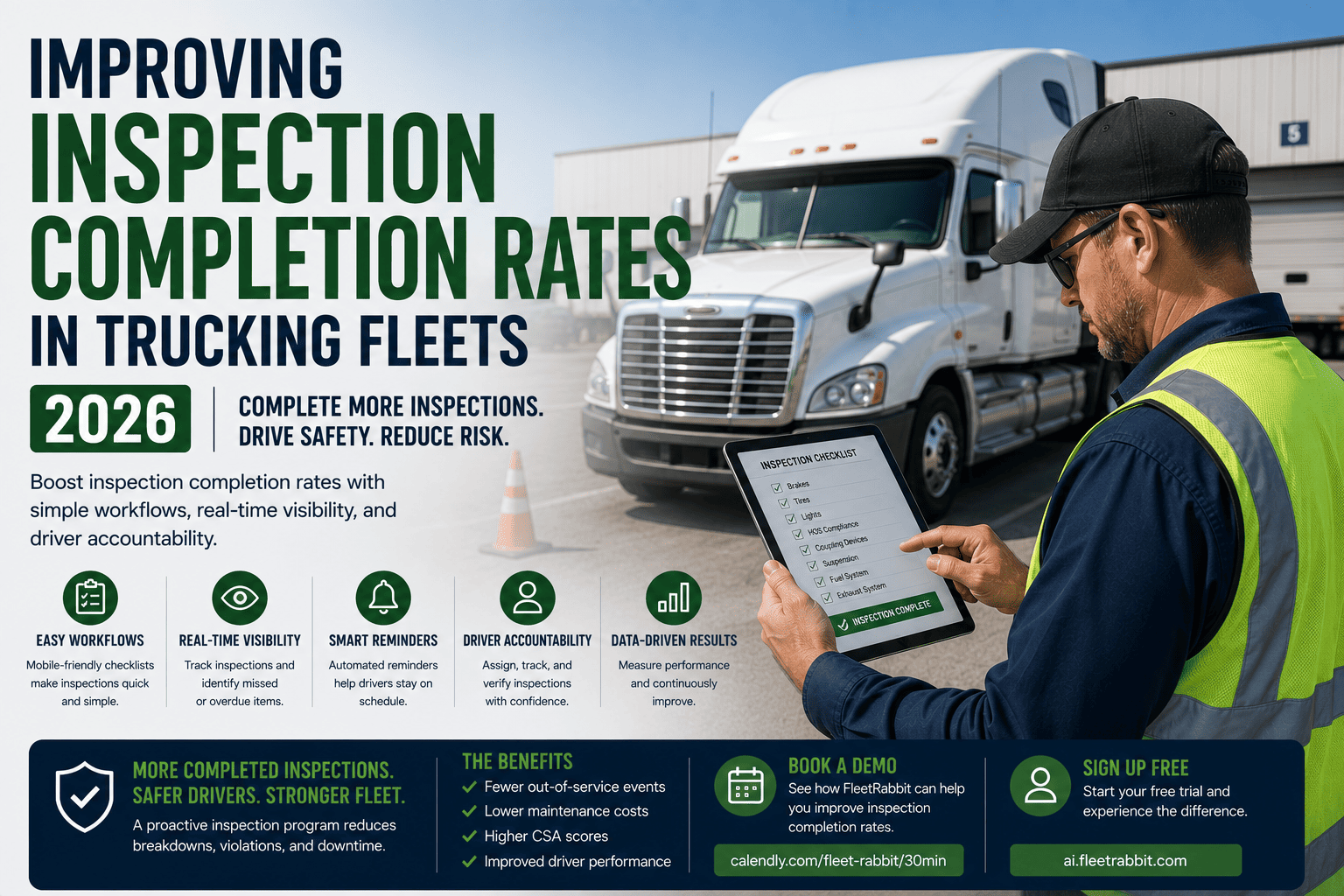
Ask most fleet managers what percentage of required inspections their drivers actually complete, and you will get a guess, not a number. That gap between assumption and reality is the real problem. Federal rules require a documented inspection at the start and end of every operating day, yet paper-based fleets routinely complete only a little over half of what is legally required, and nobody notices until an auditor asks for the records or a defect that should have been caught causes a breakdown on the highway.
Paper-based fleets typically complete only 55 to 65 percent of required driver vehicle inspection reports. Fleets that switch to digital inspections climb to 94 to 98 percent completion within 30 days. Only 7 percent of motor carriers pass a focused compliance review without a single DVIR-related citation, and DVIR failures remain among the most frequently cited violations during FMCSA audits.
The Completion Gap, Side By Side
The difference between a paper-based inspection program and a digital one is not a modest improvement, it is a structural shift in whether inspections happen at all. Seeing the two numbers next to each other explains why so many fleets that "already do inspections" still fail audits.
Why Paper-Based Inspections Fall So Far Short
Low completion rates rarely come from drivers ignoring safety on purpose. They come from a process that is easy to skip and hard to verify. A paper form completed in under three minutes, sometimes pre-signed before a trip even starts, satisfies nobody, yet it is what most fleets are actually running on. The four issues below repeat across almost every low-completion fleet.
Lost Or Illegible Forms
Paper reports get left in cabs, damaged, or filled out with handwriting nobody can read weeks later.
No Time Pressure To Finish
Without a system tracking start and end times, a rushed three-minute walk-around looks identical to a thorough one.
No Manager Visibility
A filing cabinet is not a compliance dashboard, so managers cannot see completion rates until it is too late.
Broken Signature Chain
The next driver signing off on a report they never saw is a common and easily overlooked federal violation.
Metrics Every Fleet Should Be Tracking Weekly
You cannot improve a number you never measure. A short set of core metrics, reviewed weekly rather than discovered during an audit, is what separates fleets with a real inspection program from fleets that only have a policy on paper.
| Metric | Healthy Target | Why It Matters |
|---|---|---|
| DVIR Completion Rate | 97 percent or higher | Below 90 percent signals a structural gap, not an occasional miss |
| On-Time Inspection Rate | Completed within the required window | A late inspection after departure defeats its entire purpose |
| Defect-To-Repair Time | Hours, not days | A logged defect that sits unresolved is a roadside failure waiting to happen |
| Signature Chain Completeness | Every report signed by both drivers | A missing signature is a direct, easily cited federal violation |
| Inspection Quality Score | Consistent detail across every driver | Reveals which drivers rush through checklists versus inspect thoroughly |
FleetRabbit's mobile inspection app guides drivers through every required checklist item, timestamps each step, and routes defects straight to maintenance. You can sign up for a free trial and watch your completion rate climb within the first month.
The Four Stages Of Inspection Maturity
Fleets do not jump from paper chaos to a fully predictive inspection program overnight. Most fleets sit somewhere on a four-stage ladder, and knowing your current stage is the fastest way to know what to fix next.
Reactive And Paper-Based
Inspections happen because regulation requires them. Defects surface when a truck breaks down, not before.
Digitized Checklists
Guided digital inspections with GPS, timestamps, and photo requirements replace paper forms across the fleet.
Coached And Scored
Managers review completion and quality scores regularly and coach drivers based on real inspection data.
Predictive And Integrated
Inspection data feeds maintenance scheduling and CSA tracking, flagging risk before a driver even notices it.
Where Most Fleets Actually Sit Today
A large share of fleets remain stuck at Stage 1 simply because leadership has never asked the right first question: can you state your current DVIR completion rate right now, without pulling a filing cabinet? If the honest answer is no, that alone identifies the starting point.
What Better Completion Actually Buys You
Improving completion rates is not just a compliance checkbox. FMCSA estimates that properly executed inspection reports prevent thousands of accidents annually through early defect detection, and closing the completion gap directly reduces CSA points, audit exposure, and the roadside failures that strand a driver and a shipment at the same time. Fleets that move from Stage 1 to Stage 2 maturity typically see meaningful annual savings once repeat fines, emergency repairs, and audit penalties are factored in.
Starting The Transition
Moving off paper does not require replacing your entire operation overnight. Most fleets can pilot a digital inspection workflow on a portion of their trucks within days. Fleets that book a demo often find the transition takes far less time than expected, since the inspection requirements themselves do not change, only how reliably they get captured.
FleetRabbit's mobile DVIR platform guides every driver through a complete, timestamped inspection and routes defects straight to your maintenance team. Stop guessing your completion rate and start seeing it in real time.