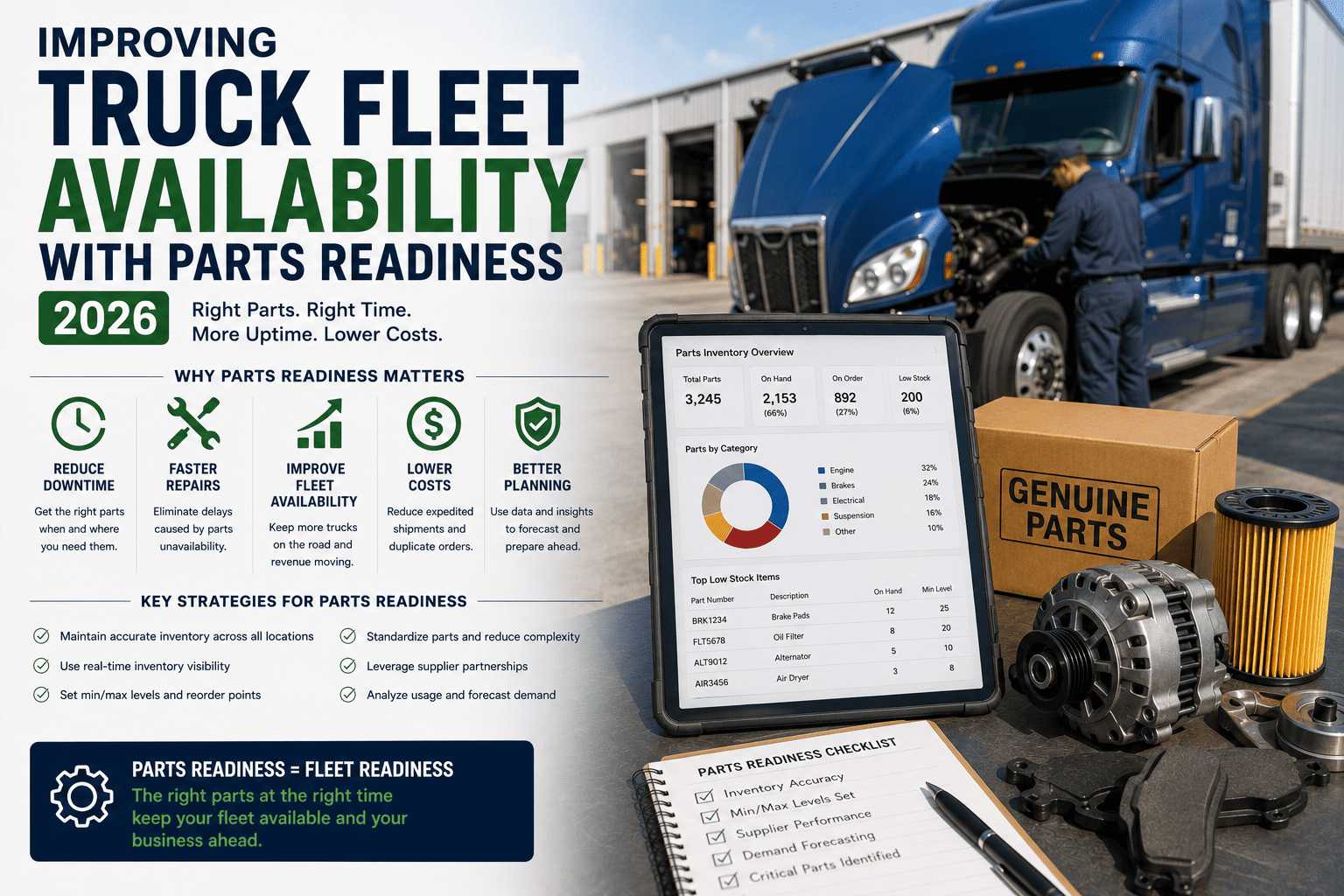
A truck can be perfectly maintained on paper and still sit in the bay for three days because one alternator, one brake chamber, or one filter wasn't on the shelf. Fleet availability isn't only a maintenance problem. It's a parts problem, and most fleets don't realize how much revenue disappears while a technician waits on a delivery truck instead of turning a wrench.
In 2026, fleets that treat spare parts planning as a core part of uptime strategy are pulling ahead of fleets that still order parts after something breaks. This guide walks through why parts readiness drives fleet availability, how to structure your inventory so the right components are always in reach, and what a modern parts-to-uptime workflow looks like in practice.
Fleet availability is directly tied to parts readiness. A missing part can strand a vehicle for days even after the diagnosis takes an hour. Fleets running dedicated parts and inventory systems report roughly 47 percent fewer stockouts and 31 percent lower carrying costs, while vehicle downtime commonly runs 448 to 760 dollars per day. Structuring inventory around a critical-spares model and connecting parts to work orders is the fastest path to higher truck availability.
Why Parts Readiness Is the Hidden Driver of Fleet Availability
Fleet managers usually measure availability by watching repair queues, technician headcount, and preventive maintenance compliance. Parts readiness rarely gets the same attention, yet it's often the actual bottleneck. A vehicle can be correctly diagnosed within the hour and still be parked for days because the part needed to finish the job is backordered, sitting in the wrong yard, or was never stocked at all.
The Financial Weight of a Single Missing Part
Vehicle downtime commonly costs 448 to 760 dollars a day once lost revenue, idle labor, and schedule disruption are combined. Multiply that across a fleet that experiences even a handful of parts-driven delays each month, and the number stops looking like a rounding error. Businesses that want to see exactly how much this is costing their own operation can book a demo to get a fleet-specific breakdown.
Duplicate Orders and Dead Stock Quietly Drain Capital
Without a shared view across garages, the same filter gets ordered under three different part numbers at three different locations, tying up thousands of dollars a year in redundant stock. At the same time, parts for retired vehicle models sit untouched on shelves, contributing to inventory that a fleet paid for but will never use. Both problems come from the same root cause: nobody has a single, accurate view of what's actually on hand.
FleetRabbit connects your parts inventory to work orders, PM schedules, and vehicle records so the right component is staged before the truck ever rolls into the bay. Fewer stockouts, less dead stock, faster turnaround.
Building a Parts Readiness System That Actually Protects Uptime
Fleet availability improves the moment parts stop being an afterthought and start being planned around your actual failure patterns. That starts with sorting your inventory by how much each part matters to keeping a vehicle on the road.
Classify Parts Before You Stock Them
Not every component deserves the same shelf space or the same urgency. Grouping parts by criticality turns a cluttered storeroom into a system that supports uptime instead of quietly working against it.
| Parts Tier | Typical Share of SKUs | Examples | Stocking Approach |
|---|---|---|---|
| Critical Spares | 10 to 20 percent of parts, 70 to 80 percent of value | Alternators, brake chambers, starters, turbochargers, injectors | Stock aggressively with safety stock; never let your top failure items run out |
| PM Consumables | 20 to 30 percent of parts, 15 to 20 percent of value | Oil, air, and fuel filters, belts, brake pads, wiper blades | Stock against the PM calendar; calculate demand before service dates arrive |
| Low-Turn Items | Remaining SKUs | Trim pieces, model-specific hardware, cosmetic components | Stock minimally or source on demand; avoid tying up capital here |
Why This Matters for Availability
When critical spares are protected with safety stock and PM consumables are ordered against a real service calendar, the parts that actually stop a vehicle from moving are rarely the reason it's parked. That single shift in stocking strategy is often where fleets see the fastest jump in truck availability.
Connect Parts to Work Orders, Not Just a Shelf
A part sitting in a bin is only useful if the system knows which vehicle needs it and when. Linking every part to a work order and a VIN means a technician isn't guessing whether the right component exists, and a fleet manager can see exactly which trucks are consuming the most parts budget over time.
Give Every Location Visibility Into Every Other Location
A part that's missing at one yard might already be sitting on a shelf thirty miles away. Multi-site visibility stops fleets from placing a new order when the part they need already exists somewhere in the network, and it lets teams transfer stock instead of paying for expedited shipping.
Automate Reorder Points Instead of Relying on Memory
A missed reorder during a busy week can leave a critical part unavailable for days. Setting minimum and maximum stock thresholds, paired with automatic alerts or purchase order generation, removes the dependency on any one person remembering to check the shelf.
Measuring Fleet Availability the Right Way
You can't improve what you don't measure. A handful of metrics tell you whether parts readiness is helping or hurting your uptime numbers.
How FleetRabbit Turns Parts Readiness Into Higher Availability
FleetRabbit connects real-time parts inventory to preventive maintenance schedules, work orders, and vehicle history in a single platform. When a group of trucks is due for service, the system calculates exactly which filters, fluids, and components will be needed, compares that against current stock, and flags shortfalls before the vehicles arrive for their appointment. When a technician closes a work order, the parts used are deducted automatically, so counts stay accurate without a manual count at month end.
Forecasting That Follows Your Fleet, Not a Generic Template
Because every part is tied to a specific vehicle and work order, FleetRabbit can show which trucks are consuming a disproportionate share of the parts budget, surface repeat failures worth investigating, and generate purchase suggestions based on actual usage velocity rather than guesswork.
A Rollout That Fits Around Your Operation
Most fleets import their existing parts inventory from a spreadsheet in under an hour and are fully operational within days, not months. Teams that want to see the forecasting and multi-location visibility in action against their own fleet data can book a demo, or sign up to start a free trial directly.
See how FleetRabbit forecasts parts demand against your real PM schedule, tracks stock across every yard, and closes the gap between diagnosis and repair. Most teams are fully set up within days.
Every truck sitting in the bay waiting on a part is revenue you're not earning. FleetRabbit gives you the visibility to stock the right components, forecast demand before service dates arrive, and get vehicles back on the road faster. Start your free trial today, no credit card required.