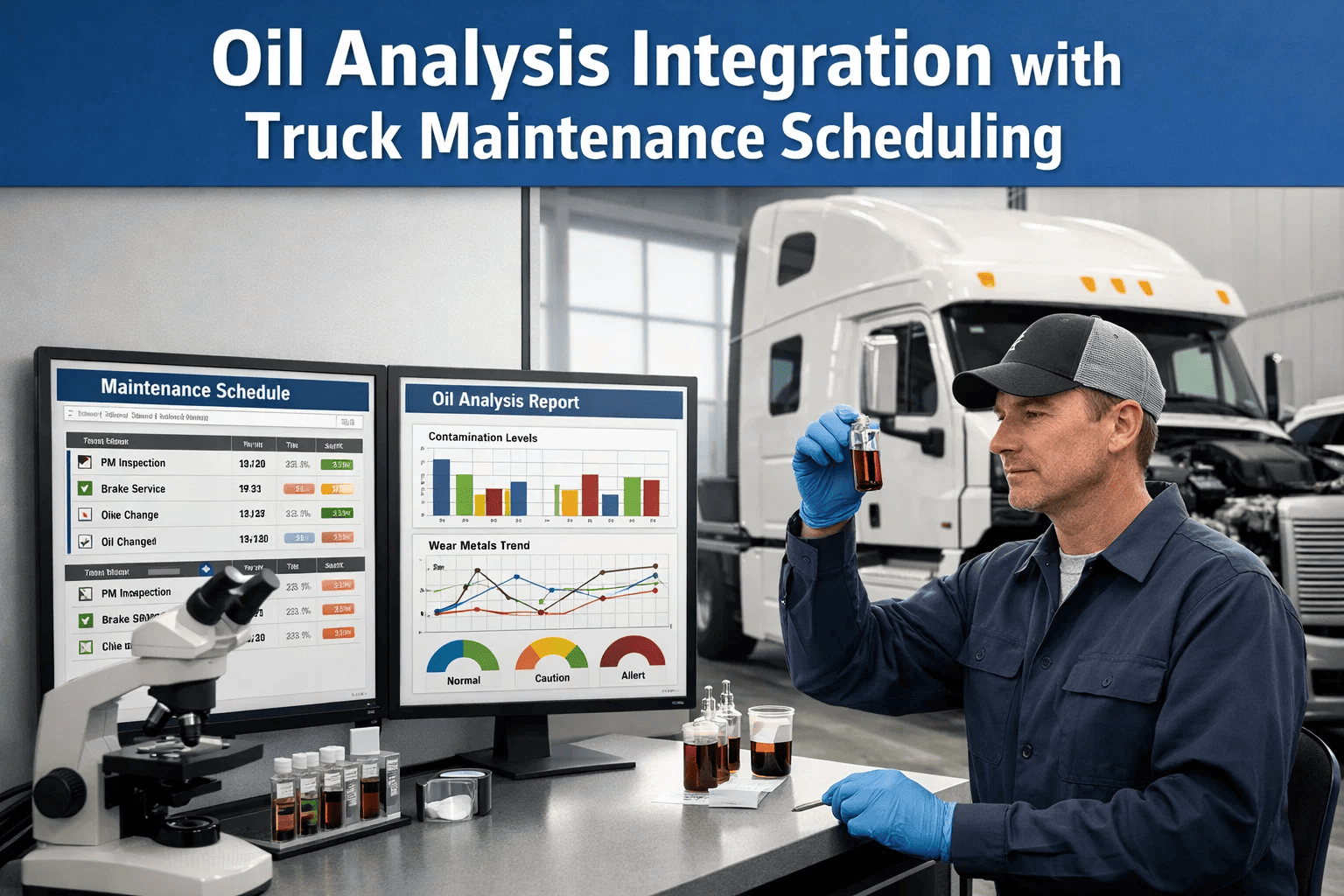
Every truck engine running in your transportation fleet is consuming oil — and that oil carries a complete diagnostic record of the engine's internal health. Particle counts reveal bearing and gear wear rates. Viscosity breakdown signals oxidation and thermal stress. Water contamination points to coolant leaks before they become engine failures. Yet the majority of commercial trucking operations discard this intelligence by scheduling oil changes on fixed mileage intervals rather than integrating laboratory oil analysis results into an active maintenance decision system. FleetRabbit's oil analysis integration module changes that — turning routine fluid samples into a real-time engine health monitoring program that drives smarter, more cost-effective maintenance scheduling.
Your Oil Is Sending You Early Warning Signals. Is Your Maintenance System Listening?
Fixed-interval oil changes leave money on the table and miss genuine failures simultaneously. Fleets that integrate laboratory oil analysis with structured maintenance scheduling reduce engine-related downtime by 61%, extend drain intervals 30–40%, and catch catastrophic failures 6–10 weeks before they occur. FleetRabbit makes this systematic — not a manual process requiring specialist expertise.
What Oil Analysis Actually Measures — And What It Reveals About Engine Health
A single oil sample analyzed by an accredited laboratory provides eight to twelve distinct diagnostic parameters, each revealing a different aspect of engine condition. Fleet managers who understand what these parameters indicate can interpret trending data intelligently — and FleetRabbit's integration platform translates raw laboratory values into specific, actionable maintenance recommendations without requiring any specialist knowledge from your team.
Iron (Fe) Concentration
Source: Cylinder liners, crankshaft, camshaft, piston rings
Rising iron trend indicates accelerating wear in core engine components. Sudden iron spike signals component distress. Sequential trend comparison is more diagnostic than single-sample thresholds.
FleetRabbit Action: Trending alert with projected wear trajectory and service recommendation window.
Copper (Cu) Concentration
Source: Bearings, bushings, oil cooler matrix, thrust washers
Elevated copper indicates bearing surface degradation or oil cooler tube corrosion. Copper combined with iron elevation points to severe bearing distress requiring immediate investigation.
FleetRabbit Action: Cross-referenced with iron data for bearing health composite score and urgency classification.
Viscosity at 100 Celsius
Indicator: Oil film strength and lubricating capacity under operating temperature
Viscosity below grade range means loss of oil film protection — components are metal-to-metal under load. Viscosity above range indicates contamination (fuel, coolant, soot) or oxidation polymerization.
FleetRabbit Action: Viscosity deviation triggers immediate review flag with contamination source diagnosis pathway.
Water Content (Karl Fischer)
Source: Coolant system leak, condensation accumulation, environment ingress
Water above 0.2% destroys oil film strength and drives accelerated corrosive wear across all bearing surfaces. Trending water content is the earliest indicator of internal coolant leaks — detected weeks before coolant loss becomes visible at the reservoir.
FleetRabbit Action: Water threshold alert with escalation protocol and recommended pressure test procedure.
Total Base Number (TBN)
Indicator: Remaining acid neutralization capacity of the oil additive package
TBN depletion indicates additive package exhaustion. Oil that has lost TBN capacity allows sulfuric acid from combustion byproducts to corrode internal surfaces. TBN trending determines actual remaining oil useful life — the data behind condition-based drain intervals.
FleetRabbit Action: TBN-based drain interval recommendation replacing fixed-mileage assumptions.
Particle Count (ISO Cleanliness)
Indicator: Total particulate contamination level and particle size distribution
Elevated particle count indicates filter bypass, damaged filter media, or extreme wear debris generation. Particle size distribution distinguishes catastrophic wear particles (large) from normal background wear (small) — enabling severity classification without laboratory specialist involvement.
FleetRabbit Action: ISO cleanliness code tracked per vehicle with trend visualization and service threshold alerts.
The Problem With Fixed-Interval Oil Changes in Commercial Trucking
The standard trucking industry practice — change oil every 15,000, 25,000, or 50,000 miles depending on OEM specification — was designed for a world without oil analysis technology. Fixed intervals are statistical averages that accommodate variability across operating conditions by being conservative. In practice, this means fleets are simultaneously wasting oil on trucks that don't need it yet and missing genuine degradation on trucks whose operating conditions accelerate oil breakdown faster than the interval assumes.
Where Fixed Intervals Waste Money
Highway trucks running light loads in mild climates have oil that is chemically fresh at 50,000-mile service intervals
New engine oil contains premium additive packages that degrade over time and miles — but at different rates depending on actual operating conditions
Fleets paying for oil analysis programs but not integrating results into scheduling get the cost without the benefit
Over-serviced vehicles accumulate labor costs and vehicle downtime that delivers no maintenance benefit
Where Fixed Intervals Miss Failures
Urban delivery trucks running stop-and-go cycles with high idle time degrade oil 40–60% faster than highway cycles at the same mileage
Trucks operating in high-temperature environments, towing at maximum load, or running in dusty conditions accelerate oil oxidation beyond interval assumptions
Coolant leak ingress — the most dangerous engine threat — is invisible until it is serious, but detectable by water analysis months before damage becomes catastrophic
Bearing distress shows in oil analysis 6–8 weeks before it escalates to engine damage — but only if someone is looking at the data
How FleetRabbit Integrates Oil Analysis Into an Active Maintenance Scheduling System
Sample Scheduling Automation
FleetRabbit calculates sampling intervals per vehicle based on mileage, engine hours, route type, and historical oil degradation rate. Technicians receive automatic dispatch notifications when a sample is due — with vehicle location, sample kit instructions, and lab submission instructions. No missed samples. No manual tracking spreadsheets. Consistent data series that enables longitudinal trend analysis.
Direct Laboratory Integration
When the laboratory completes analysis, results flow directly into FleetRabbit via API integration — not as PDF email attachments that require manual data entry. All parameters populate automatically into the vehicle's oil analysis history, triggering the platform's trend analysis algorithms immediately. No data entry lag. No miskeyed values. No results sitting unread in a maintenance supervisor's email inbox for three days.
Trend Analysis and Alert Generation
FleetRabbit compares each new result against the vehicle's complete oil analysis history and fleet-wide baseline data. Rather than simple threshold alerts, the platform evaluates rate-of-change for each parameter — identifying accelerating trends before threshold violations occur. Fleet managers receive interpreted alerts: specific vehicle, specific parameter concern, severity classification, and recommended action with a structured timeline.
Maintenance Schedule Integration
Oil analysis recommendations generate or modify scheduled work orders within FleetRabbit's maintenance module. Condition-based drain intervals replace or override fixed-mileage triggers based on actual TBN and contamination data. Additional inspections triggered by wear metal alerts populate as recommended tasks within the next scheduled service window — or as urgent stand-alone orders for critical findings. Parts and lubricant inventory updated automatically.
Outcome Capture and Model Improvement
After maintenance is performed, technician findings are captured in FleetRabbit — actual component condition, parts replaced, and observed vs. predicted degradation severity. This outcome data feeds back into the platform's vehicle-specific prediction model. Over time, FleetRabbit's drain interval recommendations and failure prediction accuracy improve continuously for your specific fleet, route mix, and operating environment.
Stop Managing Oil Changes by Mileage. Start Managing By Actual Oil Condition.
FleetRabbit's oil analysis integration platform automates sample scheduling, ingests laboratory results directly, and converts raw data into scheduled maintenance actions — without requiring any specialist interpretation from your team.
Condition-Based Drain Intervals: The Financial Case for Oil Analysis in Transportation Fleets
The most immediately quantifiable benefit of integrating oil analysis into maintenance scheduling is drain interval optimization. Most transportation fleets are either changing oil unnecessarily early (on highway trucks with light-duty cycles) or inadequately late (on urban trucks with high thermal and contamination stress). FleetRabbit uses TBN trending and contamination data to determine the precise remaining useful life of oil in each specific vehicle — eliminating both waste and risk simultaneously.
Highway Fleet Scenario
A 40-truck long-haul fleet running 50,000-mile oil changes discovers through oil analysis that highway trucks consistently show 35–40% remaining TBN at the standard interval. FleetRabbit recommends extending to 68,000–72,000 miles for these vehicles based on actual degradation rates.
Annual savings: 40 trucks saving 1.5 oil changes per truck per year at $380 per service = $22,800 in direct material and labor savings annually. Engine protection maintained actually improved through condition monitoring versus blind interval adherence.
Urban Delivery Fleet Scenario
A 60-truck urban distribution fleet running 25,000-mile oil changes discovers through oil analysis that stop-and-go cycle trucks show TBN depletion and elevated particulates at 18,000–20,000 miles. Fixed-interval servicing was consistently running these engines on exhausted lubricant for 5,000–7,000 miles per cycle.
Cost of reduced interval: $68,400 additional annual oil service cost. Cost of prevented engine damage: 4 prevented engine rebuilds at $28,000 each = $112,000 saved. Net benefit: $43,600 annually plus reduction in CSA violations from degraded engine performance.
Real Engine Failure Cases Prevented Through Oil Analysis Integration
Coolant Leak Detection 8 Weeks Before Engine Failure
Truck 22 in a regional LTL fleet shows water content in oil analysis at Month 1: 0.08% (normal background), Month 2: 0.14% (elevated, alert triggered), Month 3: 0.31% (critical threshold). FleetRabbit generates urgent service recommendation with coolant system pressure test specified. Technician discovers cracked cylinder head gasket with internal coolant seepage — not yet visible at the external coolant reservoir. Head gasket replacement: $4,200. Alternative outcome with fixed-interval servicing: engine hydro-locked on route six to eight weeks later. Engine replacement: $34,000 plus $18,000 downtime and recovery costs.
Bearing Distress Identification — 6 Weeks Before Seizure
Truck 8 in a bulk freight carrier operation shows copper and iron co-elevation developing over three consecutive samples. Copper trending from 12 ppm to 34 ppm to 71 ppm with corresponding iron trend. FleetRabbit classifies as high-probability main bearing distress with deterioration acceleration. Maintenance team performs early oil drain and inspection — main bearing shell shows spalling on two journals. Bearing replacement during planned maintenance: $2,800. Alternative outcome: main bearing failure at operating load would have destroyed the crankshaft and main journals, requiring complete short block replacement at $26,000 and 8-day downtime.
Fuel Dilution Identification — Concealed Injector Failure
Truck 35 shows viscosity reading 30% below grade specification at standard sample interval — crude oil viscosity consistent with severe fuel dilution. FleetRabbit flags immediate service with injector system inspection specified. Technician discovers malfunctioning injector allowing raw fuel injection into cylinder during non-firing period — raw fuel washing cylinder walls and draining into crankcase. Injector replacement plus immediate oil change: $1,400. Alternative outcome: continued operation with fuel-diluted oil would have destroyed cylinder liner, piston, and ring set within 8,000–12,000 additional miles — component replacement cost exceeding $18,000.
How FleetRabbit Presents Oil Analysis Data to Fleet Managers and Executives
Raw laboratory data in isolation is not useful to fleet managers who are managing operations, not running an oil analysis laboratory. FleetRabbit's dashboard architecture translates complex multi-parameter laboratory data into structured, role-appropriate operational views that drive decisions without requiring any technical interpretation from managers or executives.
Fleet Health Overview
- Trucks with normal oil analysis trending — no action required
- Trucks with developing anomalies — monitor at next sample
- Trucks with urgent oil analysis findings — service within 72 hours
- Trucks with samples overdue — automated reminder sequence active
Vehicle-Level Detail
- Complete oil analysis history with parameter trending visualized
- Current drain interval recommendation vs. standard interval comparison
- Open work orders generated from oil analysis findings
- Cost avoidance history: prevented failures and estimated savings
Executive Summary Dashboard
- Fleet-wide oil analysis compliance rate (percentage of trucks current on sampling)
- Health classification distribution across entire fleet
- Total cost avoidance from oil analysis program this period
- Drain interval optimization savings vs. fixed-interval baseline
FleetRabbit Oil Analysis Integration for Transportation Fleet Executives: Strategic Benefits
01
Asset Protection at Scale
Commercial truck engines represent $80,000–$180,000 per unit in asset value. Oil analysis integration extends engine service life 25–40% beyond time-and-mileage-based management through elimination of the two primary failure modes: lubricant exhaustion and contamination ingress. For a 50-truck fleet, this delays the replacement cycle of four to six units per year — deferring $400,000 to $700,000 in capital expenditure annually.
02
Regulatory and Insurance Leverage
FleetRabbit maintains a complete oil analysis history with dated laboratory reports, maintenance actions, and outcome documentation for every vehicle. During DOT compliance reviews, insurance audits, or accident liability investigations, this documentation demonstrates systematic, data-driven equipment management — a defense posture that fixed-schedule maintenance records cannot provide. Insurance carriers increasingly reward fleets with documented predictive maintenance programs through premium adjustments.
03
Driver Safety as a Maintenance Output
Engine failures at highway speed represent one of the highest driver safety risk scenarios in commercial trucking — sudden loss of power with a loaded trailer creates extreme following-vehicle and lane-change hazards. Oil analysis integration that prevents catastrophic in-service engine failures is not merely a cost-control measure; it is a systematic driver safety intervention that eliminates an entire failure mode and its associated accident liability exposure.
04
Supply Chain Reliability and Customer Retention
Shipper relationships are built on delivery reliability. A fleet that prevents engine failures through oil analysis integration eliminates the load disruptions, delivery delays, and emergency expediting costs that erode shipper confidence and damage contract renewal outcomes. Transportation executives who can demonstrate data-driven fleet reliability programs have a measurable competitive advantage in contract negotiations with high-value shippers who qualify carriers on performance history.
Frequently Asked Questions: Oil Analysis Integration for Truck Fleet Maintenance
Does FleetRabbit work with any accredited oil analysis laboratory, or only specific lab partners?
FleetRabbit integrates with all major accredited oil analysis laboratories via API where direct integration is available, and supports manual CSV or structured data import for labs without API connectivity. Fleet managers are not required to change laboratory relationships to implement FleetRabbit , the platform accommodates your existing lab partnerships. For fleets without an established laboratory relationship, FleetRabbit can recommend accredited partners with direct integration and competitive pricing for commercial fleet volumes.
How often should oil samples be collected from each truck in our fleet?
FleetRabbit calculates recommended sampling frequencies per vehicle based on engine type, operating cycle (highway vs. urban), mileage accumulation rate, and historical oil degradation data for that vehicle class. Starting points for most transportation fleets: highway trucks with modern DPF engines every 25,000–30,000 miles, urban delivery trucks every 12,000–15,000 miles, and heavy-haul or severe-duty applications every 8,000–10,000 miles. Frequencies are adjusted automatically as trending data reveals faster or slower degradation than initial assumptions.
What is the cost-per-truck for running an oil analysis program with FleetRabbit integration?
Laboratory oil analysis costs typically range from $18 to $45 per sample depending on the test panel scope and laboratory selected. For most transportation applications, a comprehensive panel including wear metals, viscosity, TBN, water content, and particle count is recommended. At two to four samples per truck per year, the direct Oil analysis cost runs $36 to $180 per truck annually. FleetRabbit platform cost for oil analysis integration is included in the core platform subscription. Against an average of $34,000 in prevented engine damage per major failure averted, even a program generating one such prevention per 100 trucks per year delivers 19 times return on the combined program cost.
How does oil analysis integration interact with FleetRabbit's existing preventive maintenance scheduling?
Oil analysis integration layers on top of FleetRabbit's core preventive maintenance scheduling rather than replacing it. Time and mileage-based PM schedules remain active. Oil analysis findings can override, advance, or extend oil-related service triggers based on actual condition data. Analysis findings that indicate non-oil component concerns bearing wear, coolant leak, fuel system issues — generate recommendations that flow into the broader maintenance work queue with appropriate urgency classification alongside other PM tasks. The two systems work together to create a more complete maintenance decision picture than either delivers alone.
Can oil analysis data be used to support warranty claims or dispute repair cost responsibility?
Yes and this is an increasingly important application as engine and drivetrain warranties become more complex. FleetRabbit's complete, timestamped oil analysis history demonstrates that a fleet maintained proper lubricant condition throughout the warranty period — establishing a documented record that counters manufacturer claims of maintenance-related failure causation. Conversely, if oil analysis data shows a sudden anomaly not associated with any maintenance event, it can provide evidence supporting a warranty claim for manufacturing defect. Having systematic documentation is a significant advantage in warranty dispute resolution.
How does FleetRabbit handle fleets with mixed lubricant specifications across different vehicle makes?
FleetRabbit maintains separate oil specification profiles for each vehicle in the fleet — tolerances, alert thresholds, and drain interval baselines are calibrated to the specific lubricant specification and engine type for each truck, not a generic fleet-wide average. A fleet running CK-4 15W-40 in older Cummins ISX engines alongside SP 10W-30 in newer Paccar MX engines will have correctly separate analysis parameters applied to each vehicle group. Mixed-fleet capability is a core requirement for transportation and logistics operations, and FleetRabbit is designed to handle this complexity without manual configuration by end users.
Oil Analysis Is the Highest-ROI Diagnostic Investment Available to Transportation Fleet Managers
The oil in your engines right now is either protecting them or warning you about a developing problem. Without oil analysis integration, that information is discarded at every oil change. With FleetRabbit's oil analysis integration platform, every sample becomes a structured data point in a continuous engine health monitoring program that prevents failures, optimizes service intervals, protects asset values, and gives fleet managers and executives the documentation to demonstrate systematic equipment management to auditors, insurers, and shippers alike.
The ROI case requires no complex modeling: one prevented major engine rebuild pays for the entire oil analysis program for a 40-truck fleet for five years. Average transportation fleets prevent two to four such events annually after implementing FleetRabbit-integrated oil analysis and condition-based maintenance scheduling.
Ready to Turn Your Oil Analysis Program Into an Active Maintenance System?
FleetRabbit integrates laboratory oil analysis results directly into maintenance scheduling — automating sample tracking, trending wear parameters, generating condition-based drain interval recommendations, and converting findings into scheduled work orders. See how transportation fleets achieve 61% engine downtime reduction and 12x program ROI.