A single unexpected truck breakdown costs the average trucking fleet $490 in emergency repair labor alone — before accounting for towing, a missed delivery penalty, a replacement vehicle, and driver downtime. Multiply that by six unplanned breakdowns per vehicle per year, which is the industry average for fleets still relying on reactive maintenance, and the financial case for predictive maintenance becomes impossible to ignore. Predictive maintenance uses AI-driven analysis of vehicle sensor data, mileage patterns, engine diagnostics, and inspection history to tell fleet managers when a component is likely to fail — before it does. FleetRabbit's predictive maintenance module converts raw telematics data into actionable service intervals, eliminating the reactive repair cycle that drains fleet budgets and dispatch reliability. Book a demo to see FleetRabbit's predictive maintenance in action.
Quick Answer
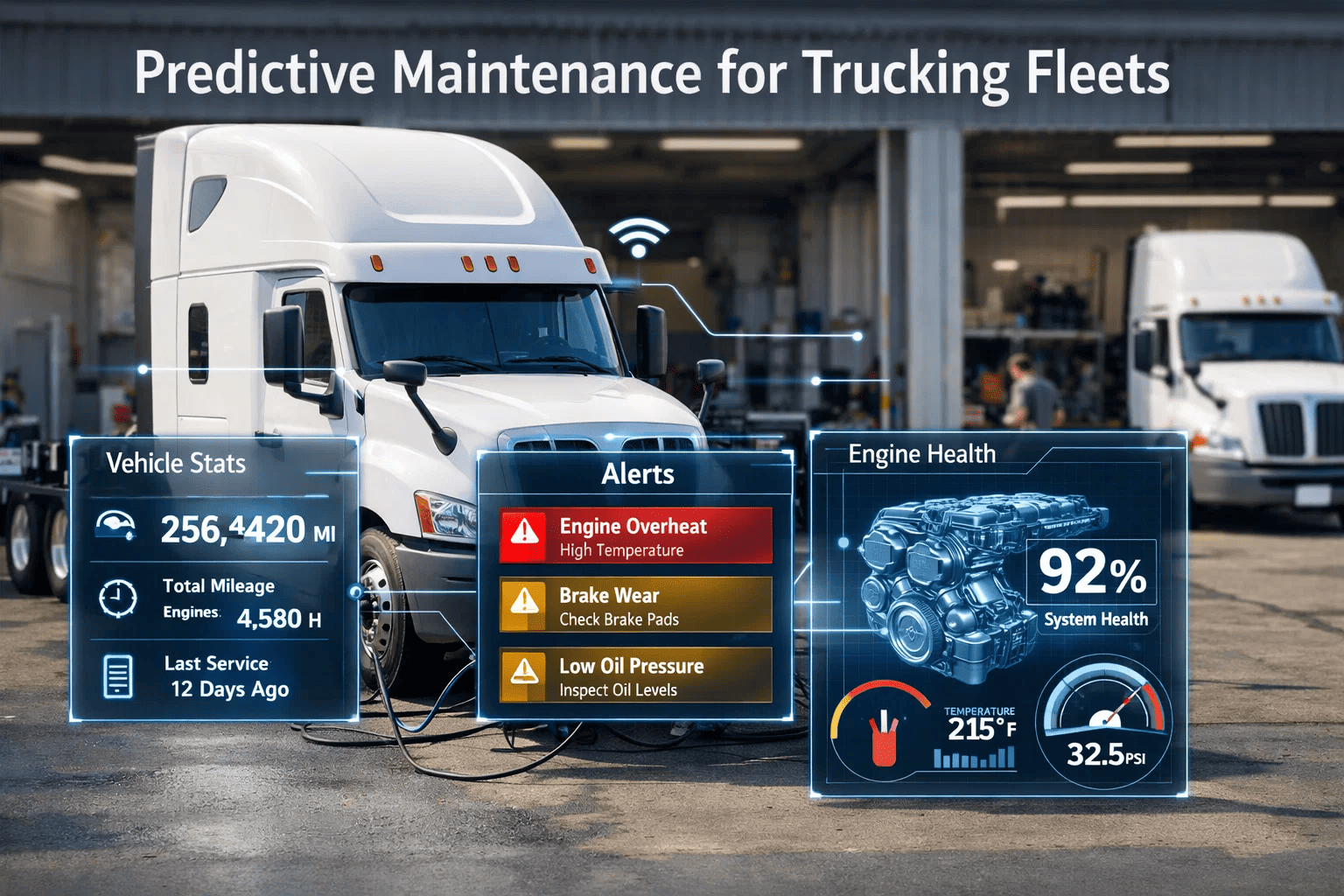
Predictive maintenance for trucking fleets uses AI, telematics data, engine diagnostics, and inspection records to forecast component failures before they happen — replacing reactive repair with proactive service scheduling. FleetRabbit's predictive maintenance system identifies at-risk components across your entire fleet in real time, triggers automated work orders before breakdowns occur, and reduces unplanned downtime by up to 45% — keeping trucks moving and profitability protected.
The True Cost of Reactive Maintenance in Trucking Operations
Most trucking fleets know reactive maintenance is expensive — but few have quantified exactly how much it costs compared to a proactive approach. The difference is significant enough to represent a competitive advantage or disadvantage depending on which approach your fleet operates under.
⚠️
Emergency Repair Premium
+35–60% over scheduled service cost
⚠️
Towing and Recovery
$200–$900 per roadside incident
⚠️
Missed Delivery Penalties
$500–$3,000+ per load depending on contract
⚠️
Secondary Component Damage
1 failed bearing → potential engine damage multiplied 3–5×
⚠️
DOT Out-of-Service Risk
Vehicle sidelined during roadside inspection
Avg. Annual Unplanned Repair Cost per Vehicle: $12,400–$18,600
✅
Scheduled Service Cost
Planned labor at standard shop rates
✅
Parts Availability
Ordered in advance — no emergency sourcing premium
✅
No Missed Deliveries
Service scheduled during route gaps, not during dispatch
✅
No Component Cascade
Component replaced before failure; no secondary damage
✅
FMCSA Compliance Protected
Documented service history supports roadside inspections
Avg. Annual Planned Maintenance Cost per Vehicle: $7,200–$9,800
How Predictive Maintenance Works — The Technology Behind It
Predictive maintenance is not simply scheduling oil changes every 15,000 miles. It is a data-driven system that monitors dozens of vehicle parameters simultaneously, identifies early warning patterns before they produce failure symptoms, and recommends specific service actions with lead time measured in days or weeks — not hours before a breakdown.
1
Engine Diagnostic Code Monitoring (OBD-II / J1939)
FleetRabbit continuously reads engine control module data through standard OBD-II and J1939 diagnostic interfaces. Fault codes, pending codes, and degraded-performance-without-fault patterns are captured and analyzed against failure signature databases built from millions of commercial vehicle data points. A pending code for coolant temperature regulation, for example, surfaces as a predictive alert days before it becomes an active fault.
Engine Temperature Trends
Coolant Pressure Variation
Turbo Boost Lag Patterns
DPF Pressure Differential
Fuel Injector Pulse Width
2
Mileage & Time-Based Component Life Tracking
Every major component in a commercial truck has a predictable service life measured in miles, hours, or calendar time. FleetRabbit tracks actual mileage and operational hours per component — not just odometer readings — and applies manufacturer service specifications alongside fleet-specific maintenance history to calculate remaining component life. Service alerts are triggered when remaining life crosses configurable thresholds, providing adequate lead time to schedule service without rushing.
Brake Lining Life (Miles)
Transmission Fluid Hrs
Belt & Hose Calendar Age
Tire Tread Depth Projection
Filter Service Intervals
3
Driver Vehicle Inspection Report (DVIR) Integration
Driver inspections are a rich early-warning data source that most maintenance systems fail to connect to predictive models. FleetRabbit's predictive maintenance module analyzes recurring driver-flagged items — a driver noting a vibration at highway speeds three inspections in a row, for example — as leading indicators of mechanical deterioration before sensor data confirms the failure. Inspection data and mechanical sensor data are fused into a unified component health score per vehicle.
Recurring Defect Patterns
Driver-Reported Vibrations
Brake Fade Observations
Unusual Noise Logs
Tire Wear Progression
4
AI Pattern Recognition & Fleet Benchmarking
FleetRabbit's AI layer compares each vehicle's performance signatures against anonymized benchmark data from similar vehicles — identifying when a specific truck's brake wear rate, fuel efficiency drop, or coolant temperature variance exceeds the normal distribution for its vehicle class, mileage band, and route type. Statistical deviation from benchmark is a powerful failure predictor that mileage-based schedules cannot replicate.
Fuel Economy Deterioration
Anomalous Idle Patterns
Oil Pressure Variance
Transmission Shift Quality
Brake Pressure Asymmetry
FleetRabbit Predictive Maintenance — End-to-End Workflow
Predictive capability only creates value when it connects directly to action. FleetRabbit closes the loop from data signal to completed service in an automated workflow that requires zero manual intervention to initiate.
Continuous Data Collection
Telematics + DVIR + engine diagnostics captured 24/7 per vehicle
→
AI Risk Scoring
Each component receives a failure risk score updated hourly
→
Fleet Manager Alert
Push notification with component, vehicle, risk level, and recommended action window
→
Auto Work Order Created
Maintenance work order auto-generated with part requirement, lead time, and service window
→
Service Completed & Recorded
Technician closes work order; vehicle health score resets; record archived automatically
Components FleetRabbit Predictive Monitoring Covers
? Braking System
High Brake lining thickness by axle
High Brake adjustment slack
Med Air brake pressure decay rate
Med ABS sensor function
? Engine & Drivetrain
High Oil pressure deviation
High Coolant temperature variance
Med Transmission fluid condition
Med DPF regeneration frequency
⚡ Electrical Systems
Med Battery voltage trend
Med Alternator output stability
Low Lighting circuit resistance
Low Sensor calibration drift
? Tires & Suspension
High Tire pressure deviation (TPMS)
High Tread wear projection
Med Shock absorber response
Med Wheel bearing temperature
FleetRabbit Predictive Maintenance
Stop Reacting to Breakdowns — Start Preventing Them
FleetRabbit's AI-powered predictive maintenance system monitors every truck in your fleet around the clock — alerting your team before failures happen, automatically creating maintenance work orders, and reducing unexpected downtime by up to 45%.
45%
Reduction in Unplanned Downtime
38%
Lower Emergency Repair Cost
Predictive Maintenance vs. Preventive Maintenance — Understanding the Difference
Fleet managers sometimes use "predictive" and "preventive" maintenance interchangeably — but they represent fundamentally different approaches with significantly different cost profiles and effectiveness levels.
Service Trigger
Fixed mileage or calendar interval
Real-time component health signals
Over-Service Risk
High — components replaced before wear requires it
Minimal — service triggered by actual condition
Under-Service Risk
Low per cycle, but missed signs between intervals
Very low — continuous monitoring between intervals
Data Required
Odometer reading only
Telematics, diagnostics, inspection data
Cost Efficiency
Moderate — some unnecessary service performed
High — service matched to actual need
Breakdown Prevention Rate
~60–70% effective
~88–94% effective with AI analysis
Fleet Performance Results — What Predictive Maintenance Delivers
45%
Reduction in Unplanned Downtime
38%
Lower Emergency Repair Spend
3.2×
ROI on Predictive Maintenance Investment
92%
On-Time Delivery Rate Improvement
$4,800
Avg. Annual Savings per Vehicle
How Fleet Managers Use FleetRabbit's Predictive Maintenance Dashboard
FleetRabbit's maintenance dashboard provides fleet managers and transportation directors with a real-time view of their entire fleet's mechanical health — organized to surface the most urgent attention items first without requiring manual data review across multiple systems.
Fleet Health Overview
Critical Risk — Requires Immediate Action
Elevated Risk — Schedule Within 7 Days
Monitoring — Schedule Within 30 Days
Healthy — No Action Required
Right front brake lining at 12% remaining life. Immediate service required. Dispatch hold activated. Work order WO-7821 auto-created.
Coolant temperature variance +8°F above baseline trend. Service recommended within 5 days. Parts check: In stock.
DPF regeneration frequency increasing. Monitor for 10 days. Oil sample analysis recommended at next service.
Frequently Asked Questions — Predictive Maintenance for Trucking
QWhat telematics hardware does FleetRabbit require for predictive maintenance?
FleetRabbit works with most commercial ELD and telematics providers already deployed in trucking fleets — including Samsara, KeepTruckin (Motive), Geotab, and others — via API integration. For fleets without existing telematics, FleetRabbit offers an integrated device option compatible with standard OBD-II and J1939 ports. No proprietary hardware lock-in.
Book a demo to discuss your existing equipment compatibility.
QHow long does it take FleetRabbit's AI to develop accurate predictions for a new fleet?
FleetRabbit's predictive models apply immediately using manufacturer baseline data and industry failure signatures — providing useful alerts from day one. AI accuracy improves continuously as vehicle-specific historical data accumulates. Most fleets see high-confidence component-level predictions within 60–90 days of deployment, with accuracy rates typically exceeding 88% within the first quarter.
QCan FleetRabbit predictive maintenance connect to our existing shop management system?
Yes. FleetRabbit integrates with common shop management and fleet maintenance software platforms. Auto-generated work orders from predictive alerts can flow directly into your existing maintenance system — eliminating double entry and ensuring maintenance staff receive alerts in the tools they already use. Custom integrations are supported for enterprise fleets with proprietary systems.
QDoes FleetRabbit handle both powered vehicles and trailers?
Yes. FleetRabbit's predictive maintenance module covers both powered units (tractors, straight trucks) and trailers equipped with trailer tracking devices. Trailer-side monitoring includes tire pressure (TPTMS), brake condition, door sensor status, and reefer unit performance for temperature-controlled equipment. A full mixed-fleet view is available in a single unified dashboard.
QHow does the system handle false positives — alerts for components that turn out to be healthy?
FleetRabbit applies a multi-signal confirmation model before triggering high-priority alerts — requiring correlation across at least two independent data signals before classifying a component as critical risk. This approach reduces false positive rates to below 7% across deployed fleets. When technicians close a work order without finding the flagged issue, that feedback improves the AI model for that vehicle and vehicle class going forward.
Predict Failures. Prevent Breakdowns. Protect Revenue.
FleetRabbit's AI-powered predictive maintenance system monitors every vehicle in your fleet around the clock — surfacing at-risk components weeks before failure, automatically routing alerts to maintenance, and delivering the documentation trail your fleet needs for FMCSA compliance and operational excellence.
AI Component Risk Scoring
Auto Work Order Creation
OBD-II / J1939 Integration
45% Downtime Reduction
DVIR Data Fusion
April 9, 2026
By Nathan Smith
All Posts