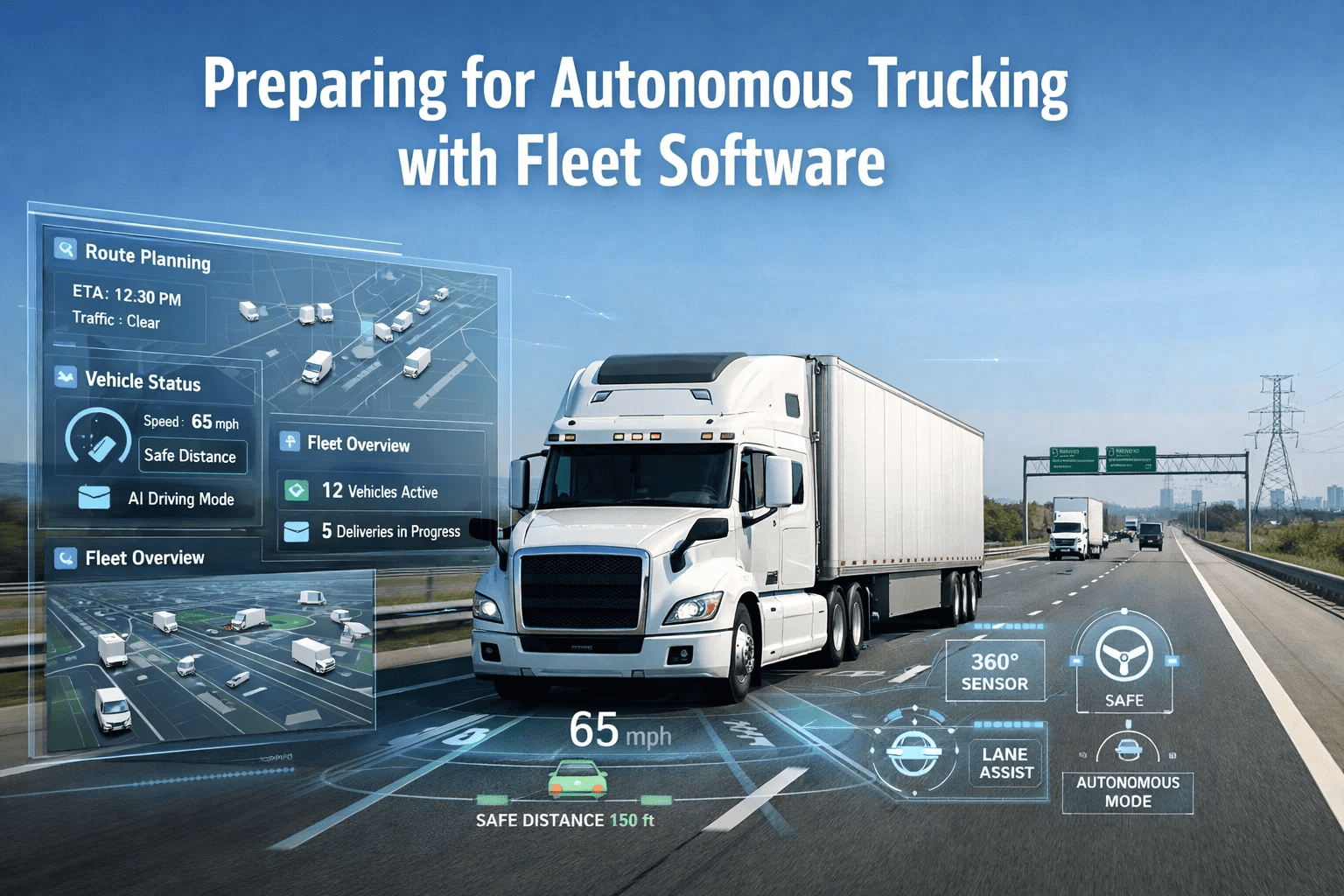
Autonomous trucking technology is not a hypothetical future state that logistics companies can address when it arrives — it is an accelerating technology transition with commercially deployed systems operating on specific highway corridors today and a defined technology development roadmap that logistics companies, fleet operators, and infrastructure managers are actively planning around. The carriers and logistics operators who are preparing their fleet management infrastructure, operational data practices, route and dispatch workflows, and maintenance program documentation for autonomous vehicle integration now will be positioned to adopt these technologies at commercial readiness rather than spending 18 to 36 months on infrastructure preparation while early-adopting competitors have already captured the operational advantages. Book a demo to see how FleetRabbit's data architecture, telematics integration, and fleet operations management capabilities position your fleet for autonomous trucking readiness.
Guide Summary
Preparing for autonomous trucking requires logistics fleet operators to understand the SAE automation level framework that defines technology capability boundaries, the operational design domains (ODD) that constrain where Level 4 systems can operate safely, the fleet management software capabilities that autonomous vehicle integration requires, the data standards and API architectures that autonomous vehicle systems depend on for fleet management integration, and the operational workflow changes that mixed autonomous-human fleets will require. This guide addresses each dimension with specific preparation actions logistics operators can take today with existing technology investments — including FleetRabbit — that will build the infrastructure autonomous vehicle integration requires.
Understanding SAE Automation Levels: Where the Technology Is Today
The Society of Automotive Engineers' J3016 automation level taxonomy — the SAE levels 0 through 5 — provides the most widely used framework for describing and comparing the capability boundaries of vehicle automation systems. Understanding these levels is essential for logistics operators evaluating autonomous trucking technology because the operational implications of each level are dramatically different — Level 2 systems (driver assistance with combined steering and acceleration control) are consumer car features today, while Level 4 (no driver required within defined operational conditions) represents the commercially relevant threshold for trucking applications. Level 3 (conditional automation requiring driver to be available and capable of taking control) has proven less commercially viable for trucking than anticipated because the driver monitoring, handoff management, and liability implications have been operationally challenging to manage at scale.
L0
No Automation
Human driver controls all driving tasks. Advanced driver assistance features (alerts, warnings) may be present but do not control the vehicle.
Status: Universal — all non-automated commercial vehicles
Logistics Impact: None — current baseline for all human-driven fleets
L1
Driver Assistance
System controls ONE of steering OR acceleration/deceleration. Examples: adaptive cruise control, lane keeping assist — driver controls all other functions.
Status: Widely deployed — available on Class 8 trucks from major manufacturers
Logistics Impact: Safety feature integration — telematics data from ADAS alerts available in fleet management
L2
Partial Automation
System controls BOTH steering AND acceleration/deceleration simultaneously in specific conditions. Driver must monitor at all times and remain ready to take control immediately.
Status: Commercially available — highway-speed platooning systems, some Class 8 OEM ADAS packages
Logistics Impact: Fuel efficiency benefit from platooning — fleet management integration captures ADAS engagement data
L3
Conditional Automation
System handles all driving tasks within defined conditions. Driver may disengage attention but must resume control when system requests. Liability transfer to ADS during automated operation complicates commercial deployment.
Status: Limited commercial deployment — regulatory and liability challenges constrain trucking adoption
Logistics Impact: Driver monitoring requirements, fatigue management integration — limited near-term commercial relevance
L4
High Automation
System performs ALL driving tasks within a defined Operational Design Domain (ODD). No driver required within ODD — system handles all conditions including failure scenarios. Driver or remote operations center may monitor but is not required to intervene.
Status: Commercial deployment beginning — specific ODD corridors in TX, AZ, and Sun Belt states
Logistics Impact: Transformational — eliminates driver HOS constraint on specific lanes, requires fleet management software integration with ADS systems, new maintenance categories
L5
Full Automation
System performs all driving tasks in ALL conditions without any boundary on operational domain. No steering wheel or pedals required. Applicable to any route, any weather, any road type.
Status: Not commercially available — long-term technology development stage
Logistics Impact: Full fleet electrification-level transformation — requires fundamental re-thinking of all fleet management workflows
Operational Design Domains: The Geographic and Condition Constraints on Level 4
Level 4 autonomous driving systems do not operate in all conditions everywhere — they operate within specifically defined Operational Design Domains (ODDs) that describe the geographic boundaries, road types, weather conditions, speed ranges, and infrastructure requirements within which the Automated Driving System (ADS) can safely control the vehicle without human intervention. The commercial relevance of Level 4 for logistics operators depends entirely on whether the ODD of available autonomous platforms matches the specific routes and operating conditions of the logistics operation — a carrier whose lanes are concentrated in Texas and Arizona Sun Belt interstate corridors may find significant ODD coverage from currently deploying autonomous truck technology, while a carrier whose operations are concentrated in Midwest and Northeast corridors with significant winter weather exposure may have minimal ODD match with currently deployed Level 4 systems.
Understanding ODD mapping relative to your specific lane portfolio is the first concrete preparation action for logistics operators evaluating autonomous trucking integration. FleetRabbit's route and GPS telematics data provides the historical lane mileage and geographic distribution data that enables systematic ODD alignment analysis — identifying which specific routes in the carrier's portfolio fall within the operational design domains of technology that will be commercially available in the 2025 to 2028 window.
High ODD Match — Near-Term Opportunity
Interstate highway operation only — no grade crossings, unprotected intersections, or complex merge scenarios
Sun Belt geography — Texas, Arizona, New Mexico, Nevada, Southern California — minimal severe weather frequency
High-volume, fixed-route dedicated lanes — consistent route reduces novel scenario frequency for ADS
Origin and destination in hub logistics centers with autonomous-capable terminal infrastructure
Route speed primarily above 45 mph sustained — urban mixed-traffic navigation still ADS development stage
Action: Evaluate autonomous truck carrier partnerships and technology provider relationships for these specific lanes — preparation for 2025-2027 commercial contracts
Moderate ODD Match — 2027-2030 Outlook
Primarily interstate with some limited-access highway segments requiring transition management
Mixed geography — some sun belt operation with expansion into mid-South and Mountain West regions
Regional distribution with hub-to-hub segments suitable for autonomous and first/last mile remaining human-driven
Weather variability present but not extreme — some cold weather seasonal variation in northern routing
Action: Build fleet management infrastructure readiness now — data standards, API integration capabilities, maintenance program documentation — for deployment window opening in 2027-2030
Lower ODD Match — 2030+ Timeline
Significant urban delivery component — complex intersection management, pedestrian interaction, unregulated road conditions
Northern geography with consistent severe winter precipitation — ADS weather capability still maturing
Highly variable routes — diverse delivery points requiring frequent novel scenario navigation
Significant off-highway operation — construction sites, agricultural facilities, non-paved terminal access
Action: Monitor technology development without near-term operational integration pressure — focus on fleet management data quality for eventual longer-horizon capability
Fleet Software Requirements for Autonomous Vehicle Integration
Integrating Level 4 autonomous trucks into a carrier's fleet management ecosystem requires fleet management software capabilities that go significantly beyond what most current platforms provide for human-driven fleets. Autonomous vehicles generate substantially more data than human-driven vehicles — sensor data from LiDAR, camera, and radar arrays, ADS decision logs capturing every control action and its algorithmic basis, detailed geolocation data at second-level precision rather than periodic GPS pings, and system health telemetry that is more complex and frequent than the OBD-II diagnostic data from conventional trucks. Fleet management platforms that can ingest, store, index, and display this data volume and variety will be the operational infrastructure backbone for mixed autonomous-human fleets.
FleetRabbit's data integration architecture — built around telematics API integration with multiple hardware and software data sources — provides the foundational approach that autonomous vehicle data integration will extend. The platform's asset management framework, PM scheduling, and work order systems are equally applicable to autonomous trucks' maintenance requirements, which include conventional chassis maintenance unchanged from human-driven vehicles alongside autonomous system maintenance (sensor calibration, compute hardware service, software update management) that requires new service categories and technician qualifications. Building proficiency with the fleet management data systems that govern autonomous truck operations on conventional systems today creates organizational capability that extends naturally to autonomous vehicle management as the technology deploys commercially.
Data Integration Architecture
Current Standard (Human Fleet)
GPS position updates every 30-60 seconds via telematics cellular upload
OBD-II fault codes and basic engine parameters
HOS records from ELD integration
Driver mobile app events and DVIR submission
Required for AV Integration
Sub-second sensor data streaming from LiDAR, camera, radar array
ADS decision and event logs — every control action with algorithmic basis
Real-time compute hardware health metrics — GPU temperature, memory, processing queue status
ADS disengagement event records — mandatory federal reporting under proposed AV regulations
Maintenance Management
Current Standard (Human Fleet)
Mileage and hour-based PM scheduling for engine, chassis, braking systems
Work order management for corrective maintenance
Parts inventory management integrated with work orders
Required for AV Integration
Sensor calibration scheduling — LiDAR and camera calibration at OEM-specified intervals or after any physical impact event
Software update management — ADS software version tracking, regression test documentation after updates
High-performance compute hardware lifecycle management — GPU and processor replacement cycles
Sensor damage tracking — incident event to sensor inspection to calibration verification workflow
Dispatch and Route Management
Current Standard (Human Fleet)
Driver HOS-constrained load assignment optimized by dispatch availability
Route planning based on delivery requirements and driver preferences
Real-time driver communication via mobile app
Required for AV Integration
ODD-aware load assignment — automated route-to-ODD match before AV truck dispatch
Remote operations center integration — human oversight for AV fleet without driver in cab
AV system health pre-departure clearance — no dispatch without ADS system health confirmation
Mixed fleet dispatch optimization — coordinating human-driven and autonomous units across combined lane portfolio
Compliance and Regulatory
Current Standard (Human Fleet)
FMCSA HOS compliance via ELD integration
Driver qualification file management
Annual vehicle inspection documentation
Required for AV Integration
ADS disengagement event documentation — proposed federal reporting requirements under FMCSA AV rulemaking
Autonomous vehicle identification and operational authorization tracking — state-specific AV operating permit documentation
AV-specific inspection protocols — sensor integrity, compute system, cybersecurity component inspection records
Operational Transformation: Managing a Mixed Autonomous-Human Fleet
The most complex operational challenge in autonomous trucking adoption is not the technology itself — it is managing the transitional period during which fleets operate a combination of human-driven trucks and autonomous systems across an integrated dispatch network. During this transition period, which industry analysts project will span 10 to 20 years from the beginning of commercial deployment, carriers must simultaneously manage the HOS constraints and human performance variability of conventional driver operations alongside the ODD constraints, system health requirements, and remote operations oversight of autonomous units — using a fleet management platform that supports both operational paradigms without requiring parallel systems.
Specific operational workflows that require transformation for mixed fleet management include: load assignment algorithms that differentiate between human-capable routes (any route within driver HOS availability) and AV-capable routes (routes within ODD boundaries, with AV system health confirmed); maintenance scheduling that handles both engine oil change intervals for diesel powertrain and sensor calibration intervals for ADS systems within the same work order system; driver management that tracks CDL compliance for human drivers alongside ADS operator certification for personnel managing the remote operations center; and compliance documentation that satisfies both FMCSA's existing human-driver regulatory framework and the emerging AV-specific reporting requirements that federal and state authorities are developing.
Load Assignment
Human-Driven Fleet
Driver HOS availability check
Driver location and proximity to load
CDL endorsement for cargo type
Driver hours available versus load transit time
AV Fleet — Additional Checks
Route ODD compliance verification before assignment
ADS system health status — hardware and software
Sensor calibration currency check
Remote ops center capacity availability
Maintenance Scheduling
Human-Driven Fleet
Mileage-based PM intervals
Engine, transmission, brake service
DVIR defect management
Annual inspection scheduling
AV Fleet — Additional Service Categories
LiDAR and camera calibration intervals
ADS software version update management
Compute hardware health and replacement lifecycle
ADS cybersecurity component review
Compliance Documentation
Human-Driven Fleet
Driver HOS records via ELD
Driver qualification file maintenance
Post-trip DVIR submission
FMCSA accident register
AV Fleet — Additional Documentation
ADS disengagement event reports
State AV operating permit compliance
ADS software version audit trail
Remote operator certification records
Data Quality Investment: The Non-Technology Preparation Action
Autonomous vehicle systems — both the ADS technology in the truck and the fleet management platforms that manage them — operate on structured, high-quality data. Autonomous vehicles train their perception and decision-making systems on data generated by vehicles operating in the real world. Fleet management platforms serving autonomous vehicles allocate loads, schedule maintenance, and manage compliance on data that must be accurate, complete, and current to function correctly. The carriers whose existing fleet management data is structured, consistent, and comprehensive are not only better prepared for autonomous vehicle integration — they are already extracting more value from their conventional fleet through better route analytics, more precise maintenance cost tracking, and stronger compliance documentation.
Specific data quality investments that benefit both current conventional fleet operations and future autonomous trucking preparation include: consistent GPS telematics data across all vehicles (unified telematics provider preferred over mixed hardware); complete maintenance records for every vehicle in the fleet with technician attribution, parts records, and cost tracking; driver qualification data fully current with no expired credentials operating in the authorization system; and route data captured at sufficient precision to support ODD analysis when autonomous truck technology routing systems require historical route characterization for their geographic coverage planning. FleetRabbit's unified data architecture supports all four of these data quality dimensions — providing the operational data foundation that autonomous vehicle integration will require, while delivering immediate ROI through better conventional fleet management today. Book a demo to assess your fleet's current data quality and architecture readiness for the operational environment that autonomous trucking will require.
Regulatory Landscape: Federal and State AV Frameworks for Commercial Trucking
The regulatory framework for autonomous commercial vehicles is developing in parallel with the technology — creating a moving target that logistics operators must monitor even if they are not yet engaged with autonomous vehicle technology directly. The FMCSA has published an Automated Driving Systems (ADS) exemption framework that allows ADS-equipped vehicles to request exemptions from specific driver-presence requirements in 49 CFR — the regulatory pathway through which Level 4 autonomous trucks can legally operate without a driver in the cab on public roads. State-level AV frameworks vary dramatically — Texas and Arizona have the most permissive commercial AV operating environments (reflecting the geographic deployment concentration of current systems), while many northern and northeastern states have more restrictive or less developed frameworks.
Sun Belt States — High Permissive
Texas, Arizona, Nevada, New Mexico, Florida
Active Commercial Deployment Permitted
Level 4 commercial operations authorized with ADS exemption — active deployment by multiple autonomous truck technology providers on interstate corridors in these states
Western States — Moderate to Permissive
California, Colorado, Utah, Oregon, Washington
Testing Operations Permitted with Reporting Requirements
AV testing and limited commercial operations permitted with state permit and mandatory reporting of disengagements and incidents to state DMV or DOT
Midwest and Southeast — Developing Frameworks
GA, TN, OH, IN, IL, MO, KS — varies significantly by state
Varied — State-Specific Assessment Required
AV regulatory frameworks in active development — some states permit testing operations, others require additional legislative action before commercial AV operations are authorized
Northeast and Midwest North — Limited Frameworks
NY, PA, MA, CT, MI, MN, WI
Limited — Policy Framework Development Stage
AV-specific commercial regulations less developed — weather conditions and infrastructure complexity in these regions creates both regulatory and technical challenges for near-term commercial AV deployment
Frequently Asked Questions
QHow will autonomous trucking affect driver employment in logistics fleets and what are fleet operators' obligations to drivers during the transition?
The employment impact of autonomous trucking is projected to be gradual and uneven across fleet types and geographic operating areas during the transitional period that extends through the 2030s. Near-term commercial Level 4 deployment is concentrated on specific long-haul interstate corridors in Sun Belt states — a geography that overlaps with a subset of long-haul trucking employment but does not affect the majority of commercial driving positions, which involve local delivery, regional distribution, urban operations, specialized freight, and routes outside current ODD boundaries. Many logistics operators plan to manage the transition through natural attrition, driver retraining for remote operations roles and terminal operations, and by concentrating human drivers on routes where autonomous systems cannot yet operate effectively. Fleet operators considering or announcing autonomous trucking adoption should engage their driver workforce proactively with honest timeline information, retraining pathways for affected positions, and labor relations management that acknowledges the transition's significance rather than minimizing it. Logistics companies that manage the human dimension of AV transition well will maintain their ability to recruit and retain drivers for the substantial portion of operations that will remain human-driven through the transitional period.
QWhat specific fleet management data does a logistics operator need to have structured and accessible before engaging with autonomous truck technology providers?
Autonomous truck technology providers and logistics companies investigating commercial AV partnerships typically want to analyze several specific data categories to assess suitability for their systems. Route data — GPS-recorded location history for all routes operated, ideally with per-mile precision and segmented by highway type — is the primary input to ODD coverage analysis that determines which of a carrier's lanes fall within the AV system's operational boundaries. Idling and dwell time patterns at origin and destination facilities affect the overall lane economics model that technology providers use to assess commercial viability. Maintenance history data — time-to-repair, breakdown frequency by route and vehicle age — informs reliability analysis for the AV integration business case. Load and cargo type distribution — by weight, commodity, and special handling requirement — identifies which loads are suitable for AV operation under the technology provider's specific system capabilities. Carriers who can produce this structured data from fleet management platforms demonstrate organizational data maturity that accelerates the commercial assessment process significantly compared to carriers who must manually reconstruct historical data from mixed record systems. FleetRabbit's analytics and telematics data provides the foundation for most of these data categories.
Book a demo to review what fleet data FleetRabbit provides that would support an AV technology provider assessment of your specific lanes.
QWhat insurance changes will carriers need when operating autonomous trucks on commercial routes?
Autonomous truck insurance is currently in active development by both insurance carriers and through regulatory framework evolution. The fundamental shift in AV insurance is the liability allocation between the vehicle operator and the technology provider — when an ADS is in control of a vehicle and an accident occurs, the liability question of whether the technology provider's system bears responsibility rather than (or in addition to) the carrier operating the vehicle is a legally developing area with significant financial implications. Current commercial AV operations in the Sun Belt typically involve technology providers carrying significant primary liability coverage for ADS-controlled operation, with the carrier's conventional commercial auto policy covering non-ADS driving periods (terminal ingress/egress, manually operated segments) and cargo liability. As autonomous trucking scales commercially, dedicated AV fleet commercial insurance products are expected to develop with specific coverage provisions for ADS operational periods, technology provider indemnification, and infrastructure operator participation in liability frameworks. Carriers planning for AV fleet integration should engage their commercial insurance brokers to assess how their current policy terms apply to AV-equipped vehicles and begin tracking the insurance market development alongside the technology deployment timeline.
Position Your Fleet for the Autonomous Trucking Era by Building the Right Data Foundation Today
FleetRabbit's telematics integration, fleet analytics, maintenance management, and route operations data provide the infrastructure that autonomous trucking readiness requires — while delivering immediate ROI on today's conventional fleet operations.
Telematics Integration
Route Analytics
Fleet Data Architecture
Mixed Fleet Management
Maintenance Documentation
AV Readiness Framework
April 21, 2026
By Jason Smith
All Posts