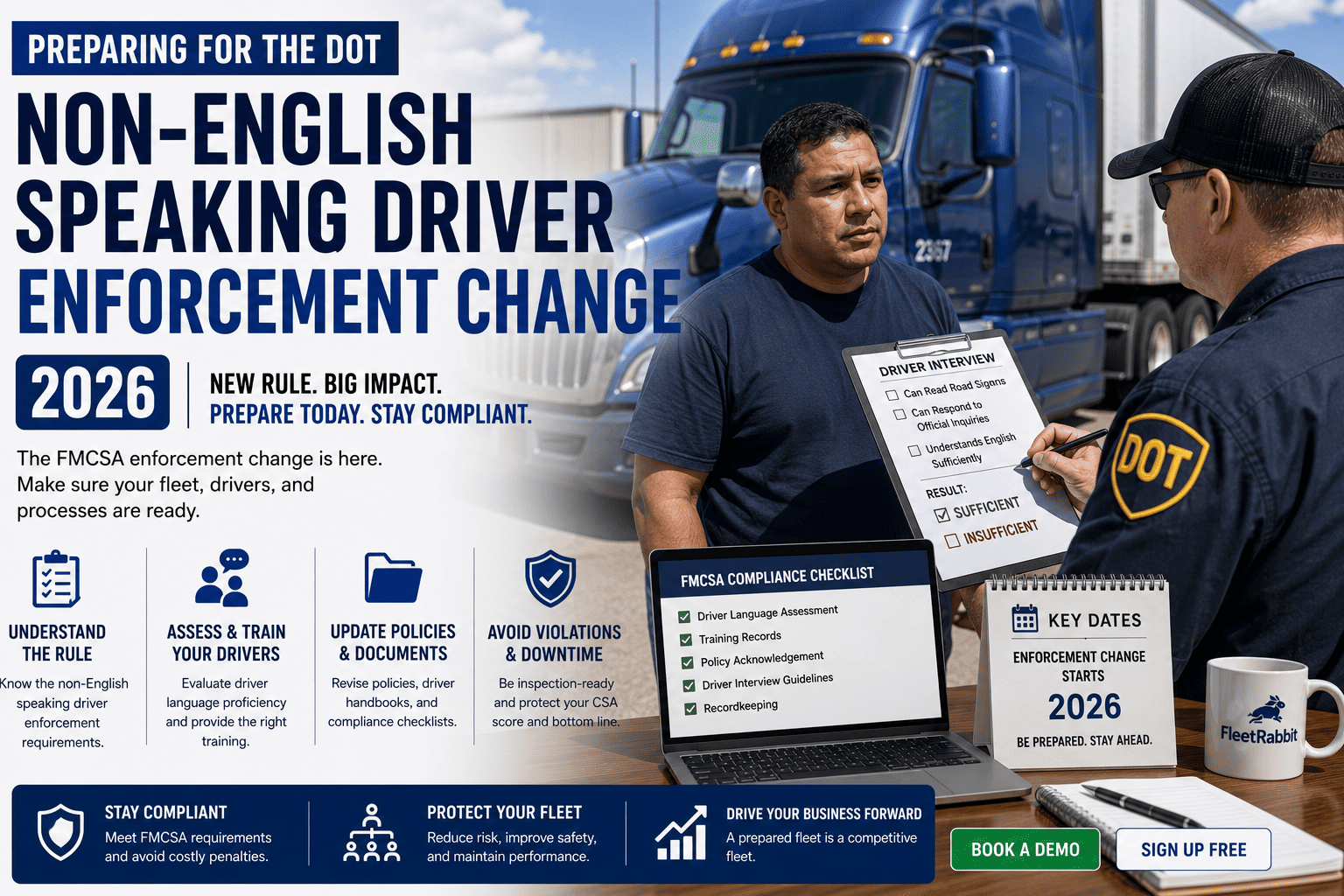
A driver who cannot pass a roadside English proficiency check can now be placed out of service on the spot, and that truck sits until the driver demonstrates compliance. This isn't a new rule quietly buried in the federal register, it's a fast-moving enforcement shift that has already sidelined thousands of drivers nationwide. For fleet managers, the real risk isn't the regulation itself, since English Language Proficiency has been a federal requirement for decades. The risk is discovering a driver isn't compliant during a roadside inspection instead of catching it during qualification review, where it belongs.
Since June 25, 2025, the Commercial Vehicle Safety Alliance has listed English Language Proficiency violations under 49 CFR 391.11(b)(2) as an out-of-service criterion, and the April 2026 edition of the inspection handbook made it permanent. Inspectors run a two-step assessment covering verbal interview and highway sign recognition, without translation aids. A failed assessment removes the driver from service immediately and can affect your CSA score. Verifying proficiency during onboarding, not waiting for a roadside inspection to find out, is now essential.
What Actually Changed In 2026
English Language Proficiency has been a qualification requirement under 49 CFR 391.11(b)(2) since long before this enforcement wave began. What changed is the enforcement posture, not the underlying rule. A 2016 policy memo had effectively suspended out-of-service enforcement for ELP violations for nearly a decade. That changed when a 2025 executive order directed FMCSA to reinstate full enforcement, and CVSA added ELP noncompliance to its North American Standard Out-of-Service Criteria. The April 2026 edition of the handbook now lists the requirement in print, making it a permanent, nationwide inspection standard rather than a temporary directive that could quietly reverse with the next policy memo.
The Border Zone Exception
FMCSA has clarified one narrow carve-out for drivers operating within specifically designated commercial zones along the U.S.-Mexico border. Inspectors can still cite a violation in these zones, but they are directed not to issue an out-of-service order there. This exception is geographically limited and does not apply to drivers operating outside those defined zones, so fleets should not assume it offers broader relief.
FleetRabbit helps you document and verify driver qualification records, including English proficiency confirmation, so nothing is left to a roadside inspection to discover. Sign up free to organize your driver files, or book a demo to see how it fits your fleet.
How The Roadside Assessment Actually Works
Understanding exactly what an inspector checks is the first step to verifying compliance before a driver ever hits the road. The table below breaks down each stage of the assessment and what carriers can do proactively at each point.
| Assessment Stage | What The Inspector Checks | What Disqualifies A Driver | What Carriers Should Verify First |
|---|---|---|---|
| Verbal Interview | Whether the driver can understand and respond to basic questions about themselves, the cargo, and the trip in English | Inability to respond sufficiently without translation assistance | Confirm English communication ability during onboarding interviews, not after a citation |
| Highway Sign Recognition | Whether the driver can identify and explain common U.S. highway traffic signs and signals | Failure to correctly identify standard signage shown by the inspector | Include sign recognition review as part of any driver orientation program |
| Assistance Restrictions | Whether the driver completes both steps independently | Reliance on an interpreter, passenger, or translation app during the assessment | Make clear during onboarding that no assistance will be available at roadside |
| Geographic Scope | Whether the stop occurs within a designated border commercial zone | Out-of-service orders apply everywhere except the narrow border zone carve-out | Don't assume any exception applies outside specifically defined zones |
What Carriers Are Responsible For Verifying
Carriers are generally responsible for confirming English Language Proficiency as part of the broader driver qualification process, alongside the other requirements already tracked in a driver's qualification file. Waiting for a roadside inspection to surface a gap means the cost has already been paid, in a stranded load, a recorded out-of-service order, and a CSA score hit that can follow the fleet for months.
Onboarding Verification
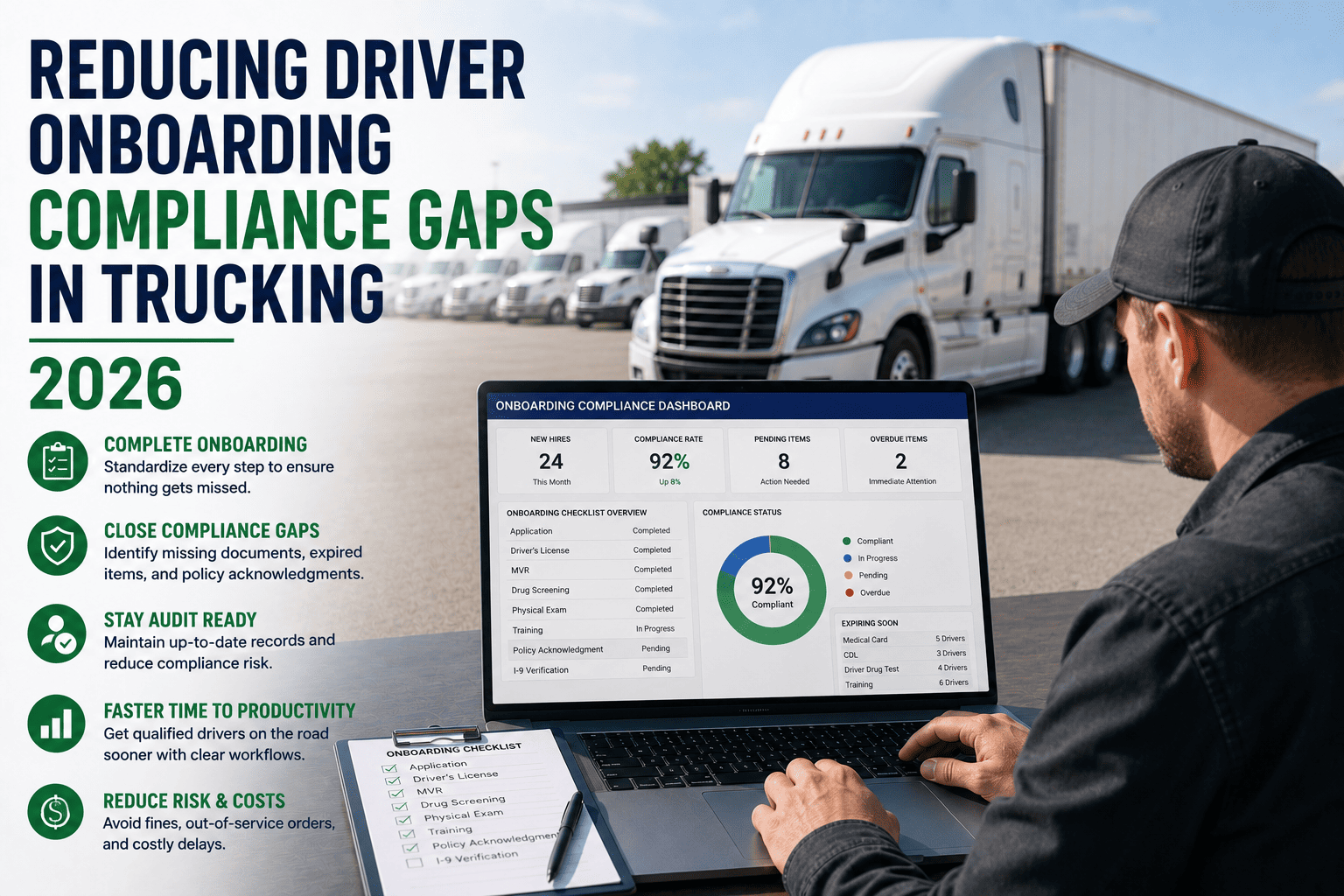
Confirming a new driver's ability to communicate in English and recognize standard highway signage during the hiring process is far cheaper than discovering a gap at a weigh station. This doesn't need to be a formal test, but it should be a documented part of the qualification review.
Ongoing Documentation
Keeping a record that English proficiency was confirmed, alongside the rest of a driver's qualification file, gives a fleet something concrete to point to if a driver's compliance is ever questioned during a review or after an incident.
Carrier Agreement Language
For fleets that lease drivers or work with owner-operators, reviewing carrier agreements for qualification language matters more than ever. If a partner carrier represents that its drivers are federally qualified, an ELP-related out-of-service event strengthens your position in any dispute over that representation.
FleetRabbit centralizes driver qualification documentation and flags gaps before an inspection finds them. Start your free sign up today, or book a 30-minute demo to review your current compliance posture.
The Downstream Cost Beyond The Stopped Truck
An out-of-service order for an English proficiency violation doesn't end when the driver is eventually cleared or replaced. It becomes part of the permanent record tied to your USDOT number, feeding directly into the Unsafe Driving and Driver Fitness categories of your CSA score. A rising CSA score makes brokers and shippers hesitant to book with a carrier, can increase insurance premiums, and quietly reduces access to better-paying freight for months after a single incident. Treating this as a qualification issue to solve at onboarding, rather than a roadside risk to manage after the fact, is the difference between a minor documentation update and a lasting hit to fleet reputation.
Making English Proficiency Compliance A Routine Check
The fleets least affected by this enforcement shift are the ones that already treated English proficiency as a standard part of driver qualification rather than an afterthought. Once verification happens during onboarding and lives in the same documented file as every other qualification record, a roadside inspection stops being a source of surprise and becomes a routine confirmation of something already on file.
FleetRabbit organizes every driver's qualification documentation in one place, helping your fleet stay ahead of ELP enforcement and every other compliance requirement that feeds your CSA score.