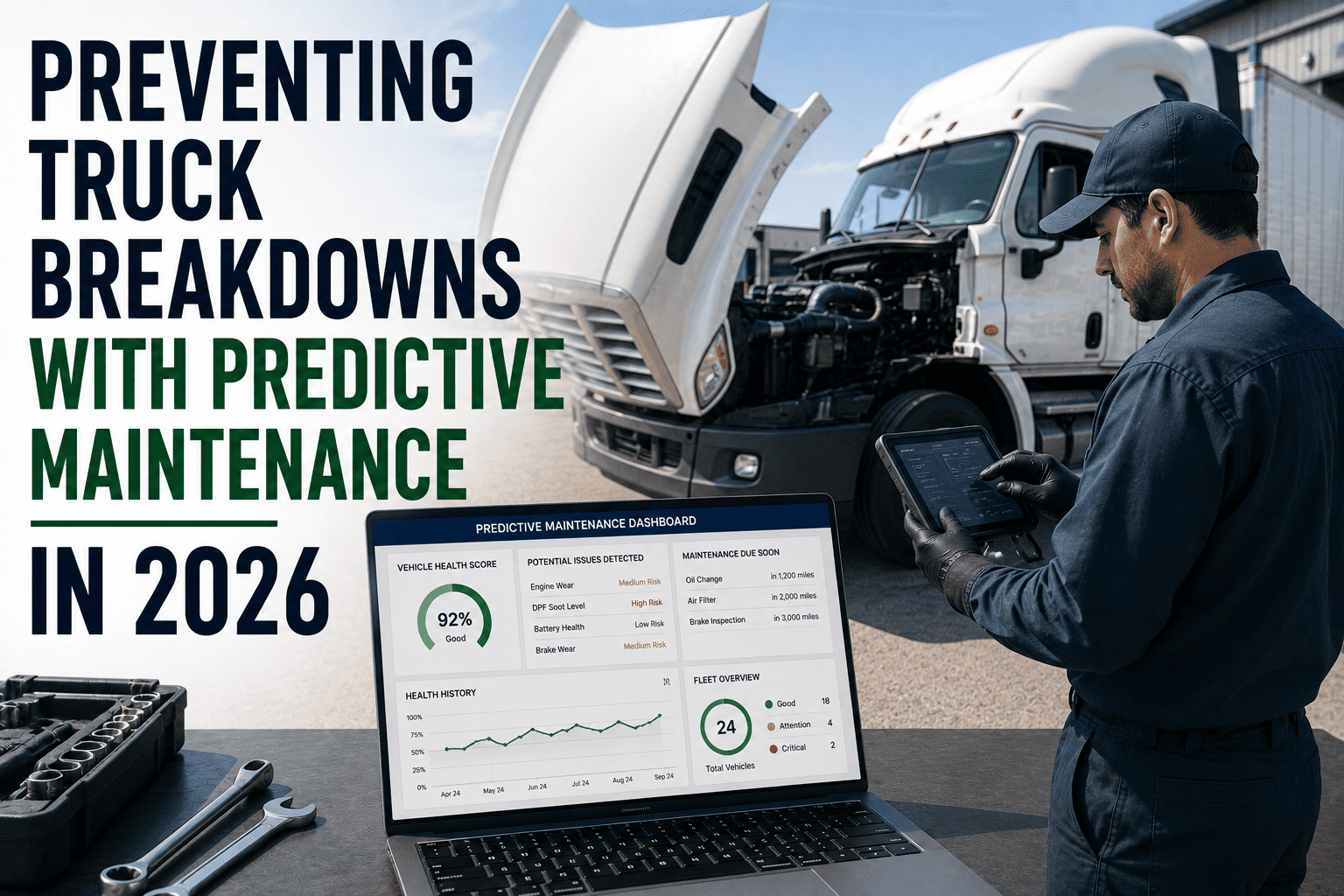
A truck does not usually break down out of nowhere. A bearing starts running hot weeks before it seizes. A brake pad thins out gradually for thousands of miles before it fails a roadside inspection. The warning signs are almost always there, sitting quietly in sensor data that nobody is watching. Predictive maintenance is the practice of watching that data continuously so a fleet manager finds out about the problem while it is still cheap to fix, not after a driver is stranded on the shoulder.
Predictive maintenance uses AI to analyze live sensor and telematics data and forecast component failures 2 to 4 weeks before they happen, instead of waiting for a fixed mileage interval or an actual breakdown. Fleets using it cut unplanned breakdowns by up to 45 percent and reduce maintenance costs by as much as 25 percent. Sign up free to connect your telematics and start receiving failure alerts within days.
The Moment a Breakdown Stops Being a Surprise
Most fleet managers have lived through the same bad afternoon. A driver calls in from the shoulder, the load is sitting still, and the clock on a missed delivery window is already running. The American Trucking Associations puts the direct repair cost of a single roadside breakdown between 450 and 760 dollars, and once towing, a missed delivery penalty, and driver downtime are added in, that figure climbs well past 1,900 dollars per incident. Across an average fleet still running reactive maintenance, vehicles experience roughly six unplanned breakdowns a year, which means this bad afternoon is not a rare event. It is a recurring budget line.
What changed in 2026 is not the trucks. It is the visibility into them. Sensors that used to live quietly inside the engine, transmission, and brake system now stream their readings continuously, and AI models trained on millions of miles of failure data can recognize the pattern that precedes a breakdown long before a human technician would notice anything unusual.
Engine and Cooling Signals
Coolant temperature trends, oil pressure drift, and fuel efficiency shifts can surface developing engine and cooling issues weeks before traditional diagnostics catch them.
Brake Wear Sensors
Brake lining sensors track remaining life in real time, flagging a component once it drops to a critical threshold so it can be replaced on a planned schedule rather than at the roadside.
Fault Code Patterns
A single truck can generate 300 to 400 fault codes a month. AI filters that noise and flags only the combinations that historically precede an actual failure.
Vibration and Load Behavior
Vibration patterns and sustained load behavior expose drivetrain and suspension wear that builds quietly under heavy daily use, long before a driver feels anything change.
How Predictive Maintenance Actually Spots a Failure Coming
Predictive maintenance is not a single sensor or a single alert. It is a continuous loop that compares what a vehicle is doing right now against what thousands of similar vehicles did in the days and weeks before they failed the same way.
Continuous Data Capture
Telematics and onboard sensors stream engine, brake, and drivetrain readings around the clock, with no manual inspection required.
Pattern Recognition
Machine learning models compare current readings against historical failure patterns across the fleet to spot early deviations.
Confirmed Risk Alert
An alert fires only once multiple independent signals agree, which keeps false positives low and trust in the system high.
Work Order Before Failure
A work order is generated automatically, parts are sourced at standard rates, and service happens during planned downtime instead of on the shoulder.
This is the part that changes the economics of maintenance entirely. Instead of a technician clearing a fault code and hoping it does not come back, the system tells the team something specific and actionable, such as a brake lining sitting at a low percentage of remaining life with a clear mileage window before it needs attention. Book a free demo and we will show you exactly what that alert looks like for your own fleet's vehicle classes.
FleetRabbit's AI monitors every truck in your fleet around the clock, correlating sensor signals before triggering an alert, and automatically opens a work order so your team acts on it instead of chasing it.
Predictive vs. Reactive: The Cost Gap Is Not Small
Fleet managers sometimes treat predictive maintenance as a nice-to-have layered on top of an already functioning maintenance program. The numbers tell a different story. The gap between a fleet that predicts failures and one that reacts to them is not incremental, it is structural, touching repair cost, downtime, and even how parts get purchased.
| Factor | Reactive Maintenance | Predictive Maintenance |
|---|---|---|
| Average Repair Cost | 490 to 1,900+ dollars per incident, including towing and downtime | Planned repair at standard labor and parts rates |
| Breakdowns Per Vehicle Annually | Roughly 6 unplanned breakdowns industry average | Reduced by up to 45 percent with AI monitoring |
| Parts Procurement | Rush shipping and emergency sourcing premiums | Standard shipping ordered weeks in advance |
| Warning Window | None, the failure is discovered in the moment | 2 to 4 weeks of advance notice on most major components |
| Fleet Uptime | Roughly 87 percent industry baseline | Climbing to 94 to 96 percent with predictive programs |
The First Prevented Breakdown Usually Pays for the Platform
This is the figure that tends to convince skeptical fleet managers fastest. A single prevented breakdown on a Class 8 truck avoids 8 to 15 hours of downtime and 2,000 to 4,000 dollars in emergency repair and lost productivity. Most predictive maintenance subscriptions cost far less than that per vehicle per year, which means the very first failure the system catches often covers the entire cost of running it.
What Changes Inside a Fleet After Switching to Predictive
The shift is not just financial. It changes how a maintenance team spends its day, how dispatch plans routes, and how drivers experience the trucks they are handed every morning.
Technicians Stop Guessing
Instead of clearing a fault code and hoping it does not return, technicians receive a specific component, a confidence level, and a recommended service window, which shortens diagnostic time significantly.
Dispatch Plans Around Service, Not Around Surprises
Knowing a vehicle needs attention within a specific mileage window lets dispatch route it for service between runs instead of pulling it off the road mid-route.
Parts Get Ordered Before They Are Urgent
Forecasting parts needs weeks ahead enables standard shipping and bulk pricing, cutting emergency procurement costs by 40 to 60 percent for fleets that adopt the practice.
Drivers Get Fewer Surprises on the Road
Fewer roadside breakdowns means fewer stranded drivers, fewer missed home time windows, and a measurable improvement in driver satisfaction and retention over time.
None of this requires replacing a fleet's existing telematics hardware. Predictive maintenance platforms connect to the data a fleet is already generating and start producing useful alerts within days, not months. If your team is ready to see what that looks like with your own vehicles, sign up for FleetRabbit and connect your telematics directly.
Predictive and Preventive Are Not Competitors
One of the most common misconceptions is that predictive maintenance replaces preventive scheduling. It does not. Preventive maintenance handles the items that wear predictably with mileage or time, like oil changes and filter swaps. Predictive maintenance fills the gap preventive scheduling cannot reach, catching the failures that develop between fixed service intervals on components where an unplanned failure is expensive or dangerous. The leading fleets in 2026 run both at once, applying preventive schedules to routine, low-risk items and predictive monitoring to the high-value components where a surprise failure actually hurts.
Where Predictive Monitoring Earns Its Keep
Not every part of a truck needs AI-level scrutiny. The components worth predictive attention are the ones where failure is both expensive and disruptive: engines, transmissions, brake systems, cooling systems, and on temperature-controlled fleets, the refrigeration unit itself. A transmission failure mid-route on a long haul can cost 8,000 to 12,000 dollars once emergency repair, driver wages, and detention are added together, which is exactly the kind of failure predictive monitoring is built to catch weeks in advance.
Frequently Asked Questions
The Bottom Line on Predicting Truck Breakdowns
Breakdowns feel random when a fleet has no visibility into the data that precedes them, but the patterns are almost always there days or weeks beforehand. The fleets pulling ahead in 2026 are not the ones spending the most on maintenance. They are the ones that removed the guesswork from maintenance decisions entirely, replacing the sinking feeling of a roadside call with a calm work order generated days in advance.
FleetRabbit's predictive maintenance system monitors every truck in your fleet continuously, correlates signals before raising an alert, and turns raw sensor data into a clear, actionable service window your team can plan around.
Connect your telematics and let FleetRabbit's AI watch every truck in your fleet around the clock. Get your first failure prediction within days and turn the next breakdown into a planned repair instead of a roadside emergency.