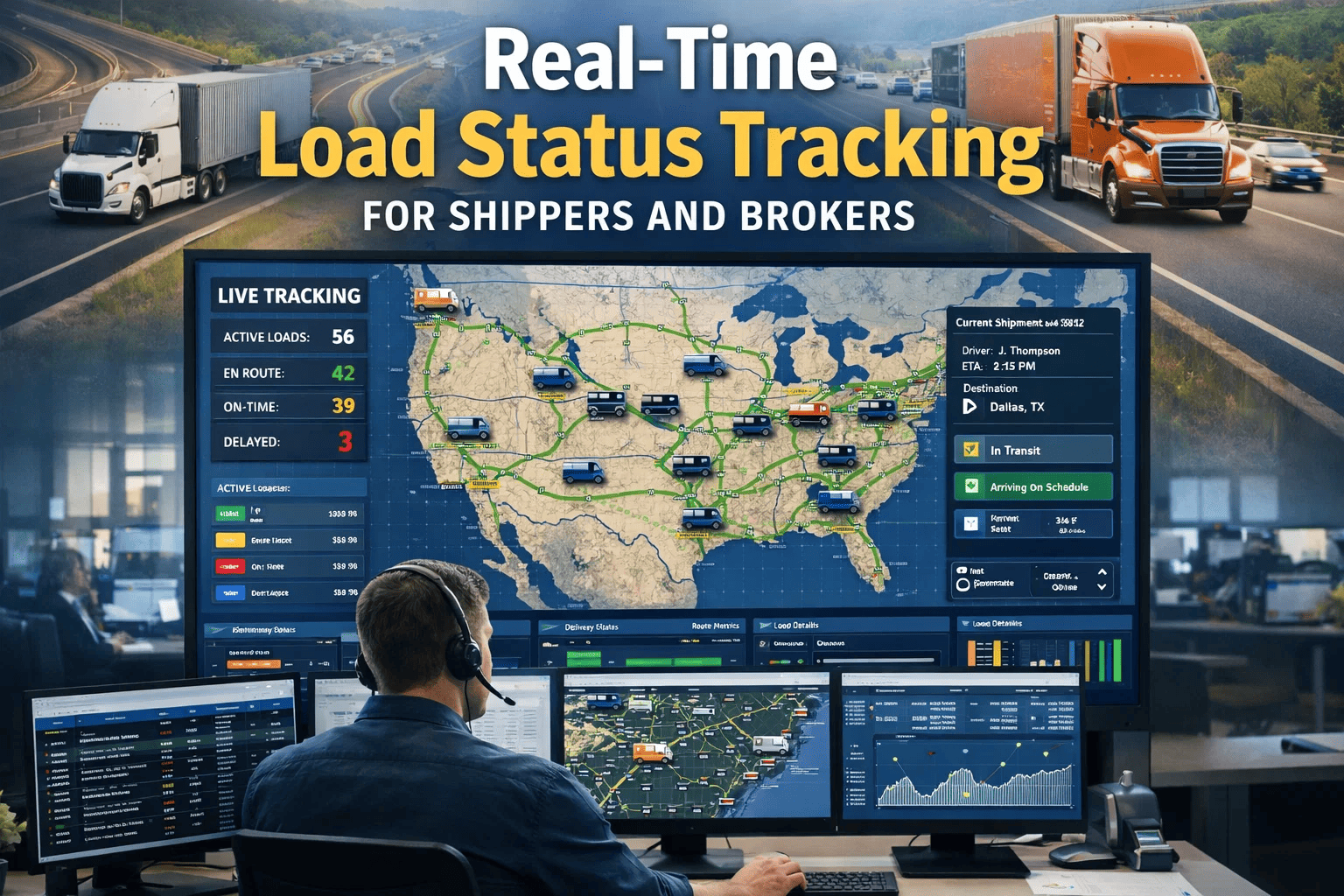
Shippers and freight brokers operating in today's competitive logistics environment face an expectation shift that has fundamentally altered what carrier relationships require: real-time shipment visibility is no longer a premium service offering — it is the baseline standard that determines carrier qualification for high-value freight contracts. The ability to answer, at any moment, where a specific load is, when it will arrive, and whether any service disruption is occurring has moved from a differentiating capability to a table-stakes requirement for carrier operations of all sizes. FleetRabbit's real-time load status tracking platform provides the operational visibility infrastructure that enables carriers to meet this standard consistently across their entire fleet — while giving dispatchers, fleet managers, and customer service teams the integrated information architecture they need to manage operations proactively rather than reactively.
Shipper Relationships Are Built on Load Visibility. FleetRabbit Delivers It Automatically — For Every Load, Every Mile.
Carriers providing proactive real-time load status updates win 2.4 times more contract renewal decisions than carriers relying on driver-initiated check calls. FleetRabbit's integrated tracking platform eliminates manual check calls, provides GPS-accurate position data and ETA calculations, and delivers automated shipper notifications at every milestone — without dispatcher intervention for routine updates.
Higher contract renewal rate for carriers providing automated real-time shipper visibility vs. check-call-dependent operations
Of shippers in 2024 freight surveys cited real-time tracking as a primary carrier qualification criterion for new freight awards
Reduction in inbound shipper status inquiry calls after automated milestone notification implementation
Average dispatcher time saved weekly per 20 active loads through elimination of routine check-call status management
The Load Visibility Standard That Shippers Now Require
The freight industry's visibility expectations evolved rapidly over the past five years, driven by shipper experience with e-commerce parcel tracking and the operational pressure of lean supply chain management. Understanding exactly what shippers and brokers require — and what gaps in carrier operations most frequently disqualify carriers from premium freight opportunities — frames the specific capabilities that FleetRabbit's platform addresses.
What Shippers Now Expect as Baseline
Where Carrier Visibility Gaps Create Commercial Risk
FleetRabbit's Real-Time Load Tracking Architecture
FleetRabbit delivers load status visibility through an integrated architecture that combines GPS telematics data, dispatch system records, and driver mobile application events into a single, continuously updated load status record — accessible to dispatchers, fleet managers, and authorized external stakeholders without separate system access or data export requirements.
Continuous Vehicle Position Data via GPS Integration
FleetRabbit integrates with GPS telematics devices installed across the carrier's fleet to receive continuous vehicle position data — typically updated every 15 to 60 seconds depending on network connectivity and device configuration. Position data is linked to the active load record for the vehicle, enabling real-time map display of load progress and ETA calculation that reflects actual vehicle position against the route and appointment schedule.
Load Assignment and Route Information From Dispatch Module
FleetRabbit's dispatch module provides the load definition — origin, destination, scheduled pickup and delivery appointments, stop sequence for multi-stop loads, and special handling requirements — that provides the context against which GPS position data is interpreted. Load assignment records connect vehicle and driver identity to the load lifecycle, ensuring that position data and status events are automatically attributed to the correct load record without manual dispatcher intervention for routine updates.
Driver-Confirmed Status Events via Mobile Application
FleetRabbit's driver mobile application provides structured event capture for load lifecycle milestones — en route to pickup confirmation, arrival at pickup, loaded and secured confirmation, en route to delivery, arrival at delivery, and proof of delivery capture. Driver-initiated events supplement automated GPS-based geofence triggers for precise milestone documentation, provide the delivery documentation required for billing and dispute resolution, and capture additional context notes where operational exceptions require explanation.
Dynamic ETA Calculation and Recalculation
FleetRabbit's ETA engine continuously recalculates estimated arrival times based on current vehicle position, remaining route distance, current route traffic conditions via mapping API integration, HOS remaining hours for the assigned driver, and historical transit time data for the specific lane and time-of-day profile. ETAs are updated automatically as conditions change — not only when dispatchers manually update schedule records — providing external stakeholders with delivery projections that reflect operational reality rather than original schedule assumptions.
Automated Stakeholder Notification at Configured Milestones
FleetRabbit's notification configuration enables carriers to define exactly which load lifecycle events trigger external notifications to which recipient types — shippers, brokers, consignees, or internal operations staff. Notification content, delivery channel (email, SMS, or API webhook), and recipient list are configured per customer or per load type without requiring dispatcher action for individual loads. Automated notifications eliminate the dispatcher time currently consumed by routine outbound status communications while improving notification consistency and timing accuracy.
Modernize Your Load Visibility Program Without Changing Your Operations Structure
FleetRabbit's tracking integration works with your existing GPS devices, existing dispatch workflow, and existing carrier-shipper relationships — adding the real-time visibility layer and automated notification infrastructure that converts your current tracking from reactive to proactive.
What Real-Time Tracking Means for Dispatcher Efficiency and Operations Center Capacity
Dispatcher capacity is the operational constraint that limits carrier growth more frequently than equipment availability or driver count. The time burden of check-call-based status management — inbound shipper inquiries, outbound driver calls to confirm position, manual load board updates, and reactive incident handling — consumes dispatcher attention that should be applied to load optimization, driver support, and customer relationship management. FleetRabbit's automation directly addresses this capacity constraint.
Current Dispatcher Time Allocation in Check-Call Operations
Dispatcher Time Allocation with FleetRabbit Automation
Geofencing and Automated Milestone Management in FleetRabbit
Geofencing — the automatic detection of a vehicle entering or exiting a defined geographic boundary — is the core technology that enables automated load milestone management without driver or dispatcher input for routine events. FleetRabbit's geofencing capability converts location data into operational events that drive notification sequences, status record updates, and time-stamp documentation automatically.
Pickup Location Arrival Detection
When a vehicle enters the geofenced boundary of the pickup location address, FleetRabbit automatically timestamps the arrival event, records it in the load history, and triggers the configured notification sequence for arrival confirmation — typically including notification to the shipper's receiving dock system and internal dispatch dashboard status update. Arrival time documentation is capture automatically, eliminating the need for driver-reported arrival calls and providing an objective timestamp for appointment adherence tracking.
Departure After Loading Confirmation
Vehicle departure from the pickup geofence triggers the loaded-and-departed status event, combined with the driver's mobile app loaded confirmation event which captures weight, seal number, and any condition notes at pickup. The loaded departure event initiates the delivery ETA calculation sequence and triggers the configured en-route notifications to the consignee — giving delivery facilities lead time for receiving dock scheduling based on real-time departure data rather than scheduled pickup appointments.
Delivery Location Approach Notification
A configurable distance-or-time threshold before the vehicle reaches the delivery geofence triggers an approaching delivery alert — typically sent to the receiving facility and the broker or shipper contact. This approach notification enables dock scheduling optimization at high-volume facilities and eliminates the surprised arrival scenario that creates dock congestion and driver wait time at facilities without real-time visibility into inbound load status. Approach notification lead time is configurable per customer based on their scheduling requirements.
Delivery Confirmation and POD Capture
Geofenced delivery arrival is combined with driver mobile application proof of delivery capture — signature, timestamp, photo documentation, and exception notation for short or damaged delivery. FleetRabbit automatically assembles the complete delivery documentation package and generates the post-delivery notification sequence to shipper, broker, and internal billing trigger. Electronic POD is available for download or API retrieval immediately after driver capture — eliminating the physical paperwork delay that creates billing cycle lag in conventional carrier operations.
Exception Management: How FleetRabbit Converts Delay Events Into Proactive Communications
The highest-value dimension of real-time tracking for shipper relationships is not routine milestone confirmation — it is proactive exception notification. The difference between a shipper receiving advance warning of a delay versus discovering a missed appointment at the point of failure determines whether service disruptions damage relationships permanently or are managed as acceptable operational realities. FleetRabbit's exception engine monitors active loads for delay risk and generates structured alerts that enable proactive management before outcomes become visible to the shipper as service failures.
Appointment Jeopardy Detection
FleetRabbit continuously compares current ETA projections against scheduled appointment windows. When ETA analysis indicates that on-time delivery is at risk — either due to traffic, distance, or driver HOS constraints — an appointment jeopardy alert is generated to dispatch with sufficient lead time to contact the consignee proactively. The alert includes current vehicle position, estimated delay duration, and root cause classification — enabling informed communication rather than uncertain apology. Early notification consistently results in better relationship outcomes than same-time or after-the-fact disclosure.
Hours of Service Constraint Flagging
FleetRabbit's integration of HOS monitoring data with dispatch load tracking enables proactive identification of loads where the assigned driver's available hours may be insufficient to complete delivery without a mandatory rest break. When HOS analysis indicates potential delivery constraint, the platform flags the load for dispatcher review with sufficient advance notice to arrange driver swap, contact the consignee, or adjust scheduling to accommodate a legal rest requirement — avoiding both the service failure and the HOS violation that compounds it.
Detention Time Monitoring and Documentation
FleetRabbit monitors vehicle dwell time at pickup and delivery facilities against configured benchmark thresholds. When a vehicle has been stationary at a facility for longer than the expected loading or unloading time, a detention alert is generated to dispatch — enabling proactive shipper contact for expedited dock access and creating the timestamped documentation required for detention time billing. Automated detention monitoring and documentation significantly improves detention claim recovery rates compared to driver-reported detention that lacks objective timestamp evidence.
Route Deviation Detection
When a vehicle deviates significantly from the planned route — beyond the tolerance threshold configured for normal navigation variation — FleetRabbit generates a route deviation alert to dispatch. Route deviation monitoring is particularly valuable for high-security and pharmaceutical cargo loads where route deviation has insurance and regulatory implications, and for loads approaching scheduled appointments where an unexpected route deviation may indicate a navigation error that will compound a growing delay risk already identified by ETA analysis.
The Competitive Advantage of Visibility in Freight Contract Competition
Real-time load tracking visibility translates directly into commercial advantage in the carrier-shipper relationship market — affecting routing guide positioning, lane award decisions, and broker network inclusion in ways that directly determine revenue opportunities. Fleet managers and carrier executives who understand this commercial connection make better decisions about visibility technology investment and can articulate the ROI case in terms that resonate with executive-level audiences.
01
Routing Guide Positioning Advantage
Shippers managing routing guides for their transportation spend increasingly require tracking capability documentation as part of carrier qualification. Carriers demonstrating real-time GPS tracking with automated notification capability consistently achieve higher routing guide positions at major shippers than carriers of equivalent equipment quality and pricing who cannot provide equivalent visibility. Routing guide position determines tender volume — carriers with higher positions receive more loads per lane, directly amplifying the commercial return on the visibility investment.
02
Broker Network Access and Load Availability
Digital freight brokers and lead logistics providers increasingly require carrier tracking integration as a condition of network participation. FleetRabbit's API-accessible tracking data enables carrier integration with broker shipper portals — providing the automated visibility feed that broker clients require without individual dispatcher intervention for each load. Carriers without API tracking capability are systematically excluded from broker networks that serve the highest-margin freight, regardless of their capacity quality or pricing competitiveness.
03
Contract Renewal Leverage Through Performance Documentation
FleetRabbit's complete load history provides carriers with objective, timestamped documentation of on-time performance, detention events, and exception management during the contract period. During annual rate negotiations and contract renewal conversations, carriers who can provide data-supported service performance records have significantly stronger positions than carriers relying on general experience impressions. Documented performance becomes a negotiating asset — demonstrating the value delivered by the carrier relationship in terms that are concrete, auditable, and directly responsive to shipper concerns about service consistency.
04
Customer Service Differentiation for Mid-Size Carriers
For regional and mid-size carriers competing against national carriers with dedicated visibility teams and technology budgets, FleetRabbit enables delivery of enterprise-level load visibility with the same automated, self-service character that large carriers provide — without the overhead of a separate customer service team managing status inquiries. This technological equivalence allows mid-size carriers to compete for shipper relationships that would otherwise default to larger carriers on the basis of visibility capability alone.
FleetRabbit Load Tracking for Brokers: Fulfilling Shipper Visibility Commitments
Freight brokers occupy a position where their shipper relationships depend on their ability to deliver visibility into loads that are physically moving under carrier operations they do not directly control. FleetRabbit's carrier-side tracking infrastructure directly supports broker shipper commitments through API data access that allows broker platforms to display carrier position data within broker-branded shipper portals without requiring separate carrier platform access.
Carrier Position Data API for Broker Platform Integration
FleetRabbit exposes real-time vehicle position and load status data through a documented API that broker logistics technology platforms can access with carrier authorization. This integration enables brokers to display accurate carrier GPS position data within their own shipper portals — fulfilling shipper visibility commitments without requiring shippers to access carrier systems or brokers to build independent tracking infrastructure. API connectivity positions carrier-broker relationships as technology partnerships rather than pure cost negotiations.
Electronic Load Tender and Status Update Integration
FleetRabbit supports electronic load tender receipt from broker Transportation Management Systems — enabling automatic load creation in the carrier's dispatch module from broker tender data without manual re-entry. Accepted tenders automatically establish the tracking record that feeds position data and milestone events back to the broker system through the same API connection. The bidirectional information flow eliminates the manual data exchange that creates information lag in conventional carrier-broker operations and reduces administrative burden on both parties simultaneously.
Automated POD and Load Closure Documentation
FleetRabbit's electronic proof of delivery workflow generates the delivery documentation that brokers require for load closure and shipper invoicing in a format that can be delivered automatically to broker systems via API or email — without requiring fleet managers or administrative staff to manually retrieve and transmit delivery documentation for each load. Automated POD delivery eliminates the billing delay that currently exists between physical delivery and invoice generation in carrier operations relying on paper documentation workflows.
Frequently Asked Questions: Real-Time Load Status Tracking for Transportation Operations
Does FleetRabbit's load tracking work with the GPS telematics devices already installed in our fleet?
FleetRabbit integrates with a wide range of commercial GPS telematics hardware and platform providers commonly deployed in transportation fleets. The platform's OEM telematics integration layer connects with major telematics providers to receive vehicle position data without requiring hardware replacement or duplicate device installation. During FleetRabbit onboarding, your current telematics provider is assessed for integration compatibility and the connection is configured within the onboarding period. Carriers without existing telematics may implement FleetRabbit's tracking using the driver mobile application as the primary position data source while telematics hardware is procured and installed.
Can shippers and consignees access load tracking information directly through a self-service portal?
Yes. FleetRabbit supports external stakeholder access to load status through configurable visibility sharing — allowing carriers to provide shippers, consignees, or broker contacts with load-specific tracking links or portal access that displays current position, ETA, and milestone status for their specific load. External access is scoped to the specific load the stakeholder is authorized to view — not the carrier's full fleet or operational data. This self-service visibility capability directly reduces inbound status inquiry volume to carrier operations centers and improves shipper experience simultaneously.
How does FleetRabbit handle multi-stop loads with multiple pickup and delivery locations?
FleetRabbit's dispatch module supports full multi-stop load configuration — defining stop sequence, appointment windows, and load/unload requirements at each location. GPS tracking and geofencing operate at each configured stop, generating arrival and departure events for every location in the load sequence. Milestone notifications are configured independently for each stop, enabling consignee-specific notifications at each delivery location in the stop sequence. ETA calculations account for time remaining to each subsequent stop based on completion of prior stops and current traffic conditions on the remaining route segments.
What happens to load tracking visibility when a vehicle enters a low-connectivity area?
FleetRabbit handles telematics connectivity gaps through position data buffering — GPS devices store position records locally when cellular connectivity is unavailable and transmit the buffered position history as a batch when connectivity is restored. The platform recognizes connectivity gaps in the position feed and reflects this in the load status display — distinguishing between a vehicle in low-connectivity area and a vehicle that has gone off-network abnormally. For extended connectivity loss events, FleetRabbit generates an alert to dispatch for awareness, enabling proactive customer communication if delivery appointment accuracy may be affected by the tracking gap.
How does FleetRabbit's tracking system document detention time for billing purposes?
FleetRabbit records arrival and departure timestamps at every geofenced pickup and delivery location with second-level precision. When a vehicle's departure from a location occurs after the configured free-time window expires, FleetRabbit automatically calculates the detention duration based on the objective geofence event timestamps — not driver-reported times, which are subject to challenge in detention billing disputes. The detention event is documented in the load record with the exact arrival time, free-time expiration, departure time, and billable detention calculation. This documentation is exportable for inclusion with detention invoices and provides the objective timestamp evidence that significantly improves claim acceptance rates with shipper accounting departments.
Can FleetRabbit's load tracking be integrated with our existing TMS or freight billing system?
FleetRabbit's integration layer supports connection with Transportation Management Systems and freight billing platforms through API connectivity and structured data exchange. Load status events, delivery confirmations, detention documentation, and electronic POD can be transmitted to connected systems automatically as milestone events occur — eliminating manual data transfer between systems and the billing delays it creates. Integration configuration is managed during onboarding with support from the FleetRabbit technical team. Contact FleetRabbit with your current TMS platform details to confirm integration scope and data exchange capabilities for your specific operational environment.
Implementing FleetRabbit Load Tracking: What Fleet Managers and Operations Teams Experience
Transportation operations that implement FleetRabbit's load tracking platform consistently report that the most significant early benefit is not the most obvious one. While external shipper satisfaction improvement is the stated objective that drives implementation decisions, the most immediately felt change inside carrier operations is the reduction in reactive status communication burden on dispatchers and the improvement in load exception awareness that enables genuinely proactive management.
Week One to Two
GPS telematics integration connected and position feed verified. Driver mobile application deployed and driver onboarding completed. Geofences configured for primary customer pickup and delivery locations. Dispatcher dashboard orientation complete. Initial automated notification templates configured for primary shipper contacts.
Week Three to Four
First complete load cycle documented through FleetRabbit tracking from tender to POD. Notification configuration refined based on initial shipper feedback regarding event types and timing preferences. Dispatcher workflow adaptation complete — check-call protocols modified to use platform status as primary source rather than driver phone calls. First detention documentation event generated and validated for billing use.
Month Two to Three
Inbound shipper status inquiry volume measurably reduced from initial baseline. Dispatcher time allocation analysis updated to confirm capacity recovery. Exception handling workflow adapted to use FleetRabbit delay alerts as the primary trigger for proactive shipper communication. On-time delivery rate visibility established for contract performance reporting. First shipper contract renewal conversation conducted with FleetRabbit performance data as supporting documentation.
Real-Time Load Visibility Is the Infrastructure That Modern Carrier-Shipper Relationships Require. FleetRabbit Delivers It Without Operational Disruption.
The transportation carriers building durable, high-value shipper relationships in today's market are not competing on rate alone — they are delivering the operational transparency that shippers require to manage their supply chains confidently. Real-time GPS tracking, automated milestone notifications, proactive exception management, and electronic POD are no longer differentiating features. They are the operational baseline that determines whether a carrier is considered for premium freight opportunities.
FleetRabbit provides the complete visibility infrastructure to meet this standard — integrated with your existing GPS devices, dispatch workflow, and carrier-shipper relationships. The platform converts your current tracking from a reactive dispatch tool into a proactive operational intelligence system that reduces administrative burden, improves shipper satisfaction, and creates the performance documentation that strengthens your commercial position in every contract renewal conversation.
Give Your Shippers and Brokers the Visibility That Wins Freight and Builds Long-Term Relationships
FleetRabbit's real-time load tracking, automated milestone notifications, exception management, and electronic POD give carriers of all sizes the visibility infrastructure that major shippers require — without adding dispatcher headcount or changing your existing operations structure.