Transportation and logistics companies operate under one of the most document-intensive regulatory frameworks in the United States. The Federal Motor Carrier Safety Administration mandates specific retention timelines for dozens of record categories — and a single missing document during a DOT audit can result in fines, increased CSA scores, and in severe cases, out-of-service orders that halt your entire operation. Yet the majority of fleet managers continue to rely on filing cabinets, shared drives, and manual spreadsheets to store records that represent millions of dollars in compliance liability. This guide covers every FMCSA record retention requirement your fleet must meet, the operational risks of non-compliance, and how FleetRabbit transforms record management from a manual burden into an automated, audit-ready system.
Why FMCSA Record Retention Is a Strategic Priority, Not an Administrative Task
Fleet executives who treat compliance recordkeeping as a back-office function are exposing their operations to financial and operational risk that far exceeds the cost of any compliance system.
The FMCSA does not grade on a curve. When a compliance review officer arrives at your terminal — whether for a routine audit or following a roadside incident — your records must be present, complete, legible, and retrievable within the timeframes the agency expects. A document that existed but cannot be located is treated identically to a document that was never created.
For fleet managers and directors of operations in transportation and logistics, this creates a practical problem: records span multiple departments, multiple vehicle types, multiple drivers, and multiple regulatory categories — each with its own retention clock. Driver qualification files, vehicle maintenance records, hours-of-service logs, drug and alcohol testing records, accident reports, and hazardous materials documentation all carry different retention timelines that must be tracked simultaneously, often across dozens or hundreds of employees and assets.
The consequences of failure extend beyond direct fines. FMCSA assigns safety ratings — Satisfactory, Conditional, and Unsatisfactory — that determine your ability to operate, your insurance premiums, and your attractiveness as a carrier partner to shippers and brokers. An Unsatisfactory rating can trigger a consent order or, in the most serious cases, a cease-operations order. The reputational and contractual damage from a poor safety rating compounds over years and is far more costly than any compliance software investment.
Complete FMCSA Record Retention Schedule — By Category
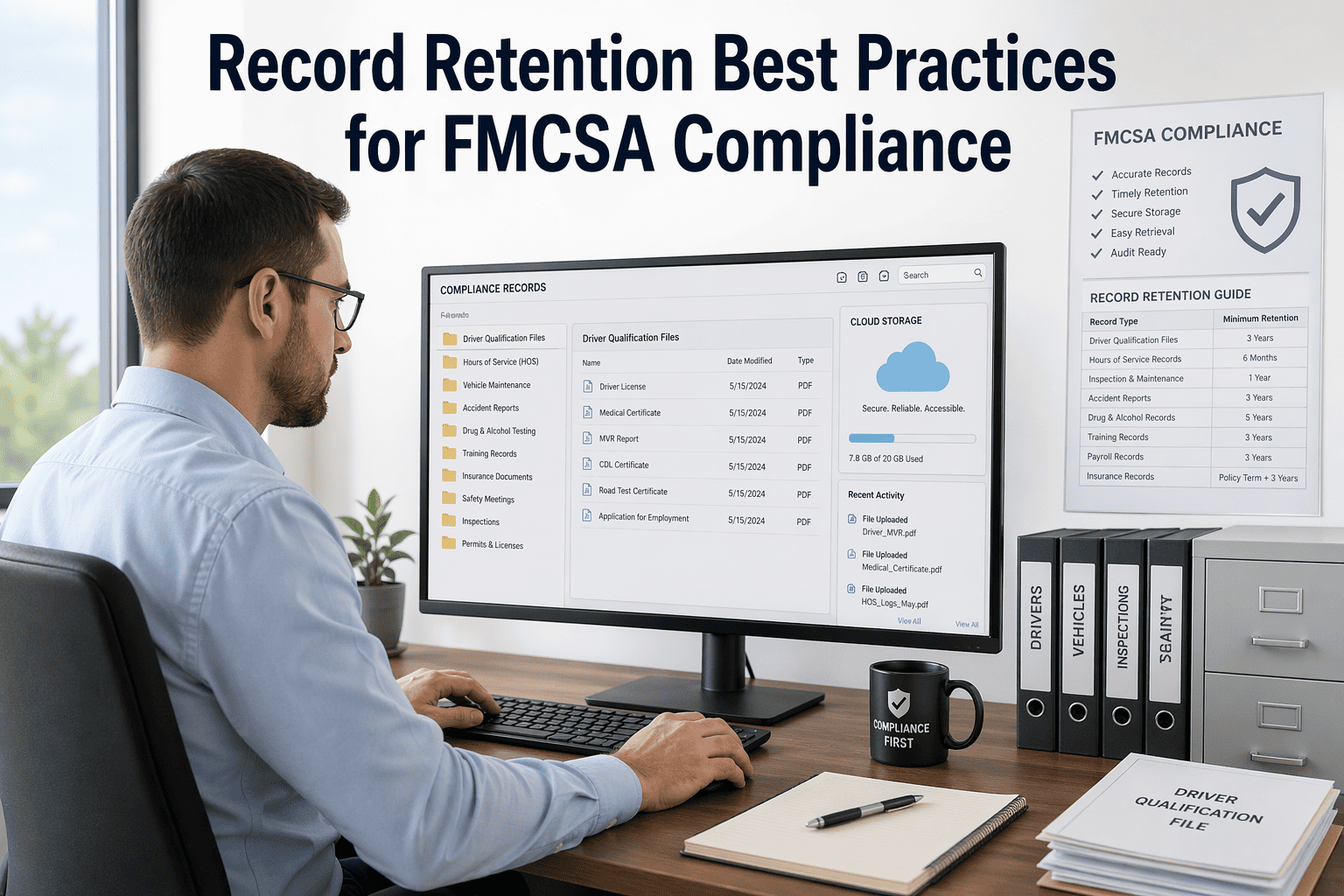
Every motor carrier subject to FMCSA regulations must understand and comply with the specific retention timelines for each record category below. These timelines are mandated under 49 CFR Parts 391, 395, 396, and 382.
Driver Qualification Files
Driver qualification files must be retained for the duration of employment plus three years after the driver leaves the company. However, specific components carry extended timelines. The medical examiner's certificate must be maintained for three years from the date of examination. Annual reviews of driving records must be retained for three years. The original employment application must be kept for the duration of employment plus three years. For commercial driver's license holders, the motor vehicle record check must be retained for three years.
In practice, this means a driver who worked for your company for ten years requires a qualification file that is complete, retrievable, and intact for thirteen years from the date of hire — covering documents that may have been created across multiple management regimes, location changes, and paper filing systems.
Hours of Service Records
Electronic logging device records and supporting documentation must be retained for six months. This applies to ELD data files, driver annotations, graph grid motor carrier copies, and supporting documentation such as bills of lading, itineraries, and schedules used to support HOS calculations. The six-month clock begins from the date the record was created, not from the date of the trip or duty period.
For carriers using paper logs prior to the ELD mandate, the same six-month retention applies. Any exemption documentation — such as short-haul exemption records or agricultural operations exemptions — must also be retained and available to demonstrate the basis for the exemption claimed.
Vehicle Inspection and Maintenance Records
Driver Vehicle Inspection Reports must be retained for three months from the date of preparation. Annual inspection reports — the annual safety inspection required for every commercial motor vehicle — must be retained for fourteen months to ensure overlap between the current and prior year's inspection. Systematic inspection, repair, and maintenance records must be retained for one year while the vehicle is in service and for six months after the vehicle leaves your fleet.
The DVIR record is particularly important because it creates the documented link between a driver-reported defect and the maintenance action taken to correct it. A DVIR without a corresponding repair certification, or a repair certification without the originating DVIR, creates a compliance gap that auditors flag immediately.
Drug and Alcohol Testing Records
Drug and alcohol testing records carry the longest retention requirements in the FMCSA framework. Records of alcohol tests with a result of 0.02 or greater must be retained for five years. Records of verified positive controlled substances tests must also be retained for five years. Refusal-to-test determinations must be retained for five years. Calibration documentation and records of employee training programs related to testing must be retained for two years. Records of negative drug test results and alcohol tests below 0.02 must be retained for one year.
Employers must also retain documentation of the testing program itself — random testing consortium enrollment, random selection methodology, and annual MIS data summary reports — for the applicable retention periods.
Accident Register and Accident Reports
Motor carriers must maintain an accident register for three years from the date of each accident. The accident register must contain the date and nature of each accident, the city or town and state where the accident occurred, the driver involved, the number of injuries and fatalities, and whether any hazardous materials were released. For accidents meeting the FMCSA recordable threshold — which includes fatalities, injuries requiring medical treatment beyond first aid, or disabling damage to any vehicle — additional documentation including police reports, insurance claims, and investigation records should be maintained alongside the register entry.
CDL Driver Documentation
Commercial driver's license verification and annual motor vehicle record checks must be retained for three years. Documentation of the annual review of the driver's driving record, as required under 49 CFR 391.25, must be retained for three years. If a driver has lost CDL privileges or has been disqualified from operating a commercial motor vehicle, documentation of that disqualification and the carrier's response must be retained for three years following the disqualification event.
The Hidden Cost of Manual Record Retention in Transportation Fleets
Paper-based and spreadsheet-driven compliance systems introduce operational risk at every stage of the document lifecycle — from creation to retrieval.
Risk 1 — Document Creation Gaps
Manual DVIR and paper-based inspection processes rely entirely on driver discipline and supervisor oversight. When a driver skips a defect entry or submits an incomplete report, the omission is rarely caught until an audit or incident surfaces it. In a fleet operating 50 vehicles across multiple terminals, a daily inspection completion rate below 100 percent creates compliance exposure that accumulates silently over months. FMCSA auditors cross-reference inspection records against HOS logs and maintenance work orders — inconsistencies reveal themselves under scrutiny even when each individual document appears complete.
Risk 2 — Retention Clock Management
Different record categories carry different retention clocks — six months for HOS, three months for DVIRs, three years for driver qualification files, five years for positive drug tests, and fourteen months for annual inspection reports. Managing these overlapping timelines manually across a fleet of any meaningful size is a full-time task that most compliance departments assign as a secondary responsibility to staff who are already managing active operations. The result is that records are either retained indefinitely — consuming storage and creating privacy risk — or purged prematurely, eliminating documentation the carrier may need to defend against a claim or audit finding.
Risk 3 — Retrieval Failure During Audits
FMCSA compliance reviews operate on compressed timelines. During a focused compliance review, carriers may be given 48 hours or less to produce specific records. For a fleet using physical filing systems, retrieving the complete driver qualification file for a specific driver — including employment application, medical examiner certificates, motor vehicle record checks, and annual review documentation — within that window is genuinely difficult. Digital records in shared drives without consistent naming conventions are often no faster to retrieve. Auditors who cannot access records they have requested draw adverse inferences that can significantly worsen the outcome of the review.
Risk 4 — Defect-to-Repair Chain Breaks
FMCSA requires that vehicle defects identified on DVIRs be certified as repaired or as not requiring repair before the vehicle returns to service. This chain — defect reported, repair action taken, certification completed — must be documented and traceable. In manual systems, the repair certification is often completed by a different person than the one who processed the original DVIR, and the two documents are frequently stored in different places. When an auditor or attorney requests the complete maintenance history for a vehicle involved in an accident, broken documentation chains create liability exposure that goes well beyond the original compliance issue.
How FleetRabbit Automates FMCSA Record Retention for Transportation Fleets
FleetRabbit is built specifically for the compliance demands of commercial transportation and logistics operations — replacing manual recordkeeping with a centralized, automated, audit-ready system that operates in real time.
FMCSA-Certified Mobile Inspections
Drivers complete pre-trip and post-trip DVIRs on their smartphones using guided inspection checklists built to FMCSA standards. Electronic signatures, photo documentation of defects, GPS location stamps, and timestamp data are captured automatically with every submission. Records are stored in FleetRabbit's cloud platform the moment the inspection is submitted — no paper, no manual entry, no administrative lag. The system enforces inspection completion before vehicles can be marked route-ready, eliminating the primary cause of DVIR compliance gaps.
Complete DQ File Management
FleetRabbit maintains structured driver qualification files for every CDL holder in your fleet. Document upload, expiry tracking, and automated renewal alerts ensure that medical examiner certificates, MVR checks, employment applications, and annual review records are complete, current, and retrievable on demand. The system tracks retention timelines automatically — alerting compliance staff when records approach their retention expiry and when required renewals are due. During an audit, the complete DQ file for any driver is accessible within seconds from any device.
Automated Work Order and Repair Certification
When a driver reports a defect on a DVIR, FleetRabbit automatically generates a work order routed to the appropriate maintenance technician. The repair workflow captures technician assignments, parts used, labor hours, and completion certification — creating an unbroken, timestamped chain from defect identification to return-to-service authorization. Every maintenance record is linked to the originating inspection report, the vehicle asset record, and the driver's activity log. The complete vehicle maintenance history is available for any vehicle in the fleet at any time.
Retention-Compliant Record Archiving
FleetRabbit stores all compliance records in secure cloud infrastructure with seven-year retention — meeting or exceeding the FMCSA's most demanding retention timelines. Records are stored with their original metadata intact, including electronic signatures, timestamps, GPS coordinates, and photo attachments. Role-based access controls ensure that compliance managers, operations directors, and authorized auditors can access the records they need without exposing sensitive personnel data to unauthorized users. Audit export packages can be generated for specific vehicles, drivers, date ranges, or record categories in minutes.
ELD Data and Supporting Documentation
FleetRabbit integrates with major ELD providers to pull hours-of-service data into the fleet management platform alongside inspection records, maintenance history, and driver qualification files. This integration creates the complete operational record that FMCSA auditors require — HOS logs, supporting documents, and vehicle inspection data in a single retrievable system. Discrepancies between ELD data and inspection records are surfaced automatically, allowing compliance staff to identify and address issues before they become audit findings.
Instant Audit-Ready Report Generation
FleetRabbit generates compliance reports for FMCSA audits, DOT roadside inspections, and internal compliance reviews on demand. Reports are structured to match the documentation expectations of FMCSA compliance review officers — covering driver qualification files, vehicle maintenance history, inspection records, and drug and alcohol program documentation. Fleet managers receive proactive alerts when records are incomplete, expiries are approaching, or inspection rates fall below the thresholds required for maintained compliance. The system provides continuous visibility into your fleet's compliance posture, not just a snapshot at audit time.
Stop Managing Compliance Records Manually
Book a live demo and see how FleetRabbit automates FMCSA record retention, generates audit-ready reports instantly, and eliminates the compliance gaps that put your fleet at risk.
Building a Record Retention Policy That Survives an FMCSA Audit
A compliant record retention policy requires more than knowing the timelines. It requires a systematic approach to document creation, storage, retrieval, and destruction that can be demonstrated to a federal auditor.
Define Record Categories and Custodians
Every record category in your retention policy must have a designated custodian — the person or role responsible for ensuring that records in that category are created accurately, stored correctly, retained for the required period, and accessible during an audit. In transportation and logistics operations, this typically means separating driver qualification records (HR or compliance department), vehicle maintenance records (fleet maintenance manager), HOS and ELD records (operations or dispatch), and drug and alcohol program records (designated employer representative). Without clear custodian assignments, record gaps accumulate at the handoff points between departments.
FleetRabbit supports this structure through role-based access and automated notifications. Each custodian receives alerts for their record category — upcoming document expirations, incomplete inspections, overdue maintenance certifications — without requiring a manual review of every record in the system.
Establish Document Creation Standards
Compliance records are only useful if they are created correctly. A DVIR that records "checked and OK" across all inspection items without photographic evidence of a defect-free vehicle offers minimal protection during litigation and may itself be a compliance violation if the vehicle actually had a defect. Your record creation standards must specify what information is required for each document type, who is authorized to create or certify each record, and what verification is required before a document is considered complete.
FleetRabbit enforces document creation standards at the point of entry. Guided inspection checklists require drivers to address each inspection item explicitly. Photo documentation fields are required for defect entries. Electronic signatures are captured at submission. The system will not allow a driver to submit an incomplete DVIR, eliminating the compliance exposure created by partial or ambiguous records.
Implement Active Retention Timeline Tracking
Retention timelines are not self-managing. A driver qualification file that is complete on the day of hire will have expired components — medical examiner certificates, motor vehicle record checks — within one to three years. Without active tracking, these expirations pass unnoticed until an audit finds them. Your retention management system must track both the retention period for existing records and the renewal schedule for records that require periodic refreshing.
The overlap is important: a driver's annual MVR check must be current for the driver to remain qualified to operate, and the prior year's check must be retained for three years after it was replaced. Your system must track both the renewal obligation and the retention obligation simultaneously. FleetRabbit manages both through automated expiry calendars that notify the appropriate custodian at 60, 30, and 7 days before a record expiry or renewal deadline.
Conduct Quarterly Internal Compliance Reviews
FMCSA compliance reviews — whether announced or unannounced — should never reveal records gaps that an internal review would have caught. Establishing a quarterly internal compliance audit process allows your team to identify and remediate documentation gaps before they become audit findings or enforcement actions. The quarterly review should cover inspection completion rates by driver and vehicle, driver qualification file completeness, drug and alcohol program documentation currency, annual inspection status for all vehicles, and accident register completeness.
FleetRabbit's compliance dashboard provides the real-time visibility required to support quarterly reviews. Inspection completion rates, document expiry status, maintenance record completeness, and driver qualification file status are visible in a single view — allowing compliance managers to identify gaps immediately rather than conducting manual record-by-record audits of paper files or spreadsheets.
Establish a Secure and Auditable Destruction Protocol
Records that have passed their required retention period should be destroyed according to a documented protocol. Retaining records beyond their required period is not a neutral decision — it creates discovery risk in litigation, privacy compliance obligations under applicable state laws, and storage burden. Your destruction protocol should document the date of destruction, the record category destroyed, the retention period that had elapsed, and the authorized signatory who approved the destruction.
For electronic records in FleetRabbit, the system maintains audit logs of all record events including creation, modification, access, and scheduled archiving. When records reach their configured retention endpoint, authorized administrators receive a notification and can execute compliant destruction with full logging of the destruction event for governance purposes.
FleetRabbit Features That Directly Support FMCSA Record Retention
Every feature in the FleetRabbit platform is designed to address the specific operational and compliance challenges faced by transportation and logistics fleet managers.
Predictive Maintenance and Work Order Automation
FleetRabbit's AI-powered predictive maintenance engine analyzes vehicle mileage, engine hours, telematics fault codes, and inspection history to identify potential failures 14 to 30 days before they occur. When a threshold is reached, the system auto-generates a work order routed to the appropriate technician — capturing every element of the maintenance event in a retrievable, timestamped record that satisfies 49 CFR Part 396 requirements. Planned maintenance replaces emergency repairs, and every service event is documented automatically without manual entry.
Real-Time Fleet Visibility Dashboard
Fleet managers and operations directors have a single real-time view of every vehicle, driver, and open work order in the fleet. Route-ready status, vehicles in maintenance, drivers approaching HOS limits, and overdue inspections are visible simultaneously — eliminating the information gaps that cause compliance failures. Every status change is logged with timestamp and user data, creating an operational record that supports both internal management and external compliance requirements.
Parts Inventory and Cost-Per-Mile Analytics
FleetRabbit's inventory management system tracks spare parts, consumables, and service materials across all locations — linking inventory usage to specific work orders and vehicle records. This creates a complete cost-per-vehicle record that supports both operational cost management and the documentation of maintenance expenditures required for financial compliance and insurance purposes. Automated reorder alerts prevent parts shortages that cause maintenance delays and create gaps in the maintenance record chain.
Geofencing and Driver Performance Monitoring
Geofencing capabilities alert fleet managers to unauthorized vehicle movement or zone violations in real time. Driver performance metrics — idle time, speed events, harsh braking — are captured continuously and stored in the driver's operational record. This data supports both operational coaching and the documentation of driver behavior required when investigating incidents or responding to adverse action claims. Performance data is retained alongside inspection and maintenance records in a single retrievable profile.
Multi-Location Fleet Management
Transportation and logistics companies frequently operate vehicles across multiple terminals, depots, and service areas. FleetRabbit supports multi-location operations with centralized record management — all inspection, maintenance, driver qualification, and compliance data from every location flows into a single platform accessible to operations leadership at the corporate level. Location-specific compliance managers retain access to their location's records while corporate compliance officers maintain visibility across the entire fleet. This eliminates the record silos that create compliance risk in distributed fleet operations.
Mobile-First Driver and Technician Access
FleetRabbit's mobile application gives drivers and technicians full access to their compliance workflows from any device. Drivers complete DVIRs, report defects with photos, view vehicle history, and receive maintenance notifications from their smartphones. Technicians access and update work orders, capture parts usage, and certify repair completions in the field without returning to a terminal workstation. Every mobile action is synchronized to the cloud platform in real time, ensuring that records are current and complete regardless of where in the operation they originate.
Case Study: From DOT Audit Risk to Full Compliance Readiness
Regional Transportation and Logistics Carrier — 85-Vehicle Fleet, 3 Terminal Locations
Six-month FleetRabbit deployment covering DVIR automation, driver qualification file management, and preventive maintenance tracking across full fleet
DVIR completion rate within 60 days of deployment
Reduction in unplanned vehicle downtime Year 1
Time to produce complete audit package for DOT review
Compliance fines following first DOT audit post-deployment
What Changed
- Replaced paper DVIR system with FleetRabbit mobile inspections — drivers complete pre-trip and post-trip inspections in under four minutes with photo documentation and electronic signature
- Driver qualification files migrated to FleetRabbit DQ management module — automated expiry alerts eliminated the manual calendar tracking that had resulted in two lapsed medical examiner certificates prior to deployment
- Preventive maintenance scheduling automated based on actual vehicle mileage pulled from ELD integration — planned-to-reactive maintenance ratio improved from 52:48 to 79:21 within six months
- Work order auto-generation from DVIR defects created complete, traceable defect-to-repair records for the first time across all three terminal locations
- First DOT compliance review following deployment required a 48-hour document production window — complete audit package generated from FleetRabbit in under two hours with zero missing records cited
- Payback period: under five months, driven primarily by avoided emergency repair costs and the elimination of two contract-affecting compliance findings from the prior year's audit
FMCSA Record Retention Requirements — Quick Reference
| Record Category | Retention Period | Regulatory Reference | FleetRabbit Feature |
|---|---|---|---|
| Driver Qualification File | Duration of employment + 3 years | 49 CFR 391.51 | DQ File Management Module |
| Medical Examiner Certificate | 3 years from date of exam | 49 CFR 391.43 | Automated Expiry Alerts |
| Motor Vehicle Record Check | 3 years | 49 CFR 391.25 | DQ File Management Module |
| Driver Vehicle Inspection Report | 3 months | 49 CFR 396.11 | Digital DVIR with Cloud Storage |
| Annual Inspection Report | 14 months | 49 CFR 396.21 | Maintenance Records Module |
| Vehicle Maintenance Records | 1 year in service + 6 months post-disposal | 49 CFR 396.3 | Work Order and Service History |
| ELD and HOS Records | 6 months | 49 CFR 395.8 | ELD Integration and HOS Dashboard |
| Positive Drug Test Records | 5 years | 49 CFR 382.401 | Compliance Document Storage |
| Negative Drug Test Records | 1 year | 49 CFR 382.401 | Compliance Document Storage |
| Accident Register | 3 years | 49 CFR 390.15 | Incident Reporting Module |
| Random Testing Records | 5 years (positive), 1 year (negative) | 49 CFR 382.401 | Compliance Document Storage |
| Hazmat Training Records | 3 years after employee departure | 49 CFR 172.704 | Driver Qualification Module |
Moving Beyond Compliance Minimum — How FleetRabbit Drives Operational Excellence
For fleet executives and directors of operations, FMCSA compliance is the floor — not the ceiling. FleetRabbit is designed to use compliance data as the foundation for operational performance improvement.
From Reactive Maintenance to Predictive Operations
The industry average planned-to-reactive maintenance ratio in transportation fleets is approximately 55:45. Best-performing fleets operate at 80:20 or better. The gap between these ratios represents emergency repair premiums, unscheduled downtime, driver reassignment costs, and missed delivery commitments that compound across every vehicle in the fleet over the course of a year. FleetRabbit's predictive maintenance engine — driven by actual vehicle data from ELD integration, telematics, and inspection history — moves your fleet progressively toward the 80:20 ratio through alerts that catch developing problems before they become emergency events. For a fleet operating 50 vehicles, shifting from 55:45 to 75:25 typically represents $180,000 to $300,000 in annual avoided repair and downtime costs.
CSA Score Management Through Data-Driven Driver Coaching
Your fleet's Compliance, Safety, Accountability score directly affects your ability to secure preferred carrier status with major shippers, maintain competitive insurance premiums, and avoid the increased scrutiny that high CSA scores attract from FMCSA. FleetRabbit's driver performance monitoring captures the behaviors that drive CSA violations — hours-of-service deviations, vehicle condition defects, and unsafe driving events — before they result in roadside violations or citations. Driver performance data is available to fleet managers in real time, enabling coaching interventions that reduce violation risk rather than simply responding to violations after they occur.
Fuel and Cost-Per-Mile Optimization
Fuel represents 25 to 35 percent of total operating costs for most transportation and logistics fleets. FleetRabbit tracks fuel consumption by vehicle, driver, and route — surfacing idle time, inefficient routing, and vehicle-specific consumption anomalies that indicate mechanical issues affecting fuel efficiency. Cost-per-mile analytics across the fleet allow operations directors to identify underperforming assets, justify replacement decisions with data, and benchmark performance across terminals and vehicle types. Fleets integrating telematics data with fuel management in FleetRabbit report average fuel savings of $3,200 per vehicle annually.
Insurance Premium Reduction Through Documented Safety Programs
Insurance carriers assign premiums based on demonstrable risk. A fleet that can present complete, auditable records of inspection compliance, preventive maintenance adherence, drug and alcohol program execution, and driver qualification currency presents a fundamentally lower risk profile than a fleet managing records manually. FleetRabbit's compliance documentation — including inspection completion rates, maintenance record completeness, and driver qualification file currency — provides the documented evidence that supports insurance negotiations and premium reduction discussions. Several FleetRabbit clients have used compliance reporting data to support meaningful insurance premium reductions within the first year of deployment.
Frequently Asked Questions — FMCSA Record Retention and FleetRabbit
FMCSA compliance review officers typically examine driver qualification files, hours-of-service records, vehicle inspection and maintenance records, accident registers, and drug and alcohol program documentation. The scope of a review depends on the type — a standard compliance review covers all categories, while a focused compliance review targets specific categories identified by CSA data. FleetRabbit maintains all record categories in a single platform and generates structured audit export packages organized by the categories FMCSA reviewers request, reducing audit response time from days to hours.
Yes. FMCSA accepts electronic records provided they meet specific requirements: the records must be accurate and accessible, the system must prevent unauthorized alteration, and records must be retrievable for inspection in a reasonable timeframe. FleetRabbit meets all FMCSA electronic records requirements — records are timestamped, electronically signed, stored with original metadata intact, and protected by role-based access controls. The platform is FMCSA certified for digital DVIR, and all records stored in FleetRabbit satisfy the agency's electronic recordkeeping standards. Book a demo to see the compliance documentation in detail.
FleetRabbit retains driver qualification files for departed drivers in a separate archived status — maintaining full record access for compliance and legal purposes while removing the driver from active operational workflows. Retention timelines for departed drivers are tracked automatically, with notifications when records reach their required retention period. The three-year post-employment retention requirement for most DQ file components is managed without any manual action required from compliance staff. Records for departed drivers can be exported on demand for legal proceedings, audit requests, or insurance claims. Start a free trial to explore the DQ file management module.
FleetRabbit integrates with major ELD providers through a hardware-agnostic integration architecture. Live vehicle location, mileage, engine hours, speed data, and HOS status are pulled directly from your existing ELD hardware into the FleetRabbit platform — connecting telematics data with inspection records, maintenance history, and driver qualification files in a single system. You do not need to replace your existing ELD hardware to implement FleetRabbit. Book a demo to confirm compatibility with your current ELD provider.
Fleet implementations of 50 vehicles typically achieve full operational deployment — including driver onboarding to the mobile DVIR application, vehicle asset data import, and maintenance schedule configuration — within one to two weeks. Driver training for the mobile application requires two to four hours per driver, and most fleets achieve above 90 percent DVIR completion rates within the first two weeks of active deployment. FleetRabbit's implementation team provides configuration support, data migration assistance, and compliance setup guidance throughout the onboarding process. Sign up for a free trial to begin the onboarding process for your fleet.
FleetRabbit supports multi-location fleet operations with a centralized record architecture. Records created at any terminal — DVIRs, maintenance work orders, inspection reports — are stored in the central platform and accessible to operations leadership at the corporate level. Location-specific compliance managers have access to their location's records and performance data, while corporate operations directors and fleet executives maintain visibility across the entire fleet from a single dashboard. This eliminates the record silos between terminals that are among the most common causes of compliance gaps in distributed transportation operations.
Protect Your Fleet. Automate Compliance. Eliminate Audit Risk.
FleetRabbit gives transportation and logistics fleet managers the automated record retention, digital DVIR, and real-time compliance visibility needed to pass every FMCSA audit and keep every vehicle operating. Join over 1,000 maintenance teams that have made manual compliance management a thing of the past.