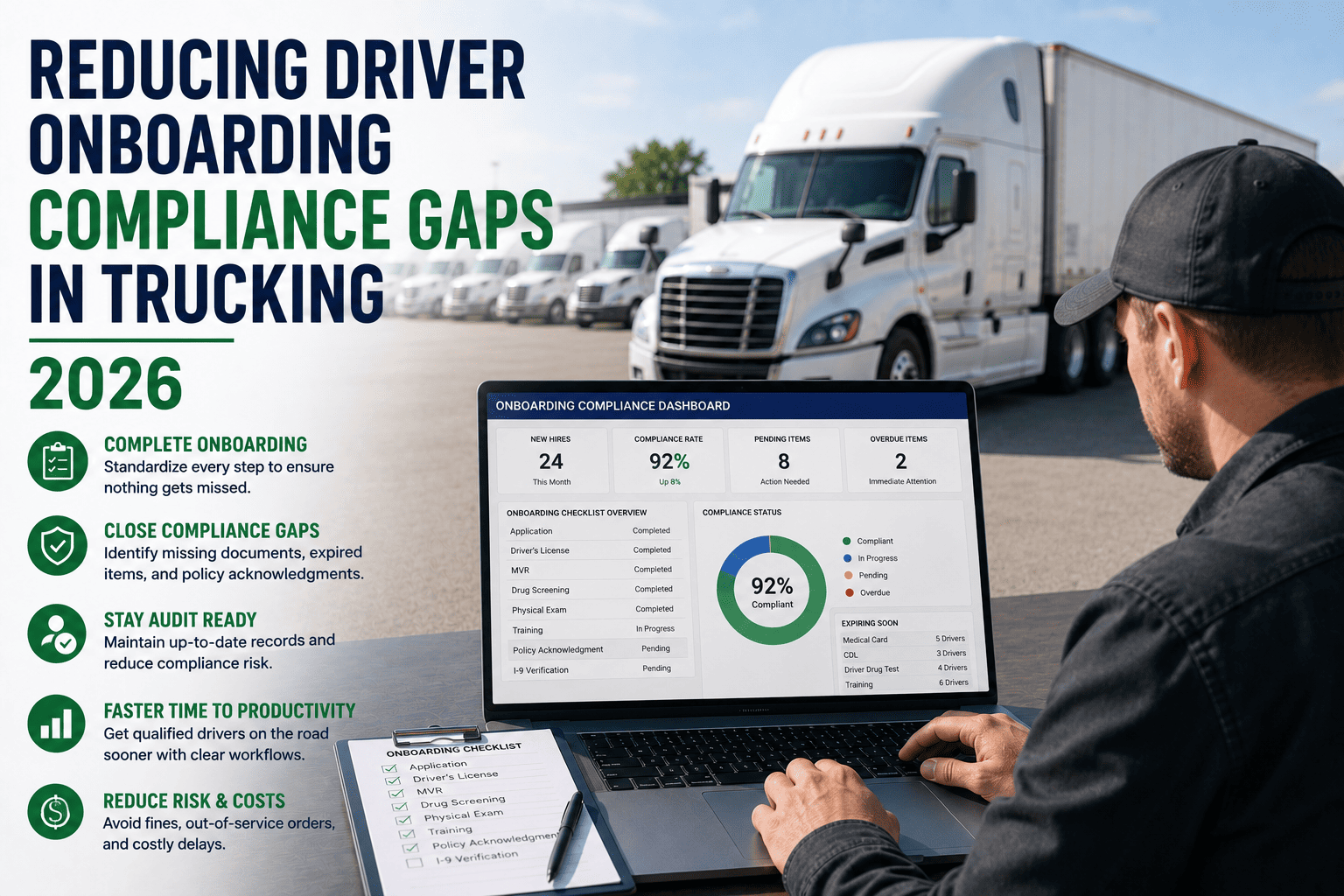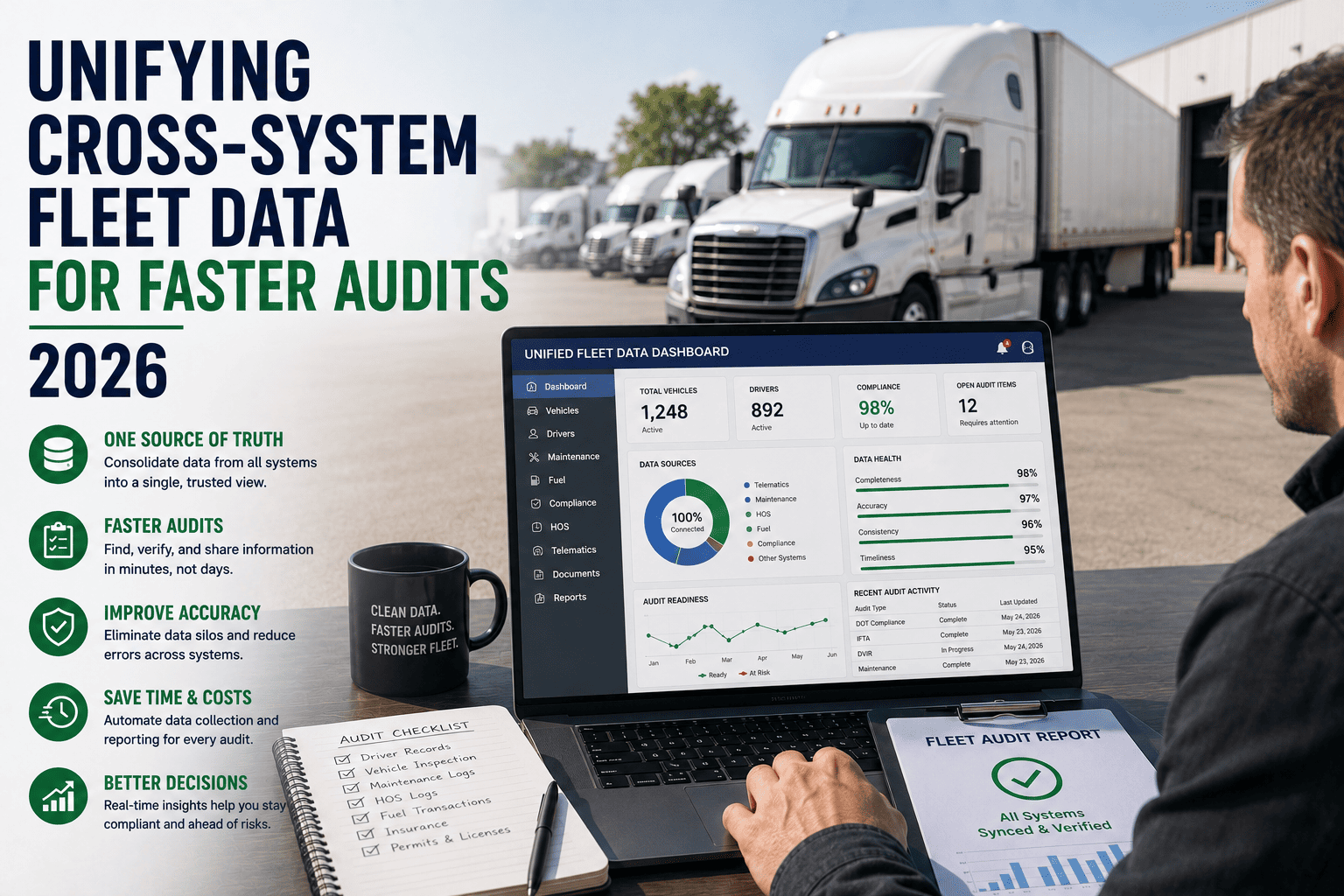
Somewhere in your fleet office right now, a compliance manager is buried under Driver Qualification Files, DVIR stacks, ELD exception reports, and renewal reminders scribbled on sticky notes. It's not a lack of effort. It's a system built for a different era, trying to survive audits designed for 2026. Manual paperwork doesn't just waste hours, it quietly bleeds money, invites violations, and burns out the very people keeping your trucks legal on the road.
Fleet compliance teams spend 15 to 25 hours weekly on manual paperwork, and administrative overhead consumes 5 to 10 percent of total fleet operating costs. Only 7 percent of motor carriers pass a DOT audit without a single violation, and a single out-of-service finding can trigger fines up to 19277 dollars. Automating documentation workflows cuts administrative time by 60 to 70 percent and dramatically lowers audit risk.
Why Compliance Paperwork Has Become a Fleet's Biggest Hidden Cost
Paperwork rarely shows up on a profit and loss statement as its own line item, yet it drains resources across every department. Administrative and overhead costs typically run around 5 to 10 percent of total operations for most fleets, and compliance documentation is one of the largest contributors inside that bucket. Every Driver Qualification File, medical certificate, DVIR, and Clearinghouse query requires someone to collect it, verify it, file it correctly, and retrieve it instantly the moment an auditor asks.
The Real Weight of Manual Recordkeeping
As enforcement tightens, regulators are relying increasingly on digital records and telematics data to assess compliance, which means manual recordkeeping is becoming harder to defend. Fleets running paper binders and shared spreadsheets are dedicating more staff hours to tracking, documentation, and audit preparation than ever before, simply to keep pace with standardized digital expectations. That extra burden often means hiring additional administrative staff or watching safety managers spend their week on data entry instead of risk reduction.
Where the Hours Actually Go
Break down a typical compliance week and the pattern becomes clear: chasing driver signatures on DVIRs, manually cross-checking CDL and medical certificate expiration dates, re-keying inspection results into spreadsheets, and assembling files ahead of a random audit. None of this work moves a truck or a shipment forward. It exists purely to prove that the work already done was done correctly, and manual systems make that proof painfully slow to produce.
FleetRabbit replaces binders and spreadsheets with digital DVIRs, automated Driver Qualification File tracking, and instant audit-ready reporting. Sign up free and see your admin workload drop within weeks.
The Documents Eating Up Your Team's Week
Not all compliance paperwork carries the same weight. Some documents demand constant attention because they expire, change, or require signatures on a rolling basis, while others simply need to be stored correctly and produced on demand. Understanding where the real time goes helps you target automation where it matters most.
| Document Type | Typical Weekly Admin Hours | Why It's Time Consuming | Automation Fix |
|---|---|---|---|
| Driver Qualification Files | 4 to 6 hours | Multiple documents per driver, ongoing annual reviews, expiration tracking | Centralized digital DQF with automated expiration alerts |
| DVIRs and Inspections | 3 to 5 hours | Daily paper forms, illegible handwriting, manual filing and follow-up | Mobile digital DVIR with instant defect routing |
| Hours of Service Logs | 2 to 4 hours | Manual log audits, chasing missing signatures, correcting edits | Automated ELD log audits with instant exception flags |
| Drug and Alcohol Clearinghouse | 1 to 2 hours | 24-hour reporting rules, annual queries, driver consent tracking | Automated query scheduling and reporting reminders |
| Maintenance and Repair Records | 2 to 3 hours | Cross-referencing work orders with inspection defects | Integrated maintenance and compliance dashboard |
| Audit and Renewal Prep | 3 to 5 hours | Manually compiling scattered records ahead of deadlines | One-click audit-ready reports generated on demand |
How Paperwork Overload Hits Different Fleets Differently
Long-haul carriers juggling interstate operations face the heaviest documentation load because of varied state requirements layered on top of federal rules, and MC numbers are now retired in favor of USDOT numbers for all registrations, insurance, and fleet documentation, adding another update cycle to already stretched teams. Regional delivery fleets deal with tighter turnaround windows, meaning any delay in verifying a driver's file or an ELD exception can hold up a route before it even starts.
Specialized and Contract Fleets Feel It Most
Fleets hauling hazmat or operating under dedicated shipper contracts carry additional layers of documentation, from hazardous materials endorsements to contract-specific safety reporting. A single missing signature or an expired certificate in these operations doesn't just risk a fine, it can pause a contract relationship entirely. Meanwhile, growing fleets adding drivers and vehicles quickly discover that paperwork scales faster than headcount, since manual binders and inconsistent recordkeeping become a liability the moment enforcement tightens.
A Practical Path to Cutting Administrative Time
Reducing paperwork burden doesn't require ripping out every process overnight. It starts with identifying where manual work repeats itself and replacing that repetition with a digital workflow that captures the same information once, correctly, and makes it instantly retrievable.
Step One: Digitize Driver Qualification Files
Move every driver's licensing, medical certification, and annual review records into a single digital file. Automated expiration alerts remove the need for manual calendar tracking, and digital storage means a file is never "missing" during an audit.
Step Two: Replace Paper DVIRs With Mobile Inspections
Digital DVIRs let drivers complete inspections from a phone, flag defects instantly, and route them straight to maintenance. This alone removes hours of manual filing while supporting the safety function DVIRs are meant to serve, since the FMCSA estimates they help prevent approximately 14,000 accidents annually through early defect identification.
Step Three: Automate Hours of Service Auditing
Instead of manually reviewing logs line by line, automated systems can flag missing signatures or HOS gaps instantly instead of relying on manual review, giving your team a prioritized list of exceptions rather than a stack of logs to review blind.
Step Four: Centralize Everything Into One Dashboard
The biggest time savings come from connecting DQF, DVIR, HOS, and maintenance data into a single view. When your team stops switching between five different tools to answer one question, audit prep drops from days to minutes.
FleetRabbit unifies Driver Qualification Files, digital DVIRs, HOS auditing, and maintenance records into a single dashboard so your team spends less time filing and more time managing the fleet. Book your demo and see it in action.
Technology That Makes Paperwork Disappear
Modern compliance platforms combine telematics, digital forms, and automated alerts to remove manual steps at every stage. Instead of a compliance manager remembering which driver's medical certificate expires next month, the system surfaces it automatically. Instead of reconstructing a DVIR history from a filing cabinet, a digital record is searchable in seconds. GenAI fleet assistants are increasingly used to answer operator questions and automate administrative workflows, shifting compliance work from manual lookup to conversational, on-demand answers.
Integration matters as much as digitization. A platform that connects ELD data, driver files, and maintenance records gives your team a single view of compliance risk instead of juggling point tools. That single view is what actually shortens audit prep time, because every document an auditor might request lives in one searchable place rather than scattered across email threads and shared drives.
Metrics That Show Your Paperwork Burden Is Shrinking
Tracking the right metrics turns "paperwork feels lighter" into a measurable business result. Audit prep time measures how long it takes to compile a complete, audit-ready file set. Fleets on manual systems often need several days, while digitized fleets produce the same package in under an hour. Document completion rate tracks what percentage of required DVIRs, DQF items, and HOS logs are filed correctly and on time, and most fleets aim for 98 percent or higher completion once automation is in place.
Watch Your Violation Rate Trend Downward
Since only 7 percent of motor carriers pass DOT audits without a single violation, tracking your own violation rate over time against that industry baseline shows whether your documentation improvements are translating into real audit performance. A declining violation count alongside a shrinking admin-hours count is the clearest sign your compliance system is working.
What Reducing Paperwork Actually Returns
The return on compliance automation shows up in three places at once. Direct labor savings come from reclaiming 15 to 25 hours per week that administrative staff previously spent on filing and cross-checking. Risk-avoidance savings come from preventing violations that carry fines reaching thousands of dollars per incident, plus the CSA score damage that follows. Retention savings come from a less obvious place: safety managers and drivers who spend less time on repetitive paperwork report higher satisfaction, and drivers leave fleets where equipment breaks down and paperwork is endless, staying instead where the app is easy and management respects their time.
Most fleets see measurable time savings within the first 90 days of switching to a digital compliance workflow, with full ROI typically realized within two quarters once reduced fines, recovered staff hours, and improved driver retention are combined.
Getting Started Without Disrupting Operations
Begin with an honest audit of where your current paperwork lives, how much time each document type consumes weekly, and which gaps have caused issues in the past. From there, prioritize digitizing the highest-volume, highest-risk documents first, typically Driver Qualification Files and DVIRs, before expanding into HOS auditing and full dashboard integration. A phased rollout over four to eight weeks lets your team adjust gradually while immediately reducing the heaviest parts of the manual workload.
Key Takeaways on Cutting Compliance Paperwork
Compliance paperwork is not a background task, it is an operational cost center that quietly consumes staff hours, increases audit risk, and contributes directly to fines that can exceed 19000 dollars per violation. Fleets that continue relying on binders, spreadsheets, and manual cross-checks are working harder for weaker results than fleets that have digitized their documentation. Reducing that burden isn't about doing less compliance work, it's about removing the repetitive manual steps that add no value and letting your team focus on the judgment calls that actually protect your fleet.
The fleets moving fastest in 2026 are treating compliance automation as core infrastructure rather than an optional upgrade. The gap between a team drowning in paperwork and one running audit-ready reports in minutes usually comes down to a single decision to centralize and digitize. That decision pays for itself in reclaimed hours within the first quarter alone.
Every week your team spends filing paper DVIRs and chasing expiring certificates is a week that could go toward running the fleet. FleetRabbit automates Driver Qualification Files, DVIRs, HOS auditing, and audit-ready reporting in one platform. Start your free trial today with no credit card required.