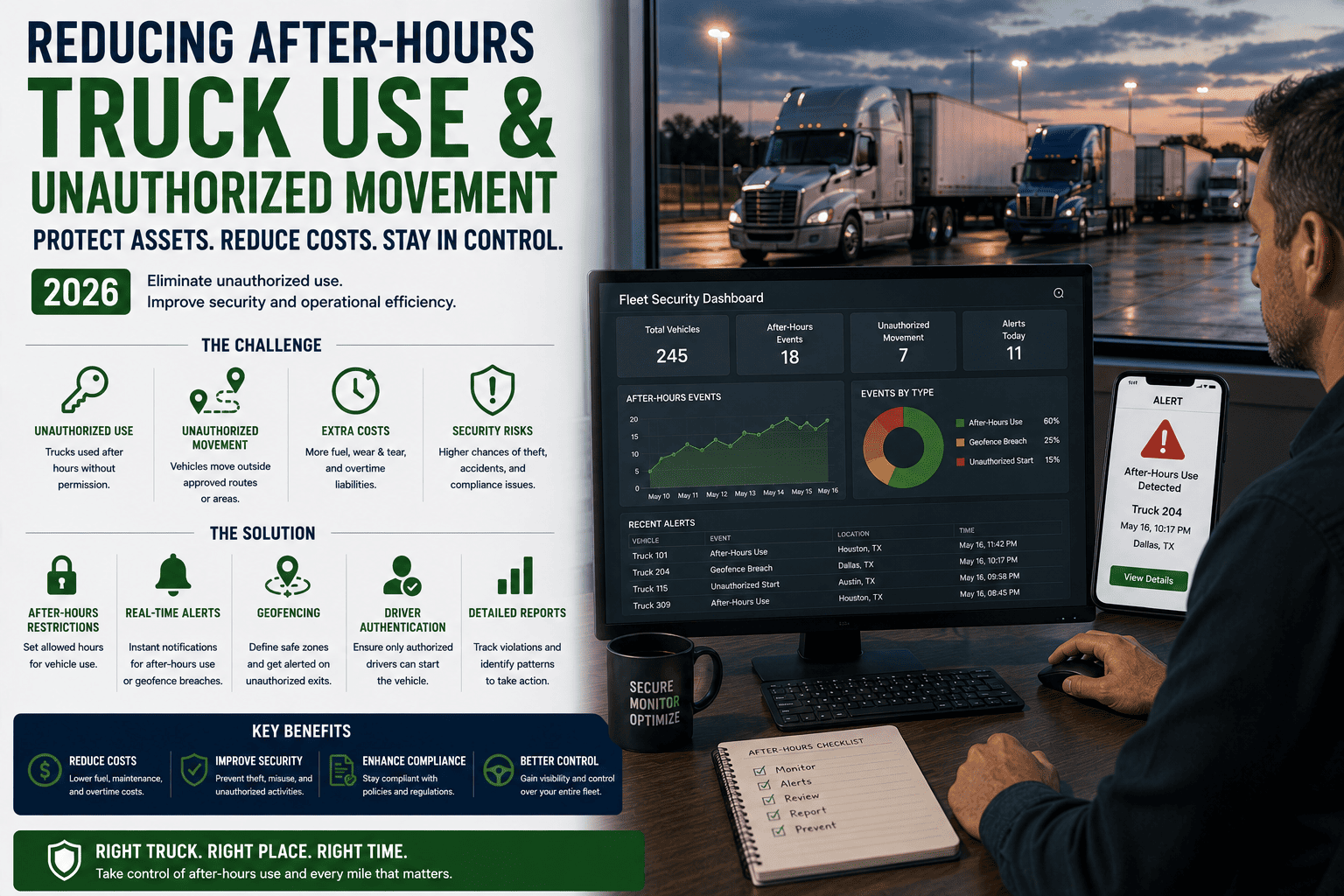
Most commercial vehicle theft happens overnight between 10 PM and 4 AM, and telematics providers report that active GPS tracking cuts after-hours and off-route vehicle use by 30 to 40 percent within 90 days of installation. Fleets running after-hours geofencing report up to a 74 percent drop in unauthorized movement in the first month alone. The difference between recovery and total loss is measured in minutes, not hours.
Why After-Hours Movement Is a Bigger Risk Than It Looks
Unauthorized truck use rarely announces itself. It shows up quietly, as an extra 40 miles on the odometer, a fuel card charge outside a route, or a vehicle parked somewhere it has no business being at 11 PM on a Tuesday. Left unmonitored, this pattern compounds into real cost: excess wear on the vehicle, fuel burned with zero business purpose, higher liability exposure if an incident occurs during unauthorized use, and in the worst cases, a truck or trailer that never comes back at all.
The scale of the problem is larger than most fleet owners assume. One HVAC company with eight service vehicles noticed unusually high fuel costs every month, and after installing GPS trackers, geofence alerts revealed two technicians quietly driving company trucks for personal use every single evening after their shifts ended. The company recovered roughly 600 dollars a month once the pattern was addressed, money that had been leaking out silently for who knows how long.
The National Recovery Gap Nobody Talks About
Without any tracking in place, the national average recovery rate for a stolen commercial vehicle sits at roughly 34 percent, and most vehicles that are not recovered get stripped for parts within 48 hours. With active GPS tracking in place, recovery rates climb well above 80 percent, with most vehicles recovered within 24 hours, often before a police report is even filed. That gap is not a technology preference, it is the difference between a full replacement bill and a truck back on the road within a day.
The Four Moments Where Unauthorized Use Slips Through
Unauthorized movement tends to happen in a handful of predictable scenarios. Recognizing them makes it far easier to decide exactly where monitoring needs to be strongest.
How Geofencing Turns Passive Tracking Into Active Prevention
GPS tracking on its own only tells you where a vehicle is if someone happens to check the map. Geofencing is the rule layer built on top of that location data, and it is what actually prevents unauthorized use rather than just documenting it after the fact. A geofence is a virtual boundary drawn around a depot, yard, job site, or approved route, and any vehicle that crosses that boundary outside its authorized schedule triggers an immediate alert instead of waiting to be discovered the next morning.
What Happens the Moment a Truck Crosses the Line
A well-configured after-hours geofence follows a simple sequence. The truck exits the depot boundary outside its scheduled operating hours with no trip assigned in the system. Within seconds, a push notification and text alert reach the fleet manager with the vehicle's identity, live coordinates, direction of travel, and exact timestamp. From there, a shareable live tracking link can be generated instantly, giving both the fleet manager and, if needed, law enforcement, a real-time view instead of a stale morning report.
Why Response Speed Changes Everything
When a theft is actually in progress, the gap between recovery and total loss is measured in minutes. Fleets with real-time alerts recover the asset in roughly 73 percent of cases when the alert fires within three minutes of the unauthorized movement. Without any alert system in place, that recovery rate drops below 20 percent, since the vehicle typically already has hours of head start by the time anyone notices it is missing.
FleetRabbit configures depot boundaries, scheduled hours, and instant alerts around your actual routes and assets, so unauthorized movement fires a notification within seconds instead of surfacing the next morning. You can sign up free and set up your first geofence today.
With Tracking vs Without: The Numbers Side by Side
The clearest way to understand the value of active monitoring is to compare fleet outcomes with and without it, side by side, using the same real-world benchmarks fleet managers rely on today.
| Outcome Measured | Without Active Tracking | With GPS + Geofencing | Why It Matters |
|---|---|---|---|
| Vehicle Recovery Rate | Roughly 34 percent recovered | Well above 80 percent recovered | Most unrecovered vehicles are stripped for parts within 48 hours |
| Time to Recovery | Often days, if recovered at all | Most recovered within 24 hours | Faster recovery means less downtime and lower replacement risk |
| After-Hours Unauthorized Use | Goes unnoticed until fuel or mileage review | Reduced 30 to 40 percent within 90 days | Drivers change behavior once they know boundaries are monitored |
| Theft-in-Progress Recovery | Below 20 percent recovery rate | Around 73 percent when alerts fire within 3 minutes | Alert speed is the single biggest factor in recovery outcomes |
| Replacement Cost Exposure | 35,000 to 65,000 dollars per vehicle plus lost revenue | Largely avoided through fast recovery or deterrence | One recovered vehicle can offset years of monitoring cost |
Building a Practical After-Hours Monitoring Setup
Getting this right does not require an enterprise security overhaul. Start with a geofence around every depot, yard, and regular overnight parking location, paired with defined operating hours for each vehicle. Layer in a route or trip verification rule so any vehicle without an assigned trip on record is automatically flagged the moment it moves. Add door sensors on trailers carrying high-value cargo so an unauthorized opening triggers its own alert independent of vehicle movement.
Avoiding Alert Fatigue
The fastest way to make a monitoring system useless is to let it fire on every minor event until managers start ignoring it. Configure alerts around genuine exceptions, a vehicle leaving outside scheduled hours, a route deviation beyond a set distance threshold, or a dwell time that runs well past what a stop should normally take, rather than pinging on every stop, idle moment, or minor vibration.
Once the boundaries and rules are in place, review the alert log weekly rather than only reacting when something goes wrong. A quick weekly pass through after-hours events, route deviations, and dwell-time flags turns the system from a reactive tool into a genuine deterrent, since drivers and would-be thieves alike quickly learn that unmonitored movement is no longer possible.
Frequently Asked Questions
Key Takeaways
Unauthorized after-hours truck use is rarely a single dramatic event, it is usually a pattern that builds quietly until fuel costs, mileage, or a missing vehicle finally force the issue into view. The fleets that close this gap are not the ones with the most expensive hardware, they are the ones with clear geofence boundaries, defined operating hours, and alerts that actually reach a manager within seconds rather than hours. That single shift, from discovering a problem the next morning to catching it the moment it starts, is what separates a fleet that absorbs constant small losses from one that stops them before they happen.
FleetRabbit sets up depot geofences, after-hours alerts, and route verification around your actual fleet, so unauthorized movement fires an instant notification instead of a surprise the following day. Start your free trial today with no credit card required, or book a demo to see a live alert in action.